Table of Contents
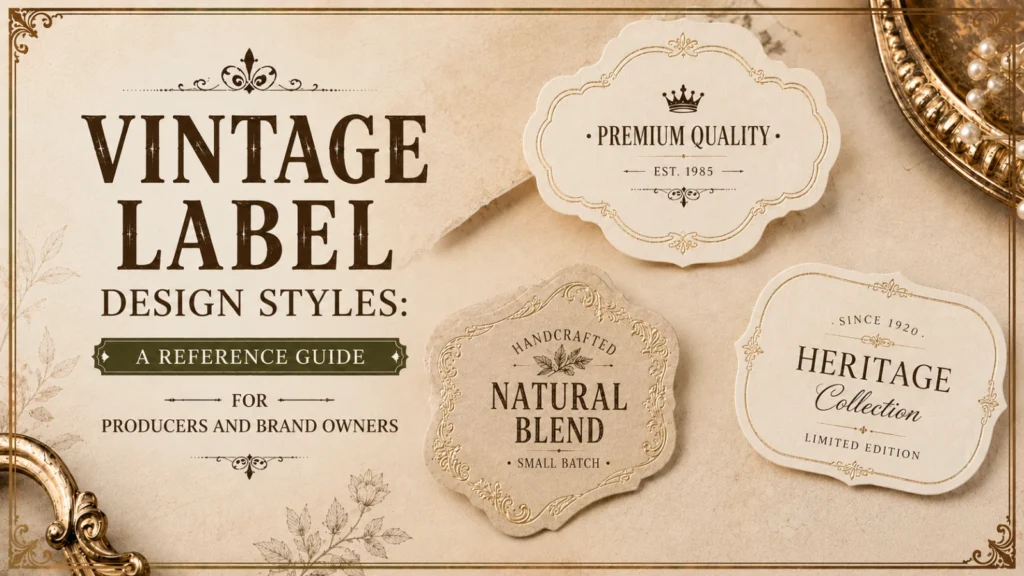
Vintage Label Design Styles: A Reference Guide for Producers and Brand Owners
Vintage label design draws from a specific visual history. The right reference — a period, a printing method, a graphic convention — can make a product feel established, handcrafted, or deeply familiar. This guide covers the main label design styles used today and explains how to apply them without making a label feel dated or out of place.
Why Vintage Label Design Keeps Coming Back
Vintage aesthetics in label design are not about copying the past. They work because they borrow something older styles understood well: the relationship between visual detail, material, and trust.
For a new product, a vintage-inspired label can signal craft, story, or heritage before the buyer reads a word of copy. For an established product, vintage design can anchor a limited run, an anniversary edition, or a repositioning toward a more premium price point.
The most effective vintage labels choose a specific visual language and apply it with intent. Ornament for its own sake reads as costume. Ornament chosen to match the product and audience reads as character.
Vintage Label Styles: A Working Reference
Art Nouveau

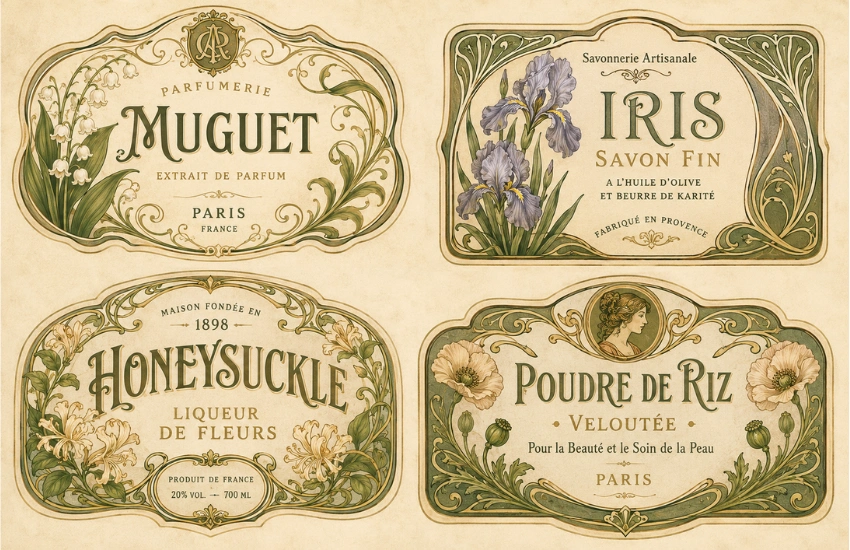
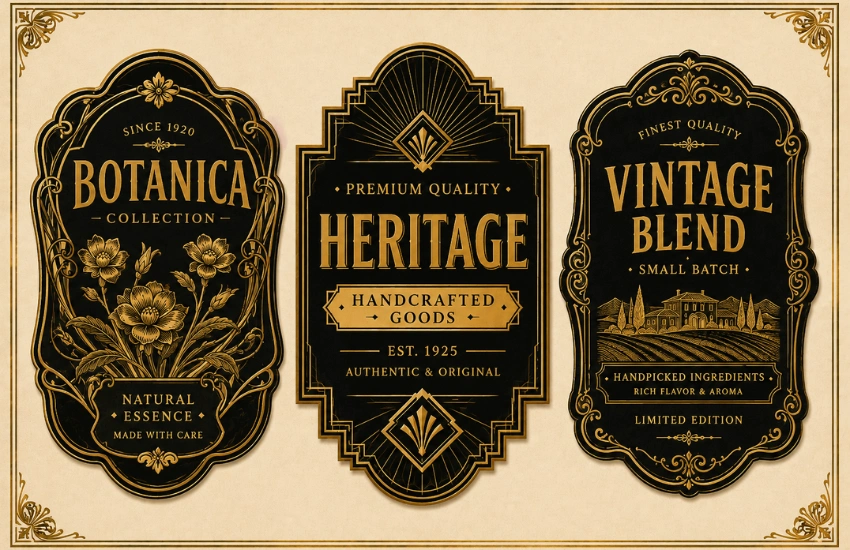
Art Nouveau belongs to the late nineteenth and early twentieth centuries. Its defining features are flowing organic curves, botanical and floral forms, intricate linework, and rich color contrast — creating a natural, handcrafted impression well-suited to botanical extracts, herbal products, wines, and specialty foods that emphasize ingredient provenance.
Characteristic details include sinuous plant-like borders, stylized botanical and female figures, and contrasting color fields that suggest illuminated design rather than mechanical printing.
Art Deco

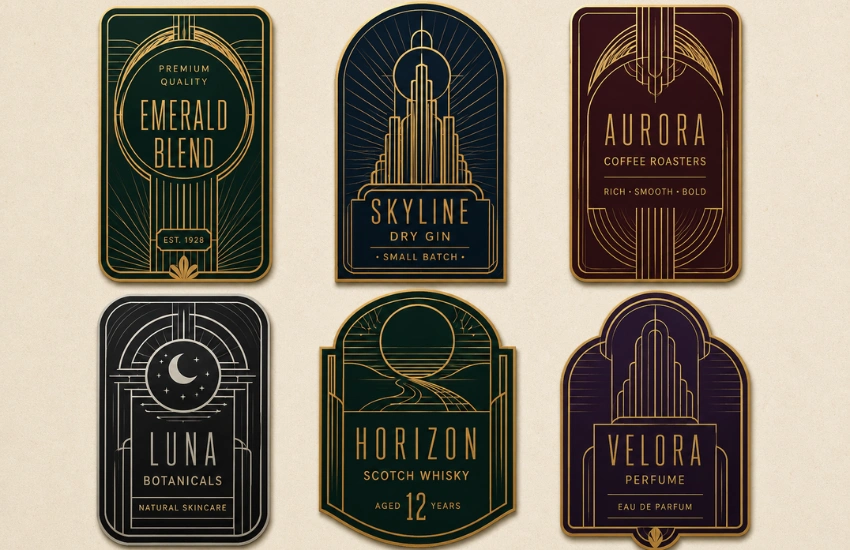
Art Deco is most closely associated with the 1920s through the 1940s — geometric shapes, bilateral symmetry, bold ornamental framing, and a sense of glamour. In label design, Art Deco cues work well for premium spirits, craft beverages, chocolate, and fragrance. For those categories, digital printing for beverage labels allows rapid short-run production of Art Deco-inspired designs alongside a core SKU — making limited or seasonal editions practical without plates or minimum orders.
Streamline Moderne

Streamline Moderne emerged from Art Deco in the 1930s and carried into the 1940s. Where Art Deco emphasizes ornament and geometry, Streamline Moderne strips back decoration in favor of smooth surfaces, horizontal motion lines, and industrial precision.
A useful distinction: Art Deco tends toward triangle and sunburst motifs; Streamline Moderne tends toward horizontal bands, tapered forms, and curved speed lines — a distinction worth understanding before committing to either.
Specific Vintage Details That Carry Into Label Design
Letterpress-Inspired Texture

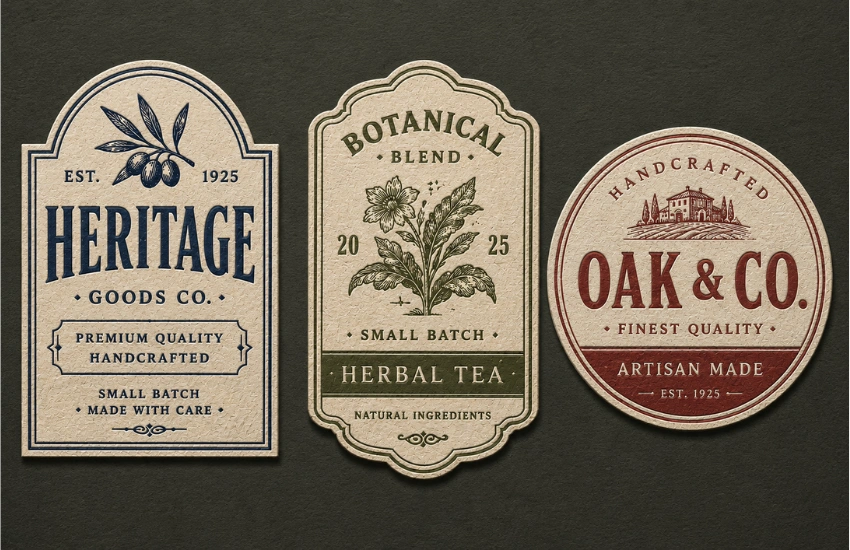
Letterpress printing produces a tactile quality through direct physical impression that standard digital printing does not replicate in the same way. Letterpress-inspired label design borrows that quality visually: limited color palettes, traditional serif or display typefaces, and subtle impression texture suggesting physical craft. This aesthetic works particularly well for artisan food and beverage, handmade goods, and brands signaling small-batch production. Short-run label printing on digital systems makes this practical for runs from a few hundred to several thousand labels — with no plates required between jobs.
The ArrowJet UV 330H supports CMYK + varnish configurations — including spot gloss and tactile finishes — that allow producers to achieve letterpress-adjacent surface effects from a digital press. White ink capability extends the substrate range to clear, metallic, and dark stocks.
Badge-Style Layouts

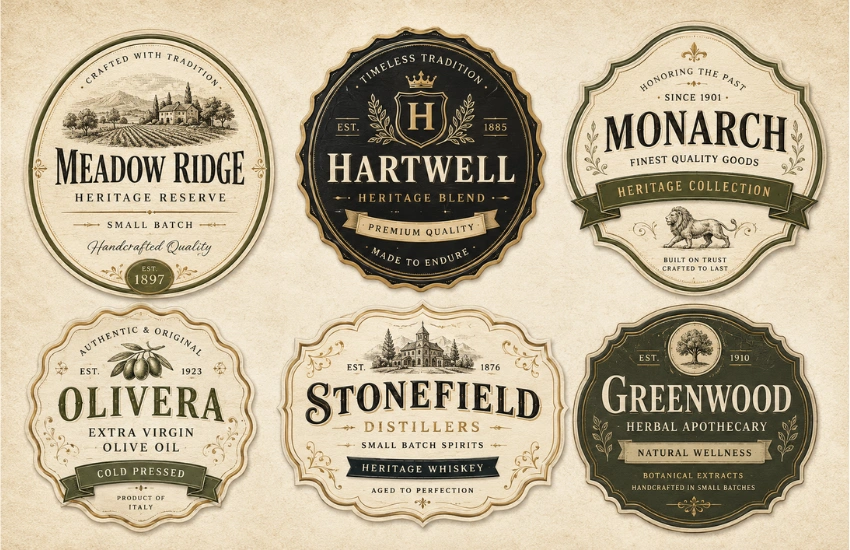
Badge-inspired labels reference historical graphic systems: stamps, wax seals, crests, carved marks, and trade emblems. The badge format centers a focal shape — circle, oval, shield, or pennant — with text and ornament layered within and around it. Craft breweries, specialty food producers, and outdoor brands use badge formats to signal heritage, quality standards, or geographic origin.
Badge labels require precise die-cutting because the design shape extends to the label edge. The ArrowCut Nova 330R and ArrowCut Nova 250R use CO₂ laser technology to cut complex contours, kiss cuts, and perforations in a single pass — no physical dies required, making short-run badge label production practical without tooling cost or lead time.
How to Apply Vintage Inspiration Without Dating the Label
A vintage-inspired label still has to function as modern packaging. It needs a clear information hierarchy, readable regulatory and product copy, and a format appropriate for the shelf, SKU count, and production run.
Before committing to a visual direction, determine what the design should communicate:
- Art Nouveau: organic, handcrafted, botanical, premium-natural
- Art Deco: bold, glamorous, symmetrical, high-finish
- Streamline Moderne: sleek, precise, industrial-quality, forward-looking
- Letterpress and badge details: craft, establishment, authenticity, small-batch
Once the visual direction is set, how white space in label design interacts with the ornament becomes one of the key decisions — too little and the label reads as busy; too much and the vintage character is lost. Equally, setting up label artwork for print — bleed, crops, and color profiles — ensures the design translates accurately from screen to substrate.
ArrowJet Aqua 330R
Short print runs and variable data requirements are common with vintage-inspired designs used for seasonal editions, regional variants, or SKU families. The ArrowJet Aqua 330R handles short-to-high volume runs without minimum order constraints — a practical fit for brands producing multiple vintage-inspired label variants.
Thinking Through Label Production for a Vintage Design
Vintage label styles often call for detailed shapes, specialty ink effects, and short-run flexibility. Arrow Systems manufactures digital label presses and label finishing systems built for exactly this kind of work.
For varnish and specialty ink effects, the ArrowJet UV 330H supports CMYK + white + varnish in a single hybrid press. For custom-shape label cutting, the ArrowCut Nova 330R and ArrowCut Nova 250R deliver CO₂ laser die-cutting with no physical tooling. For high-speed short-run label printing, the ArrowJet Aqua 330R handles production volumes without minimum order constraints. Browse the full range at arrsys.com or contact the team to discuss your requirements.
FAQ: Vintage Label Design
Vintage labels typically draw from a recognizable historical period or design convention. Common cues include ornate borders, geometric symmetry, muted or period-accurate color palettes, badge shapes, traditional serif or display typefaces, and tactile printing textures. The visual effect comes from combining several of these signals consistently.
Art Deco tends to be geometric, symmetrical, decorative, and visually bold. Streamline Moderne moves away from ornament toward smoother surfaces, horizontal motion lines, and simplified forms. Art Deco signals glamour and finish; Streamline Moderne signals speed, precision, and industrial quality.
Yes, when applied with intent. Vintage design communicates something specific — heritage, craft, a period reference — and needs to match what the product is and who it is for. Effective vintage labels pair period-inspired visual elements with clear modern hierarchy and accurate regulatory information.
Craft spirits, specialty coffee, artisan food, craft beer, premium personal care, and botanical supplement brands are the most frequent adopters. These categories use the label as a primary purchase signal, communicating quality, origin, or craft before any other product experience.
Vintage-inspired designs often require precise die-cutting for badge shapes, specialty ink effects such as spot varnish or white ink, and short-run flexibility for seasonal or limited editions. Digital label presses and CO₂ laser finishing systems are the most practical production combination for these requirements.

Vintage Label Design Styles: A Reference Guide for Producers and Brand Owners
Table of Contents Vintage Label Design Styles: A Reference Guide for Producers and Brand Owners Vintage label design draws from a specific visual history. The

Label Adhesive Types, Properties & Selection Guide
Table of Contents Label Adhesive Types, Properties & Selection Guide The right label adhesive depends on the surface, temperature, shape, and conditions of the application

Label Trends: Minimalist Label Design
Table of Contents Label Trends: Minimalist Label Design Minimalist label design removes clutter — nude palettes, gradients, transparent labels, and smart-labels let the product speak

Tamper-Evident Label Printing: How to Choose the Right System
Table of Contents Tamper-Evident Label Printing: How to Choose the Right System Match tamper-evident label type — void, breakaway, or destructible — to product risk,

Skincare Label Printing: Materials, Inks & FDA Rules
Table of Contents Skincare Label Printing: Materials, Inks & FDA Rules Skincare labels must withstand moisture, oils, friction, and aggressive formulation actives while meeting FDA

Arrow Systems to Participate in R2R USA Conference & Expo 2026
Table of Contents Arrow Systems to Participate in R2R USA Conference & Expo 2026 Cleveland, OH — Arrow Systems Inc. will participate in the 2026