Table of Contents
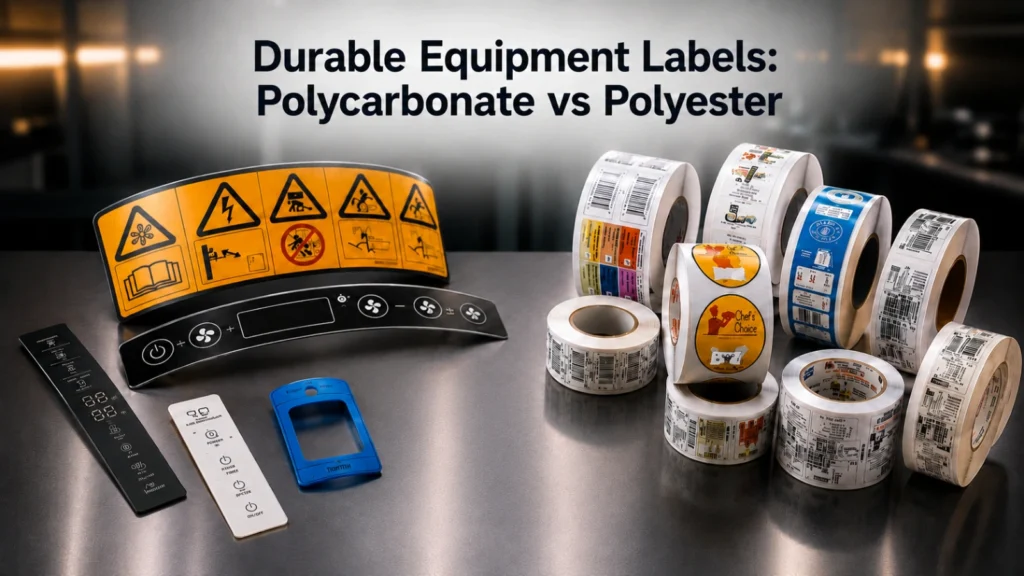
Durable Equipment Labels: Polycarbonate vs Polyester vs Metal
Polycarbonate and polyester each fail in predictable ways when misspecified — this guide maps the right substrate to your operating environment.
Key Takeaways
- Polycarbonate wins for touched surfaces and subsurface graphics — verify solvent exposure and UV tolerance before specifying; it crazes under aromatic hydrocarbons and ketones.
- Polyester is the default substrate for motor IDs, valve tags, barcode labels, and rating plates — it balances chemical resistance, heat tolerance, and cost better than any other film.
- IUID and MIL-STD-130 compliance is a system-level decision: substrate, marking method, 2D Data Matrix grade, and permanence must all be validated together — not assumed from substrate alone.
- In-house UV digital printing with the ArrowJet UV 330H plus digital cutting (EZCut or Cut Nova) makes short-run, mixed-SKU, variable-data nameplate production economically viable in hours rather than weeks.
Why Industrial Labels Need Extreme Durability
Industrial labels face solvent splash, caustic washdown, UV exposure, abrasion, and thermal cycling — often in the same shift — and must remain legible for the full 10–20 year service life of the asset.
A durable label in a chemical plant means something very different from a durable label on a shipping carton. When a motor tag fades or a valve label peels, technicians lose the link between physical equipment and the records that govern it. The cost of label failure is rarely just the cost of replacing the label.
Preventive maintenance disruption
A missing motor ID can stall a full preventive maintenance cycle — the asset cannot be matched to its service record, triggering a hold on work orders that depend on confirmed equipment identity.
Lockout/tagout misalignment risk
An illegible valve tag can cause a misalignment during a lockout/tagout procedure, where accurate identification of the correct isolation point is a safety-critical requirement, not an administrative preference.
Government audit compliance flag
A faded IUID plate can trigger a compliance flag during a government audit. For regulated assets, mark permanence is a contractual and legal obligation under applicable specifications including MIL-STD-130.
This is why operations and engineering teams treat substrate selection as an engineering decision, not a procurement one. The right label starts with the operating environment — not the label catalog.
Substrate Comparison at a Glance
Polycarbonate, polyester, and metal each have a clear primary use case and a specific set of failure conditions — this table maps the key decision variables.
Property | Polycarbonate | Polyester (PET) |
Typical use | Control panel overlays, HMI bezels, instrument faceplates | Motor ID, valve tags, rating plates, barcode labels |
Impact resistance | High | Moderate |
Chemical resistance | Moderate; sensitive to aromatics, ketones, strong alkalis | Broad; vulnerable to strong oxidizers and hot caustics |
UV tolerance | Requires hardcoat or UV-stabilized grade | Good with topcoat |
Variable data / serialization | Easy via digital print | Easy via digital print |
Per-unit cost | Moderate | Lower |
Lead time for short runs | Hours in-house | Hours in-house |
Use this table as a starting filter, not a final specification. Substrate selection should always be validated against the actual operating environment, chemical exposure profile, and asset service life — not on generic benchmarks alone.
Polycarbonate Labels: Best Uses and Limitations
Polycarbonate is the substrate for touched surfaces, subsurface-protected graphics, and impact-critical applications — but it cracks or crazes under aromatic solvents and unfiltered UV.
Impact and flex resistance
Polycarbonate handles repeated mechanical contact better than most films. Control panel overlays, membrane switch graphics, instrument faceplates, and HMI bezels — surfaces where operators repeatedly press, wipe, and clean — are the primary industrial applications. Polycarbonate absorbs impact without fracturing, making it suitable for surfaces subject to continuous physical interaction.
Subsurface printing for abrasion-proof graphics
Graphics printed on the back (second surface) of clear polycarbonate are protected by the substrate itself — they cannot be abraded off the front face. This construction is essential for control panels where chemicals and abrasives are applied to the front face during cleaning. The printed layer is physically behind the protective polycarbonate, not on top of it.
Optical clarity for backlit panels
Polycarbonate’s optical clarity makes it the correct choice for backlit panels, windowed displays, and any label application where the substrate needs to transmit light evenly. No other film substrate replicates this combination of clarity and mechanical toughness.
Limitations: solvents, UV, and alkalis
Polycarbonate is sensitive to aromatic hydrocarbons (toluene, xylene), ketones (acetone, MEK), and strong alkaline cleaners — these cause crazing and stress-cracking on contact. Uncoated polycarbonate also yellows under prolonged UV exposure. Outdoor or sun-exposed installations require a UV-stabilized or hardcoated grade. Specify polycarbonate when operators will physically touch the label; reconsider it for continuous solvent immersion or unfiltered sunlight without protective topcoats.
Polyester Labels: The Everyday Industrial Workhorse
Polyester (PET) is the default substrate for most durable industrial labels — it balances chemical resistance, heat tolerance, dimensional stability, and cost better than any other film.
Primary applications for polyester nameplates
Polyester is the standard specification for motor ID tags and asset plates on pumps, gearboxes, and compressors; valve tags and pipe identification in process plants; barcode and serialization labels for WIP and finished-goods tracking; and rating plates on electrical enclosures and panels. These applications share a common requirement: a label that bonds reliably, holds its print, and remains scannable across years of industrial exposure.
Chemical and temperature performance
A topcoated polyester is typically rated for continuous service across a wide temperature range and performs well against fuels, oils, dilute acids, and most industrial cleaners. Paired with a high-performance acrylic adhesive, polyester bonds reliably to powder-coated steel, painted aluminum, and stainless surfaces — provided the surface is properly cleaned and free of silicone or oil residue.
Destructible polyester for tamper indication
For applications requiring a one-way tamper indicator, destructible polyester variants fracture when removal is attempted, leaving visible residue on both the substrate and the label. This construction is used for warranty seals, calibration stickers, and security tagging on regulated equipment.
Limitations: strong oxidizers and hot caustics
Polyester is not invincible. Strong oxidizers, concentrated caustics at elevated temperatures, and certain chlorinated solvents can attack the film or the adhesive bond line. For applications involving these chemistries, validate the specific construction — film grade, adhesive formulation, and topcoat — against the actual exposure conditions. For the majority of equipment ID applications, a properly specified polyester construction will outlast the asset it identifies.
ArrowJet UV 330H for Durable Labels on Polycarbonate and Polyester
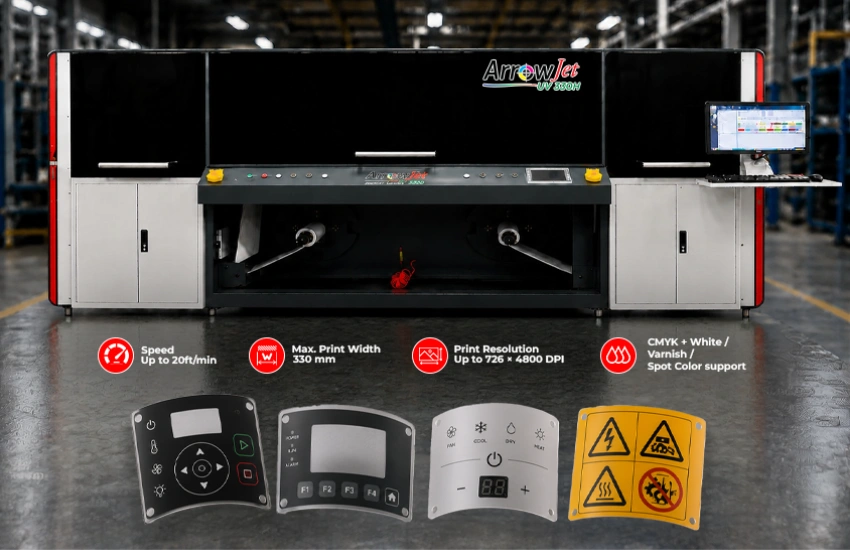
The ArrowJet UV 330H brings durable label production in-house — eliminating converter lead times and minimum order quantities for mixed-SKU, variable-data industrial label workflows.

Subsurface and surface printing on polycarbonate
The ArrowJet UV 330H supports both surface and second-surface printing on clear polycarbonate, enabling the protected-graphic construction used in control panel overlays and HMI bezels. Graphics deposited on the back face of the substrate are shielded from abrasion by the polycarbonate itself — the same construction used by premium industrial overlay manufacturers.
Variable data, serialization, and 1D/2D barcode printing
Asset ID and IUID workflows require every label to carry unique serialized data — part numbers, asset IDs, 2D Data Matrix codes, or QR codes that link to records in ERP or asset management systems. The ArrowJet UV 330H prints fully variable data natively on every pass, without plate changes or incremental setup costs per unique label.
Wide substrate compatibility for mixed industrial workflows
Polyester, polycarbonate, vinyl, and specialty films all run on the same platform. Operations managing pumps, control panels, valve manifolds, and drums — each requiring different substrate specifications — can consolidate production onto a single press rather than managing separate substrates across multiple vendors or production lines. For a broader view of Arrow’s UV label press range, see the full product category.
Short-run economics for project-based nameplate production
Standard converter minimums often force operations to over-order nameplates to hit economic quantities, creating inventory that becomes obsolete when engineering changes the part number or asset configuration. The ArrowJet UV 330H makes it practical to produce exactly 50 nameplates for a single equipment build — or several thousand valve tags for a plant-wide rollout — without minimum-quantity penalties. Artwork, serialization data, and production scheduling can be driven from existing ERP and asset management systems directly.
EZCut and Cut Nova for Precision Nameplate Cutting
Digital cutting systems eliminate die tooling costs — enabling custom nameplate shapes, mounting holes, and rounded corners on demand, with optical registration between print and cut.
Industrial nameplates rarely come in standard rectangles. They need rounded corners to match enclosure geometry, mounting holes for mechanical fastening, notched edges for alignment guides, and contoured shapes that fit specific equipment profiles. Traditional die-cutting requires tooling fabrication — a fixed cost that makes short runs and custom shapes prohibitively expensive when outsourced.
Arrow EZCut 330R+ — blade die cutting for production nameplate shapes
The Arrow EZCut 330R+ is a flatbed and roll-to-roll hybrid blade die cutter with cutting accuracy of ±0.1 mm, a maximum speed of 150 cuts per minute, and support for self-adhesive polyester, polycarbonate, PET, PVC, aluminum plastic film, and specialty films — covering the full substrate range used for industrial nameplates. Its flatbed mode handles sheet-format nameplate stock in addition to roll-fed label material, which matters for operations that mix rolled valve tags with sheet-cut panel overlays. Cut paths are driven directly from artwork files with optical registration aligning cut to print. The result is finished, ready-to-apply nameplates without tooling fabrication lead times or minimum-order constraints.
ArrowCut Nova — die-free laser finishing for custom shapes
The ArrowCut Nova 330R is a production-grade CO₂ laser finisher handling media up to 348 mm wide, with throughput up to 10,000 labels/hour — suited to industrial operations running high volumes of valve tags or nameplate programs across a plant estate. For smaller facilities or operations with more modest output requirements, the ArrowCut Nova 250R provides the same die-free laser cutting capability in a compact footprint with a 250 mm web width. Both eliminate physical dies entirely — enabling custom nameplate shapes, perforations, through-holes, and contour cuts that change job to job without setup cost or tooling lead time.
The print-laminate-cut workflow for finished durable nameplates
Combined with an abrasion-resistant overlaminate — typically applied inline between print and cut — the ArrowJet UV 330H plus EZCut or ArrowCut Nova workflow produces finished, ready-to-apply durable nameplates in hours rather than weeks. Arrow’s full range of label finishing systems handles lamination, die-cutting, slitting, and rewinding across the polyester and polycarbonate substrate range. For mixed-SKU industrial label production, this consolidated in-house workflow is where the capital investment in equipment pays back most quickly against outsourcing costs, setup charges, and inventory carrying costs.
Substrate Selection: A Four-Step Specification Framework
Match substrate to the operating environment — not to a catalog default — by mapping exposure, temperature, service life, and variable data requirements before specifying.
Step 1: Define the operating environment for each asset group
List every asset type that needs nameplate identification. For each group, note the primary chemical exposures (solvent type and concentration, washdown chemistry), temperature range, UV or outdoor exposure duration, and mechanical contact type (abrasion, vibration, impact). Assets within the same plant often fall into very different environment tiers.
Step 2: Match substrate to environment using chemical compatibility data
Cross-reference each asset group’s exposure profile against substrate compatibility charts. Polycarbonate for touched surfaces and protected graphics; polyester as the default for chemical environments, motor IDs, and barcode applications; metal for high-temperature and multi-decade outdoor installations. Where compatibility is uncertain, request material samples and conduct a timed immersion or exposure test before specifying at scale.
Step 3: Map variable data and serialization requirements
Identify which asset groups require unique serialized IDs, 2D Data Matrix codes, barcodes, or other variable data per label. This step determines whether outsourcing to a converter remains viable — high SKU count with variable data and frequent revision cycles typically shifts the economics decisively toward in-house digital print production.
Step 4: Model total cost across run lengths, including revision cycles
Include tooling and setup charges, minimum order quantities, lead time costs, and the cost of scrapping obsolete inventory after engineering changes in the total outsourcing cost. Compare against the annualized capital and consumable cost of in-house UV digital print plus digital cut. For operations running dozens of nameplate SKUs with regular revisions, in-house production typically reaches payback within a reasonable capital horizon.
Frequently Asked Questions — Durable Equipment Labels: Polycarbonate vs Polyester vs Metal
Common questions from operations, engineering, and compliance teams specifying industrial nameplates for asset identification, IUID compliance, and in-house production workflows.
- Start with the chemicals the label will actually contact, their concentration, and the contact duration. Polyester generally handles a broader range of solvents, acids, and oils with fewer compatibility concerns. Polycarbonate is the better choice when the label needs impact resistance, subsurface-printed graphics, or optical clarity — but review it carefully for environments containing aromatic solvents, ketones, or strong alkalis. When in doubt, request a chemical compatibility chart from the substrate manufacturer and validate with a sample exposure test before committing to a substrate specification.
They can, but compliance depends on more than the printer. The substrate construction, marking method, contrast ratio, 2D Data Matrix symbol grade, and mark permanence all need to be validated against the applicable specification. Both polyester and metal constructions are used in IUID applications. Work with a label engineer to confirm that your printed output meets the required readability and durability grading for your specific government contract or program — this is a system-level validation, not a substrate assumption.
Most adhesion failures trace back to surface contamination, not adhesive failure. Powder-coated and painted surfaces should be fully cured before labeling. Clean the application surface with isopropyl alcohol to remove oils, mold release agents, and silicone contamination. Avoid applying labels to cold or condensation-covered surfaces, and follow the adhesive manufacturer’s specified application temperature range. For textured or low-surface-energy substrates — such as certain powder coatings or engineered plastics — use an adhesive specifically formulated for that surface condition.
The crossover typically occurs when you run many distinct nameplate SKUs, frequent design revisions, variable serialized data per label, or short run quantities that do not align with standard converter minimums. If your operation regularly pays setup charges, accepts multi-week lead times from outside nameplate vendors, or scraps obsolete nameplate inventory after engineering changes, in-house production with a UV digital press and digital cutter usually reaches payback within a reasonable capital horizon. Operations producing only a few high-volume, stable SKUs on consistent long-run schedules may still find outsourcing more cost-effective.
Request a Durable Label Sample Kit or Substrate-Selection Review
If your operation is specifying nameplates for pumps, control panels, valves, drums, or regulated assets — Arrow Systems offers a 20-minute substrate-selection review to validate polycarbonate, polyester, and metal options against your operating environment, asset service life, and IUID requirements.
The review covers your asset groups, chemical exposure profiles, variable data requirements, and run-length economics — and scopes whether the ArrowJet UV 330H with EZCut or Cut Nova fits your nameplate production volume and SKU mix.

Durable Equipment Labels: Polycarbonate vs Polyester
Table of Contents Durable Equipment Labels: Polycarbonate vs Polyester vs Metal Polycarbonate and polyester each fail in predictable ways when misspecified — this guide maps

CBD Label Requirements: What Your Labels Must Say
Table of Contents CBD Label Requirements: What Your Labels Must Say CBD labels must carry truthful product information, avoid medical or therapeutic claims, and comply

Medical Device Labels: UDI Requirements, FDA 21 CFR Part 801, and Printing Considerations
Table of Contents Medical Device Labels: UDI Requirements, FDA 21 CFR Part 801, and Printing Considerations FDA 21 CFR Part 801 and the UDI rule

USDA Food Label Guidelines: Six Common FSIS Labeling Mistakes to Avoid
Table of Contents USDA Food Label Guidelines: Six Common FSIS Labeling Mistakes to Avoid USDA FSIS food label approval is blocked most often by six

Beauty Product Labels: INCI Names, Formatting & FDA Rules
Table of Contents Beauty Product Labels: INCI Names, Formatting & FDA Rules Beauty product labels must list every ingredient by INCI name in descending order

GHS Label Printing: HazCom 2012 Compliance for Chemical Manufacturers
Table of Contents GHS Label Printing: HazCom 2012 Compliance for Chemical Manufacturers OSHA HazCom 2012 requires six GHS label elements on every shipped chemical container