arrowjet-aqua-330r-cannabis-mso-label-printing

Table of Contents

Cannabis MSO Label Printing: In-House or Outsource?

Cannabis MSO label printing moves in-house when label versions outgrow converter minimums or batch data must print with static artwork.

This guide covers multi-state operator label printing — when to keep it outsourced and when to bring it in-house.

Key Takeaways

  • Active label versions — not unit volume — is the number that determines whether outsourcing still makes economic sense; calculate it as SKUs × states × variants per SKU.
  • Two objective triggers signal it’s time to move in-house: version count crossing roughly 150–200, and batch-level variable data (lot, potency, track-and-trace codes) that converters push to manual secondary stickers.
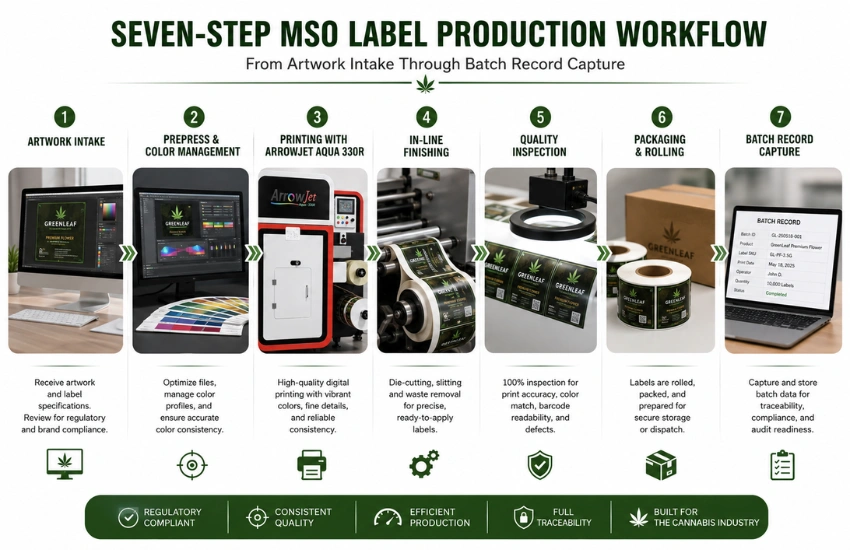
  • A seven-step workflow — from artwork intake through batch record capture — turns a press purchase into actual production control, with ownership assigned at each gate.
  • The ArrowJet Aqua 330R prints pressure-sensitive roll labels for jars, pre-roll tubes, and bottles; the ArrowJet Aqua 800M handles wider-web flexible packaging like mylar pouches.
  • Multi-site MSOs typically centralize artwork governance in one library while phasing printing capacity — a hub, distributed sites, or a hybrid — based on interstate transfer restrictions and turnaround needs.

Why Cannabis MSOs Delay Moving Labels In-House — And What It Costs

Converter relationships predate rapid multi-state growth, so labeling stays a rounding-error line item until a compliance deadline breaks it.

Most multi-state operators inherited their label supply chain. The converter relationship predates the second and third license, the price per thousand looks reasonable, and label spend is a rounding error next to cultivation build-out, extraction equipment, and dispensary fit-outs. Nobody escalates a line item that small. This is the same gap that Arrow’s range of digital label printers is built to close once version count outgrows what a converter can serve economically.

Unit price is the least significant cost in multi-state label outsourcing. The real spend accumulates in places that never appear on the converter invoice:

  • Obsolescence write-offs when a state revises a required declaration, symbol, or panel and existing stock becomes scrap.
  • Lead-time exposure when a multi-week reprint cycle collides with a compliance deadline or a limited-release drop.
  • Relabeling labor to apply secondary stickers over outdated content or missing batch data.
  • Warehouse carry across multiple state facilities, each holding its own MOQ-driven label inventory.
  • Version ambiguity when nobody can prove which artwork revision went onto which batch.

Quiet symptoms worth auditing this week

  • Operators hand-applying a second sticker for potency, lot, or package date.
  • Receiving teams relabeling converter stock before it can be used.
  • Approved artwork living in email threads and shared drives instead of a controlled library.
  • Packaging schedules waiting on a converter proof.
  • Low-volume state SKUs ordered in quantities you will never consume.

None of these is catastrophic alone. Together they describe an operation where labeling is a dependency rather than a capability.

Volume Trigger: The Label Version Count That Changes the Math

Active label versions — not unit volume — is the number that actually breaks converter outsourcing economics for cannabis MSOs.

MSOs usually track label volume in units. That is the wrong denominator. The variable that breaks outsourcing economics is active label versions, because each version carries its own artwork file, approval cycle, MOQ, and inventory position.

Active label versions (the formula)

SKUs × States × Variants per SKU = Active Label Versions. Variants include package size, potency tier, strain, and medical versus adult-use presentation — a single edible line can generate several versions inside one state before crossing a border.

Converter MOQ (minimum order quantity)

The minimum label quantity a converter will produce per version, typically priced in a way that makes small runs economically unattractive. As version count climbs and volume per version falls, MOQ-driven overbuying grows faster than revenue.

Illustrative estimate only — substitute your own figures: 40 SKUs across 4 states with 3 variants each produces roughly 480 active label versions. At a converter MOQ of 2,000 labels per version, that portfolio commits you to nearly a million labels, regardless of what each version actually sells. That is the inversion point: you are no longer buying labels efficiently at scale — you are buying inventory you will likely scrap at the next rule revision.

You have likely crossed the volume trigger if…

  • Active label versions exceed roughly 150–200 and keep growing with each license.
  • More than a quarter of your versions run below converter MOQ in a typical quarter.
  • You wrote off obsolete label stock in at least two of the last four quarters.
  • Each new state license adds versions faster than it adds unit volume.
  • Limited-release or single-harvest SKUs need their own version but never justify an MOQ.

Those thresholds are illustrative starting points, not benchmarks. Replace them with your own version count, MOQ terms, and write-off history.

Compliance Complexity Trigger: Variable Data Across States

The second trigger depends on what the label must carry — batch-level data that converters are not built to handle economically.

Sort your label content into three tiers:

Content Tier

Examples

Converter Fit

Static artwork

Brand graphics, product name, base panel layout

Good — handles this well

Per-state variable content

State warning statements, universal symbols, required panel elements, medical versus adult-use language

Workable, but multiplies versions, plates, and proof cycles

Batch-level variable data

Harvest and batch lot, package date, potency and serving declarations, testing lab reference, state track-and-trace package identifiers such as METRC tags, COA QR or 2D codes

Poor — usually pushed to secondary stickers or hand application

METRC

A state-run seed-to-sale track-and-trace system used across many cannabis-legal states to tag and monitor product packages from cultivation through retail sale.

COA (certificate of analysis)

A lab report confirming potency, contaminant, and safety testing results for a specific harvest or batch — often linked to the package via a QR or 2D code.

Converters are built for repeat static runs. Batch-level data changes every run, which is why so many MSOs end up with a thermal printer beside the packaging table and an operator typing lot numbers by hand. That workaround is also the largest version-control exposure in the operation: when an inspector asks which artwork revision was applied to a specific batch of pre-rolls, an email thread is not an answer.

Signals it is time to bring labels in-house

  • More than one artwork revision cycle per quarter across the portfolio.
  • Secondary stickers applied by hand for potency, lot, or package identifiers.
  • No controlled version log tying artwork revision to production batch.
  • Packaging downtime waiting on external proofs.
  • Different state facilities running visibly different revisions of the same brand label.
  • Track-and-trace identifiers applied separately from the primary label.

The point here is structural: the more of your label content changes per state and per batch, the less an external converter can serve you economically.

Cannabis label compliance and track-and-trace requirements vary by state and change frequently. Compliance is the operator’s responsibility and should be confirmed with qualified regulatory counsel or the applicable state regulator. Arrow Systems sells label printing and packaging hardware; Arrow does not provide regulatory or compliance advisory services.

The MSO Workflow for In-House Label Production

Buying a press does not create control; a seven-step workflow with named owners at each gate does.

cannabis-mso-in-house-label-workflow
  1. Artwork intake and state-by-state regulatory review. Compliance owns this gate. Every new or revised label enters through one intake path and is reviewed against the requirements of each state where it will be applied. Output: a state-mapped artwork specification.
  2. Single versioned artwork library with approval gates. Packaging or brand operations owns the library: one source of truth, sequential revision numbers, and a documented approval before any file releases to press. No printing from a desktop copy.
  3. Variable data pulled from systems of record. IT and operations own the integration. Batch lot, harvest ID, package date, potency values, testing reference, and track-and-trace package identifiers should flow from your ERP or seed-to-sale platform into the print file. Removing operator keystrokes removes the most common source of mislabeled product.
  4. Print profile and substrate confirmation by format. Production engineering owns this step. Concentrate jar labels, small-diameter pre-roll tubes, tincture bottles, edible carton labels, and mylar pouches each need their own confirmed material and profile.
  5. First-article approval and code verification. Quality owns the gate. Verify content against the approved revision, then scan and verify every barcode, 2D code, and COA QR code before the run releases.
  6. Finishing to production-ready rolls. Laminate, die-cut, slit, and rewind inline or near-line so labels reach the packaging line in applicator-ready form — Arrow’s label finishing systems handle this step for both roll-label and flexible packaging formats.
  7. Batch record capture. Quality or compliance owns retention. Log artwork revision number, print date, quantity produced, and the batch or package identifiers printed. This record is what answers the audit question.

What changes for a multi-site operator

Artwork governance belongs in one place: one library, one review path, one approval authority. Printing can sit in a hub that ships finished rolls to state facilities, or be distributed to individual sites where interstate transfer restrictions or turnaround needs require local production. Most MSOs land on a hybrid — a hub for higher-volume formats, local capacity for batch-level and fast-turn work.

ArrowJet Aqua 330R for MSO In-House Roll Label Production

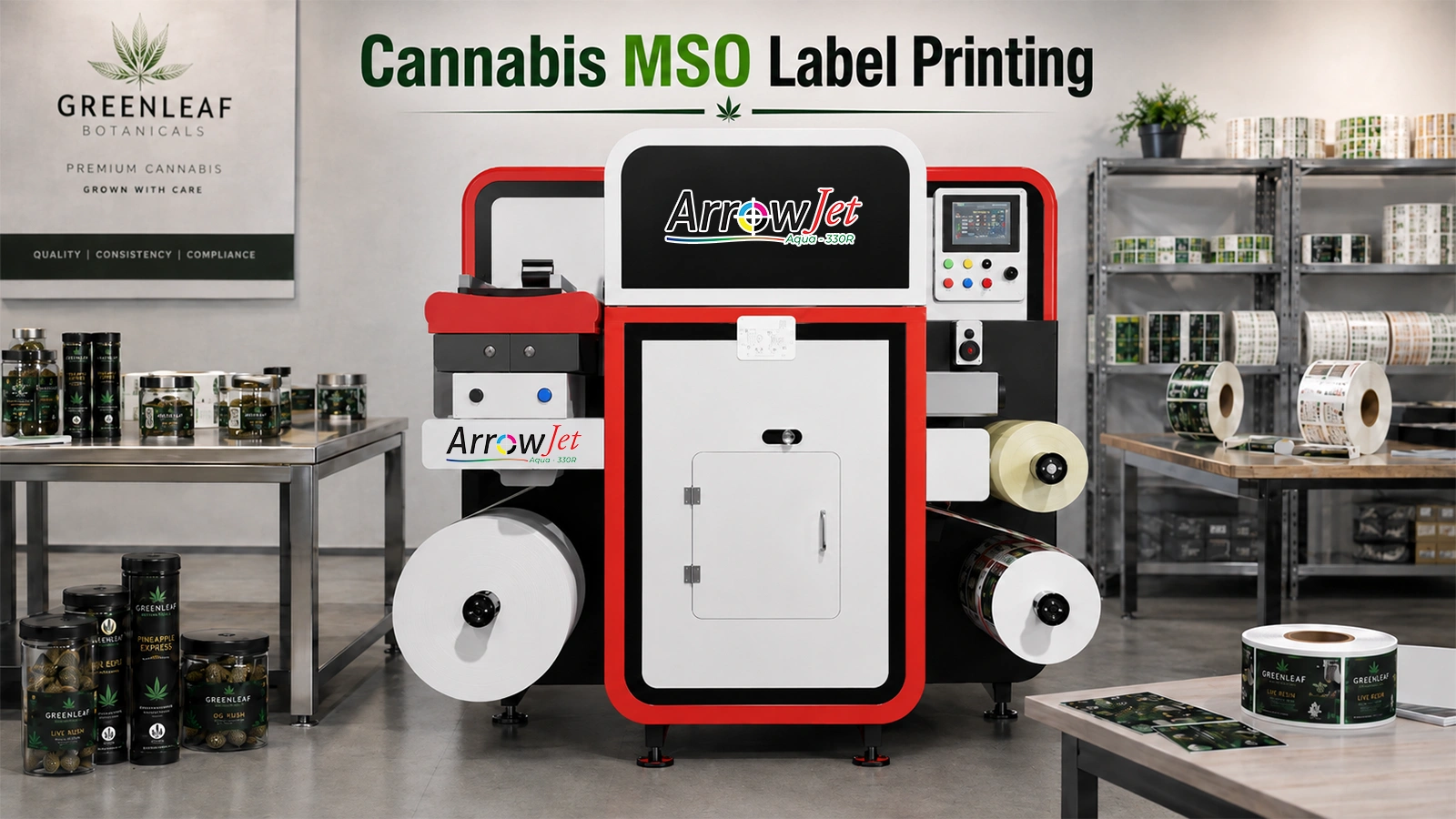
The ArrowJet Aqua 330R prints pressure-sensitive roll labels for jars, pre-roll tubes, and bottles at high SKU-version volumes.

The ArrowJet Aqua 330R, from Arrow Systems — a manufacturer of digital label printing and flexible packaging equipment — is a water-based inkjet roll label system built for pressure-sensitive cannabis label production. Typical applications include:

  • Flower and concentrate jar labels, including small-diameter containers.
  • Pre-roll tube wraps and tube labels.
  • Tincture and topical bottle labels.
  • Pressure-sensitive labels applied to edible cartons and child-resistant or exit packaging components.

ArrowJet Aqua 330R — core specifications for cannabis roll-label production

Water-based aqueous inkjet running on a Memjet DuraFlex® engine, with three print-speed tiers — 90, 150, and 195 ft/min — and a maximum media width of 380 mm. Runs on three-phase 220V/400V power.

It fits MSO conditions where version count is high and run lengths are short: many state variants, frequent compliance revisions, limited-release strain drops, and batch-level variable data printed alongside static artwork rather than added later as a sticker. Water-based inkjet is often preferred in consumable-adjacent packaging environments for handling and ventilation reasons — lower VOCs and no harsh solvent odor near product. Confirm substrate suitability, adhesive pairing, and configuration with Arrow Systems for your specific containers and application method.

ArrowJet Aqua 800M for Flexible Packaging and Pouch Runs

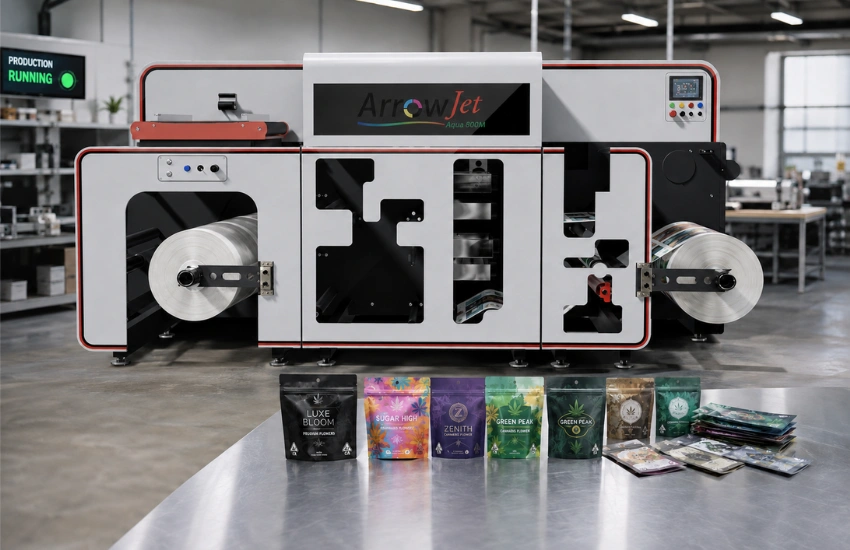
The ArrowJet Aqua 800M is a wider-web aqueous inkjet system built for mylar pouches and other flexible cannabis packaging formats.

The ArrowJet Aqua 800M is a wider-web water-based inkjet system built for flexible packaging and mylar pouch labeling: mylar pouches for flower and edibles, bags, and similar formats where graphics and compliance panels print on the package itself instead of an applied label. It’s part of Arrow’s broader flexible packaging printer range.

ArrowJet Aqua 800M — core specifications for cannabis flexible packaging

Water-based aqueous pigment inkjet system with a maximum media width of 800 mm and maximum printing width of 638 mm, running at 90, 150, and 195 ft/min across three resolution tiers up to 1600 × 1600 dpi. Built on a Memjet DuraFlex® engine. Supports coated paper, PP, PET, PVC, BOPP, and mylar substrates. Runs on three-phase 220V/400V power with a 6-bar compressed air requirement.

arrowjet-aqua-800m-cannabis-flexible-packaging

For MSOs, cannabis pouch formats carry the same content burden as jars — state-specific warning statements and symbols, potency and serving declarations, ingredient and allergen panels for edibles, batch and package dates, and COA codes. Handling those panels in-house removes the same lead-time and obsolescence exposure addressed on the roll-label side. Most operators phase this capability rather than buying both systems at once: the common sequence is roll labels first, because version count and revision frequency are highest there, followed by flexible packaging capacity as pouch volume consolidates. Confirm format, material, and configuration details with Arrow Systems before sizing either step.

Frequently Asked Questions — Cannabis MSO Label Printing

Common questions from cannabis MSO operations, compliance, and packaging leaders evaluating in-house label production.

Version count usually matters more than unit volume. As an illustrative starting point, operators managing roughly 150 or more active label versions across three or more states — with a meaningful share running below converter MOQ — often find the economics favor in-house production. Run your own numbers: SKUs × states × variants gives active versions. Compare that against MOQ commitments, obsolete-label write-offs from the past year, and relabeling labor.

The mechanism is a controlled artwork library with approval gates. When a state revises a required declaration, compliance updates the affected artwork, routes it through review, and increments the revision number. With no plate or external proof cycle, teams can often move from approved file to printed labels the same or next day. Each run then writes a batch record linking revision number, print date, and quantity. A press supports controlled execution of compliant artwork; it does not make an operation compliant. Requirements vary by state and change frequently.
Roll labels and flexible packaging are different production problems. Pressure-sensitive roll label work — jars, pre-roll tubes, tinctures, carton labels — is generally best served by a narrower-web roll label system such as the ArrowJet Aqua 330R. Wider-web flexible formats like mylar pouches typically call for a system built for that work, such as the ArrowJet Aqua 800M. Many MSOs start with roll labels, where version churn is highest, and add flexible capacity later as pouch volume justifies it.

No. Arrow Systems manufactures digital label printing and flexible packaging hardware — the ArrowJet Aqua 330R and Aqua 800M among them. A press supports controlled execution of approved, compliant artwork; it does not determine what that artwork must say. State cannabis labeling and track-and-trace requirements vary and change frequently, so confirm current rules with your compliance counsel or state regulator before finalizing artwork.

Next Step

Pressure-test the decision with your own numbers rather than a general framework.

Operational takeaways to act on:

  • Count active label versions by state, not just annual label units, and compare each version against converter MOQ.
  • Total the last four quarters of obsolete-label write-offs, relabeling labor, and proof-cycle downtime.
  • List which content is batch-level — lot, potency, package date, track-and-trace and COA codes — and where it is applied today.
  • Centralize artwork governance first; decide hub versus distributed printing second.
  • Phase capacity: roll labels where version churn is highest, flexible packaging as pouch volume consolidates.

Request an In-House Label Production Assessment

Bring your active label version count by state, current converter lead times and MOQs, batch-level variable data requirements, and the container and pouch formats you run.

Arrow Systems will map which volumes and formats justify in-house production now, which are better left outsourced, and how ArrowJet Aqua 330R and Aqua 800M configurations align to your roll-label and flexible-packaging mix — structured as a phased build plan that fits an expanding footprint.