Table of Contents
White Ink Clear Label Printing: When You Need It and Why
White ink under clear film keeps brand color, mandatory copy, and barcodes readable no matter what sits behind the label.
Key Takeaways
- White ink is structurally required — not decorative — whenever a clear-film label sits over a dark, tinted, metallic, or SKU-varying container, because process inks alone can’t hold color or legibility.
- The “no label look” only works when the fill is light or opaque, typography is heavy enough to hold contrast, and mandatory copy still passes a legibility check on the filled container.
- Opacity is a spec, not a hope: single-hit white suits light containers, while double-hit white is typically required for dark, colored, or metallic containers and behind full-color panels.
- UV inkjet — including the ArrowJet UV 330H — cures instantly and lays down opaque white; standard aqueous inkjet systems are generally not configured to print opaque white on clear film.
- Approve from a retained physical sample on the real substrate and container, never from a screen proof — a monitor can’t simulate an amber glass wall behind translucent ink.
Why White Ink Is the Critical Variable on Clear Label Substrates
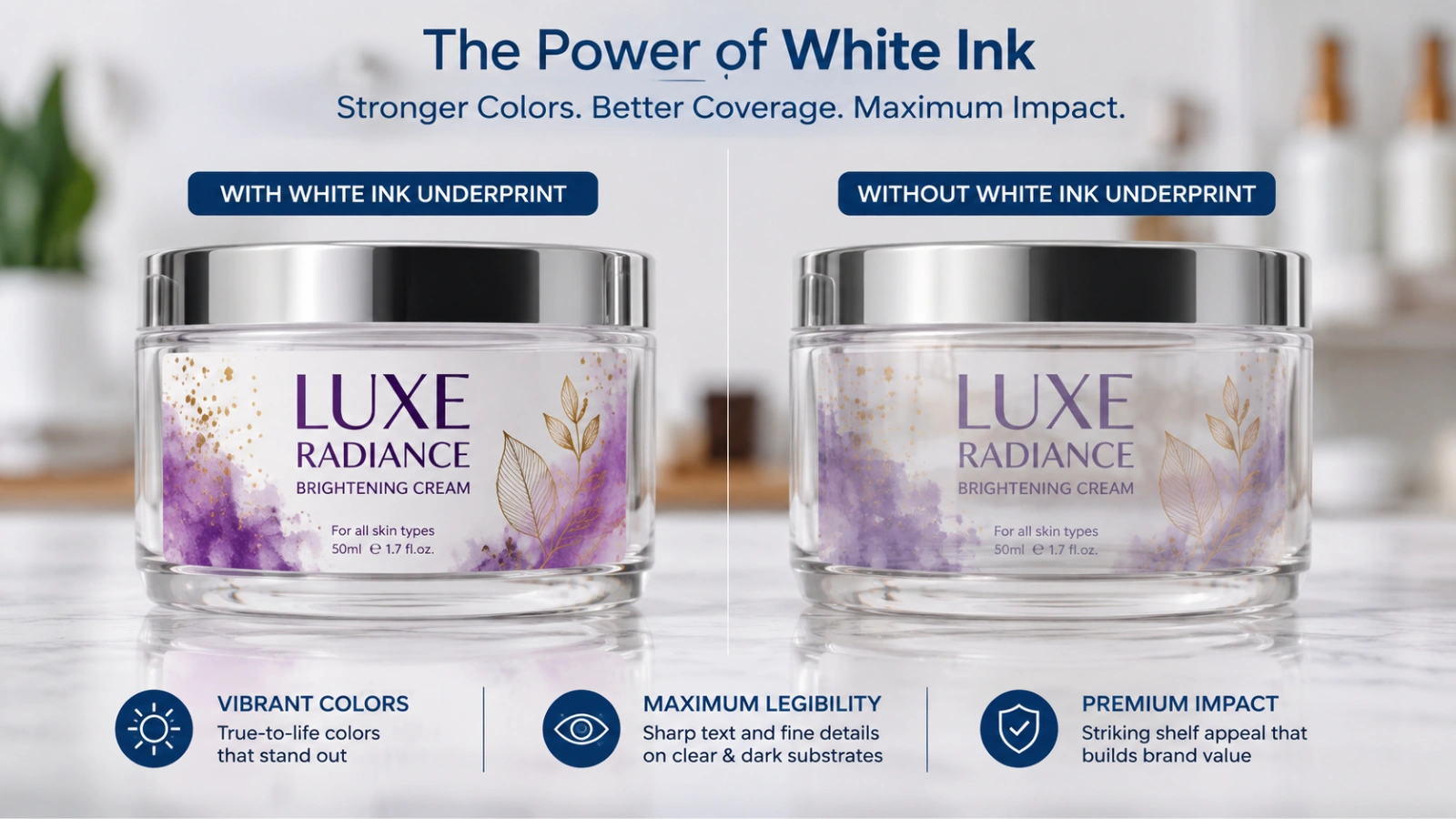
Process inks are translucent — on clear film, the container and its contents become part of the printed color unless white ink restores a base.
On white paper or white film, the substrate itself is the reflective base that makes CMYK look like the color that was approved. Clear label printing removes that base: clear BOPP labels, polyethylene terephthalate film (PET), and polyethylene film substrates have none of their own. Light passes through the ink, hits whatever is behind the label, and returns through the ink film a second time. The container and the product become part of the color formula.
That is why one approved artwork file produces different results across a portfolio:
Clear jar of opaque white cream
Closest to a white-substrate result, though texture and the fill line still shift the read.
Black matte airless pump
Color values collapse toward black, midtones go muddy, and light tints disappear.
Amber or cobalt glass dropper
The glass adds a strong color cast that pulls every printed hue toward the container color.
Metallized or frosted acrylic
Reflection and diffusion change contrast unpredictably under retail lighting.
The symptoms are predictable: brand color drifts SKU to SKU, imagery loses accuracy, ingredient and warning copy lose contrast, and barcode or 2D code scan reliability weakens. Any transparent film has this problem, but cosmetics and personal care feel it first because container colors, formula colors, and SKU counts all vary at once.
The "No Label Look": When Transparent Means No White Ink
The no-label look prints directly on clear glass or plastic on purpose — it only works under specific, checkable conditions.
Transparent label printing in this style signals formula transparency without a printed background color. Premium beauty brands use the no-label look to let the product itself — a gel, a facial oil, a serum with visible viscosity — carry shelf presence.
It works when specific conditions line up:
- The fill is light-colored or opaque, giving printed copy a usable background.
- The design is mark-and-minimal-type, not full-bleed imagery or gradients.
- Type is set heavy enough to hold contrast against a variable background.
- Barcodes and 2D codes sit over an area with stable, high-contrast backing.
Guardrails matter. Avoid fine reversed type and hairline rules on a clear substrate, because there is no reliable contrast to reverse out of. Keep scannable elements away from fill lines, seams, and shrink-band edges.
Treat mandatory copy as the first failure point. Ingredient declarations, warnings, net contents, and lot codes are usually the smallest, lightest-weight text on the label — exactly what regulators and retailers expect to be legible. Verify placement and legibility of all required content with your regulatory team against applicable labeling requirements before committing to a no-white design.
When White Ink Is Essential: Opaque Elements, Dark Containers, and Product Visibility
Printing white ink on clear labels is structurally required — not stylistically preferred — in five recurring scenarios.
Flood white underprint
Sits behind a full-color panel so color and imagery reproduce the same way on a frosted glass jar and a black cylinder.
Spot white
Sits behind logos, claim badges, seals, and shade names that must stay crisp over dark or patterned containers.
Partial white
Creates a legibility window for the ingredient panel while leaving an unprinted fill-level window — critical for oils, gels, and sun care tubes where seeing the product is part of the promise.
White beneath metallic, neon, or high-chroma elements
Required because foil-effect inks and fluorescents lose punch without an opaque base underneath.
White as the stabilizer across container colors
Keeps one design consistent when it runs on multiple bottle colors, limited-edition units, and regional variants.
Opacity Is a Spec, Not a Hope
Print white ink on clear labels to a locked-down spec, not a hope: opacity is a function of ink film thickness, pigment loading, screen or drop volume, and cure. Two converters can both say “we print white” and deliver visibly different results.
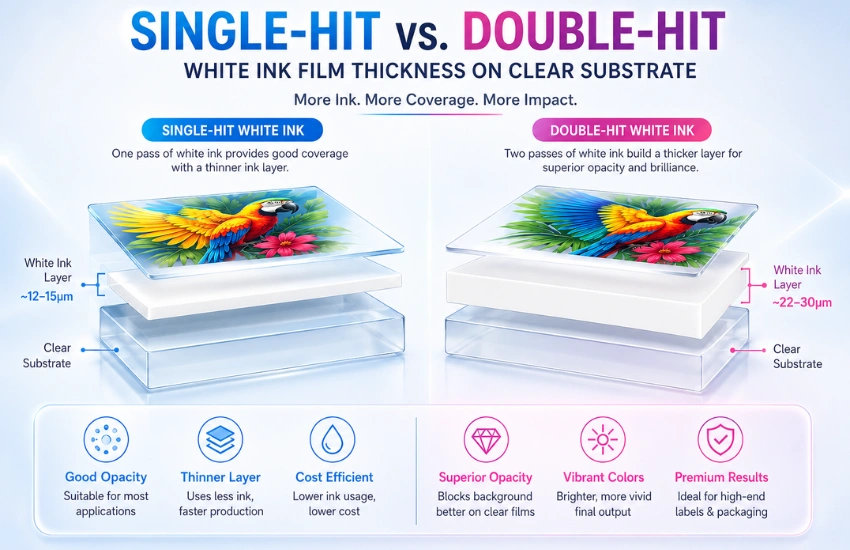
Single-hit white
One white lay-down. Often adequate over light containers, or where white is decorative rather than a color-accuracy base.
Double-hit white
Two white lay-downs, usually with cure between them, building film thickness for higher opacity. Commonly specified for dark, colored, or metallic containers and behind full-color panels.
Specify which one is needed, then verify it physically. Ask for printed samples on the exact substrate, applied to the exact container, filled or mocked up with the actual formula color. Evaluate under daylight and under store-style lighting, and compare side by side against a control sample rather than a monitor proof — a screen cannot simulate an amber glass wall behind translucent ink. Treat any opacity number cited without a shared measurement method as an illustrative estimate only, and lock approval to the retained physical sample.
Specify surface protection at the same time. Cosmetics labels see bathroom humidity, oil and cream contact, and repeated handling, so a laminate or appropriate varnish is typically specified alongside white — include it in sample testing rather than adding it later.
Which Printing Technologies Can Print White Ink
White behaves differently from CMYK — it needs its own station, more ink on the sheet, and controlled cure so it doesn’t spread on film.
Not every press configuration includes a white channel, and among those that do, opacity strength and run-length fit vary widely. UV curable inkjet — the ink chemistry behind UV inkjet label printers — is one of the technologies built to jet opaque white reliably on film.
Technology | White ink availability | Typical opacity strength | Run-length fit | Setup / changeover notes |
Flexo | Dedicated white station, plate-based | Strong; double-hit possible with multiple stations | Longer runs | Plates and press setup per SKU; cost per version is high on short runs |
UV inkjet | Jettable pigmented white on its own channel, often laid down with priority | Good to strong, depending on configuration and single vs. double hit | Short to mid runs; versioning-friendly | No plates; per-SKU changeover is largely file and preset driven |
Aqueous inkjet | Generally not configured for opaque white | Not applicable | Short to mid runs | Excellent on white and metallized stocks; not the tool for white on clear film |
Toner / electrophotographic | Depends on configuration; white is not universal | Varies widely by system | Short runs | Confirm a white station exists rather than assuming |
Screen | Yes, very high film thickness | Very high | Specialty and decorative work | Slower; often combined with other processes |
Vendor qualification questions:
- Which unit or channel prints white, and is it single hit or double?
- Is white applied inline or on a second pass?
- How is opacity checked run to run, and what physical control is retained between reprints?
- Does the quote include the white pass, or is it an add-on?
ArrowJet UV 330H: Hybrid Press With White Ink Capability
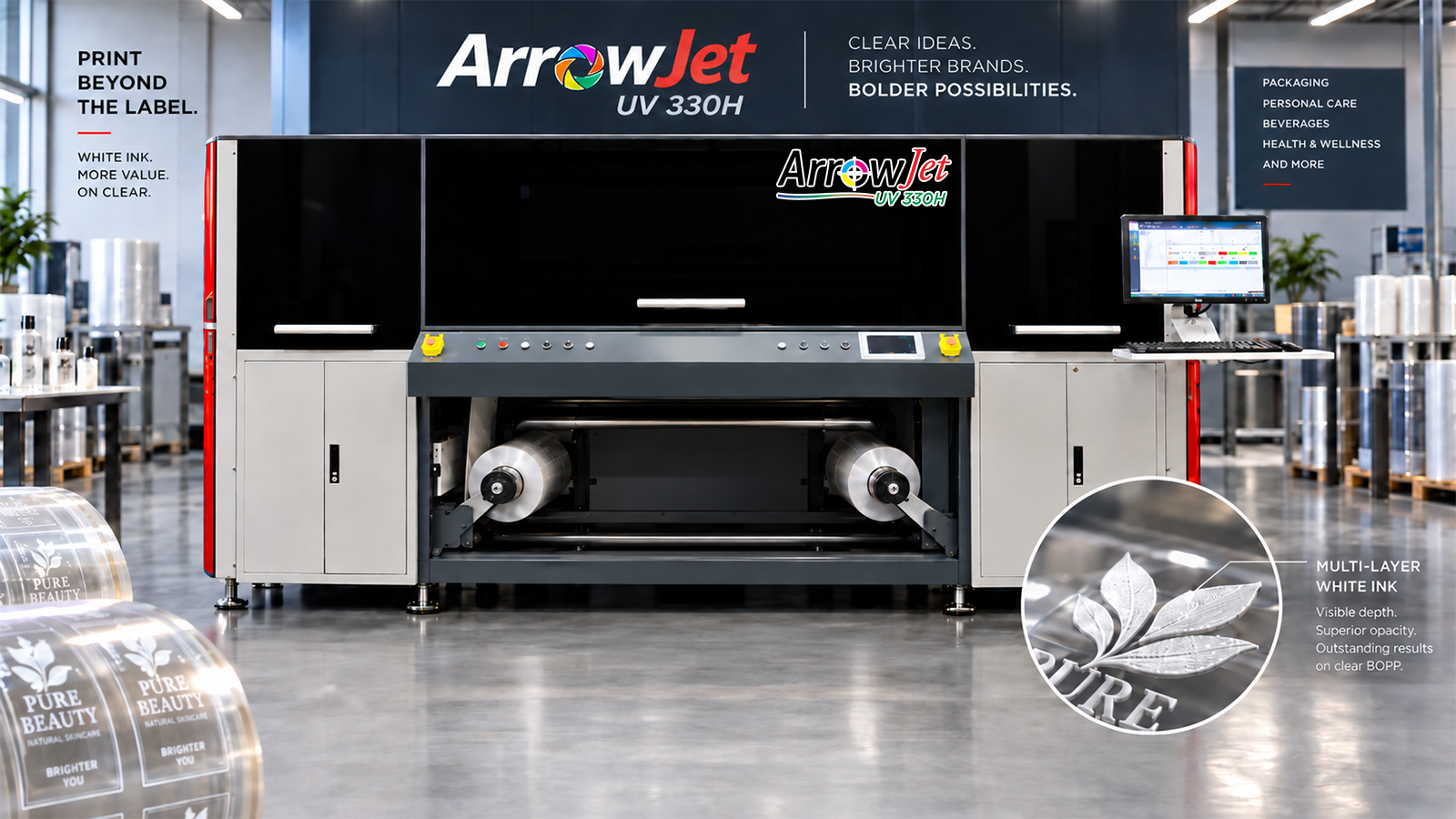
The ArrowJet UV 330H is a hybrid UV label press that prints opaque white, CMYK, and varnish in the same pass on clear, specialty film.
The UV 330H is a hybrid roll-to-roll and flatbed UV inkjet printer, and that combination suits transparent BOPP label printing and specialty films for a mechanical reason: as a UV LED inkjet printer, its LED lamps cure ink instantly on non-absorbent substrates, keeping a heavy white film from spreading before the color layers go down — the core control problem when jetting white on film.
Roll-to-roll and flatbed in one platform
The UV 330H combines roll-to-roll productivity with flatbed precision in a single system, printing labels, sheets, and rigid substrates up to 50 mm thick in flatbed mode without switching machines. Maximum print width is 330 mm, maximum media width is 350 mm, flatbed printing area is 350 mm × 1500 mm, and maximum roll diameter is 450 mm.
CMYK + White + Varnish ink configurations
The press supports CMYK + White (WW), CMYK + Varnish (VV), or CMYK + White + Varnish (WV) configurations, printing opaque white for clear, metallic, and dark substrates alongside clear ink and varnish for spot gloss, textures, and tactile finishes.
Zoned inspection vacuum bed
Keeps media flat and ensures accurate registration across CMYK, white, and varnish layers, even on challenging clear and specialty film substrates.
Applications
Cosmetic and personal care labels are among the UV 330H’s application categories, alongside food and beverage, pharmaceutical and nutraceutical, industrial, and household and cleaning product labels.
For cosmetics and personal-care brands, the practical advantage is versioning: because the press works from a digital file rather than a plate set, each new SKU, shade extension, or regional ingredient panel is a file change rather than a new tooling investment.
Capability claims mean less than a physical sample. Send the substrate and container intended for shipment, then evaluate the printed result in hand.
When to Choose Aqueous Instead and Skip the White Ink Requirement
If transparency isn’t doing real design work, the cleanest fix is removing the white-ink dependency with an opaque white or metallized stock.
Printing on white or metallized pressure-sensitive stock gives an opaque base for free, simplifies color management, and widens the vendor pool.
Aqueous inkjet fits well when:
- The aesthetic is matte or textured paper, common in clean-beauty and refill-forward lines.
- SKUs are cost-sensitive and do not require film clarity.
- Simpler color control across reprints without an opacity variable is a priority.
- Low-odor and water-based ink considerations matter in the facility or with fillers.
Choose clear plus white when
The container is dark or colored, product visibility or a fill-level window is part of the concept, metallic or neon accents are involved, or one design must run across multiple container colors.
Choose white or metallized stock when
The design is fully opaque anyway, run lengths are short and cost-driven, timelines are tight, or the brand look is paper-forward.
Most portfolios need both. Arrow Systems’ ArrowJet Aqua 330R is the aqueous counterpart to the UV 330H — a water-based inkjet press printing CMYK on opaque paper and metallized label stocks at speeds up to 195 ft/min across a 380 mm web, with no white-ink pass required. Keep one prepress structure across both presses — consistent layer naming, a defined white spot channel, and shared job presets — so a design can move between a clear-plus-white build and a white-stock build without rebuilding artwork.
Frequently Asked Questions — White Ink Clear Label Printing
Common questions from cosmetics and personal-care brand, packaging, and QA teams specifying white ink on clear label substrates.
No. A genuine no-label-look design can run with no white ink when the fill behind the label is light or opaque, the type is heavy enough to hold contrast, and scannable codes sit over stable backing. The risk is mandatory copy: ingredient lists, warnings, and net contents are typically the smallest text on the label and fail first on transparent stock. Test a printed sample on the filled container before approval, and confirm legibility expectations with your regulatory team against applicable labeling requirements.
Single-hit white is one white lay-down; double-hit applies white twice, building film thickness for higher opacity. Because opacity depends on film thickness, pigment loading, and cure, double-hit is commonly specified for dark or strongly tinted containers — black airless pumps, amber droppers, cobalt glass — and behind full-color panels that must match across SKUs. It typically costs more and may affect throughput. Decide from side-by-side samples on your actual container rather than a general rule.
Generally no. Aqueous inkjet systems are typically not configured with an opaque white channel, and opaque white needs the high pigment loading and film build that water-based systems on clear film are not designed to deliver. Aqueous is a strong choice on white and metallized pressure-sensitive stocks, where the substrate supplies the opaque base. If a design requires opaque white on transparent film, plan on UV inkjet, flexo with a dedicated white station, or screen printing, depending on run length and opacity needs.
Build white as a named spot channel — not as 100% K or a placeholder tint — set to overprint or knock out as intended, and mark which elements sit on white and which are intentionally unbacked. Note whether flood, spot, or partial white is required, and single or double hit. In the print request, state substrate, container color and finish, formula color, laminate or varnish, and required scan contrast. Ask for a physical sample on the real container and retain it as the approved control.
Regulatory validation — including FDA cosmetic labeling compliance, ingredient (INCI) listing, and state-level requirements — is the brand’s responsibility and should be confirmed with qualified regulatory counsel. Arrow Systems sells label printing hardware; Arrow does not provide regulatory or compliance advisory services.
Get a White Ink Label Press Assessment from Arrow Systems
Don’t approve a clear-label program from a screen proof. If your team is deciding between a true no-label look and a structurally required opaque white base, Arrow Systems offers a structured press assessment for packaging, operations, and QA leaders.
The assessment reviews your substrate, container, and SKU mix, and covers single-hit vs. double-hit opacity, laminate or varnish specification, and mandatory-copy contrast — to recommend a press configuration, ArrowJet UV 330H, ArrowJet Aqua 330R, or both, that fits your production volume and portfolio.
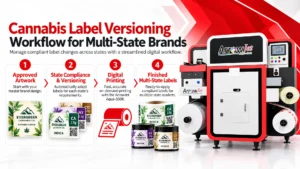
Cannabis Label Versioning Workflow for Multi-State Brands
Table of Contents Cannabis Label Versioning Workflow for Multi-State Brands A cannabis label versioning workflow produces state-specific labels from one master template by moving state-variable
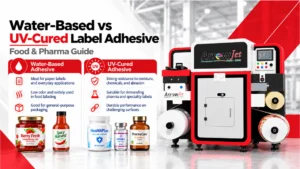
Water-Based vs UV-Cured Label Adhesive: Food & Pharma Guide
Table of Contents Water-Based vs UV-Cured Label Adhesive: Food & Pharma Guide Water-based adhesives suit dry, ambient containers; UV-cured hot melts suit cold, wet, curved
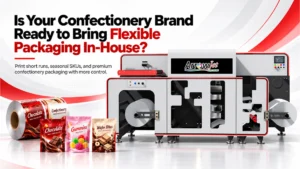
Is Your Confectionery Brand Ready to Bring Flexible Packaging In-House?
Table of Contents Is Your Confectionery Brand Ready to Bring Flexible Packaging In-House? In-house flexible packaging pays off for confectionery brands with many SKUs, short
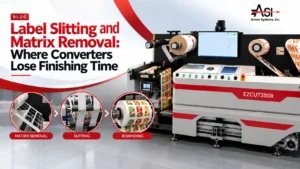
Label Slitting and Matrix Removal: Where Converters Lose Finishing Time
Table of Contents Label Slitting and Matrix Removal: Where Converters Lose Finishing Time Label slitting and matrix removal, plus rewinding, cost converters more finishing time
Limited Edition Spirits Label Printing: 4 Holiday Delay Fixes
Table of Contents Limited Edition Spirits Label Printing: 4 Holiday Delay Fixes Limited edition spirits label printing runs late because of the calendar, not the
Section 179 Label Printer Timing: Install Before December 31
Table of Contents Section 179 Label Printer Timing: Install Before December 31 A section 179 label printer purchase counts for 2026 only if the press