Color Sticker Printer

Table of Contents

Color Sticker Printer for Business: 4 Reasons to Print In-House

Key Takeaways

  • In-house label printing eliminates supplier lead times and lets teams produce labels when they are needed.
  • Color label printers range from compact entry-level presses to roll-to-roll production systems — the right fit depends on volume, substrate, and workflow.
  • Digital printing enables unlimited design variations and variable data within the same print run.
  • Labels are not only for retail — internal labeling for storage, samples, and inventory is a real and practical use case.
  • Defining volume, material, and finishing requirements before purchase prevents over-investing in equipment that exceeds actual needs.

Color stickers and labels do real work on the shelf — they communicate brand identity, product details, and handling instructions in the space of a few square inches. For businesses that depend on labels, a single supplier delay can hold up a finished product run. A color sticker printer eliminates that dependency by moving label production in-house, where teams control output, timing, and artwork without waiting for external turnarounds.

The case for in-house printing is not about owning hardware for its own sake. It is about controlling the production workflow so that label changes, short runs, and demand spikes do not become operational bottlenecks. Here are four practical reasons businesses make the switch.

1. Lower Lead Times

Label delays from suppliers can hold up finished goods — in-house printing puts production control back with the team.

When a label order is placed with an outside supplier, the business loses control over timing. Proof approvals, production schedules, and shipping all sit outside the team’s hands. If a supplier is backed up, experiences a quality issue, or a proof revision is needed, finished products can sit idle while the business waits for packaging components to arrive.

Bringing in-house label production online removes that external dependency. Labels can be produced close to the moment they are needed, in exactly the quantities required. If a design needs a last-minute update, the correction can be made and a new batch queued within the same workday. For businesses that manage seasonal SKUs, limited runs, or frequent product updates, this kind of responsiveness has direct operational value.

In-house printing also reduces the safety stock a business needs to hold. When the lead time is measured in hours rather than days or weeks, there is less reason to carry large label inventories that may become obsolete if artwork or regulatory requirements change.

2. Equipment Options for Different Workspaces

Color label presses are available across a wide range of formats and output capacities — there is not a single “standard” machine that fits every business.

One common assumption is that in-house label printing requires a large production setup with dedicated floor space, three-phase power, and specialized operators. That assumption does not reflect the current equipment landscape. Digital label presses now exist at multiple tiers, from compact units for office environments to full roll-to-roll industrial presses for higher-volume production.

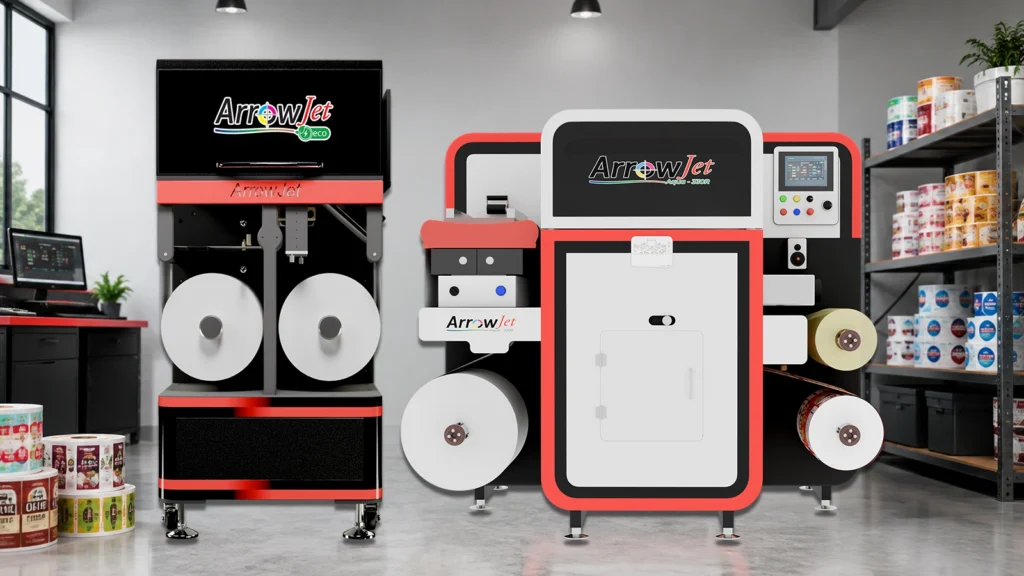
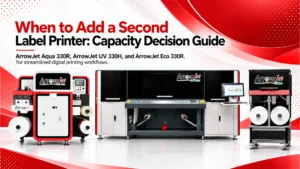
For businesses taking their first step into industrial in-house printing, the ArrowJet Eco 330R is a compact single-pass digital press that runs on standard single-phase power with no air compressor required. It handles paper labels, coated stocks, and flexible packaging substrates at production speeds, with a footprint suited to smaller production environments. It is designed for teams that need real industrial output without the overhead of a large-format press installation.

For businesses with higher throughput requirements or a need for a wider substrate range, the ArrowJet Aqua 330R is a full-color pigmented inkjet label press built for demanding label production workflows. It supports a broad range of label materials — paper, PP, PET, BOPP, and more — and is compatible with both offline and inline finishing solutions.

Choosing between them (and other options in between) comes down to a clear assessment of label dimensions, monthly volume, substrate types, and finishing requirements. That assessment should happen before any hardware comparison begins.

Explore Arrow's Digital Label Printers

Arrow Systems manufactures digital label presses designed for in-house production at multiple capacity tiers.

3. More Control Over the Creative Process

Digital label printing removes the minimum-order and lead-time barriers that restrict design flexibility with outside suppliers.

With an outside printer, every design change carries a cost — new artwork setup, a minimum reorder quantity, and another round of lead time. That friction discourages experimentation and slows down packaging updates. Businesses end up printing more of a single design than they need, or delaying a correction until the next order cycle.

In-house digital label printers remove that friction entirely. A business can print five different label versions in a single session, each in a quantity that matches actual demand. Seasonal designs, limited editions, test packaging, promotional variants, and compliance corrections can all be produced without committing to large runs or waiting on a vendor’s production schedule.

Digital printing also supports variable data workflows when the press, RIP software, and artwork are configured for it. This means unique barcodes, sequential serial numbers, QR codes, and personalized label elements can be incorporated within a single print run. For businesses managing batch tracking, traceability requirements, or consumer-facing personalization, variable data capability has real value beyond basic design flexibility.

4. Better Organization and Internal Labeling

A label printer serves more than retail products — internal labeling for storage, samples, shipping, and inventory is a consistent day-to-day use case.

Not every label that comes out of an in-house press ends up on a consumer product. Businesses regularly need labels for sample bottles, prototype packaging, storage containers, filing systems, internal inventory bins, and outbound shipments. These functional labels are often produced inconsistently — handwritten notes, printed paper taped to surfaces, or labels ordered in small quantities from a supplier at disproportionate cost.

A dedicated color sticker printer consolidates that demand into a single, reliable workflow. The same press that handles branded product labels can produce clear, professional internal identification labels on demand. This reduces confusion in warehouse and production environments, makes inventory management more systematic, and removes the need to maintain separate small-batch label supplies for internal use.

The operational payoff is incremental but real: fewer mislabeled shipments, faster inventory identification, and a cleaner workspace where materials are consistently marked and easy to locate.

What to Consider Before Buying a Color Sticker Printer

Defining requirements before comparing hardware leads to a better equipment decision and prevents over-investing in capacity that will not be used.

The right color label printer for one business may be completely wrong for another. A clear-eyed assessment of the following factors will produce a narrower, more useful shortlist before any equipment demos take place.

Monthly Label Volume

Estimate how many labels or stickers the business prints per month across all SKUs and use cases. Volume determines which press class makes economic sense — lower-volume operations can often run efficiently on a compact entry-level press, while higher monthly volumes justify the throughput of a mid-range or production-class system.

Artwork Change Frequency

How often does label artwork change? Businesses with frequent design updates, seasonal variants, or multiple SKUs benefit most from the zero-setup-cost flexibility of digital printing. Operations with one stable label design printed in high volume may find the per-unit economics favor outsourcing for that SKU.

Label Size and Substrate Requirements

Label dimensions and required materials — coated paper, PP, PET, BOPP, clear films — affect both press selection and ink compatibility. Some substrates require pre-treatment or specific ink formulations. Confirming substrate compatibility before purchase prevents post-installation surprises.

Finishing Requirements

Printed rolls often need additional processing: die cutting to shape, lamination for durability, matrix removal, or slitting to final roll width. Some presses support inline finishing; others require a separate label finishing unit. Understanding the full workflow — from printed roll to finished label — ensures the total system is scoped correctly from the start.

Variable Data Requirements

If labels require unique barcodes, QR codes, batch numbers, or serial numbers, the press and software workflow must be configured to support variable data. Confirming this capability during the evaluation phase prevents workflow gaps after installation.

Operator Time and Training

Digital label presses vary in the skill level required to set up and operate them. Simpler compact presses are designed for minimal operator intervention; production-class systems may require more setup knowledge. Factor in the time the team can realistically dedicate to press operation and maintenance.

Ready to Evaluate In-House Label Printing Equipment?

Arrow Systems manufactures digital label presses and finishing systems for businesses bringing label production in-house.

Frequently Asked Questions

Not every business does. A color sticker printer makes the most sense when a business needs fast turnaround, short print runs, multiple label designs, or tight control over label inventory. Businesses that print the same label in large quantities and are happy with supplier lead times may not see a strong return from in-house equipment.

Color label printers range from compact desktop units for low-volume office use to industrial roll-fed digital presses designed for production workflows. Entry-level industrial presses like the ArrowJet Eco 330R run on single-phase power without requiring an air compressor, making them accessible for businesses that want production-level output in a smaller footprint. Mid-range presses like the ArrowJet Aqua 330R expand substrate range and throughput for higher-demand operations.

Digital label presses support variable data printing when the printer, RIP software, and artwork files are configured correctly. This enables businesses to print unique barcodes, sequential numbers, QR codes, and personalized label content within a single print run — without stopping to re-plate or reconfigure the job.

Key factors include monthly label volume, how frequently artwork changes, required label dimensions, substrate and adhesive compatibility, finishing needs such as cutting and lamination, and whether the workflow requires variable data support. Defining these requirements before comparing equipment narrows the field and prevents over-investing in capacity that will not be used.

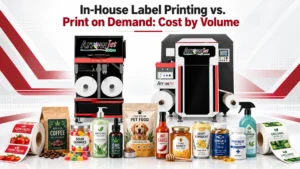
In-house printing works best for short-to-medium runs, fast-changing designs, and labels that need variable data. High-volume commodity runs with stable artwork may still be cost-effective to outsource. Many businesses adopt a hybrid model — outsourcing stable, high-volume SKUs while handling variable or short-run jobs in-house with their own equipment.