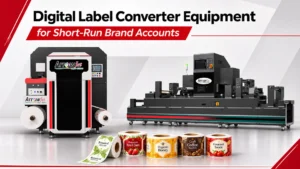
Digital Label Converter Equipment for Short-Run Brand Accounts
Table of Contents Digital Label Converter Equipment for Short-Run Brand Accounts Winning short-run brand accounts takes a matched stack: a right-sized digital press, fitted finishing,
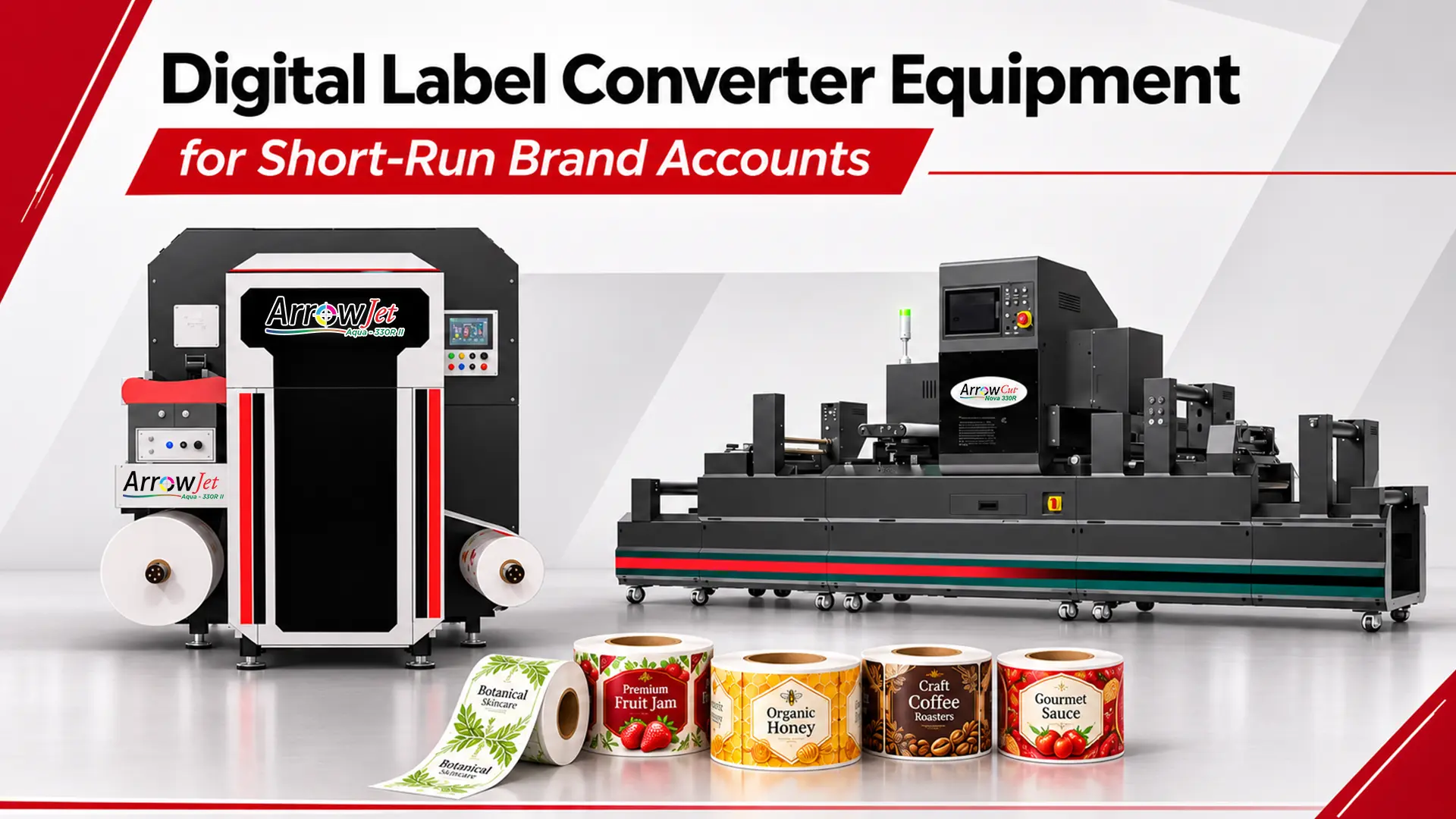
Winning short-run brand accounts takes a matched stack: a right-sized digital press, fitted finishing, premium capability, and workflow QC.
Digital label converter equipment is a four-layer stack, not a single press purchase, and a weak layer becomes the bottleneck.
Brand buyers in craft beverage, cosmetics, nutraceuticals, and specialty food now split product lines into more SKUs and order fewer labels per SKU. This guide is for trade shops: converters that have printed mostly through brokers, distributors, or wholesale channels, often on flexo, and now want to win direct short-run brand accounts. For a label converter starting digital, the equipment for digital label converting falls into four layers.
Layer 1: Digital press
The print engine, sized to realistic monthly linear footage and to the substrate range brand prospects actually request.
Layer 2: Finishing
Cutting, matrix removal, slitting, and rewinding. The cutting method (semi-rotary, blade, or laser) should match the shape mix and run lengths you win.
Layer 3: Premium capability
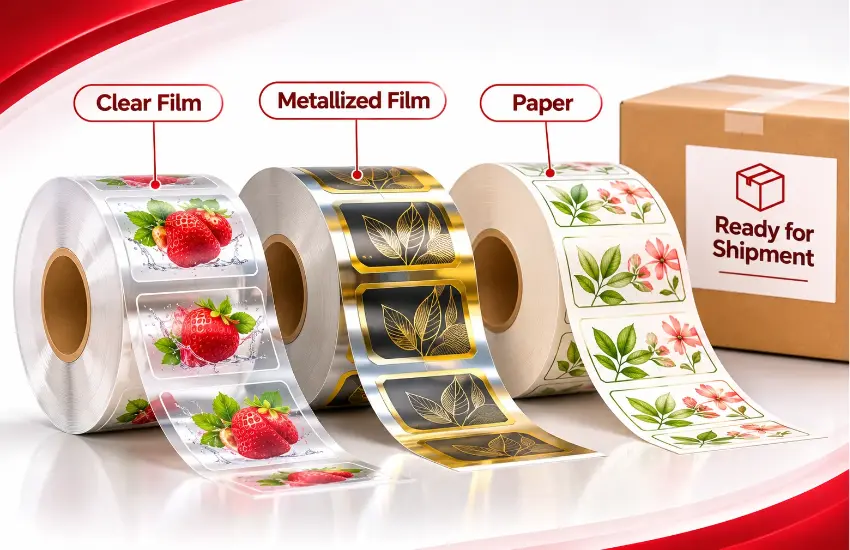
White ink, spot or tactile varnish, lamination, and qualified specialty films that let a converter quote cosmetics, spirits, and specialty food work.
Layer 4: Workflow and QC
Preflight, imposition, color management, version control, and inspection, so a small prepress team can handle dozens of SKUs a week without errors.
If you already run a toner or entry inkjet device, the same framework applies. The gaps usually show up in the layers around the press.
Direct brand buyers judge how a shop handles change: short runs, fast proofs, versioning, consistency, and a premium look.
Direct brand accounts evaluate converters differently than brokers do. Price matters, but each of these brand account label requirements maps to a specific equipment layer.
Buyer expectation | What the buyer wants | Layer that delivers it |
Short runs and frequent reorders | A few hundred to a few thousand labels per SKU, with no plate charges and no minimums sized for flexo | Layer 1 (digital press) and Layer 2 (die-free or quick-change finishing) |
Fast proofs | Same-day or next-day digital proofs, which many buyers now treat as a baseline | Layer 1 and Layer 4 (automated preflight and saved templates) |
Versioning | Flavors, scents, sizes, and seasonal variants run on a shared die line, with no new tooling for each variant | Layer 1 (ganged versions) and Layer 4 (imposition and version control) |
Consistency | The third reorder matches the first, and digital work sits next to any flexo-printed SKUs on shelf | Layer 4 (color targets, profiles, and first-article inspection) |
Premium look | White ink, spot or tactile varnish, and clear, metallized, or textured films | Layer 3 (premium capability) and Layer 2 (lamination and clean film cutting) |
A press-first purchase can cover short runs and fast proofs. But if finishing is still manual, or one person still builds prepress files by hand, the shop misses the turnaround it quoted. That is how accounts are lost.
Size a digital press for converters from real demand: monthly linear feet, run hours, and changeover time, not rated speed alone.
Start with demand, not spec sheets. Arrow’s range of digital label printers spans entry, growth, and production speed tiers, and the right tier depends on your actual job mix. Converter capacity planning works best as a short, repeatable worksheet.
Step 1: Pull three to six months of quotes, including lost ones
Estimate jobs per month, average run length, and SKUs per order. Lost and declined quotes count, because they are demand your current setup could not serve.
Step 2: Convert the job mix to monthly linear feet
Multiply jobs per month by average run length by label repeat. Running labels more than one across reduces linear footage proportionally.
Step 3: Divide by the press’s rated speed, then add changeover time
Run hours equal monthly linear feet divided by rated speed. Then add makeready, proofing, cleaning, and maintenance time for every job.
Step 4: Compare the total against available shift hours
One shift of 8 hours across about 21 working days gives roughly 168 hours a month. If press and changeover hours already fill most of a single shift, an entry tier may be outgrown within a year.
Illustrative worksheet inputs (example only):
Input | Scenario A: entering brand work | Scenario B: growing brand book |
Jobs per month | 60 | 150 |
Average run length | 2,000 labels | 3,000 labels |
Label repeat (one across) | 4 in. (1/3 ft) | 4 in. (1/3 ft) |
Monthly linear feet | 60 × 2,000 × 1/3 ≈ 40,000 ft | 150 × 3,000 × 1/3 ≈ 150,000 ft |
Changeover time (assumed 20 min per job) | 20 hours | 50 hours |
Applying those inputs to the rated top speeds of the three ArrowJet presses used in the example stacks gives the following monthly hours.
Press (rated top speed) | Scenario A: run hours | Scenario A: run + changeover | Scenario B: run hours | Scenario B: run + changeover |
ArrowJet Eco 330R (20 m/min, about 66 ft/min) | 10.2 h | 30.2 h | 38.1 h | 88.1 h (about 52% of one shift) |
ArrowJet Aqua 330R II (220 ft/min) | 3.0 h | 23.0 h | 11.4 h | 61.4 h (about 37% of one shift) |
ArrowJet Bolt 330R Hybrid Pro M (450 ft/min) | 1.5 h | 21.5 h | 5.6 h | 55.6 h (about 33% of one shift) |
Run hours use each press’s rated top speed. The Aqua 330R II also runs at 150 and 90 ft/min tiers, which raise run hours. The 20-minute changeover is an assumption; time your own.
At short-run volumes, changeovers often cost more hours than printing. In Scenario B, moving from the entry to the production press saves about 32 hours of run time, but the 50 hours of changeover stay the same. Rising SKU counts add changeovers even when total footage stays flat, so ganging versions and saved templates matter as much as rated speed.
Substrate range
Compare each press’s supported media and maximum print width against the papers, films, and specialty stocks your brand prospects actually request.
Ink durability
Match the ink system to moisture, refrigeration, abrasion, or product-contact demands. Water-based pigment inks typically pair with varnish or lamination for wet or high-abrasion end uses.
Uptime, service, and consumables
Ask about service response times, printhead and consumables supply, and how quickly a down press can be back in production for a brand on a deadline.
Floor space and power
Plan for a second press or finisher later. Utility needs differ widely: the ArrowJet Eco 330R runs on single-phase 230V power with no air compressor, while the Aries semi-rotary finisher needs 400V three-phase power and 6 bar compressed air.
Workflow example: A craft brewery orders 12 SKUs at 500 labels each, all on the same can-label die line. On flexo, that order means 12 plate sets. On digital, the 12 versions can be ganged onto one roll and run in a single pass with one changeover instead of twelve. That is what makes short run label profitability realistic.
Finishing is often the first bottleneck after a press arrives, so choose the cutting method for the jobs you actually win.
The press can print a dozen SKUs in one pass, but if each SKU then waits on a die, a manual slit, or a hand rewind, the turnaround advantage disappears. Arrow’s label finishing systems cover all three cutting methods, so the converter finishing line can follow the job mix rather than the other way around.
Method | Best-fit job mix | Tooling or setup consideration | Typical tradeoff | Arrow example |
Semi-rotary die cutting | Repeat shapes, standard sizes, longer short runs | Requires magnetic or flexible dies; die lead time and storage must be managed | Efficient on repeat work; new shapes wait on tooling | Aries (magnetic cylinder, up to 30 m/min) |
Blade (digital) cutting | Prototypes, odd shapes, very short runs, sample packs | No dies; cut paths come from the file | Slower on longer runs; blade wear and material limits | EZCut 330R+ (up to 150 cuts/min, ±0.1 mm) |
Laser cutting | High-mix work with frequent new shapes | Die-free; settings must be qualified for each substrate | Strong flexibility; check edge quality and fit on films and adhesives | ArrowCut Nova 330R (150W CO₂), Taurus (350W CO₂) |
Die lead time drives the decision. If a brand sends a new bottle shape on Monday and wants labels Friday, a semi-rotary-only line depends on the die vendor. Die-free cutting removes that wait, but it can trade away throughput on longer runs.
Finishing hours belong on the capacity worksheet next to press hours. Using the two scenarios above (Scenario A: 40,000 ft and 120,000 labels a month; Scenario B: 150,000 ft and 450,000 labels), rated finisher speeds give these monthly cutting hours before setup:
Finisher (rated speed) | Scenario A cutting hours | Scenario B cutting hours |
Aries semi-rotary (30 m/min, about 98 ft/min) | 6.8 h | 25.4 h |
Taurus TRS35PL-PLUS laser (70 m/min, about 230 ft/min) | 2.9 h | 10.9 h |
ArrowCut Nova 330R laser (up to 10,000 labels/hour) | 12.0 h | 45.0 h |
Labels-per-hour ratings vary with label size and cut complexity. Time a sample of your typical shapes before committing a finisher to a schedule.
In Scenario B, the Aqua 330R II needs about 11 hours of press time, while a single ArrowCut Nova 330R at its rated maximum needs about 45 hours of cutting. That gap is why a growing shop should budget finishing capacity before a second press.
Matrix stripping
Fine shapes and thin films can tear the waste matrix during stripping, so test each new shape and film before you quote it.
Slitting and rewinding
Match the customer’s core size, outside roll diameter, labels per roll, and unwind direction. These specs belong on every job ticket.
Waste per changeover
On a 500-label job, setup waste can be a meaningful share of the run. Track waste by job so quotes reflect real material cost.
Cosmetics, spirits, and specialty food brands expect white ink, varnish, and films that survive a cooler, a shower, or a shelf.
These brands treat the label as part of the product. Each premium effect is delivered either at the press or in finishing, and knowing which machine does what prevents quoting work the stack cannot produce.
White ink underlay
An opaque white layer printed under color on clear and metallized films so colors stay opaque. Among the presses in this guide, the ArrowJet UV 330H is the one built for white, with CMYK + White and CMYK + White + Varnish configurations on a hybrid roll-to-roll and flatbed platform.
Spot or tactile varnish
Clear coatings that add gloss contrast or a raised feel. The ArrowJet UV 330H prints clear ink and varnish for spot gloss and tactile textures; the ArrowJet Bolt 330R Hybrid Pro M adds an inline varnish station; and the Aries accepts an optional UV varnish module.
Lamination
A protective film for scuff, moisture, and chemical resistance. Cold lamination is built into the EZCut 330R+ and the Aries, and the ArrowCut Nova 330R laminates inline before cutting.
Substrate qualification should be a written process, not trial and error on a customer job.
Workflow example: A cosmetics brand wants a “no-label look” on a clear bottle. The press must lay down an even white underlay in register with color. Finishing must cut clear film cleanly without visible edge defects. The adhesive must stay clear on the container.
For food, beverage, and cosmetic labels, confirm substrate and ink suitability against the brand’s own compliance requirements, including any applicable FDA rules. Do not assume a material is suitable because it ran well on another job. Request sample labels on clear and metallized films to judge white underlay and varnish quality firsthand.
A small prepress team cannot hand-build files for 40 SKUs a week; automation and recorded color targets close the gap.
Automated preflight
Catches low-resolution images, missing bleeds, and unconverted spot colors before anyone opens the file.
Imposition and gang-up
Nests multiple versions onto one roll to reduce changeovers and material waste on multi-SKU orders.
Saved die-line templates
Stores a job template for each die line, so a repeat shape is never rebuilt from scratch.
Color management
Uses device profiles for each press and substrate combination, a brand color library with target values for each customer’s critical colors, and printed approval swatches stored with the job record. Reorders are matched against the stored target, not against memory.
Version control
Locks artwork revisions to SKU codes and requires approval before a version is released to press. If you run an MIS or ERP, confirm how job tickets, SKU codes, and approvals pass between it and prepress.
QC discipline
Combines first-article inspection against the approved proof, a signed QC sign-off before the full run, and a defect log reviewed weekly to find repeat causes.
Workflow example: A rush file arrives at 9 a.m., and preflight flags a missing bleed that the designer fixes within minutes. The job drops into the saved die-line template and prints with the brand’s stored profile. A hard proof is photographed, sent, and approved before the shift ends. Automation shortens that path; the discipline around it makes the result repeatable.
These Arrow Systems stacks map press and finishing to volume tiers; treat them as starting points, not fixed packages.
Tier | Press | Finishing | Best fit | When to step up |
Entry | ArrowJet Eco 330R | EZCut 330R+ (blade) | Testing direct brand work; high shape variety | Press hours near capacity; finishing queue growing |
Growth | ArrowJet Aqua 330R II | ArrowCut Nova 330R (laser) | Steady accounts; rising SKU counts | Premium requests turned away; second shift needed |
Production | ArrowJet Bolt 330R Hybrid Pro M | Aries (semi-rotary) or Taurus (laser) | High volume; broad premium mix | Add capacity or a second line |
This stack suits shops testing direct brand work at low-to-moderate volume with high shape variety.
Press
The ArrowJet Eco 330R is a compact single-pass press on the Memjet DuraFlex® engine, printing CMYK water-based pigment inks at up to 20 m/min, 1600 × 1600 dpi, and up to 324 mm print width. It runs on single-phase 230V power without an air compressor and ships with Xitron or Arrow RIP.
Finishing
The Arrow EZCut 330R+ is a die-free blade cutter combining flatbed and roll-to-roll cutting, with cutting accuracy of ±0.1 mm, up to 150 cuts per minute, cold lamination, automatic matrix removal and rewinding, and one-click repeat cutting for reorders.
This stack suits shops with steady brand accounts and rising SKU counts that need finishing to keep pace with the press.
Press
The ArrowJet Aqua 330R II runs on the Memjet DuraCore™ engine at three speed tiers of 90, 150, and 220 ft/min, with a 322 mm (12.69 in.) print width and adphos aNIR® near-infrared drying. Like other Memjet-powered ArrowJet presses, it carries Memjet’s Setanta technology updates.
Finishing
The ArrowCut Nova 330R is a die-free laser finisher with a 150W CO₂ galvo laser and a 13.7 in. web width. It laminates, cuts, removes matrix, slits with up to 5 knives, and rewinds inline, with kiss cut, full cut, perforation, and etching modes.
This stack suits higher monthly volume and a broader premium job mix.
Press
The ArrowJet Bolt 330R Hybrid Pro M uses the Memjet DuraBolt™ engine with dual ThunderBolt printheads at up to 450 ft/min, plus inline primer and varnish stations and an NIR dryer.
Finishing option 1: Aries semi-rotary
The Aries is a semi-rotary finisher with a magnetic cylinder that laminates, die cuts, removes waste, and slits at up to 30 m/min. Offset adjustment simplifies full-bleed labels, and it fits repeat shapes run from a managed die library.
Finishing option 2: Taurus laser
The Taurus Laser Finisher is a die-free 350W sealed CO₂ laser running up to 30 m/min, or up to 70 m/min on the TRS35PL-PLUS, with kiss cut, full cut, perforation, and engraving. It requires a water chiller and fume extractor.
The choice between Aries and Taurus depends on shape mix: Aries rewards repeat shapes with existing dies, while Taurus removes die lead time for high-mix production. Book a live or virtual
Three signals show a stack is full: press hours near capacity, a growing finishing backlog, and declined premium requests.
Signal 1: Press hours are near capacity on your worksheet
Run plus changeover hours regularly fill most of the available shift, and quotes are being declined or pushed out for capacity.
Signal 2: A backlog is forming in the finishing queue
Printed rolls wait for cutting, slitting, or rewinding. In that case, added finishing capacity may deliver more than a faster press.
Signal 3: You are turning away premium-finish requests
Brands ask for white underlay, spot varnish, or specialty films the current stack cannot produce or finish cleanly.
Each signal points to a different layer, so a converter equipment investment should target the layer that is actually full rather than the press by default.
Common questions from trade shops planning a short-run label converter setup for direct brand accounts.
Yes. Many converters keep flexo for long runs and move short runs, prototypes, and versioned SKUs to digital. The main challenge is color, since a brand may see both processes side by side on shelf. Build shared color targets, profile each process, approve swatches for any SKU that crosses between them, and route jobs by run length and complexity rather than habit.
Look at your shape mix and die lead times. If most jobs reuse a small set of standard shapes at moderate run lengths, semi-rotary with a managed die library often works well. If new shapes arrive weekly, or brands want samples before committing, die-free blade or laser cutting avoids waiting on tooling. Many shops run a mix, so review the last 90 days of jobs and count how many required new dies.
There is no universal threshold. Estimate monthly linear feet, convert it to press hours at the rated speed, then add changeover, proofing, and maintenance time. If that total regularly fills most of your available hours, or finishing is backing up behind the press, evaluate the next tier. Count the quotes you declined for capacity, too, since they represent demand your current stack cannot serve.
Store a target for every critical brand color, along with the press profile, substrate, and approved swatch for that job. On reorder, print a first article and compare it with the stored target using a spectrophotometer, not visual memory. Document any adjustments, update the record, and note substrate lot numbers on the job ticket. Repeatable color depends less on the press than on recording what was approved.
Substrate and ink suitability for food, beverage, and cosmetic labels, including FDA and state-level requirements, is the brand’s responsibility and should be confirmed with qualified regulatory counsel. Arrow Systems sells label printing and finishing hardware; Arrow does not provide regulatory or compliance advisory services.
Short-run brand accounts reward converters who deliver fast proofs, clean versioning, consistent color, and premium finishes on every job. A press alone cannot do that.
Bring your recent job mix, average run lengths, SKU counts, substrate list, and premium-finish requests. Arrow Systems will help map them to an entry, growth, or production stack with a matching finishing configuration, and show where prepress and QC automation can relieve bottlenecks.
Table of Contents Digital Label Converter Equipment for Short-Run Brand Accounts Winning short-run brand accounts takes a matched stack: a right-sized digital press, fitted finishing,
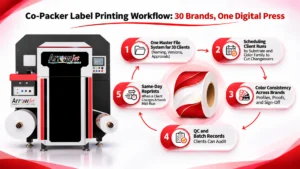
Table of Contents Co-Packer Label Printing Workflow: 30 Brands, One Digital Press A co-packer label printing workflow lets one digital press run labels for dozens
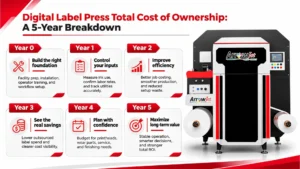
Table of Contents Digital Label Press Total Cost of Ownership: A 5-Year Breakdown Digital label press total cost of ownership is the five-year cost to
Table of Contents Cannabis Label Smudging: Why Pre-Roll and Vape Labels Fail Cannabis label smudging on pre-roll tubes and vape carts has four causes: unprotected
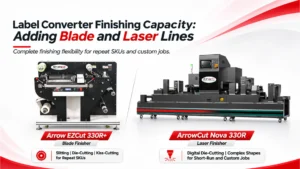
Table of Contents Label Converter Finishing Capacity: Adding Blade and Laser Lines Label converter finishing capacity falls short from volume, job mix, or both. Diagnose
Table of Contents Confectionery Packaging Capacity Planning: Use Q4 Data for ROI Confectionery packaging capacity planning works best on cost data logged during Q4 peak,