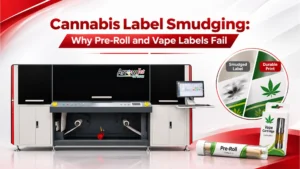
Cannabis Label Smudging: Why Pre-Roll and Vape Labels Fail
Table of Contents Cannabis Label Smudging: Why Pre-Roll and Vape Labels Fail Cannabis label smudging on pre-roll tubes and vape carts has four causes: unprotected

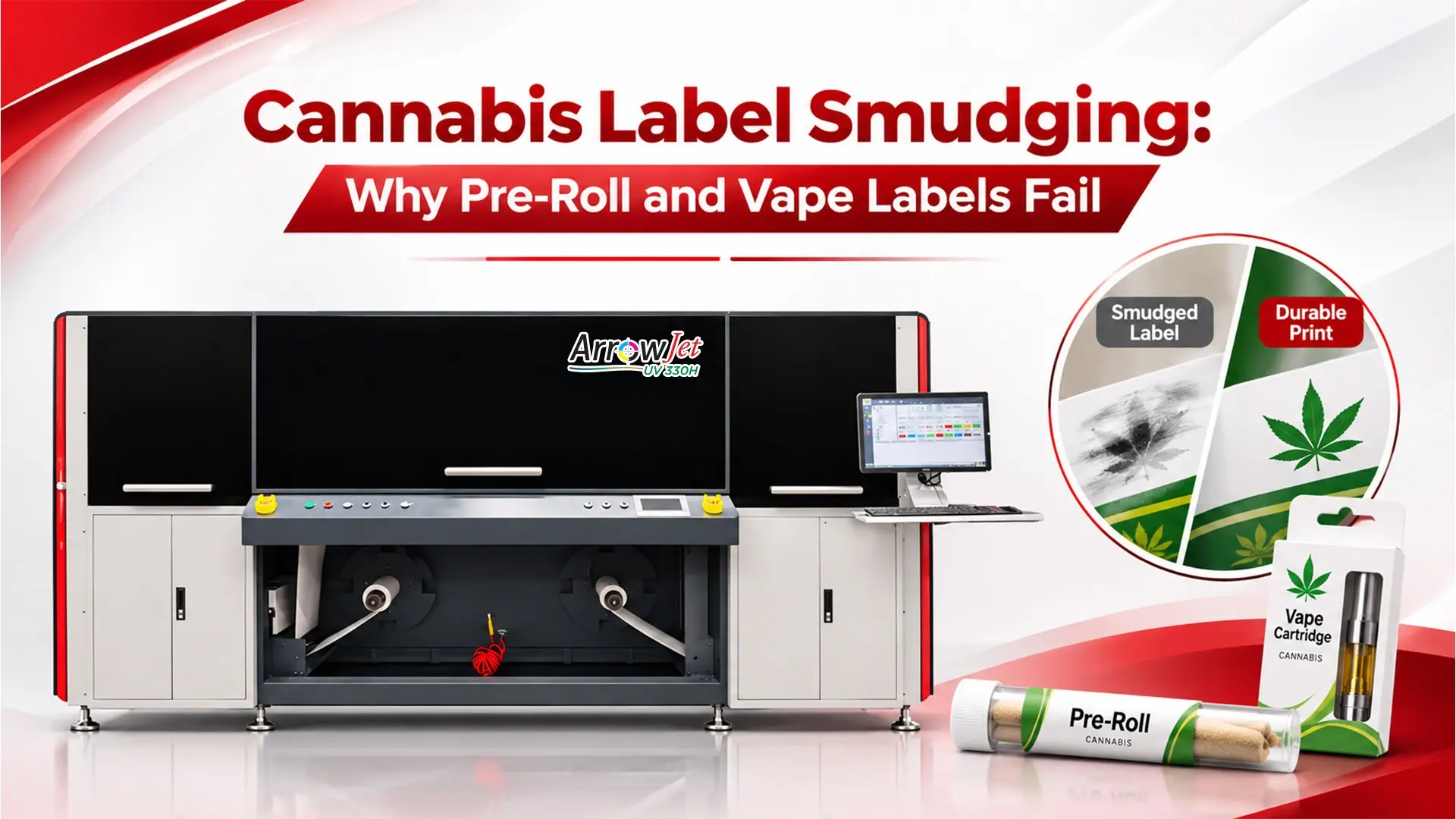
Cannabis label smudging on pre-roll tubes and vape carts has four causes: unprotected ink, micro type, adhesive mismatch, or die-cut damage.
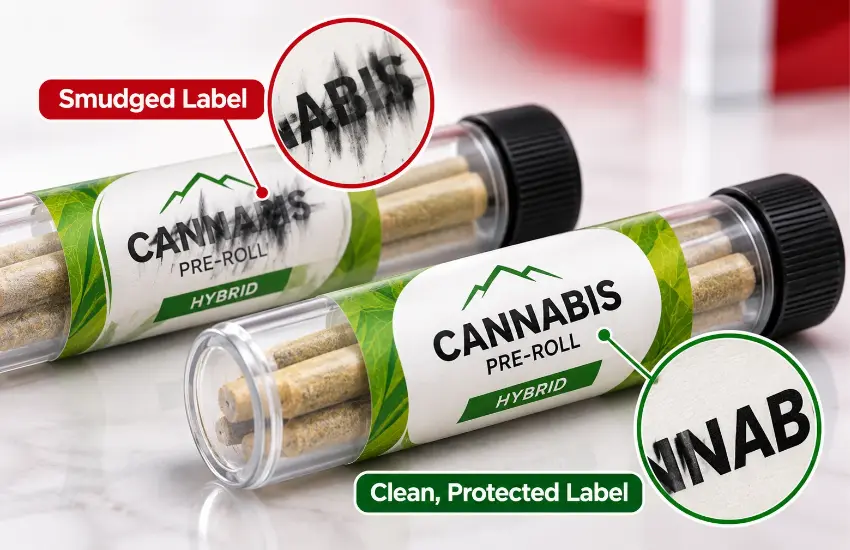
Small cannabis labels fit required text onto thumbnail-sized surfaces, then face hand oils, sanitizer, and friction from counter to pocket.
A label on a pre-roll tube may carry a government warning, potency figures, batch or lot numbers, a universal symbol, and brand art. All of that information sits on a surface not much larger than a thumbnail, so small cannabis label durability depends on every layer holding up: ink, top coat, adhesive, and cut edge.
After printing, the label travels a rough handling path:
Along the way, the label is exposed to hand oils, hand sanitizer, residue from vape hardware, and dispensary or window lighting. Pre-roll tubes are often tight-radius plastic, sometimes with child-resistant pop-tops. Frequent strain and batch changes also mean short runs, which leaves little time for testing. Teams that print these short runs in-house on digital label printers can trial a fix on one SKU family before rolling it out.
Match the symptom you see at retail to its likely cause, the quick check that confirms it, and the production change that fixes it.
Symptom at retail | Likely cause | Quick in-house check | Production fix |
Color smears when touched with damp or sanitized hands; ink wears off at grip points | Unprotected aqueous ink | Damp-fingertip rub and sanitizer wipe compared with an untouched control | Varnish over UV-cured ink, or a cold laminate over aqueous ink |
Labels fade on packs kept near windows or under display lighting | Unprotected ink with no light barrier | Compare displayed packs with stored packs from the same batch | Add a varnish or laminate; confirm lightfastness with your ink and material supplier |
Warning or potency text looks fuzzy or filled in on fresh labels | Sub-resolution micro type | 5–10x loupe check for closed counters and broken thin strokes | Medium or bold weight, high contrast, no small reverse type |
Corners flag, edges lift, or labels wrinkle on tubes and cartridges | Adhesive and facestock mismatch | Apply to real containers, wait, then inspect edges and seams | Conformable facestock, matched adhesive, clean containers, adequate dwell time |
Torn corners, ragged edges, or labels pulled off with the waste matrix | Die-cut finishing defects | Magnified edge inspection; watch the matrix as it strips | Clean cuts from sharp blades or a laser, gentle matrix stripping, rounded corners |
Aqueous ink with no varnish or laminate can smear, rub off, or fade once moisture, sanitizer, friction, and light reach it.
What you see
Color smears when the label is touched with damp or sanitized hands, and ink wears away at grip points. Packs kept near windows or under display lighting may also fade over time, so pre-roll tube label fading in a window display can be an unprotected-ink problem.
Why it happens
Aqueous inks are typically water-sensitive. Without a laminate or protective coating, moisture, sanitizer, and friction can lift or move the ink. Unprotected prints also lack a barrier against light, which can contribute to fading depending on the ink set and exposure.
Why the top layer matters most
Rub resistance on small labels depends heavily on what sits on top of the ink, not only on the ink itself. ASTM D5264, the standard practice for Sutherland rub testing, can be used to compare the relative abrasion resistance of inks, coatings, laminates, and substrates, which makes it a fair way to compare a varnished sample with a laminated one.
Production fix
Add a protective top layer: varnish applied over UV-cured ink at the press, or a cold laminate applied over aqueous ink during finishing.
Fuzzy warning text on a fresh label is a resolution and design problem: the ink has not moved, but the letter edges never formed.
What you see
Small warning or potency text looks fuzzy, filled in, or soft at the edges, even on a fresh label. Staff often describe these labels as “smudged.”
Why it happens
Print resolution has limits at tiny sizes. Dot gain, low resolution, thin font weights, low-contrast color pairs, and reverse type (light text on a dark background) all erode edge definition. Any later abrasion makes already-soft text harder to read.
Production fix
Use a medium or bold weight for required text, avoid reverse type at small sizes, and keep contrast high, ideally dark text on a light field. On clear tube labels, an opaque white underprint creates that light field behind the text.
Several states set minimum text and symbol sizes and require labels to stay legible or permanently affixed, so smudging can be a compliance issue.
Smudged micro type and lifting edges are not only cosmetic. The five states below set specific minimums for required text and the cannabis symbol, and their rules also say how readable or how firmly attached a label must be.
State and rule | Minimum size for required text | Cannabis symbol minimum | Legibility and attachment language |
California (DCC, 4 CCR Division 19) | 6 point | 0.5 inch tall on the primary panel; 0.25 × 0.25 inch on vape cartridges and vaporizers | Display information clearly and legibly; required labeling unobstructed and conspicuous; government warning in capital, bold letters |
Colorado (1 CCR 212-3, Rule 3-1010) | 1/16 inch | 1/2 × 1/2 inch; 1/4 × 1/4 inch on vaporizer delivery devices | Labeling text on the container and marketing layer must be unobstructed and conspicuous |
Washington (WAC 314-55-106) | Not set in the symbol rule | 3/4 × 3/4 inch on the principal display panel | Symbol must be legible and readily visible; symbol stickers must not cover or obscure required labeling |
New Jersey (CRC guide, N.J.A.C. 17:30-16) | Warnings at least 6 point; high-potency, ingestible, and e-device warnings at least 10 point on the front | 0.75 × 0.5 inch on packaging | Legible, permanently affixed label |
Ohio (DCC guidance, OAC 1301:18-4) | Not set in the guidance | 1/4 × 1/4 inch; a vape cartridge is not treated as a container for the symbol | Each retail package permanently affixed with a label in legible English |
Why legibility rules matter for smeared ink and soft micro type
California and Colorado require required labeling to be unobstructed and conspicuous. Warning text that smears under sanitizer, or micro type that prints soft, works against that requirement even when every word is technically on the label.
Why attachment rules matter for edge lift and damaged die-cut edges
New Jersey and Ohio require labels to be permanently affixed. Edge lift on a pre-roll tube, or a nicked die-cut edge that starts peeling, turns an adhesion or finishing defect into an attachment question.
Why vape cartridge labels need extra care
California allows the universal symbol on vape cartridges to be as small as 0.25 × 0.25 inch, and Colorado allows 1/4 inch on vaporizer delivery devices. At that size, soft print or a ragged cut edge affects required content directly.
How to check against an inch-based rule
Colorado states its text minimum in inches, not points, so measure printed text height on the finished label under magnification instead of relying on the font size in the design file.
These rules change, and other states set their own, so confirm current requirements with your state regulator or compliance counsel. For how state rules and variable data fit into in-house printing, see our guide to cannabis label compliance in 2026.
Edge lift on pre-roll tubes is an adhesion failure: the facestock, adhesive, container surface, or dwell time cannot hold the curve.
What you see
Corners flag up, edges lift, wrinkles form across the label, or labels shift and catch on other packs in the exit bag. Edge lift is a frequent complaint on narrow pre-roll tubes.
Production fix
Lifting edges call for a conformable facestock, an adhesive matched to the container plastic, clean containers, and adequate dwell time before handling. Because this is a materials issue, settle the combination with your adhesive or material supplier.
Facestock stiffness vs. container radius
Stiff films try to spring back flat on a tight curve, which pulls the label edges away from narrow pre-roll tubes.
Adhesive selection
Some plastics and textured surfaces need a more aggressive or more conformable adhesive than a general-purpose label adhesive.
Surface energy and cleanliness
Mold release agents, dust, or oils on the container block adhesive wet-out and weaken the bond from the start.
Dwell time
Pressure-sensitive adhesives build strength over time, so labels handled immediately after application are more likely to lift.
Tiny die-cut shapes leave little margin for error, and a nicked or torn edge becomes the starting point for lift and abrasion.
What you see
Torn corners, ragged or fuzzy edges, and labels that lift off the liner during matrix stripping. Vape cartridge label scuffing often starts at a nicked edge.
Why it happens
Small shapes leave little margin for error. Dull or poorly set blades drag instead of cutting cleanly, and aggressive matrix stripping can pull tiny labels away with the waste. Sharp 90-degree corners concentrate stress, both during cutting and later on the container.
Production fix
Keep blades sharp and correctly set, or move small shapes to laser cutting, which uses no blade. Strip the matrix gently and design rounded corner radii into the shapes from the start. Arrow’s label finishing systems include both blade die cutters and laser finishers.
Protect the ink at the press or with a laminate, then cut small shapes cleanly; edge lift from adhesion stays a materials fix.
Once you have isolated the cause, match the production path to your SKUs and containers. Arrow Systems, a manufacturer of label printing and finishing equipment, offers two in-house print paths for this problem, both paired with a laser finisher suited to small shapes.
ArrowJet UV 330H: UV-cured ink with varnish applied in the press
The ArrowJet UV 330H is a hybrid UV label press that prints roll-to-roll and flatbed, with CMYK + Varnish and CMYK + White + Varnish ink configurations. The varnish goes down as part of the print process, which suits high-touch, rub-prone SKUs. Opaque white printed under color on clear film helps required text keep high contrast on clear tube labels. The right cannabis label varnish depends on the finish you want and the handling the pack will see.
ArrowJet Aqua 330R: aqueous pigment ink with a cold laminate
The ArrowJet Aqua 330R is a roll-to-roll label press built on the Memjet DuraFlex printhead, printing water-based pigment inks at up to 1600 × 1600 dpi. That resolution helps small required text hold its edges, though font weight and contrast still decide legibility. A cold laminate applied during finishing places a film barrier over the water-sensitive ink, adding protection against moisture, sanitizer, and abrasion, with laminate options that vary by finish.
ArrowCut Nova 250R: laser finishing for small label shapes
The ArrowCut Nova 250R is a compact laser label finisher with a 125-watt CO2 galvo laser that pairs with either press. It laminates, die-cuts, removes waste, and slits roll labels in one pass, so Aqua 330R labels get their cold laminate and their cut on the same machine, and UV 330H labels get the same clean cut. Because the laser cuts without a blade or physical die, blade drag and blade wear drop out as causes of edge damage. Matrix removal and corner radii still need attention on tiny shapes.
Component | Failure modes addressed | Protection or finishing approach | Confirm before committing |
ArrowJet UV 330H | Smearing, rub-off, and fading; low text contrast on clear film, solved with a white underprint | UV-cured ink + varnish applied at the press | Varnish compatibility with your facestock and the finish you want |
ArrowJet Aqua 330R | Smearing, rub-off, and fading once laminated; soft micro type, with sharp edges at up to 1600 × 1600 dpi | Aqueous pigment ink + cold lamination | Laminate adds a material step; confirm laminate conformability on tight radii |
ArrowCut Nova 250R | Blade drag, ragged edges, and nicked corners on tiny die-cuts; applies the cold laminate for Aqua 330R labels | 125W CO2 laser cutting with lamination, waste removal, and slitting in one pass | Matrix handling and corner radii on tiny shapes |
Edge lift on curved tubes is solved at the material level. Choose the facestock, adhesive, and container preparation with your adhesive or material supplier at the same time as the press and finishing setup. Arrow Systems can provide full resolution, ink, and material details for each machine on request.
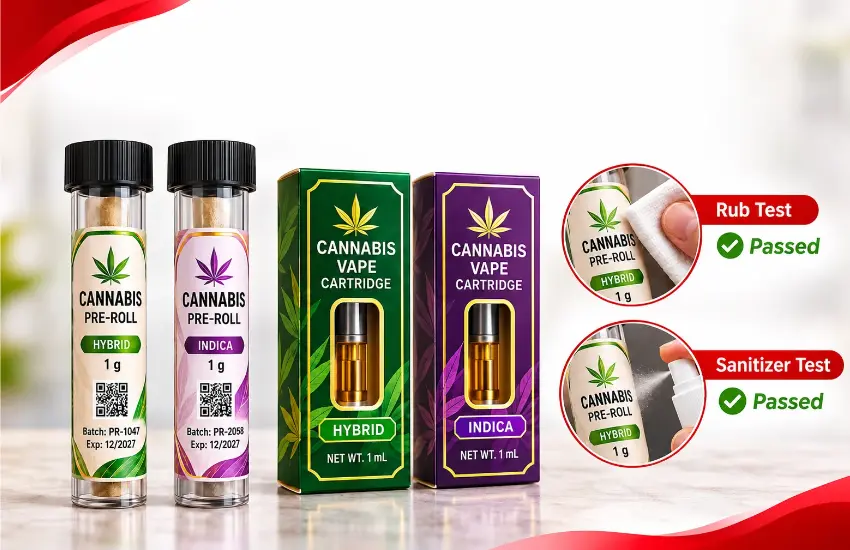
Run five checks on every new SKU family before a full run: rub, tape, sanitizer wipe, wrap-and-wait, and magnified legibility.
Step 1: Rub test
Rub by hand with a damp fingertip, or use a Sutherland rub tester following ASTM D5264, which applies to labels, folding cartons, and other printed packaging. Run varnished, laminated, and unprotected samples in the same session so the comparison is fair.
Step 2: Tape test for ink and coating anchorage
ASTM F2252 describes a tape method for evaluating ink or coating adhesion on flexible packaging materials whose surfaces are not damaged by the tape. The standard does not set pass or fail criteria, so agree acceptance levels with your material supplier before testing.
Step 3: Sanitizer or alcohol wipe
Wipe printed samples with the sanitizer your retail partners actually use, then compare them with an untouched control under good light.
Step 4: Wrap-and-wait test on the actual container
Apply labels to production pre-roll tubes or cart boxes, allow the dwell time your adhesive supplier recommends, then inspect edges, corners, and seams.
Step 5: Magnified legibility check
Inspect the smallest required text at 5–10x for closed counters and broken strokes, then confirm a reader unfamiliar with the label can read it aloud.
Operations automation keeps these fixes consistent from run to run. Lock print profiles, the varnish or laminate choice, and cutter settings for each SKU family, and require a first-article check before every changeover.
Plain definitions for the print, adhesive, and finishing terms used in this guide.
Dot gain
The spread of printed ink dots beyond their intended size, which thickens strokes and can fill in the small counters of micro type.
Reverse type
Light text knocked out of a dark background; at small sizes, reverse type loses edge definition faster than dark text on a light field.
Counters
The enclosed or partly enclosed spaces inside letters such as “e,” “a,” and “o”; closed-in counters are an early sign of sub-resolution text.
Facestock
The printable top layer of a pressure-sensitive label construction; its stiffness decides how well a label holds a tight curve.
Wet-out
The flow of adhesive into full contact with the container surface; oils, dust, and mold release agents block wet-out.
Dwell time
The time after application during which a pressure-sensitive adhesive builds bond strength on the container.
Matrix stripping
Removing the waste material around die-cut labels so only the finished labels stay on the liner; aggressive stripping can pull tiny labels away.
Cold lamination
Applying a clear pressure-sensitive film over a printed label without heat, adding a physical barrier against moisture, sanitizer, and abrasion.
Common questions from cannabis packaging, QA, and operations teams diagnosing label durability on pre-roll tubes and vape carts.
Fresh labels have not been handled yet. Smudging usually appears after hand oils, sanitizer, and friction in display bins or exit bags act on unprotected ink. Some “smudging” is actually low-resolution micro type that was soft from the start. A damp rub test, a sanitizer wipe, and a magnified text check before release will separate the two causes.
Both can work. Varnish over UV-cured ink is applied during printing and suits high-touch SKUs. Cold lamination over aqueous ink adds a physical film barrier and offers more finish options. The better choice depends on your containers, handling exposure, and SKU mix, so test both on your actual cart boxes and confirm material compatibility with your supplier.
It depends on your state’s minimum and on font weight, contrast, print resolution, and the surface. California requires label text of at least 6 point, Colorado requires required labeling text of at least 1/16 of an inch, and New Jersey requires warnings of at least 6 point, with some warnings at 10 point. Bold, dark text on a light background holds up better than thin or reverse type at the same size. Confirm current rules with your state regulator or compliance counsel, then verify legibility on printed samples under magnification.
It can. California and Colorado require required labeling to be unobstructed and conspicuous, and New Jersey and Ohio require labels to be permanently affixed. A label whose warning text smears into illegibility, or that lifts off the container, works against those requirements. Confirm how your state applies them with your regulator or compliance counsel.
Cannabis packaging and labeling rules, including warning text, universal symbols, and minimum type sizes, are set state by state and change often. This guide is general information, not legal advice; confirm requirements with your state regulator or compliance counsel. Arrow Systems sells label printing and finishing hardware and does not provide regulatory or compliance advisory services.
State regulator documents and testing standards used in this guide; check each for updates before relying on it for a label.
Diagnose first, then fix. Matching the fix to the actual failure is faster and cheaper than replacing everything at once.
Send Arrow Systems a few failed labels along with sample pre-roll tubes or cart boxes, and the team can help identify which of the four failure modes is involved. From there, compare whether an ArrowJet UV 330H or ArrowJet Aqua 330R setup, finished on the ArrowCut Nova 250R, fits your SKU mix and operations goals before committing to a production path.
Table of Contents Cannabis Label Smudging: Why Pre-Roll and Vape Labels Fail Cannabis label smudging on pre-roll tubes and vape carts has four causes: unprotected
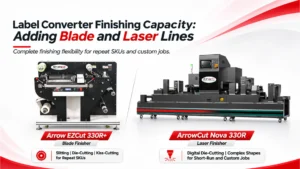
Table of Contents Label Converter Finishing Capacity: Adding Blade and Laser Lines Label converter finishing capacity falls short from volume, job mix, or both. Diagnose
Table of Contents Confectionery Packaging Capacity Planning: Use Q4 Data for ROI Confectionery packaging capacity planning works best on cost data logged during Q4 peak,
Table of Contents Gold Foil Labels Digital Printing: Foil Effects Without Stamping Digital presses create gold foil label effects by printing on pre-metallized PET film
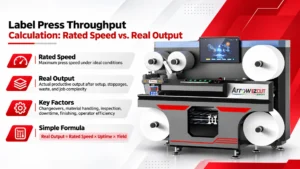
Table of Contents Label Press Throughput Calculation: Rated Speed vs. Real Output A label press throughput calculation turns rated speed into realistic labels per shift,
Table of Contents Seasonal Coffee Label Printing: Holiday Runs on One Press Seasonal coffee label printing works best when every Q4 label runs on one