Table of Contents
Why Print Your Own Product Labels: Speed, Control, and On-Demand Flexibility
In-house digital label printing removes outsourcing delays, eliminates minimum order quantities, and lets businesses update designs on demand — without scrapping pre-printed inventory.
Key Takeaways
- In-house label printing removes outsourced production delays — no file queues, minimum orders, or shipping lead times.
- Digital printing makes it practical to produce multiple label versions, seasonal designs, and promotional variants without ordering large quantities of each.
- Variable data printing allows batch codes, lot numbers, serial identifiers, and region-specific information to change label by label within a single print run.
- Small businesses benefit from printing closer to actual demand, reducing pre-printed inventory that becomes obsolete when designs or products change.
- Outsourcing remains appropriate for very large stable runs, specialty finishes (hot foil, embossing), or substrates outside the capability of a standard roll-fed press.
In-House Label Printing Reduces Turnaround Time
Outsourcing label production adds multiple handoff stages — file submission, proof approval, print production, and shipping — that can take days or weeks per revision cycle.
When labels are sourced externally, every change triggers a timeline: artwork must be prepared, submitted, proofed, produced, and shipped before anything can be applied to a product. For stable, high-volume labels that rarely change, that lead time is manageable. For labels tied to seasonal promotions, regulatory updates, or short-run product launches, it is a recurring bottleneck.
In-house label production with a digital press eliminates the external handoff entirely. Labels can be printed when inventory runs low, when artwork is updated, or when a batch needs to ship the same day. The print file stays under the team’s direct control from approval to output.
Digital Printing Gives You More Design Control
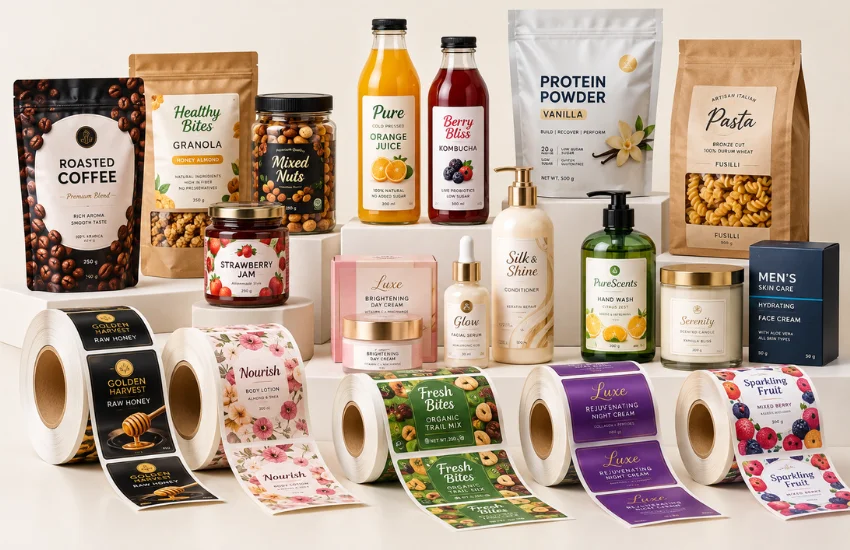
Digital label printing makes it practical to produce multiple design versions, test new artwork, and update labels without committing to large minimum quantities of each variant.
With outsourced label printing — particularly offset or flexographic methods — changing a design means remaking plates and meeting minimum order quantities before the new version goes to press. That creates pressure to lock in artwork early and order large enough quantities to justify the setup cost. Design iterations and small-run variations become expensive.
Digital inkjet printing removes the plate variable entirely. A design change is a file change. Businesses can create seasonal label versions, flavor or scent variants, promotional versions, or private-label designs without ordering excess quantities of each. For brands managing many SKUs, or products that update frequently, this flexibility can make label changes part of routine operations rather than a major production event.
Label Production Method | Design Change Process | Minimum Quantity | Best Suited For |
Outsourced flexographic | Plate remake required; artwork locked before production | Typically thousands of labels per design | Large, stable, single-design runs |
Outsourced digital | File update only; faster than flexo but still requires external submission and lead time | Lower than flexo; varies by supplier | Medium runs with occasional revisions |
In-house digital (own press) | File update only; immediate production from approved artwork | No minimum — print the quantity needed | Short runs, frequent revisions, multiple SKUs, on-demand printing |
Variable Data Printing Supports Traceability and SKU Variety
Variable data printing allows specific label fields — batch codes, lot numbers, serial identifiers, expiry dates, or regional text — to change from label to label within a single run, without stopping the press.
Digital printing drives output directly from a digital file. When variable data fields are configured in the artwork, the press reads updated values for each label without requiring a plate change or job interruption. The operator does not need to stop and restart the run to switch between lot numbers or date codes.
For operations subject to traceability requirements — food production, nutraceuticals, pharmaceuticals, or industrial products — this capability supports better record-keeping and audit readiness. Labels can carry serialized identifiers tied to specific production records without the manual intervention or risk of labeling errors that come from applying batch information by hand after printing.
Variable Data Printing (VDP)
A digital printing method in which specific label elements — such as text strings, barcodes, or numerical sequences — change automatically from one printed unit to the next based on a data source. VDP requires no plate changes and does not interrupt print production between variants.
Batch Code / Lot Number
A numeric or alphanumeric identifier printed on a product label that links the unit to a specific production run. Used in traceability, recall management, and quality control documentation across food, pharmaceutical, chemical, and industrial sectors.
Label Serialization
The assignment of a unique identifier to each individual label in a print run. Serialized labels support unit-level traceability and are used in anti-counterfeiting, pharmaceutical track-and-trace, and supply chain authentication applications.
Small Businesses Can Print Closer to Demand
For small businesses, in-house digital label printing reduces the cash tied up in pre-printed label inventory and eliminates the waste that results when designs change before stock is used.
Small businesses and startups often face a difficult tradeoff when outsourcing labels: order enough to meet a supplier’s minimum quantity requirement, or pay a premium per-unit rate for a smaller run. Either way, the result is label inventory that may exceed near-term production needs. If a formula changes, a product is discontinued, or artwork is updated before that inventory is used, the pre-printed labels become waste.
An in-house label workflow shifts that equation. With a digital press, businesses can print only what they need for an upcoming production run. Labels can also be used across more functions — product identification, storage containers, work-in-progress tags, sample labels, and shipping labels — from the same system. For early-stage operations establishing consistent internal processes, that versatility reduces the number of vendor relationships needed to keep packaging moving.
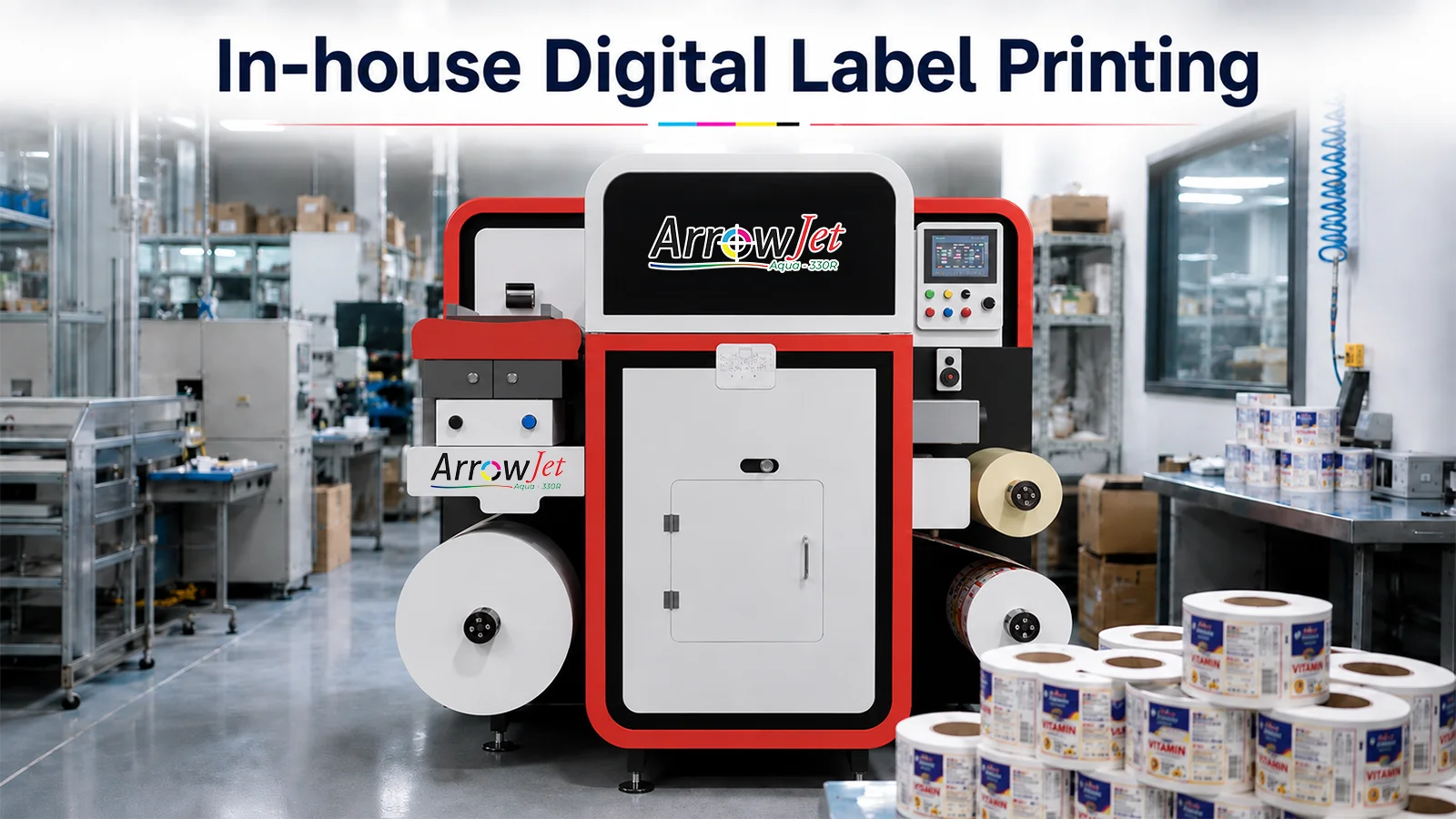
Entry-level industrial digital presses such as the ArrowJet Eco 330R are specifically designed for this transition: compact footprint, single-phase power, no air compressor required, and no minimum order constraint. Businesses can begin producing labels in-house at a production quality that keeps pace with growth, without the infrastructure requirements of a full commercial press.
Choosing the Right In-House Digital Label Press
The right digital label press depends on production volume, label format range, substrate requirements, and how frequently designs change.
Not every in-house label press fits every operation. A business producing a few hundred labels a week for internal use has different requirements from a converter or brand owner running thousands of labels across multiple SKUs per shift. Key variables to evaluate include print speed, maximum print width, compatible substrates, and the level of infrastructure — power supply, compressed air, floor space — the press requires.
Arrow Systems offers a range of digital label printers matched to different production scales:
A high-speed single-pass digital inkjet label press powered by the Memjet DuraFlex® print engine. Designed for converters and in-house label operations with consistent production volume across multiple SKUs. Prints CMYK aqueous pigment ink at 1600 × 1600 dpi on roll-fed pressure-sensitive label stock.
ArrowJet Eco 330R
The entry-level model in the ArrowJet label press range. Runs on single-phase power, requires no air compressor, and installs with a compact footprint — making it practical for businesses moving from desktop label production to industrial digital printing for the first time. Prints up to 20 m/min at 1600 × 1600 dpi with up to 324 mm print width.
Selecting between models requires assessing current label volume, anticipated growth, substrate mix, and whether the operation runs long stable jobs or frequent short-run variety work. Arrow’s team can help evaluate which configuration fits a specific workflow before purchase.
When Outsourcing Still Makes Sense
In-house label printing is not the lower-cost option in every situation — outsourcing remains appropriate for specific volume levels, finishing requirements, and substrate types.
In-house digital printing performs best at short to medium run lengths, with frequent design changes, and across operations managing many label variants simultaneously. At very high volumes — tens of thousands of identical labels with no near-term design changes — outsourced flexographic printing can reduce the per-unit cost meaningfully, particularly when the capital and operating cost of a press are included in the comparison.
Outsourcing also remains the practical choice when labels require specialty finishing processes — hot foil stamping, embossing, or specialty laminations — that are not available on a standard digital press. Similarly, unusual substrates or package formats that fall outside the media handling range of an in-house press may need to be sent to a converter with the appropriate equipment.
The decision ultimately depends on total cost — equipment, consumables, labor, obsolescence waste — balanced against the operational value of faster turnaround and tighter design control. Both approaches can coexist: many businesses maintain an in-house press for short runs and design iteration while outsourcing large stable volumes to reduce per-unit cost.
Frequently Asked Questions
Common questions about in-house digital label printing — when it makes sense, how variable data works, and how to choose between press options.
Printing labels in-house removes the delays associated with outsourced production — no file submission queues, no minimum order quantities, and no waiting on shipping. Businesses gain the ability to update artwork immediately, print exactly the quantity needed, and respond to product or regulatory changes without scrapping pre-printed inventory. For operations managing multiple SKUs or frequent design revisions, in-house digital printing typically lowers total label cost once inventory waste and ordering lead time are factored in.
Yes. Digital inkjet label presses support variable data printing, which means specific fields — such as batch codes, lot numbers, serial identifiers, expiry dates, or region-specific language — can change from label to label within a single print run. The digital file drives the output, so no tooling or plate changes are required between variants. This is useful for operations that need traceability data on labels or run multiple regional versions of the same product.
Not always. In-house printing is most cost-effective for short to medium runs, frequent design changes, and operations with many SKUs. For very large, stable runs — tens of thousands of identical labels — outsourced flexographic printing can be less expensive per label. The full comparison should include equipment cost, consumables, labor, waste from obsolete pre-printed stock, and the cost of production delays caused by external lead times.
Both are single-pass digital inkjet label presses from Arrow Systems. The ArrowJet Aqua 330R is a high-speed production press suited for converters and in-house operations with significant label volume. The ArrowJet Eco 330R is the entry-level model — compact, single-phase power, no air compressor required — designed for businesses stepping up from desktop printers to industrial label production for the first time. The right choice depends on production volume, label format range, and available infrastructure.
Outsourcing remains practical for very large, stable print runs where flexographic unit costs are lower; for specialty finishes such as hot foil stamping or embossing that require dedicated converting equipment; for unusual substrates or package formats outside the capability of an in-house press; and for businesses where label volume is too low to justify the capital investment in a press. The decision depends on total cost, required quality level, substrate range, and how frequently designs change.
Ready to evaluate in-house label printing for your operation?
Arrow Systems manufactures digital label presses for converters and in-house brand teams across food & beverage, nutraceuticals, cosmetics, industrial, and more. Talk to the team about your label volume, format requirements, and substrates — and find out which press configuration fits your workflow.
Cannabis Label Versioning Workflow for Multi-State Brands
Table of Contents Cannabis Label Versioning Workflow for Multi-State Brands A cannabis label versioning workflow produces state-specific labels from one master template by moving state-variable
Water-Based vs UV-Cured Label Adhesive: Food & Pharma Guide
Table of Contents Water-Based vs UV-Cured Label Adhesive: Food & Pharma Guide Water-based adhesives suit dry, ambient containers; UV-cured hot melts suit cold, wet, curved
Is Your Confectionery Brand Ready to Bring Flexible Packaging In-House?
Table of Contents Is Your Confectionery Brand Ready to Bring Flexible Packaging In-House? In-house flexible packaging pays off for confectionery brands with many SKUs, short
Label Slitting and Matrix Removal: Where Converters Lose Finishing Time
Table of Contents Label Slitting and Matrix Removal: Where Converters Lose Finishing Time Label slitting and matrix removal, plus rewinding, cost converters more finishing time
Limited Edition Spirits Label Printing: 4 Holiday Delay Fixes
Table of Contents Limited Edition Spirits Label Printing: 4 Holiday Delay Fixes Limited edition spirits label printing runs late because of the calendar, not the
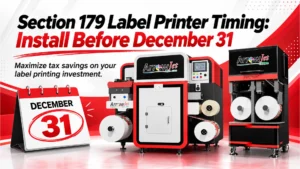
Section 179 Label Printer Timing: Install Before December 31
Table of Contents Section 179 Label Printer Timing: Install Before December 31 A section 179 label printer purchase counts for 2026 only if the press