Table of Contents
GHS Label Compliance: A Practical Guide for Chemical Label Printing
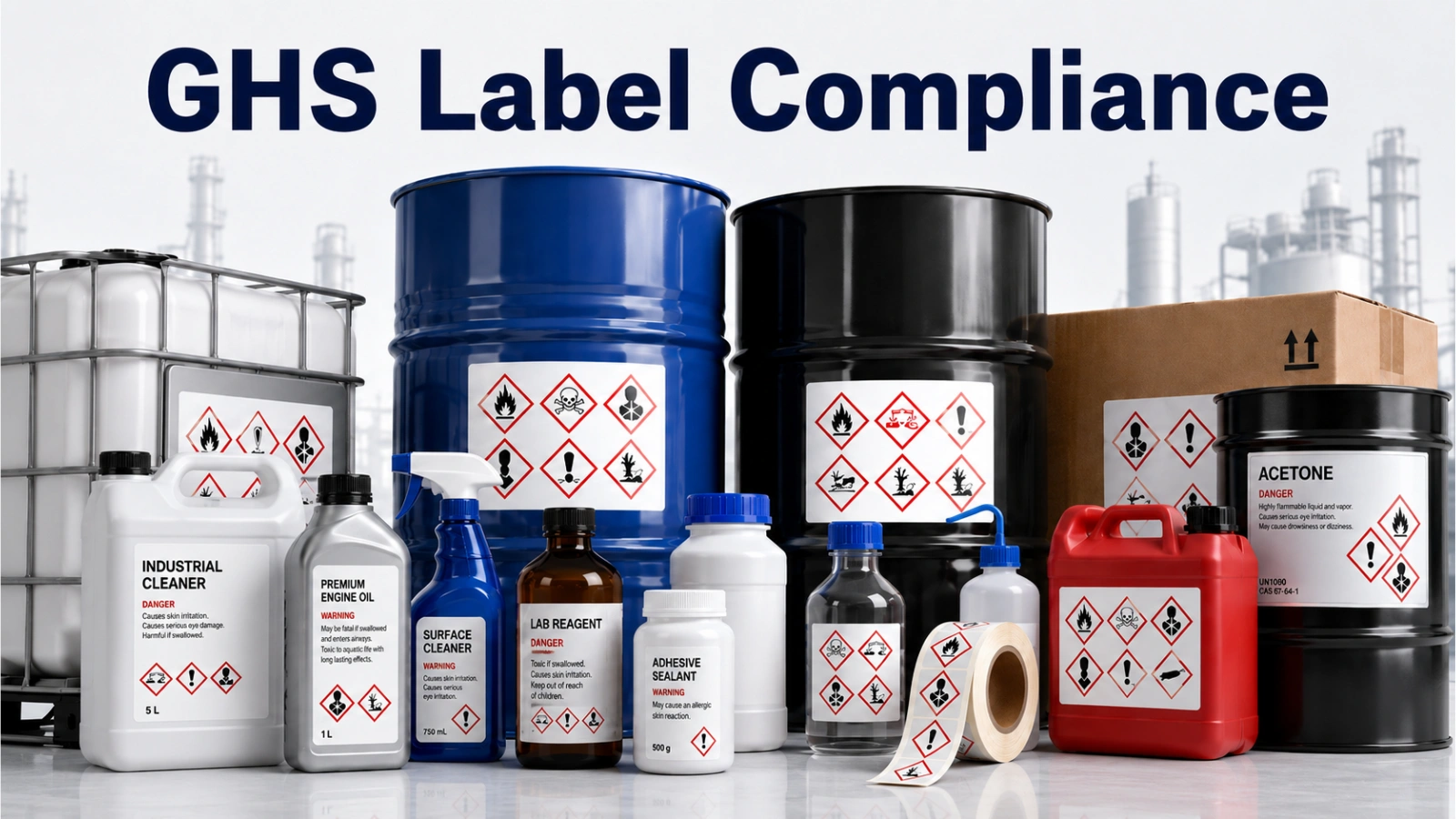
GHS label compliance is a safety-critical requirement for any business that manufactures, distributes, stores, ships, or handles hazardous chemicals — and maintaining accurate labels as regulations and formulations change is an ongoing operational challenge.
This article is a practical overview, not legal advice. Always confirm requirements against the current Safety Data Sheet, OSHA Hazard Communication Standard, applicable international rules, and qualified regulatory guidance.
Key Takeaways
- GHS requires six elements on every hazardous chemical label: product identifier, signal word, hazard statements, precautionary statements, pictograms, and supplier identification.
- In the United States, GHS requirements are enforced through OSHA’s Hazard Communication Standard; other jurisdictions — Canada (WHMIS), the EU (CLP) — adopt GHS with variations.
- Chemical labels must be updated when formulations, hazard classifications, regulatory references, or market requirements change, making on-demand print capability a practical advantage.
- BS 5609 is a marine label durability standard — separate from GHS — that governs how well a label physically survives sea transport, not what content it carries.
- In-house digital label printing supports GHS compliance through on-demand production, variable data printing, rapid revision, and elimination of obsolete preprinted stock.
- The ArrowJet Nova 250R combines a Memjet inkjet engine with an inline 125W CO₂ laser to print and cut GHS-compliant labels in a single automated pass, with no physical dies required.
What Is GHS Labeling?
GHS is an international chemical hazard communication system that standardizes label elements and Safety Data Sheets so workers can identify hazards consistently across workplaces and markets.
The Globally Harmonized System of Classification and Labelling of Chemicals was developed by the United Nations to replace a fragmented patchwork of national and regional hazard communication standards. By aligning how chemical hazards are classified and communicated, GHS allows workers, emergency responders, and supply chain partners to read and interpret labels with a consistent framework — regardless of where the chemical originates.
In the United States, GHS-aligned requirements are implemented through OSHA’s Hazard Communication Standard (HCS). Companies that produce, import, or handle hazardous chemicals must ensure their labels and Safety Data Sheets reflect the correct hazard classification of each product. Other jurisdictions — including Canada (WHMIS), the European Union (CLP), and many others — have adopted GHS with varying modifications, which means businesses distributing chemicals internationally may need to manage multiple label versions for the same product.
Why GHS Compliance Matters for Chemical Businesses
Non-compliant GHS labels create safety risks, regulatory exposure, and supply chain delays — and the consequences extend well beyond the workplace floor.
GHS labels are designed for fast recognition. In a warehouse, production environment, laboratory, or emergency response situation, a correctly formatted label helps workers understand the hazard category and take appropriate precautions — even without access to the full Safety Data Sheet.
The business consequences of incomplete or inaccurate labeling are significant. Missing or incorrect label elements can contribute to:
- Workplace incidents and injuries from misidentified or unrecognized hazards
- Shipment holds, customs delays, or rejected loads at border inspection
- OSHA citations, regulatory action, and financial penalties
- Product recalls and legal liability exposure
- Damage to customer and distributor relationships
For chemical businesses managing frequently changing formulations, multilingual markets, or multiple product lines, maintaining accurate, current labels on every container is a continuous operational task — not a one-time compliance exercise.
Six Required Elements of a GHS Label
Every GHS-compliant label must include six core elements. Missing any one of them creates both safety and regulatory risk. See Arrow’s GHS industrial label printing solutions for hardware built to produce compliant labels in-house.
- Product Identifier
The chemical or product name as it appears on the Safety Data Sheet. The product identifier must match the SDS exactly so workers and emergency responders can cross-reference hazard information accurately. This may be a chemical name, trade name, or mixture name depending on the product.
- Signal Word
“Danger” indicates more severe hazards; “Warning” indicates less severe hazards. Only one signal word appears on a label — if a product has multiple hazard categories that would trigger both words, “Danger” takes precedence. Signal words are GHS-assigned and must not be altered.
- Hazard Statements
Standardized phrases that describe the nature and degree of the chemical hazard — for example, flammable, corrosive, or toxic to aquatic organisms. Each statement corresponds to a specific hazard category and carries an H-code (for example, H225 for highly flammable liquid). Statements use GHS-assigned language and are not paraphrased.
- Precautionary Statements
Instructions that reduce exposure and injury risk, organized across four areas: prevention (how to avoid the hazard), response (what to do if exposed), storage (how to store the chemical safely), and disposal (how to dispose of it and its container). These carry P-codes and use standardized GHS language.
- Pictograms
GHS pictograms are standardized diamond-shaped symbols with a red border that communicate hazard type visually. There are nine GHS pictograms covering flammable, oxidizing, corrosive, acute toxicity, health hazard, environmental hazard, and other categories. Pictograms must be printed at sufficient size and contrast to be immediately recognizable on the container.
- Supplier Identification
The name, address, and contact information of the manufacturer or distributor responsible for the product. This allows recipients, emergency responders, and regulators to obtain additional hazard information and reach the responsible party when needed.
Which Chemicals Require GHS Labels?
GHS labeling requirements apply based on hazard classification — not container size, shape, or product format. See manufacturing and industrial label printing for equipment used across chemical and industrial label operations.
Hazardous chemicals in any container format — bottles, drums, pails, intermediate bulk containers, or other vessels — generally require complete, legible GHS labels when supplied in a workplace or commercial setting. The key factor is hazard classification: if a chemical meets the criteria for any GHS hazard category, it requires a label with all six required elements.
Articles — items that do not release hazardous chemicals under normal conditions of use — may be treated differently depending on the applicable regulations and the nature of the article. Businesses should confirm with qualified regulatory counsel which products in their catalog require GHS labeling and under which standard.
It is also important to note that a single chemical may require different label versions for different markets. Hazard statements, pictograms, and classification thresholds can differ between the US, Canada, the EU, and other GHS-adopting regions. Chemical companies distributing internationally often maintain multiple label versions and must apply the correct version for each destination — a workflow that in-house digital printing is particularly well-suited to support.
Label Durability and BS 5609 for Marine-Shipped Chemicals
BS 5609 is a marine label durability standard — separate from GHS — that specifies labels on chemicals shipped by sea must physically withstand saltwater, abrasion, and extended handling.
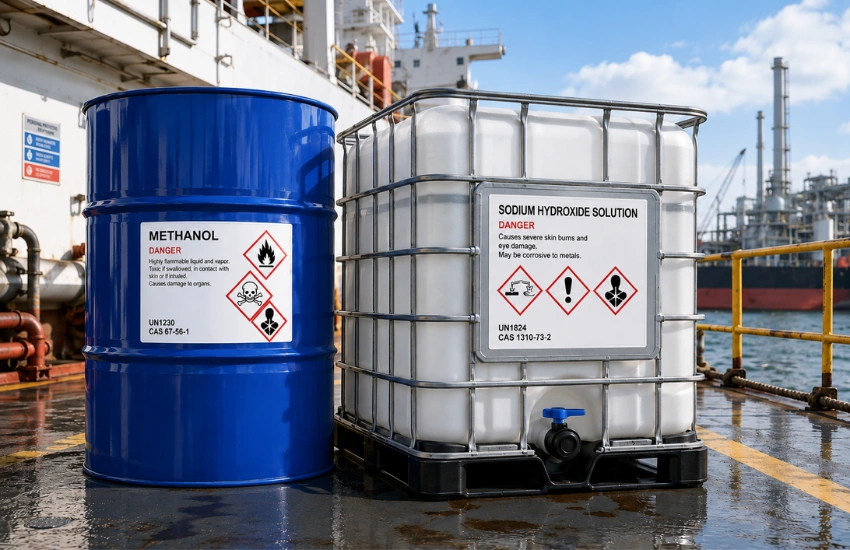
When hazardous chemicals are shipped by sea, the International Maritime Dangerous Goods (IMDG) Code and some national regulations require that labels remain legible throughout the voyage. BS 5609 specifies test procedures for marine label durability, including immersion in artificial seawater, abrasion resistance, and adhesion performance across extended exposure periods.
Standard | What It Governs | Who It Applies To | US Equivalent |
GHS / OSHA HCS | Content and format of hazard communication labels — what appears on the label | Chemical manufacturers, importers, distributors, and employers handling hazardous chemicals | OSHA Hazard Communication Standard (HCS 2012, GHS-aligned) |
BS 5609 | Physical durability of labels shipped by sea — how well the label survives transport | Chemicals transported by marine vessel under IMDG or equivalent codes | No direct US equivalent; referenced in international shipping regulations |
Achieving BS 5609 compliance is a function of the complete label system — substrate, adhesive, ink, and any overlaminate — not any single component in isolation. Substrates commonly associated with marine-grade label performance include PET and BOPP films with compatible pressure-sensitive adhesives. The complete label system must be tested and qualified for the specific environment and duration of exposure it will face in transit.
Why Chemical Operations Print GHS Labels In-House
In-house digital label printing gives chemical businesses direct control over GHS label accuracy, update speed, and short-run production — capabilities that outsourced label supply cannot easily match.
GHS labels change. Formulations are revised. Hazard classifications are updated. Regulatory references evolve. Customer requirements specify different languages, market variants, or lot-specific variable data. When any of these factors change, the label must change with them — and businesses that manage label updates internally respond faster and at lower cost than those dependent on external suppliers. Explore chemical label printing solutions or browse Arrow’s full range of digital label printers for the complete product lineup.
On-demand production
Print the quantity needed when it is needed. Chemical operations with fluctuating batch sizes, seasonal SKUs, or regulatory-driven updates avoid the cost of overprinting and the risk of applying outdated labels from pre-built inventory.
Variable data printing
Incorporate lot numbers, batch codes, production dates, barcodes, and QR codes directly into each print run without separate labeling steps. Variable data is particularly important for traceability in regulated chemical environments.
Rapid label revision
When a Safety Data Sheet is updated or a hazard classification changes, the label file is updated in software and new labels are produced immediately — no plate changes, no minimum print runs, no lead time from an external supplier.
Multilingual capability
Produce the correct label version for different markets from a single digital press, managing language variants as separate files in the same workflow. Especially valuable for chemical distributors serving both US and international customers from the same facility.
Reduced waste and obsolescence
Preprinted label inventory becomes obsolete whenever formulations, regulations, or customer requirements change. In-house printing eliminates the cost of writing off large quantities of non-conforming preprinted stock.
The ArrowJet Nova 250R for GHS Label Production
The ArrowJet Nova 250R combines a Memjet inkjet print engine with an inline 125W CO₂ laser to print and cut GHS-compliant labels in a single automated pass — with no physical dies required.
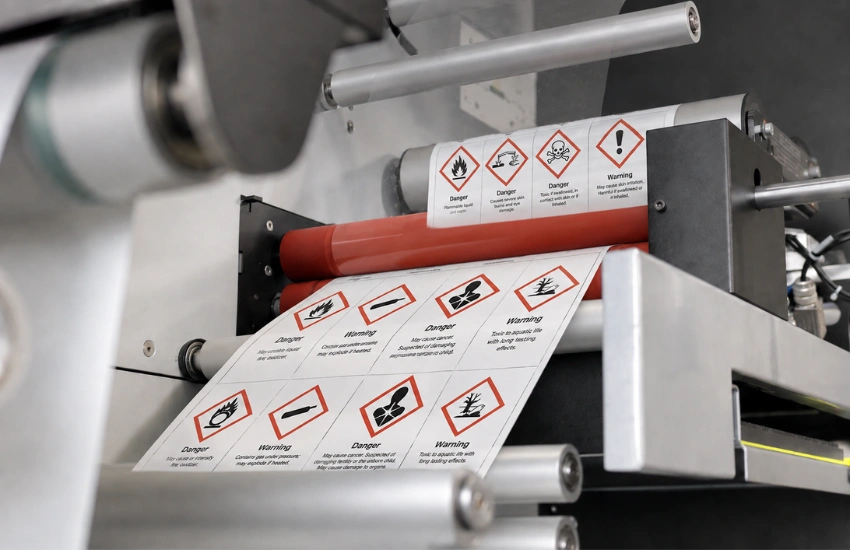
For chemical label operations that need to produce accurate, on-demand GHS labels with variable data and precise cut registration, the ArrowJet Nova 250R delivers an integrated print-and-cut workflow without a separate finishing step. Labels exit the machine finished — printed, cut to shape, and wound — ready to apply.
The Nova 250R prints at 1600 × 1600 dpi, sufficient resolution to reproduce GHS pictograms, signal words, and small-point regulatory text with the clarity required for hazard communication. Inline laser cutting eliminates physical dies and allows fast job changeover between label shapes and sizes — which suits chemical operations managing multiple SKUs or frequently updated label versions across product lines.
ArrowJet Nova 250R — Key Specifications for GHS Label Workflows
Specification | Value |
Print engine | Single-pass Memjet inkjet |
Print resolution | 1600 × 1600 dpi |
Print speed | 10–60 ft/min (3–18 m/min) |
Max media width | 9.84″ (250 mm) |
Laser power | 125W CO₂ inline laser |
Max web speed (laser) | 82 ft/min (25 m/min) |
Cutting modes | Full cut, half cut, perforation, marking, scribing — in one pass |
Ink colors | CMYK (2L per color) |
Finishing | Inline slitting, dual rewinders |
Job changeover | Auto job changeover (barcode reader option) |
Power | 100–220V |
Workflow advantages for GHS label production
Print and cut in one pass
Labels exit the machine finished — no transfer to a separate finisher, no alignment step, no secondary process. The inline workflow reduces handling and keeps production moving.
No physical dies required
Cutting shapes are defined in software. Job changes between label formats are executed without swapping tooling — which reduces downtime when managing multiple label SKUs or shape variants across a product line.
Variable data ready
Lot numbers, batch codes, barcodes, and QR codes are applied inline with the print run. This supports chemical traceability requirements without a separate labeling step or risk of manual application errors.
Short-run capable
Economical for runs from a single label to thousands, making it practical to print exactly the quantity needed per batch — reducing the risk of applying outdated labels remaining from a previous larger run.
Auto job changeover
An optional barcode reader allows the system to detect QR codes on the media and switch cutting jobs automatically, reducing operator intervention in multi-SKU chemical label runs.
For chemical operations with an existing finishing line that need a dedicated label printer rather than an all-in-one system, the ArrowJet Aqua 330R is a high-speed single-pass aqueous pigment label press printing at 1600 × 1600 dpi with a 12.75″ maximum print width, compatible with downstream die-cutting and lamination equipment.
Frequently Asked Questions
Common questions about GHS label requirements, BS 5609 durability standards, and how digital label printing supports chemical label compliance workflows.
A complete GHS label must include: (1) product identifier matching the Safety Data Sheet, (2) signal word — “Danger” or “Warning” depending on hazard severity, (3) hazard statements describing the nature of the chemical hazard, (4) precautionary statements covering prevention, response, storage, and disposal, (5) GHS pictograms indicating the hazard type, and (6) supplier identification with the responsible party’s name, address, and contact information. Missing any of these elements creates both safety and regulatory risk.
Yes. In the United States, GHS-aligned requirements are implemented through OSHA’s Hazard Communication Standard (HCS). Chemical manufacturers, importers, distributors, and employers who handle hazardous chemicals must ensure labels and Safety Data Sheets comply with HCS requirements. OSHA has authority to cite and penalize non-compliant workplaces.
No. GHS is a hazard communication system governing label content and format. BS 5609 is a British Standard for marine label durability, specifying that labels on chemicals shipped by sea must withstand saltwater exposure, abrasion, and extended handling. The two standards address different requirements — GHS governs what information appears on a label; BS 5609 governs how well the label physically holds up in marine transport conditions. A label can meet GHS content requirements without meeting BS 5609 durability standards, and vice versa.
Yes. Many chemical manufacturers and distributors use in-house digital label printers to produce GHS-compliant labels on demand. In-house printing allows businesses to update labels quickly when formulations, hazard classifications, or regulatory references change — without maintaining large inventories of preprinted labels that may become non-conforming after a regulatory revision.
GHS labels must be updated whenever the Safety Data Sheet is revised, the hazard classification changes, regulatory references are updated, or new market or customer requirements apply — including multilingual requirements for international distribution. The frequency varies by product type and regulatory environment. Because update triggers are unpredictable, in-house print capability is a meaningful operational advantage for chemical businesses managing multiple SKUs.
Ready to take control of your chemical label production?
Arrow Systems manufactures digital label presses and inline print-and-cut systems for chemical manufacturers, distributors, and industrial label operations across the US. Talk to the team about your label volume, format requirements, and compliance workflows — and find out which press configuration fits your operation.
Blade vs. Laser Label Die Cutting: Accuracy, Speed, and Cost per Label
Table of Contents Blade vs. Laser Label Die Cutting: Accuracy, Speed, and Cost per Label Blade die-cutting suits simple shapes and long runs; CO2 laser
Custom Food Packaging: Key Questions Answered for Food Brands
Table of Contents Custom Food Packaging: Key Questions Answered for Food Brands Custom food packaging shapes how shoppers recognize, evaluate, and choose a product —
GHS Label Durability Failure: 4 Causes and Practical Fixes
Table of Contents GHS Label Durability Failure: 4 Causes and Practical Fixes GHS label durability failures trace to four causes: aqueous ink chemistry, paper face

White Ink Clear Label Printing: When You Need It and Why
Table of Contents White Ink Clear Label Printing: When You Need It and Why White ink under clear film keeps brand color, mandatory copy, and
GHS Label Compliance: A Practical Guide for Chemical Label Printing
Table of Contents GHS Label Compliance: A Practical Guide for Chemical Label Printing GHS label compliance is a safety-critical requirement for any business that manufactures,
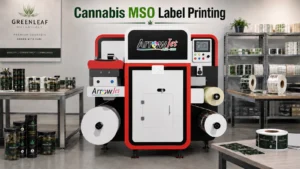
Cannabis MSO Label Printing: In-House or Outsource?
Table of Contents Cannabis MSO Label Printing: In-House or Outsource? Cannabis MSO label printing moves in-house when label versions outgrow converter minimums or batch data