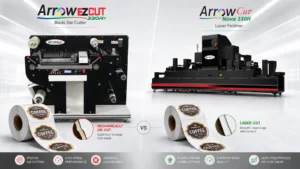
Blade vs. Laser Label Die Cutting: Accuracy, Speed, and Cost per Label
Table of Contents Blade vs. Laser Label Die Cutting: Accuracy, Speed, and Cost per Label Blade die-cutting suits simple shapes and long runs; CO2 laser
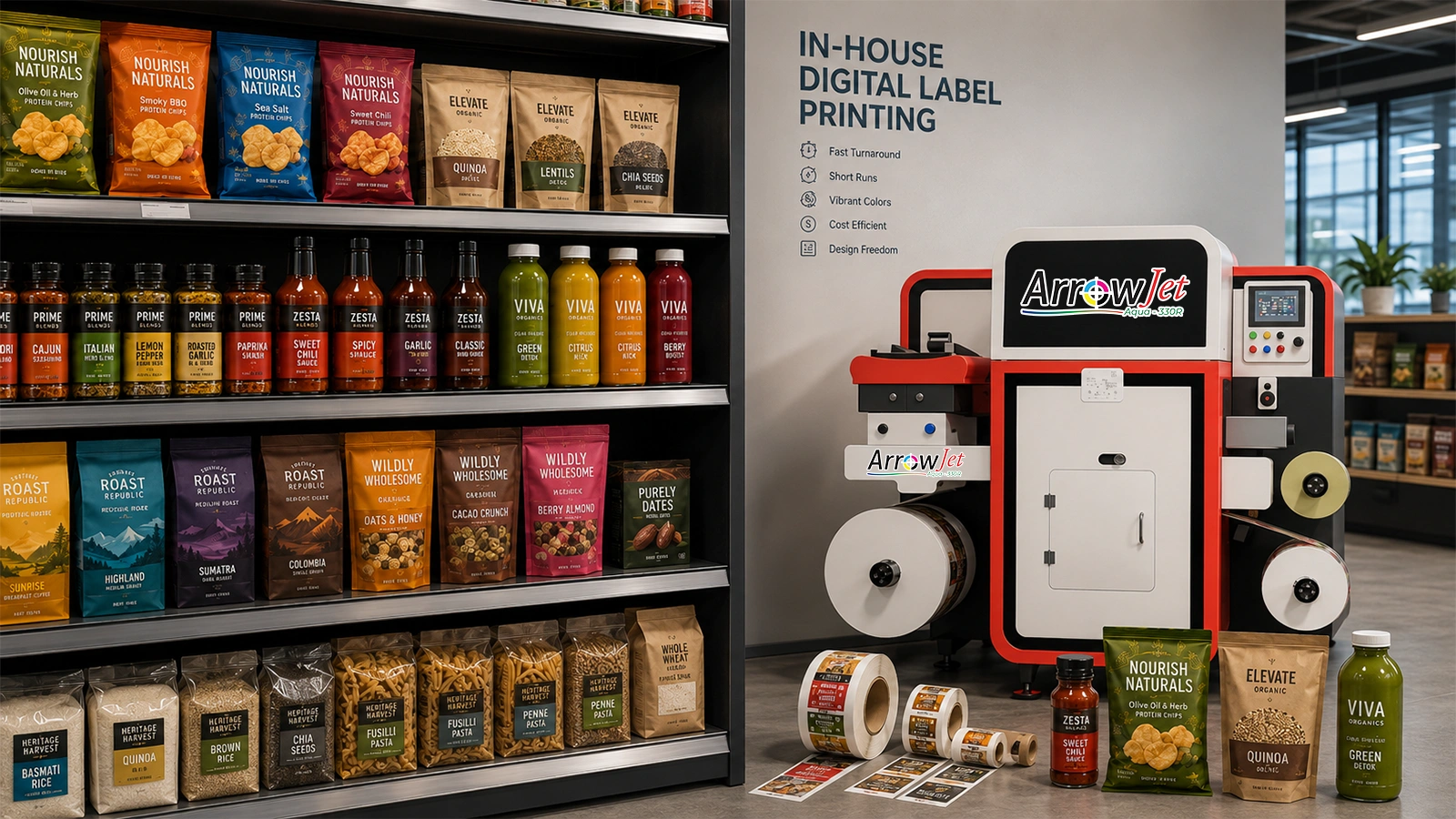
Custom food packaging shapes how shoppers recognize, evaluate, and choose a product — and the printing system behind it determines how fast a brand can update, scale, or test new designs.
Custom food packaging gives brands direct control over how a product is presented, understood, and chosen at the shelf — without relying on generic or third-party packaging formats.
In a retail environment where multiple competing products share similar price points or ingredient lists, packaging is often the first — and sometimes only — signal a shopper receives before making a purchase decision. A well-designed package communicates what the product is, who it is for, and why it deserves attention, all within a few seconds of shelf time.
Custom packaging allows food brands to highlight the specific elements that differentiate their product: ingredient quality, certifications, nutritional content, flavor variety, usage occasions, or brand story. These signals are harder to convey on generic or co-manufactured packaging, where format constraints limit what can be communicated and how.
Custom packaging also supports product line management. When a brand launches new SKUs, seasonal variants, or limited-edition runs, a controlled packaging system makes those changes faster and more consistent — without waiting on a converter’s production queue or hitting large minimum order requirements.
Shelf communication
Custom packaging allows a brand to place the most relevant signals — flavor, nutrition facts, certifications, allergen information — where shoppers are most likely to scan them. This is especially important in categories where shoppers make fast decisions with limited product knowledge.
Brand differentiation
When product ingredients or price points are similar across competitors, packaging design becomes a primary purchase driver. Custom formats, finishes, and layouts help a product communicate a distinct identity rather than blending into the category.
SKU and variant flexibility
Custom packaging enables brands to support multiple SKUs — different sizes, flavors, formats, or markets — with consistent brand presentation. Each variant can carry product-specific information without requiring a full packaging redesign from scratch.
Compliance visibility
Food brands are required to display specific regulatory information — nutrition facts, allergen declarations, net weight, country of origin — in defined formats and placement positions. Custom packaging makes it easier to design these elements in accurately from the start, rather than retrofitting them onto an existing format.
Food packaging materials span paper, film, foil, flexible pouches, cartons, and laminated structures — and the right choice depends on product type, shelf life requirements, and direct food-contact status.
There is no single best material for food packaging. The appropriate choice depends on what the product is, how it will be stored and distributed, what shelf life it needs to achieve, and whether the packaging surface comes into direct contact with the food itself.
Material Type | Common Food Applications | Key Considerations |
Coated paper | Dry goods, shelf-stable products, snack bags | Cost-effective; not suitable for moisture-exposed surfaces without barrier coating |
BOPP (biaxially oriented polypropylene) | Pressure-sensitive food labels, snack packaging | Moisture and oil resistant; common for food label face stocks |
PET (polyester film) | Labels for refrigerated and frozen products, pouches | Good temperature and chemical resistance; suitable for cold-chain applications |
Foil and metalized film | Barrier packaging, premium labels, snack wrappers | Excellent moisture and oxygen barrier; adds shelf differentiation |
Flexible pouches (laminated film) | Snacks, pet food, coffee, meal kits, frozen goods | Multi-layer construction; barrier and seal properties vary by laminate structure |
Cartons and paperboard | Cereals, frozen meals, dairy, beverage multipacks | Printable surface area; requires barrier coating for direct food contact |
If packaging or labels come into direct contact with food, the material, adhesive, coating, and ink system must each be evaluated for that specific use. Food-safe packaging decisions should be made in coordination with qualified substrate and ink suppliers, and regulatory guidance should be applied to your specific product category and market.
Brands working with flexible pouches, sachets, or Mylar-style bag formats should also evaluate printing systems designed specifically for film substrates. The ArrowJet Aqua 800M is a wide-web digital press built for flexible food packaging production — handling film-based pouches and packaging formats that rigid label presses are not configured to run. Arrow’s full digital flexible packaging printer range addresses the tension control, substrate compatibility, and ink adhesion requirements specific to film-based food packaging workflows.
Effective food packaging communicates quickly and clearly — not just attractively — by using design, material, and finish choices that match the product’s positioning and retail context.
Shelf appeal is often misread as brightness. In practice, packaging that performs well on shelf tends to be packaging that is easy to decode quickly — where the product, brand, and key differentiator are immediately clear without effort from the shopper.
Color and contrast remain important tools, but they work best when they serve communication rather than competing with it. A package that is visually busy may attract initial attention but fail to convert if the key product information is hard to find or read.
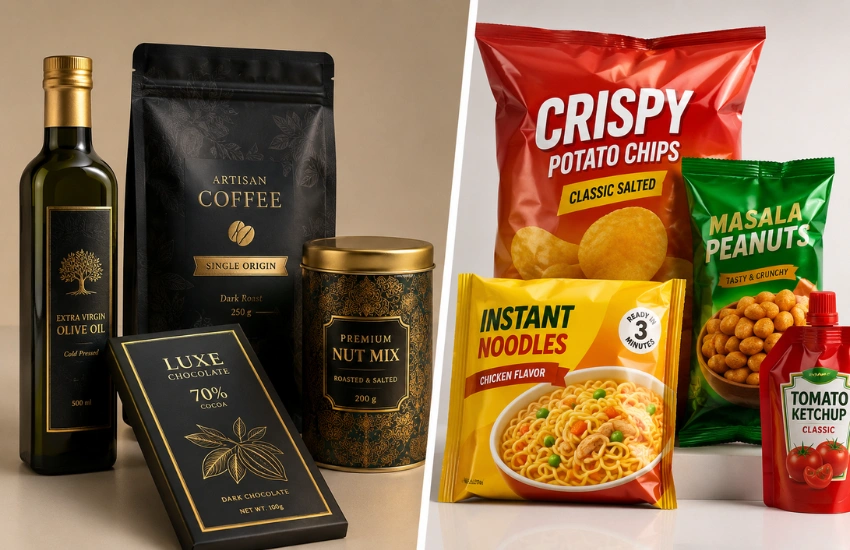
Foil-effect and metallic finishes
Foil-like or holographic finishes draw the eye on a crowded shelf and signal premium positioning. These effects can be applied selectively — to product names, seals, or logo marks — to create visual hierarchy without overwhelming the overall layout.
Varnish and texture effects
Spot gloss varnish on specific design elements adds tactile and visual contrast against a matte background. Raised or textured effects on key areas — brand marks, product names — can reinforce premium positioning even on standard label substrates.
Clear or transparent elements
Window areas, clear films, or die-cut windows allow shoppers to see the product directly. This is particularly effective for food products where color, texture, or portion size is a meaningful purchase signal.
Design hierarchy matched to the purchase decision
Premium products typically benefit from cleaner, more restrained layouts that signal quality through space and material. Value-oriented, snack, or children’s products tend to perform better with more energetic color use and prominent flavor or variety cues. The goal is a package that feels intentional for its category — not one that simply follows a visual trend.
In-house digital label printing can give food brands faster turnaround, lower minimum order requirements, and the ability to update artwork without waiting on a converter — if the system is matched to the substrate and application.
Food brands managing multiple SKUs, seasonal variants, or frequent regulatory updates often find that outsourced label production creates friction: minimum order quantities that lead to obsolete inventory, lead times that slow product launches, and inflexibility when label content needs to change quickly.
In-house digital printing addresses these constraints by allowing brands to print exactly what they need, when they need it, from approved digital artwork files. For brands testing new markets, refreshing packaging seasonally, or carrying several product varieties under one label system, this approach can reduce waste and improve responsiveness.
For food label production specifically, water-based pigment ink systems are commonly used because they offer good durability on coated paper and film substrates and are compatible with food-contact label workflows when the full material system — substrate, adhesive, coating, and ink — is properly validated.
The ArrowJet Aqua 330R is a high-speed, roll-to-roll digital label printer using Memjet DuraFlex technology with water-based pigment inks. It prints at up to 150 ft/min on coated paper, PP, PET, BOPP, and other substrates commonly used for food product labels. The system is Nestle Guidance Compliant and supports in-house label production for food brands that need short-run flexibility, rapid design revision, or multi-SKU printing without plate charges or converter lead times.
In-house printing is not automatically the right choice for every food brand. The workflow must be matched to the specific substrate, finishing requirements, food-contact status, and production volume before it can be scaled. Brands evaluating this approach benefit from assessing their full label system — not just the printer — before committing to a configuration. See also: digital printing for food packaging and labels for a broader overview of how this technology applies across food product formats.
Food brands with lower production volumes, or those entering in-house label printing for the first time, may also want to evaluate the ArrowJet Eco 330R — a digital label press designed for brands that need on-demand print flexibility without the throughput demands of a high-volume operation. For brands ready to explore the full equipment range, Arrow’s digital label printers cover configurations from entry-level to high-throughput production systems.
Before committing to a printing system or workflow for food packaging, food brands should assess food-contact status, material compatibility, production volume, and finishing requirements.
Launching an in-house food packaging printing operation involves more than selecting a printer. The full workflow — substrate, adhesive, ink, coating, finishing, fill, seal, and storage — must be validated together. Evaluating any one element in isolation leads to problems that surface later in production rather than before launch.
Evaluation Area | Key Questions to Answer |
Food-contact status | Does the label or packaging surface come into direct contact with food? If yes, the material, adhesive, coating, and ink must each be assessed for food-contact suitability. |
Substrate compatibility | Which face stock and adhesive combination is appropriate for the product, storage environment, and surface it will be applied to? Paper, BOPP, PET, and foil substrates each behave differently under printing and in use. |
Ink system suitability | Is the ink type compatible with the chosen substrate? Does the intended application require specific ink properties — water resistance, UV durability, cold-chain performance? |
Production volume and SKU count | How many labels per run, and how many distinct SKUs? High SKU counts with short runs favor digital inkjet; large single-SKU runs may have different economics. |
Design revision frequency | How often does label content change — seasonally, annually, or in response to regulatory updates? Frequent revisions favor on-demand digital production over pre-printed inventory. |
Finishing requirements | Does the label require lamination, die-cutting, slitting, or specialty coatings after printing? Finishing must be matched to the substrate and the printer output. |
Variable data requirements | Does the workflow require batch codes, date codes, lot numbers, or other variable information printed inline? Not all digital systems support variable data at production speed. |
Regulatory compliance | Does the finished label meet applicable labeling requirements for the product category and target market — including FDA food labeling rules, allergen declarations, net weight, and country of origin? |
The above is a practical evaluation framework — not regulatory or legal advice. Consult qualified regulatory counsel and supplier documentation for your specific products and markets.
Common questions from food brands on packaging materials, ink selection, in-house printing, and what distinguishes food labels from food packaging.
Packaging can directly influence shelf appeal, product comprehension, and perceived value — all of which contribute to purchase decisions. Results depend on the product category, retail environment, design execution, and competitive positioning. Packaging that communicates clearly and matches the brand’s market position tends to outperform packaging that is merely visually busy.
No single ink type is mandatory for all food label applications. Water-based pigment inks are widely used for food label workflows because of their durability and compatibility with common food packaging substrates. However, food-contact suitability depends on the full material system — ink, substrate, adhesive, and coating — not on the ink type alone. Consult your substrate and ink supplier, and apply regulatory guidance appropriate to your specific product and market.
Yes. Digital inkjet printing is well-suited for short-run food label production, including test batches, seasonal variants, and limited-edition SKUs. It eliminates plate costs, supports rapid design iteration, and allows brands to print only what they need — reducing obsolete inventory risk. The workflow must still be validated for the substrate, ink system, and any food-contact requirements relevant to the specific application.
Food packaging is the physical container or wrapping that contains or protects the product — pouches, bags, cartons, shrink sleeves, trays. A food label is the printed information applied to that packaging, either directly or via a pressure-sensitive label adhered to the surface. Both require attention to material compatibility and regulatory content, but they involve different substrates, production workflows, and equipment configurations.
Key evaluation factors include: whether labels contact food directly; which substrates and adhesives are approved for the application; whether the ink system is compatible with the substrate; production volume and SKU count; frequency of design revisions; finishing requirements such as lamination or die-cutting; and whether the complete workflow can be validated before scaling. Brands benefit from engaging an equipment supplier who can assess these factors across the full label system rather than the printer alone.
If your food brand is managing multiple SKUs, carrying pre-printed label inventory that goes obsolete, or waiting weeks for converter lead times, in-house digital label printing may be worth evaluating.
Arrow Systems manufactures digital label printing equipment used by food brands for short-run, on-demand label production. Our team can help you assess whether an ArrowJet system fits your substrate requirements, SKU count, and production workflow before you commit to a configuration.
Table of Contents Blade vs. Laser Label Die Cutting: Accuracy, Speed, and Cost per Label Blade die-cutting suits simple shapes and long runs; CO2 laser
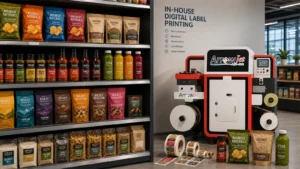
Table of Contents Custom Food Packaging: Key Questions Answered for Food Brands Custom food packaging shapes how shoppers recognize, evaluate, and choose a product —
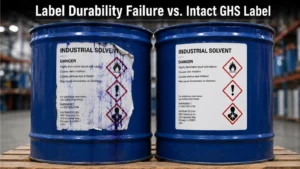
Table of Contents GHS Label Durability Failure: 4 Causes and Practical Fixes GHS label durability failures trace to four causes: aqueous ink chemistry, paper face

Table of Contents White Ink Clear Label Printing: When You Need It and Why White ink under clear film keeps brand color, mandatory copy, and
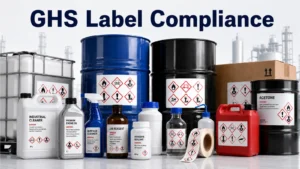
Table of Contents GHS Label Compliance: A Practical Guide for Chemical Label Printing GHS label compliance is a safety-critical requirement for any business that manufactures,
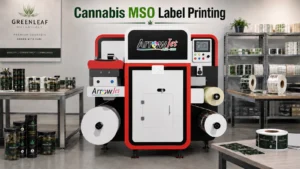
Table of Contents Cannabis MSO Label Printing: In-House or Outsource? Cannabis MSO label printing moves in-house when label versions outgrow converter minimums or batch data