The American Bumper Sticker: A Brief History
Table of Contents The American Bumper Sticker: A Brief History The American bumper sticker is a small adhesive label that became one of the most

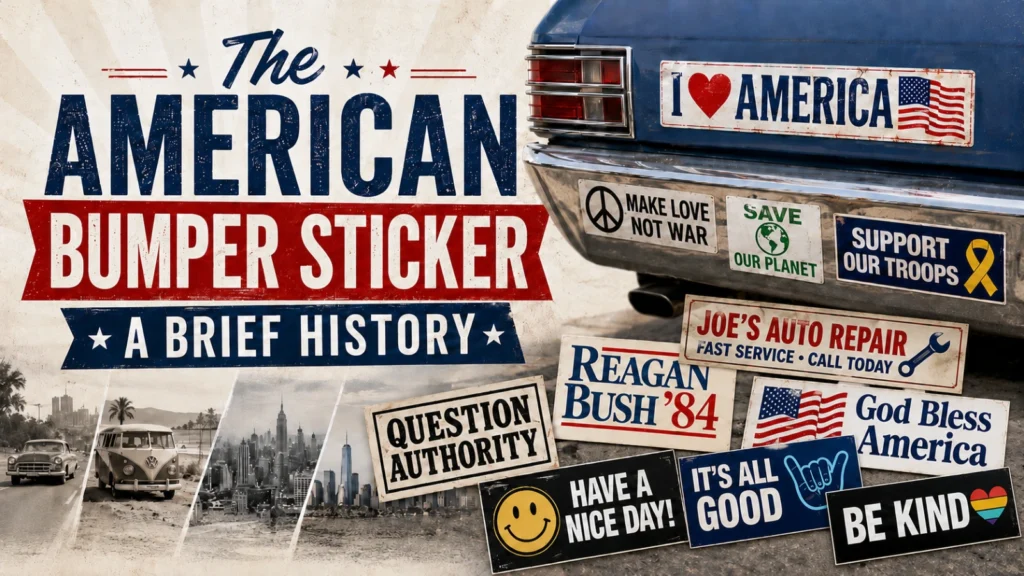
The American bumper sticker is a small adhesive label that became one of the most recognizable forms of public expression in US history — moving from postwar manufacturing surplus to political campaigns, First Amendment courtrooms, and the rear bumpers of millions of vehicles.
Before adhesive-backed bumper stickers existed, vehicle-based advertising relied on physical attachments — signs wired or bolted to carriages, then to early automobiles.
Early roadside and vehicle advertising appeared on carriage-related materials long before the automobile era. As cars became part of daily American life in the early twentieth century, drivers and businesses experimented with ways to carry messages into public spaces. Metal signs, painted placards, and cardboard displays were affixed to vehicles, fenders, and bumpers — functional, but requiring tools, brackets, or wire to install.
The first paper signs designed to be placed inside car windows appeared during the 1940s. These were an early step toward a portable, vehicle-based advertising format — but they lacked the outdoor durability and adhesive convenience that would define the bumper sticker as a product category.
The modern bumper sticker became commercially viable when WWII-era manufacturing produced practical pressure-sensitive adhesives, adhesive-backed materials, and durable fluorescent inks.
Forest Gill, a silkscreen printer based in Kansas City, is credited with developing the first adhesive bumper stickers. Gill used fluorescent inks and pressure-sensitive adhesive-backed paper strips — materials that had become accessible through wartime manufacturing advances. His method allowed a printed message to be applied directly to a vehicle bumper without wire, bolt, or bracket.
The innovation was not just adhesive chemistry. The combination of vivid silkscreen-printed color and a format requiring no installation made the bumper sticker genuinely practical for mass distribution. Tourism operators and, soon, political campaigns recognized what that meant: a message that traveled wherever the vehicle traveled, at no further cost to the sender.
Tourism advertising drove the first wave of bumper sticker adoption in the 1950s; political campaigns followed and made the format a fixture of American elections.
By the early 1950s, bumper stickers were widely used by tourist attractions to extend their reach beyond the destination itself. Locations such as Rock City at Lookout Mountain, Georgia became closely associated with vehicle-based advertising. Visitors left with a sticker, and the sticker carried the attraction’s name into every road trip, parking lot, and driveway it passed through.
Political campaigns noticed quickly. The 1952 presidential campaign of Dwight D. Eisenhower helped bring bumper stickers into American political culture with the “I Like Ike” slogan, which appeared on car bumpers across the country. The vehicle itself had become a medium for political affiliation — visible, inexpensive, and impossible to miss in traffic.
Since then, bumper stickers have become one of the most persistent forms of American public expression. Messages can be funny, commercial, philosophical, patriotic, local, provocative, or deeply personal. Research has even suggested behavioral connections: a 2005 study on road rage found that drivers whose cars displayed bumper stickers showed higher rates of territorial driving behavior — regardless of the content or belief expressed by those stickers. A small piece of adhesive, it turns out, can say something about the driver that goes well beyond the printed text.
In 1991, bumper stickers became the subject of landmark First Amendment cases, confirming that even offensive messages displayed on a vehicle can qualify as protected speech.
A Georgia supreme court judge ruled that profanity displayed on a bumper sticker was constitutionally protected expression. A federal district court in Alabama reached a parallel conclusion in a separate case, ruling that a sticker bearing a profane message carried “serious literary and political value” and therefore came under First Amendment protection.
These cases reinforced a principle that had been building since bumper stickers entered political culture: the car bumper had become a genuine public forum. A small piece of printed adhesive could intersect with some of the most fundamental questions in American constitutional law about the limits — and the breadth — of free expression.
The table below traces the bumper sticker’s development from its earliest vehicle-based predecessors through its recognition as protected speech and the arrival of digital printing.
Era / Year | Development | Significance |
Early 1900s | Metal and cardboard signs attached to vehicles | First vehicle-based advertising; no adhesive — required physical mounting hardware |
1940s | Paper window signs appear; WWII manufacturing advances in adhesives and inks | Material foundation laid for the adhesive bumper sticker |
Late 1940s | Forest Gill develops adhesive bumper stickers in Kansas City using silkscreen and pressure-sensitive materials | First true adhesive bumper sticker — no bracket or wire required |
Early 1950s | Tourism attractions adopt the format; Rock City (Lookout Mountain, GA) becomes closely associated with bumper sticker campaigns | First mass commercial use for destination advertising |
1952 | Eisenhower campaign distributes “I Like Ike” bumper stickers nationally | Political campaigns adopt the format; bumper sticker enters American election culture |
1991 | Georgia and Alabama court cases establish bumper sticker free speech precedent | First Amendment protection confirmed for vehicle-displayed expression, including offensive language |
2005 | Academic study links bumper sticker display to territorial driving behavior | First empirical research connecting bumper sticker use to driver psychology |
Present | Bumper stickers produced on digital inkjet and UV inkjet presses on vinyl and polypropylene film | Digital printing eliminates plates and minimum orders, enabling custom and short-run production at commercial quality |
Bumper stickers remain effective because they combine physical visibility with personal choice — the driver selects what message, if any, to display.
A vehicle carries its message into public spaces — roads, parking lots, driveways, and neighborhoods — with no ongoing cost to the sender. The message travels wherever the vehicle goes, reaching audiences that no static sign can reach.
Unlike a billboard or broadcast ad, a bumper sticker is selected by the driver. That selection signals identity, values, humor, or affiliation in a way that feels authentic rather than externally imposed — which is part of why readers engage with bumper stickers differently than they engage with conventional advertising.
The format is compact, lightweight, inexpensive to produce, and easy to distribute — in person, at events, by mail, or as a point-of-sale inclusion. No installation tools, no permits, no recurring cost after initial production.
A short phrase or distinctive graphic seen repeatedly in traffic can form a durable impression. The brevity the format demands — typically a single line — forces creative conciseness that longer formats often lack.
The printing technology behind bumper stickers has changed substantially since Forest Gill’s silkscreen press — digital inkjet systems now produce custom sticker runs without plates, films, or minimum order commitments.
Forest Gill’s silkscreen process was the right technology for its era: durable, capable of vivid color, and reproducible at scale. But silkscreen printing requires a separate screen for each color, setup time per job, and minimum run quantities to justify the plate cost. For the tourism and campaign uses that drove early adoption, those constraints were manageable — runs were large and designs were standardized.
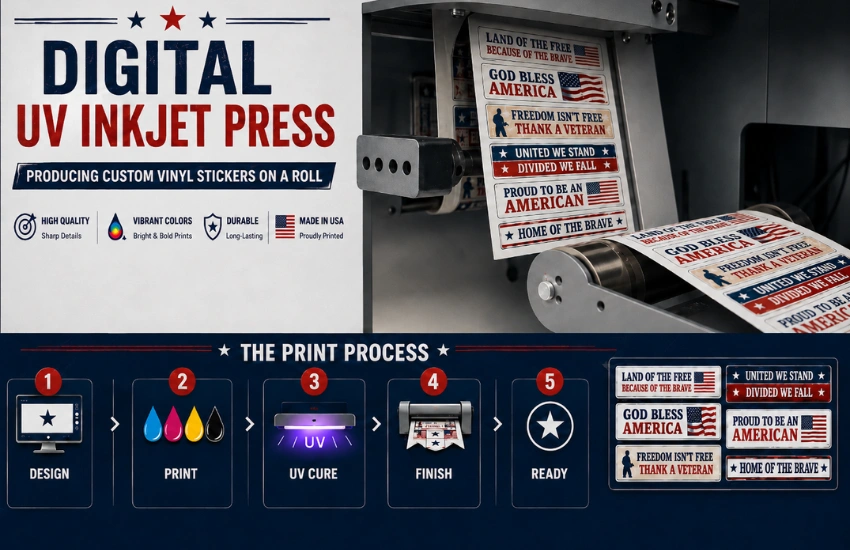
Modern bumper sticker production increasingly runs on digital inkjet presses, which print directly from a digital file with no plate or screen required. For outdoor-durable applications like bumper stickers — where weather resistance, UV stability, and adhesion through heat and rain cycles matter — UV inkjet systems are particularly well suited. UV inks cure instantly under UV light, bonding directly to vinyl and polypropylene substrates to produce a scratch-resistant, weatherproof surface that holds up on a vehicle exterior.

Arrow Systems manufactures the ArrowJet UV 330H, a UV inkjet label and sticker press built for roll-to-roll production on vinyl, polypropylene, and specialty substrates. For operations producing custom stickers and labels across multiple designs or short-run SKUs, the UV 330H removes the per-design setup cost that makes silkscreen impractical below a certain volume — the same file flexibility that has made digital printing the default for custom label production across most commercial printing environments.
Forest Gill, a Kansas City silkscreen printer, is commonly credited with developing the first adhesive bumper stickers. He combined pressure-sensitive adhesive-backed paper with fluorescent silkscreen inks — materials that became available through World War II-era manufacturing advances.
Bumper stickers became widely popular in the 1950s, driven first by tourism promotions and then by political campaigns. The 1952 Eisenhower presidential campaign — with its “I Like Ike” slogan — helped establish the political bumper sticker as a fixture of American elections.
Yes. Court cases in 1991 established that bumper stickers — including those carrying offensive language — can qualify as protected expression under the First Amendment. A Georgia supreme court judge ruled that profanity on a bumper sticker was constitutionally protected speech; a federal district court in Alabama reached a similar conclusion in a separate ruling the same year.
No. Tourism advertising was the primary use case before political campaigns adopted the format in the 1950s. Today bumper stickers are used for business advertising, humor, personal identity, causes, local pride, sports allegiances, and many other forms of self-expression. Political messaging is one application among many.
Modern bumper stickers are primarily produced on digital inkjet presses, which print directly from a digital file with no plates or minimum order requirements. UV inkjet systems — such as the ArrowJet UV 330H — are well suited for bumper sticker production because UV-cured inks bond directly to vinyl and polypropylene substrates, producing a weatherproof, scratch-resistant surface built for outdoor vehicle use. Digital printing has replaced silkscreen for most custom and short-run sticker production.
Arrow Systems manufactures digital label and sticker presses used by commercial printers, brand owners, and converters across the US to produce custom runs on vinyl, polypropylene, and specialty substrates — without silkscreen setup costs or minimum order commitments. See the ArrowJet UV 330H and explore which system fits your production requirements.

Table of Contents The American Bumper Sticker: A Brief History The American bumper sticker is a small adhesive label that became one of the most

Table of Contents Durable Equipment Labels: Polycarbonate vs Polyester vs Metal Polycarbonate and polyester each fail in predictable ways when misspecified — this guide maps

Table of Contents CBD Label Requirements: What Your Labels Must Say CBD labels must carry truthful product information, avoid medical or therapeutic claims, and comply

Table of Contents Medical Device Labels: UDI Requirements, FDA 21 CFR Part 801, and Printing Considerations FDA 21 CFR Part 801 and the UDI rule

Table of Contents USDA Food Label Guidelines: Six Common FSIS Labeling Mistakes to Avoid USDA FSIS food label approval is blocked most often by six

Table of Contents Beauty Product Labels: INCI Names, Formatting & FDA Rules Beauty product labels must list every ingredient by INCI name in descending order