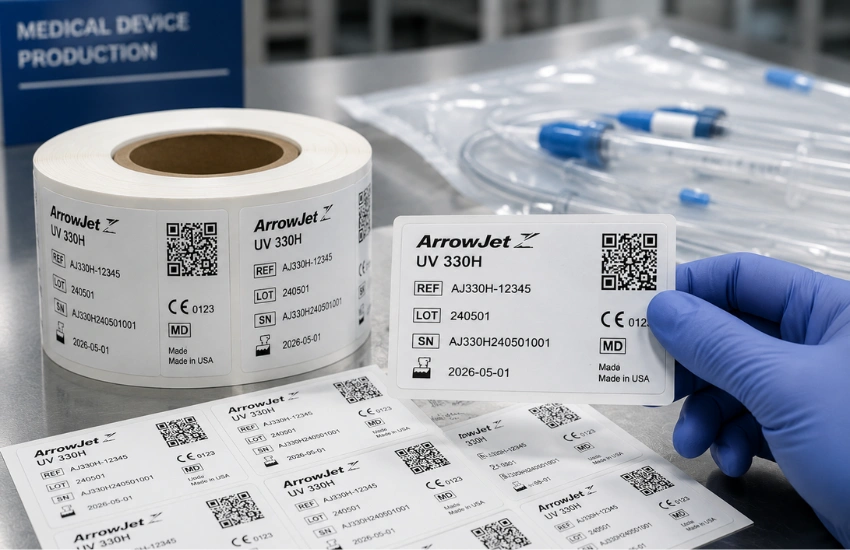
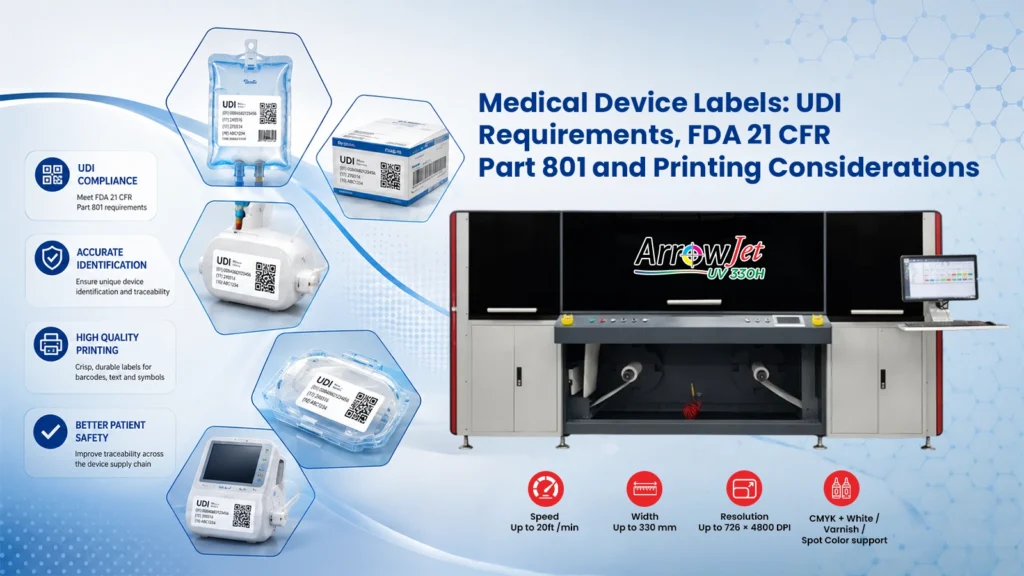
ArrowJet UV 330H digital label press printing FDA UDI-compliant medical device labels on durable synthetic substrates.

Table of Contents

Medical Device Labels: UDI Requirements, FDA 21 CFR Part 801, and Printing Considerations

FDA 21 CFR Part 801 and the UDI rule together define what must appear on every medical device label — from manufacturer identity to GUDID-linked barcode identifiers.

Key Takeaways

  • Part 801 and the UDI rule are one stacked requirement — information Part 801 requires on the label cannot be relocated to an IFU, and the UDI must appear in both human-readable text and AIDC barcode form simultaneously.
  • A UDI consists of a fixed Device Identifier (DI), which links to the GUDID record, and a conditional Production Identifier (PI) carrying lot, serial, expiration, and manufacturing date data.
  • Both HIBC and GS1 are FDA-accredited issuing agency standards — selection depends on distribution channels, internal ERP/MES infrastructure, and global reach.
  • UV inkjet (ArrowJet UV 330H) is suited to durable device-level UDI labels on polypropylene, polyester, and specialty synthetic substrates that must withstand solvent wipes, repeated handling, and cleaning agents.
  • Aqueous inkjet (ArrowJet Aqua 330R) is the appropriate match for outer cartons, shipper labels, and secondary packaging labels printed on coated paper stocks where UV chemistry is not required.
  • Compliance requires operational controls — controlled artwork tied to GUDID, validated variable data merge, first-article barcode verification against ISO/IEC 15415/15416, and auditable batch records — not equipment selection alone.

FDA 21 CFR Part 801: What It Requires on Medical Device Labels

Part 801 is the foundational regulation governing medical device label content — manufacturer identity, directions for use, and required warnings — and draws a critical legal distinction between the label, labeling, and IFU.

21 CFR Part 801 governs the content and form of labeling for medical devices distributed in the United States. For packaging engineers and labeling teams, the most operationally significant rule is this: information Part 801 requires on the label cannot be relocated to a package insert or IFU. The label and the IFU are legally distinct, and neither substitutes for the other’s required content.

At a baseline, Part 801 requires the following on the label of most medical devices:

Manufacturer, packer, or distributor identity

The name and place of business of the manufacturer, packer, or distributor must appear on the label. A common production pitfall is an outdated manufacturer address following a corporate restructure or facility relocation — the label must reflect the current registered information at the time of distribution.

Adequate directions for use

Most devices require adequate directions for use on or accompanying the label. The prescription device exemption under 21 CFR 801.109 allows prescription devices to omit lay directions on the label itself, provided all conditions are met in full — including the required “Rx only” or equivalent statement and adequate directions for the practitioner. This exemption is frequently misapplied when its conditions are not satisfied entirely.

Device identification and intended use

The label must contain information sufficient to identify the device and its intended use. Intended-use language that drifts from the cleared indication — even subtly through updated marketing copy — is a recurring Part 801 compliance gap in production environments.

Required warnings and precautions

Where applicable, required warnings and precautionary statements must appear on the label. These cannot be confined to the IFU or a downloadable document when Part 801 requires physical label placement.

Label vs. Labeling vs. IFU: Why the Distinction Matters in Production

Label

The physical printed material affixed directly to the device or its immediate container. What appears here is governed by Part 801 and, where applicable, the UDI rule. Required content cannot be moved off the label to accompanying documents.

Labeling

All written, printed, or graphic matter that accompanies the device — including the label, package inserts, and IFUs. Broader in scope than the label alone; subject to Part 801 requirements across the full set of accompanying materials.

IFU (Instructions for Use)

The document providing detailed usage, contraindication, and handling guidance. IFU content does not need to be replicated in full on the primary label, but Part 801-required label content cannot be deferred to the IFU. The IFU supplements — it does not substitute for — required label information.

Unique Device Identification: What Must Appear on the Label

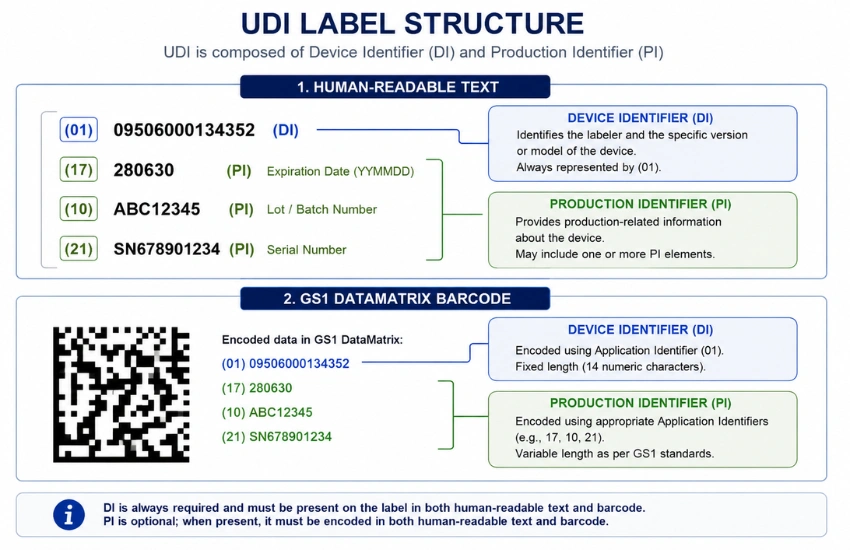
The UDI rule (21 CFR Part 830) requires every medical device label to carry a standardized identifier — the DI plus PI — in both human-readable text and scannable AIDC barcode form, with the DI linked to a GUDID submission.

Medical device UDI label structure showing Device Identifier (DI) and Production Identifier (PI) in human-readable and AIDC barcode format per 21 CFR Part 830.

The UDI rule sits on top of Part 801. Where Part 801 governs general label content, the UDI rule mandates a standardized identifier that allows every device to be uniquely tracked across the supply chain — from the manufacturing floor through distribution to the point of care.

Device Identifier (DI)

A mandatory, fixed portion of the UDI that identifies the labeler and the specific version or model of the device. The DI is the key that links back to the device record in the FDA’s Global Unique Device Identification Database (GUDID). Any drift between the DI printed on the label and the active GUDID record is a compliance gap. Controlled artwork and periodic GUDID reconciliation are the primary controls against this type of drift.

Production Identifier (PI)

A conditional, variable portion of the UDI that carries one or more of: lot or batch number, serial number, manufacturing date, expiration date, and — for human cells, tissues, and cellular and tissue-based products (HCT/Ps) — a distinct identification code. The PI changes between or within production runs, which is why in-house UDI label production requires variable data printing (VDP) capability at the press.

AIDC (Automatic Identification and Data Capture)

The machine-readable form of the UDI, typically a linear or 2D barcode. The UDI must appear in both human-readable plain text and AIDC format. Either form alone does not satisfy the requirement — both must be present on the label.

GUDID (Global Unique Device Identification Database)

The FDA-administered database to which UDIs must be submitted. The label data — particularly the DI and associated device attributes — must match the GUDID submission exactly. GUDID records require ongoing maintenance when device attributes change due to revisions, reformulations, or regulatory amendments.

UDI applicability is tiered by device classification, with Class III devices subject to the rule first and Class I last. Direct-mark requirements apply to certain reusable devices intended for reprocessing. Teams should confirm current obligations against FDA-published guidance and their own device classification portfolio.

This guide is informational and does not constitute regulatory or legal advice. Confirm UDI applicability, compliance dates, and exemption conditions with qualified regulatory counsel for each device in your portfolio.

Barcoding Requirements: HIBC vs. GS1 Standards

The FDA does not mandate a single barcode symbology — it accredits issuing agencies whose standards construct compliant UDIs, with HIBC and GS1 the two most relevant for medical devices.

HIBC (Health Industry Business Communications Council)

HIBC identifier structure

HIBC was developed specifically for the healthcare supply chain. Its structure uses a Labeler Identification Code (LIC) assigned by HIBCC, followed by a product or catalog number and a check character. HIBC accommodates manufacturer-specific catalog numbers without requiring a Global Trade Item Number — an advantage for manufacturers whose product numbering does not map naturally to GTIN infrastructure.

HIBC distribution footprint

HIBC is common among device manufacturers whose distribution is concentrated in U.S. hospital systems and group purchasing organizations (GPOs) that historically standardized on the HIBC framework. HIBC-128 and HIBC 2D are the most common carriers for medical device UDIs in this channel.

GS1

GS1 identifier structure

GS1 uses the Global Trade Item Number (GTIN) as the Device Identifier, combined with Application Identifiers (AIs): (01) for GTIN, (10) for lot number, (17) for expiration date, and (21) for serial number. GS1-128 and GS1 DataMatrix are the most common carriers for medical device UDIs under the GS1 standard.

GS1 distribution footprint

GS1 is the dominant standard in global retail and is broadly implemented in hospital materials management systems where scanning workflows are standardized around GS1 Application Identifiers. GS1 also has broader international recognition under EU MDR and other regulatory frameworks outside the United States, making it the default choice for manufacturers distributing globally.

HIBC vs. GS1: Side-by-Side Comparison

Factor

HIBC

GS1

Identifier basis

LIC + catalog number + check character

GTIN + Application Identifiers

Primary footprint

U.S. hospital supply chain and GPO channels

Global, including EU MDR contexts

Catalog fit

Works without GTIN infrastructure

Requires GTIN assignment

Common barcode carriers

HIBC-128, HIBC 2D

GS1-128, GS1 DataMatrix

Best fit when

U.S. hospital and GPO channels predominate; existing catalog numbering in place

Global distribution, EU MDR compliance, or GS1-aligned ERP/WMS already deployed

Practical selection factors: what your customers’ scanning systems already process; what your ERP, MES, and inventory systems support; whether you distribute internationally; and whether your product catalog maps to GTIN infrastructure. Some manufacturers maintain both, applying HIBC for legacy customers and GS1 for newer accounts — without forcing a system migration on either side.

Whichever standard you select, barcode print quality must be verifiable. ISO/IEC 15415 (2D symbols) and ISO/IEC 15416 (linear symbols) define grading methodologies, and FDA guidance references minimum grade expectations. Treat these as engineering targets to validate against your verifier, not as manufacturing assumptions.

The ArrowJet UV 330H for Durable UDI Labels on Hard Substrates

The ArrowJet UV 330H is a true hybrid UV label press — roll-to-roll and flatbed in a single platform — suited to durable device-level UDI labels on synthetic substrates that must withstand solvent wipes, handling, and cleaning agent exposure.

ArrowJet UV 330H hybrid UV label press printing durable UDI labels on synthetic roll substrate for medical device identification.

Medical device labels applied directly to instruments, trays, and primary containers face exposure that standard packaging labels do not: solvent wipes, repeated handling, cold storage, and sterilization-adjacent conditions. Labels must remain legible and scannable through the device’s full intended use cycle.

UV-cured inks form a tough, abrasion-resistant film immediately after curing and adhere to a wide range of synthetic substrates used for device-level identification. The ArrowJet UV label press range uses LED-cure architecture that polymerizes ink instantly on substrate contact — no evaporation required — which is why UV bonds reliably to film and synthetic stocks that water-based inks cannot.

Variable data printing for UDI Production Identifiers

UDI labels require variable PI data — lot number, serial number, expiration date — that changes between or within production runs. The ArrowJet UV 330H supports variable data printing including barcode and QR code generation. This allows PI to be merged from the production order or MES at print time, reducing transcription risk and keeping label data consistent with the device’s GUDID-linked artwork record.

Substrate range for device-level labels

The ArrowJet UV 330H handles films and specialty synthetics — including polypropylene (PP), polyester (PET), treated plastics, and polyimide-style materials where validated with your substrate supplier — that are commonly specified for device-level identification labels. The press supports a maximum print width of 330 mm and handles rigid media up to 50 mm thickness in flatbed mode, with a flatbed print area of 350 mm × 1500 mm.

Ink configurations for medical label applications

The ArrowJet UV 330H supports CMYK + White (WW), CMYK + Varnish (VV), and CMYK + White + Varnish (WV) configurations. Opaque white ink enables printing on clear, metallic, and dark substrates — relevant for device identification labels on opaque or dark primary containers where ink visibility requires a white underbase layer.

In-house UV UDI label workflow

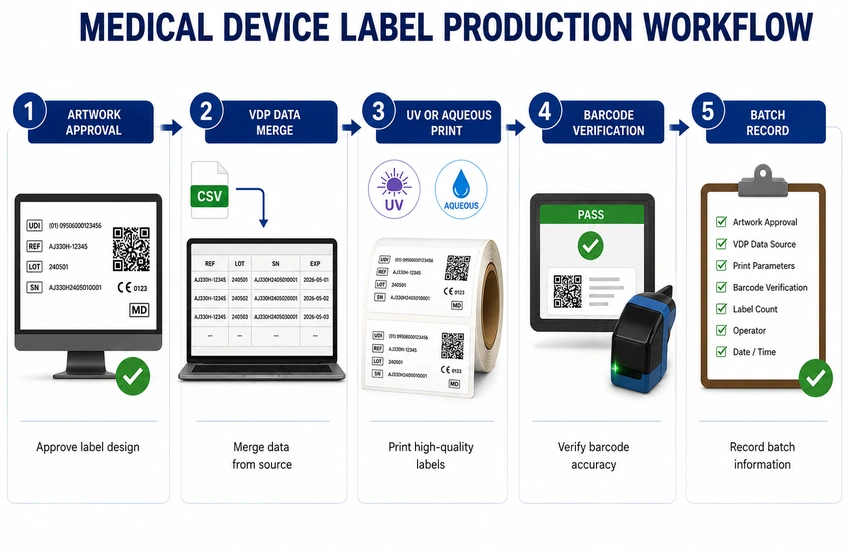
A repeatable in-house UV workflow for UDI labels proceeds in five steps: (1) pull approved artwork from a controlled repository linked to the device’s GUDID record; (2) merge variable PI data from the production order or MES; (3) print with the configured UV profile for the selected substrate; (4) verify barcodes against the ISO/IEC target grade using an inline or offline verifier; (5) reconcile first-article samples to the artwork master before releasing the run. This sequence produces an auditable trail from artwork approval through label application.

Typical device-level applications for the ArrowJet UV 330H include: UDI labels on hard plastic and metal-adjacent packaging, instrument tray and reusable accessory identification labels, and durable secondary labels that must survive the cleaning agents used in clinical environments.

The ArrowJet Aqua 330R for Standard Medical Packaging Labels

The ArrowJet Aqua 330R is an aqueous pigment roll-to-roll label press suited to outer cartons, shipper labels, kit cartons, and secondary packaging labels on coated paper stocks where UV chemistry is not required.

Not every medical device label requires UV durability. Outer cartons, shipper labels, kit cartons, and many secondary packaging labels are printed on coated paper substrates that do not see harsh chemical or physical exposure. For these applications, aqueous inkjet offers a better fit on substrate compatibility and consumable cost.

Aqueous chemistry on medical packaging substrates

The ArrowJet Aqua 330R uses Memjet DuraFlex® aqueous pigment inkjet technology. Aqueous pigment inks pair naturally with coated paper and select treated film substrates used for outer cartons and secondary packaging, where high-quality color graphics and legible regulated text are the primary requirements. The press handles substrate thicknesses from 0.05 mm to 0.35 mm, with a maximum print width of 12.75 inches (324 mm) and print speeds up to 90–150 ft/min.

Cost profile for standard medical packaging label runs

For outer carton, shipper, and kit-carton labels on coated paper, aqueous inkjet offers lower per-label ink cost relative to UV at equivalent ink coverage. Digital production eliminates plates and minimum order quantities — which removes the obsolete-label inventory risk that accumulates when labels are revised due to regulatory changes, manufacturer address updates, or indication amendments.

Regulatory ink compliance reference

Nestle Guidance compliance is a confirmed specification for the ArrowJet Aqua 330R, providing a recognized food-contact reference for aqueous pigment ink safety relevant to adjacent packaging applications. Specific compliance requirements for your device’s outer packaging should be confirmed with your regulatory and packaging engineering teams based on device classification and applicable regulations.

Matching Print Technology to Medical Device Label Type

UV inkjet suits durable device-level labels on synthetic substrates; aqueous inkjet suits outer cartons and secondary packaging on coated paper — a two-technology configuration is standard in mature medical device labeling operations.

Label type

Typical substrate

Recommended technology

Arrow platform

Device-level UDI on instruments and trays

Polypropylene, polyester, treated plastics, specialty synthetics

UV inkjet

ArrowJet UV 330H

Primary container UDI on hard packaging

Synthetic film, hard plastic

UV inkjet

ArrowJet UV 330H

Outer carton and shipper labels

Coated paper, select treated film

Aqueous inkjet

ArrowJet Aqua 330R

Kit cartons and secondary packaging

Coated paper

Aqueous inkjet

ArrowJet Aqua 330R

A coordinated two-technology configuration is common in mature medical device labeling operations:

  • UV (ArrowJet UV 330H) for durable primary and device-level UDI labels on hard substrates and specialty synthetics.
  • Aqueous (ArrowJet Aqua 330R) for outer cartons, shipper labels, and secondary packaging on coated paper.

Both can be integrated with ERP or MES workflows so that label data — DI, PI, GUDID-linked attributes, batch records — is pulled from the production order at print time rather than re-keyed manually at the press. This integration reduces transcription risk and creates a direct digital link between the device record and the physical label produced.

Operational Checklist for Compliant Medical Device Label Production

Compliance in medical device label production comes from operational controls — artwork governance, GUDID alignment, variable data validation, barcode verification, and auditable batch records — not equipment selection alone.

Artwork governance

A controlled artwork repository with explicit version IDs, approval signoffs, and change history. Artwork must be linked to the device’s GUDID record so the DI printed on the label matches the active database entry. Version-controlled artwork is the primary defense against label-to-GUDID drift, which is one of the most common labeling compliance gaps found during audits.

GUDID reconciliation

Periodic checks confirming that DI-linked attributes on the label match the active GUDID record. Regulatory changes, product modifications, and corporate changes can all introduce drift between what is printed and what GUDID holds. Reconciliation frequency should align with change control triggers and the device’s revision history.

Variable data validation

Confirmation that PI fields — lot number, serial number, expiration date — match the production order before print release. Where PI data is merged from ERP or MES, the merge logic itself should be validated. Re-keyed data is a known source of transcription error in label production and a common audit finding in Class II and Class III device labeling operations.

First-article approval

Sample inspection and barcode verification on the first labels of each run, with sign-off captured before the run is released. First-article approval is the final checkpoint between the controlled artwork and the labels that will be applied to devices in distribution.

Inline or offline barcode verification

Symbol grading against ISO/IEC 15415 (2D symbols) and ISO/IEC 15416 (linear symbols) targets, with out-of-grade symbols treated as non-conforming and removed from the label population before application. Verification results should be captured in the batch record — not noted verbally and discarded.

Batch records

An auditable log linking each label run to artwork version, operator, equipment, substrate lot, and barcode verification results. When integrated with ERP or MES, the batch record connects the physical label directly to the device’s manufacturing record — which is what regulatory auditors increasingly expect to see as evidence of a controlled labeling operation.

Change control

A defined process for label revisions triggered by artwork updates, regulatory changes, indication amendments, or GUDID record modifications. Change control gates prevent outdated label versions from entering the production queue and reaching distribution.

Arrow Systems sells label printing hardware. Arrow does not provide regulatory, compliance, or quality system advisory services. The controls described above are standard operational expectations for medical device labeling — confirm specific requirements applicable to your devices with your regulatory affairs and quality teams.

Frequently Asked Questions — Medical Device Labels and UDI Printing

Common questions from medical device packaging engineers, regulatory operations leaders, and labeling teams evaluating FDA Part 801 requirements, UDI compliance, barcode selection, and in-house label printing options.

Part 801 defines the general content requirements for medical device labels and labeling — manufacturer information, directions for use, and required warnings. The UDI rule (21 CFR Part 830) layers a standardized device identification system on top: the DI plus PI in both human-readable text and AIDC barcode form. Both apply simultaneously to most devices in distribution. They are stacked requirements, not alternatives.

Most do, but applicability and timing depend on device class and specific exemptions. Class III devices were brought into scope first; lower-risk classes followed on staggered compliance dates. Some Class I devices and certain product categories have specific exemptions or alternative pathways. Confirm current requirements for each device against FDA-published guidance — not a generic checklist applied across the portfolio.

Both are accepted under FDA-accredited issuing agency standards. The right choice depends on what your hospital and distributor customers scan, what your internal ERP or MES supports, and whether you distribute globally. GS1 has broader international adoption and is recognized under EU MDR; HIBC has deep roots in the U.S. hospital and GPO supply chain. Some manufacturers maintain both to cover legacy and newer accounts without requiring a system migration on either side.

Yes, provided the in-house operation includes controlled artwork linked to the GUDID record, validated variable data flow for PI fields, appropriate print technology for the substrate, barcode verification against ISO/IEC grade targets, and audit-ready batch records. In-house printing can shorten lead times and reduce obsolete-label inventory risk. The compliance controls must be at least as rigorous as those at an external converter — the press alone does not constitute a compliant labeling operation.
ISO/IEC 15415 covers 2D symbols such as GS1 DataMatrix and HIBC 2D; ISO/IEC 15416 covers linear symbols. FDA guidance references minimum grade expectations under the applicable issuing agency standard. Set verifier targets to meet those grades, document grading results as part of the batch record for every production run, and treat out-of-grade symbols as non-conforming product — not as a reprint suggestion.

Evaluate Your Medical Device Label Printing Setup with Arrow Systems

If your labeling team is assessing in-house UDI label printing — or looking to reduce reliance on external converters for variable-data label runs across Class II or Class III device portfolios — the right starting point is a structured look at your current setup: substrate mix, device classes, GUDID alignment, and existing print and verification workflow.

Arrow Systems offers equipment consultations for packaging engineers and labeling operations leaders evaluating digital label press hardware for medical device applications — including the ArrowJet UV 330H for durable UDI labels on hard substrates and the ArrowJet Aqua 330R for standard medical packaging and outer carton labels.