Table of Contents
Digital Label Printer for a Small Brand: The Real Break-Even Math
Break-even for an in-house digital label press is driven by SKU count and revision frequency — not annual label volume.
Key Takeaways
This is the label printing break-even math every small brand should run before assuming they’re “too small” for an in-house press.
- Break-even is set by SKU count, run size versus MOQ, and revision frequency — not by annual label volume alone.
- Compare landed cost per applied label on both sides, including overbuy, obsolescence, expedite fees, and internal hours — not just quoted cents per label.
- Plate, die, and setup charges should be counted per SKU per revision; that line is usually understated in a quick mental comparison.
- Moving print in-house also moves prepress, color management, substrate qualification, and maintenance in-house — budget staff and training time for it.
- A hybrid split — long runs outsourced, short runs in-house — is a legitimate answer for many portfolios, not an all-or-nothing decision.
Why the Volume Myth Doesn't Apply to Digital Printing
The “you need volume” rule is real — it just belongs to flexo, where fixed per-job costs only pay off across long runs.
Flexo label printing cost is fixed per job — plates for each color, a cutting die for each label shape, makeready material, and press setup time. Those costs do not shrink when your run does, so the only way to make cents-per-label look good is to spread them across a long run. That converter MOQ label printing default exists for the same reason: a converter quoting several thousand labels per SKU is not difficult, since below that quantity setup swamps the job.
Digital label printers change the cost stack rather than the cost per square inch. No plates, no dedicated die for many formats, minimal makeready — which means run length stops driving the economics. Once that happens, the question shifts from “how many labels do we print per month” to “how many SKUs, versions, revisions, and reorders do we manage per year, and what does each one cost in setup, overbuy, scrap, and waiting.”
How to Calculate the Real Break-Even for a Small Brand
There is no universal minimum label volume for a digital press — break-even is specific to your SKU mix, order quantities, and revision rate.
Collect both sides before comparing anything. For multi-SKU brands, the threshold for in-house digital printing often arrives at volumes well below what the team assumed. Total in-house label printing cost includes lease or amortized capital, ink and substrate, labor, and maintenance — not just the per-label ink price.
Outsourced cost lines to collect (last 12 months)
- Quoted per-label price at the quantity you actually order — not the price at your converter’s top break.
- Plate, die, and setup charges, counted per SKU per revision.
- MOQ overbuy: labels purchased minus labels applied.
- Obsolescence and scrap: pre-printed rolls written off after artwork, ingredient, supplier, or panel updates.
- Inbound freight, plus every rush or expedite fee from the past year.
- Internal hours: procurement, proofing rounds, version tracking, roll receiving and storage.
- Revenue or margin impact from launches, resets, or co-man windows that slipped waiting on labels.
In-house cost lines to collect
- Monthly lease payment, or capital cost amortized over your planned service life.
- Ink and consumables per label at your typical coverage.
- Blank substrate cost per label, by facestock and liner.
- Maintenance, service coverage, and spare parts.
- Operator time per run, including changeover.
- Prepress and file prep time, plus any finishing step (laminate, die-cut, slit, rewind).
- Space and power for the system and blank stock.
Illustrative worked example
The table below is an illustrative model structure only — populate it with your own quotes. The figures are placeholders to show how the lines interact; they are not benchmarks and do not represent any specific brand.
Cost line | Outsourced (illustrative) | In-house (illustrative) |
Labels applied per year | 300,000 | 300,000 |
Labels purchased or printed | 420,000 (MOQ overbuy) | 305,000 (print-to-order plus setup waste) |
Per-label print or consumable cost | Quoted price at your real order quantity | Ink plus substrate at your coverage |
Plate, die, and setup | Per SKU × revisions per year | $0 per order |
Obsolescence write-off | Rolls stranded by revisions | Limited to blank stock only |
Freight and expedite | Per shipment, plus rush fees | $0 |
Equipment cost | $0 | Lease or amortized capital |
Internal labor | Procurement, proofing, roll management | Prepress plus operator time per run |
Landed cost per applied label | Your total ÷ labels applied | Your total ÷ labels applied |
Run both columns with your own figures. Two lines usually surprise teams: the gap between labels purchased and labels applied, and the annual total of setup charges once revisions are counted properly.
The Second Axis: SKU Count and Revision Frequency
Two brands can print the same annual volume and land in completely different places — the second variable is SKU count and revision frequency, not total labels printed.
Run the SKU count label revisions check before comparing total volume — it explains more of the break-even variance than annual label count ever will.
Brand A — stable, low-revision profile
A handful of stable SKUs, one artwork refresh every few years, predictable reorders. Long runs, few setups, minimal obsolescence. Outsourcing often remains the cheaper option for this profile.
Brand B — high-SKU, high-revision profile
Dozens of SKUs, artwork or panel changes several times a year, seasonal variants, and two retailer-specific versions. At the same total volume as Brand A, this profile carries many times the setup charges, far more overbuy, and recurring write-offs — reaching break-even much earlier, with volume having nothing to do with it.
Screening cues that the math is worth running
Teams often find the numbers start to favor in-house short-run digital label printing when several of these are true at once. Treat this as a screening cue, not a benchmark — where your line actually falls depends on label size, substrate, color coverage, run frequency, and finishing needs.
- A low-double-digit count of active SKUs or more, with real spread in demand between them.
- Typical run needs well below your converter’s MOQ.
- Artwork, ingredient, or panel revisions more than once a year across the portfolio.
- Recurring expedite fees, or launches delayed by label lead time.
- New SKU or variant tests you have shelved because a test run was not economical.
What Changes When Print Moves In-House
Lead time compresses, print-to-order removes overbuy, version control improves, and test velocity goes up — but the brand also takes on new operational responsibilities.
Lead time compresses
A reorder cycle measured in weeks — quote, proof, plate, schedule, print, ship — collapses to days, and for repeat files on qualified stock it can run same-day or next-day. That changes what you can commit to a retailer or a co-man.
Print-to-order removes overbuy and obsolescence
You print what the run needs. A panel update or supplier change costs a file revision instead of a write-off, because your inventory is blank stock that serves every SKU.
Version control improves
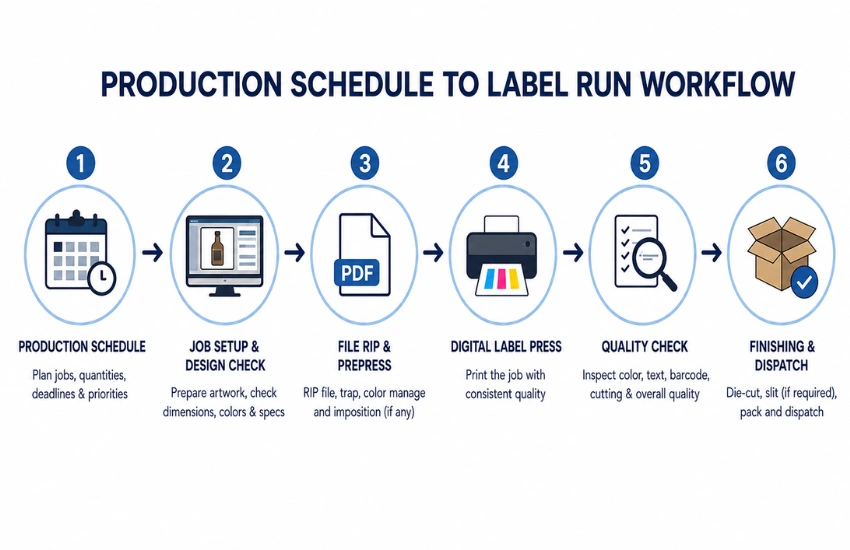
Replacing a plate order with a file update keeps label content in one place. With basic operations automation, label runs can trigger off the production schedule instead of a separate procurement cycle, with artwork versions tied to your system of record rather than a folder one person maintains.
Test velocity goes up
Limited editions, regional versions, shade and size variants, and packaging tests become affordable at real-world quantities.
New responsibilities the brand takes on
Prepress and file discipline, color management and brand-color match expectations, substrate and adhesive qualification for your containers and cold chain, and routine maintenance all become internal responsibilities. Any finishing step — laminate, die-cut, slit, rewind — either moves in-house or stays with a finishing partner; Arrow’s label finishing systems cover that step for brands scaling their in-house workflow. Budget operator time per run and a genuine learning curve, and note that if nobody owns file control today, that gap follows you in-house.
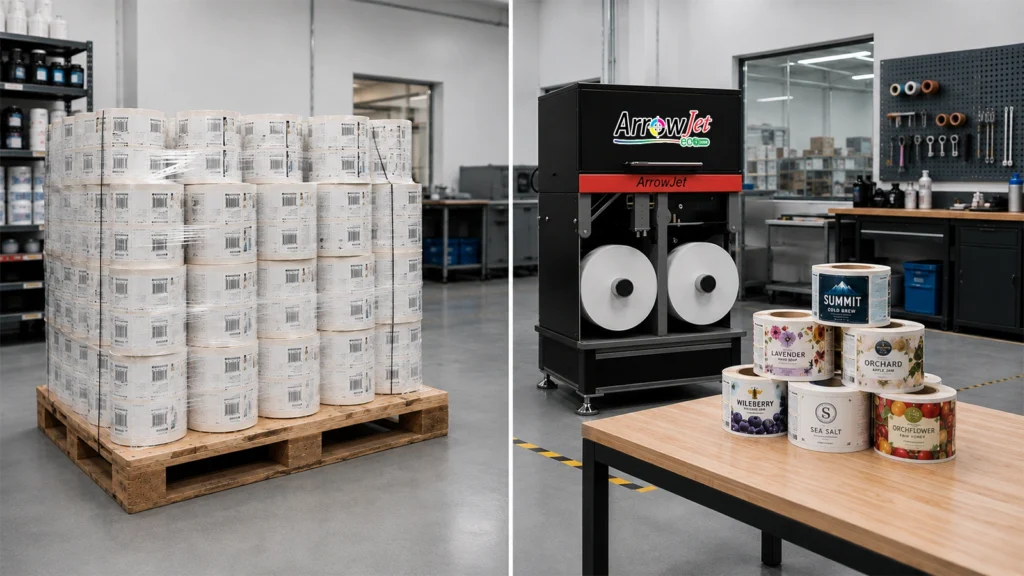
ArrowJet Eco 330R: An Entry-Level In-House Production Step
The ArrowJet Eco 330R is a compact, single-pass digital label press built for short-run and variable-data label production at up to 20 m/min.
For small and mid-sized brands, the ArrowJet Eco 330R from Arrow Systems is best understood as a first in-house production step rather than a converter replacement. It is a roll-fed digital press that prints the quantity a run actually needs instead of the quantity an MOQ dictates, running on single-phase power with no air compressor required.
Specification | Details |
Print technology | Single-pass digital inkjet |
Print engine | Memjet DuraFlex® |
Ink set | CMYK water-based pigment |
Max print width | 324 mm |
Speed | Up to 20 m/min |
Resolution | 1600 × 1600 dpi |
Power | Single-phase 230V, no air compressor required |
Label segments the Eco 330R serves
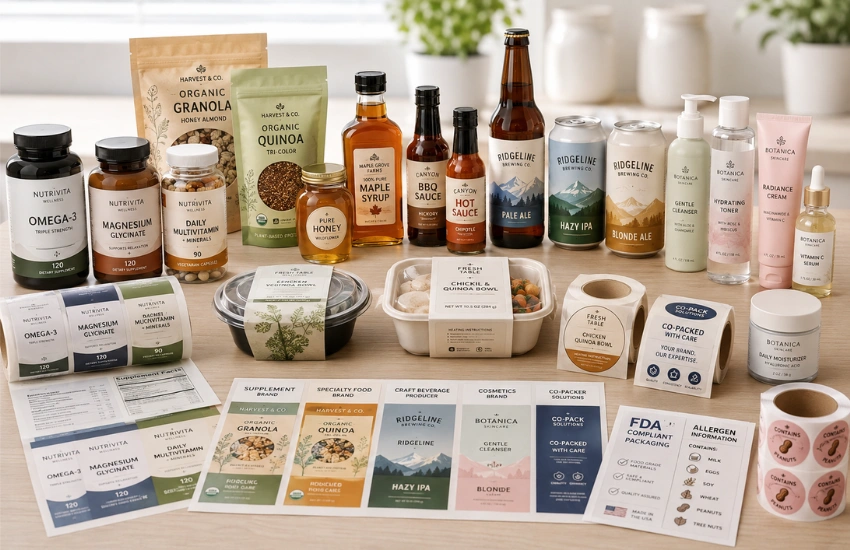
The ArrowJet Eco 330R fits food and beverage, nutraceutical/supplement, cosmetic, pharmaceutical, pet, and household label production, alongside short-run and customized jobs and variable-data printing for lot, date, and version differences within a single job. Co-packers handling many independent artwork cycles fit the same profile.
Variable data label printing on the Eco 330R
The Eco 330R supports variable data label printing for lot, date, and version differences within a single job — sometimes marketed as variable data labels or variable information labels, all describing the same capability: each label in a run can differ without stopping the press or ordering a separate SKU.
Before committing
Confirm the details against your actual formats: label sizes and layout, facestock and adhesive compatibility with your containers, color expectations, finishing requirements, floor space, and how label runs will connect to your production schedule. Ask Arrow Systems to review configuration and substrate compatibility for your specific label mix.
Scenarios Where In-House Wins at Low Volume
Revision frequency, SKU spread, and lead-time risk — not total volume — are the recurring drivers across the brand profiles that reach break-even earliest.
Supplement brand with frequent panel revisions
Formula tweaks, allergen statement updates, and supplement facts panel changes each strand pre-printed inventory and trigger new setup charges. The cost driver is revision frequency, not volume.
Specialty food brand with seasonal and channel-specific SKUs
Farmers-market sizes, holiday flavors, and a few wholesale-only formats each need a few hundred labels, and every one hits an MOQ. SKU count multiplied by setup charges flips the math long before total volume does.
Craft beverage producer running limited releases
One-off batches, collaborations, and variety-pack versions have short lives and unpredictable quantities. Lead-time risk is the driver: a release date that cannot move cannot depend on a multi-week label window, and expedite fees erase bulk savings.
Cosmetics brand with shade and size variants
A wide, shallow catalog — many variants, low demand per variant — is the classic overbuy trap. Printing to actual demand per shade avoids writing off slow movers when the line gets refreshed.
Co-packer or private-label operation
Serving multiple client brands means running independent artwork approvals and revision cycles at the same time. Per-client versioning is the cost driver, and in-house printing removes the need to hold client-specific inventory that may never be consumed.
Brand entering a new regional retailer
New date, lot, or barcode format requirements arrive with a fixed reset date. Lead-time risk plus a mid-cycle format change is exactly where a converter reorder is most expensive and least flexible.
Verify current labeling and panel requirements for your category — including FDA, allergen, and applicable state requirements — with qualified regulatory support. Arrow Systems sells label printing hardware; Arrow does not provide regulatory or compliance advisory services.
Frequently Asked Questions — Digital Label Printer Break-Even
Common questions from founders, ops managers, and packaging leads evaluating an in-house digital label press for the first time.
There is no reliable universal number, and any single figure deserves scrutiny. Volume matters less than SKU count, run size relative to your converter’s MOQ, and how often artwork or panels change. Brands printing modest monthly volumes across a large SKU count can reach break-even sooner than brands printing more labels across a few stable SKUs. Build outsourced and in-house cost columns with your own quotes, then compare landed cost per applied label rather than quoted cents per label.
Many small brands start without a dedicated hire, assigning the press to an existing packaging or production team member with clear ownership of file control. Someone still has to own prepress, color expectations, substrate qualification, and routine maintenance, because those responsibilities move in-house with the equipment. Plan for training time and a learning curve on the first several formats, and expect to formalize the role as SKU count and run frequency grow.
Yes, and a hybrid model is a common approach. Long-run, stable core SKUs can stay with the converter where flexo economics still favor scale, while short runs, new SKU tests, seasonal versions, and post-revision reprints move in-house. That limits exposure to MOQ overbuy and obsolescence where it hurts most, and lets in-house work scale as confidence and volume build. Run the break-even by SKU tier rather than portfolio-wide to see where the split should sit.
Get Your Break-Even Model From Arrow Systems
Send Arrow Systems your SKU count, monthly volume by SKU, quoted per-label price at your actual order quantity, plate and die charges, revision frequency, substrates, and label sizes.
We will build a break-even model for your format mix and give you a straight read on whether an entry-level system such as the ArrowJet Eco 330R fits, or whether a hybrid outsource and in-house model makes more sense right now.
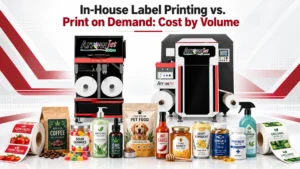
In-House Label Printing vs. Print on Demand: Cost by Volume
Table of Contents In-House Label Printing vs. Print on Demand: Cost by Volume In-house label printing vs. print on demand comes down to a cost-per-label
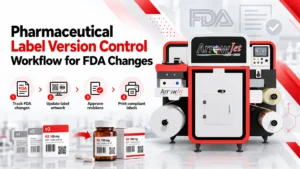
Pharmaceutical Label Version Control Workflow for FDA Changes
Table of Contents Pharmaceutical Label Version Control Workflow for FDA Changes A GMP label version control workflow moves an approved revision to the line: change
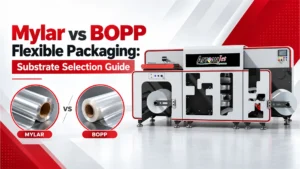
Mylar vs BOPP Flexible Packaging: Substrate Selection Guide
Table of Contents Mylar vs BOPP Flexible Packaging: Substrate Selection Guide PET (Mylar) leads on oxygen and aroma barrier and heat tolerance; BOPP leads on
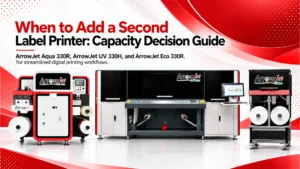
When to Add a Second Label Printer: Capacity Decision Guide
Table of Contents When to Add a Second Label Printer: Capacity Decision Guide Three measurable signals decide it — sustained utilization above your scheduling ceiling,
Diagnosing Supplement Label Peeling HDPE Bottle Failures
Table of Contents Diagnosing Supplement Label Peeling HDPE Bottle Failures HDPE label peeling traces to low surface energy, an adhesive mismatch, or moisture exposure —
Roll-to-Roll vs. Sheet-Fed Label Printing: Throughput & Cost
Table of Contents Roll-to-Roll vs. Sheet-Fed Label Printing: Throughput & Cost Rolls win on cost per applied label with an automatic applicator; sheets win on