Table of Contents
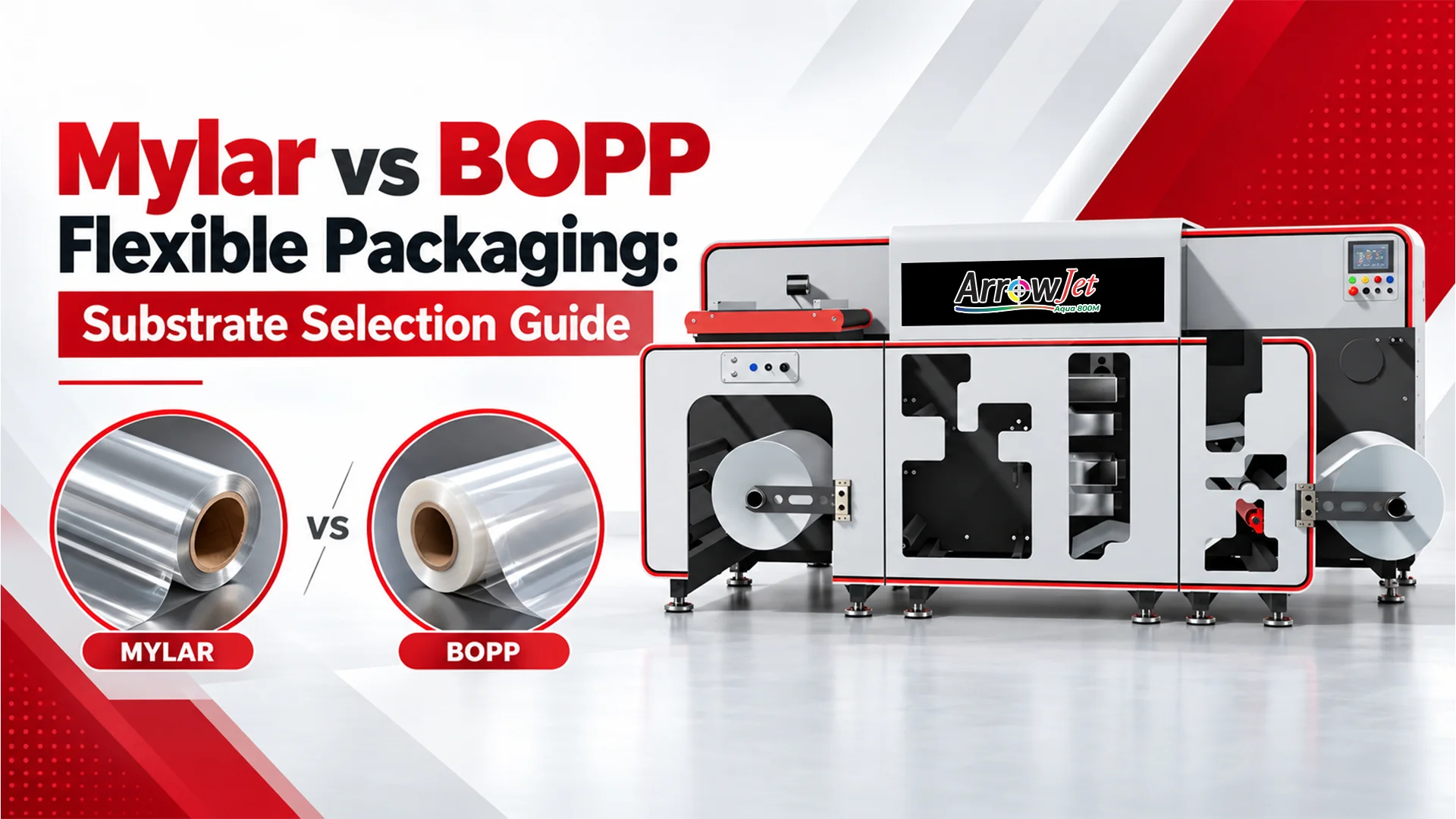
Mylar vs BOPP Flexible Packaging: Substrate Selection Guide
PET (Mylar) leads on oxygen and aroma barrier and heat tolerance; BOPP leads on moisture barrier, clarity, and cost.
Key Takeaways
- PET (Mylar) provides the stronger oxygen and aroma barrier and higher heat tolerance; BOPP provides the stronger moisture barrier, better clarity and gloss, and lower cost — choose by product sensitivity, not by film name.
- Barrier performance comes from the laminate structure — metallization, foil, tie layers, and sealant — not the base web alone; compare complete structures using supplier-tested values.
- Most “barrier failures” trace back to seal contamination, zipper or slider interfaces, laser scores, or flex cracking — run seal integrity and distribution testing before re-specifying a film.
- Both films require corona or flame surface treatment before printing, and treatment decays over time — a dyne pen check on incoming rolls prevents a scrapped run.
- Digital presses built for film webs, such as the ArrowJet Aqua 800M for wide-web production and the ArrowJet Eco 330R for smaller-format runs, let converters standardize substrate and vary artwork digitally instead of committing to pre-printed film per SKU.
Why Substrate Selection Is a Press-and-Process Decision
Substrate choice sets barrier, print, and cost outcomes together — and decides what your press and ink set can run.
This flexible packaging substrate selection guide is written for packaging engineers, operations and QA leads, and the brand owners who sign off on film specs in cannabis, pet, and confectionery. It covers a side-by-side barrier comparison, the press and ink behavior each substrate demands on a digital flexible packaging printer, sourcing and MOQ realities, application-level fits, and a seven-step qualification workflow.
Keep one principle in view throughout: barrier comes from the structure — films, metallization, tie layers, and sealant — not the name on the roll label. The best structure on paper is worthless if your press, ink set, and finishing line cannot run it repeatably at your run lengths, which is why substrate selection and press capability belong in the same evaluation.
What Is Mylar (PET Film), and What Is BOPP? Structure and Properties
Mylar is a trade name for PET film; BOPP is biaxially oriented polypropylene — different polymers, different barrier strengths.
What Is Mylar? PET Film Basics and Where It Fits
What “Mylar” actually refers to
“Mylar” is a DuPont trade name used generically for decades to describe biaxially oriented PET film. When a buyer says “mylar pouch,” they almost always mean a PET-based laminate — frequently PET / metallized layer / sealant, or PET / foil / sealant — not a bare monoweb.
PET’s barrier and dimensional properties
PET’s polar, highly crystalline structure gives it a comparatively strong oxygen barrier among common packaging films, plus good resistance to aroma and flavor scalping. It also holds dimensional stability under heat and web tension, which matters for tight registration on multi-color graphics and small mandatory copy.
What PET needs to reach high-barrier performance
PET does limited heavy lifting on its own. Metallized layers, aluminum foil, EVOH, or barrier coatings are what push a structure into true high-barrier territory. PET is the film that carries print, survives lamination and sealing heat, and contributes puncture and tear resistance while those layers do the barrier work.
Typical PET/Mylar applications:
- Cannabis flower and edible pouches requiring aroma containment and light blocking.
- Premium confectionery packaging where oxygen and aroma retention drive shelf life.
- High-fat pet treat packaging where grease and oxidation resistance matter more than clarity.
What Is BOPP? Structure, Properties, and Common Applications
What BOPP is and why it resists moisture
BOPP is biaxially oriented polypropylene, available as clear, white/opaque (cavitated), matte, and metallized. It is nonpolar and hydrophobic, which is why it generally provides a better moisture barrier than PET at comparable gauge.
BOPP’s practical strengths
BOPP runs stiff for its cost, delivers strong gloss and clarity for product windows, holds matte and soft-touch finishes well, and offers good dead-fold behavior for twist-wrap and flow-wrap formats. It is also widely stocked in standard widths and gauges, which shortens lead times.
BOPP’s practical limits
As a monoweb, BOPP’s oxygen barrier is modest, so metallization or a barrier coating is usually required for oxygen-sensitive products. BOPP is also more heat-sensitive than PET, so aggressive drying, curing, or sealing conditions can cause shrinkage, curl, or web distortion.
Typical BOPP applications:
- Pet treat bags and mid-size kibble bags, often reverse-printed BOPP laminated to a sealant web.
- Candy wrappers, flow-wrapped bars, and gusseted confectionery bags.
- Clear-window structures where product visibility drives purchase.
Comparing PET vs BOPP packaging film starts with the base web, but neither wins alone on barrier: the base web sets a starting point, while the finished laminate — metallization, tie layers, and sealant — determines what a structure can actually deliver on shelf.
Barrier Performance Compared: Oxygen, Moisture, Light, and Heat
Barrier performance below is directional, not a datasheet — gauge, coating, metallization, and conversion quality all change results.
Attribute | Mylar / PET | BOPP |
Oxygen barrier (monoweb) | Generally stronger | Generally weaker |
Moisture barrier (monoweb) | Generally weaker | Generally stronger |
Light blocking | Requires metallization, foil, or opaque layer | Requires metallization or white/cavitated grade |
Heat resistance | Higher; tolerates hotter seal jaws and dryers | Lower; distortion and shrink risk |
Stiffness per unit cost | Moderate | Favorable |
Gloss / clarity | Good | Excellent |
Print surface prep | Corona/flame treatment; check dyne level; primer often used | Corona treatment; treatment decays faster; topcoated grades common |
Typical structures | PET / met-PET / PE; PET / foil / PE | BOPP / met-BOPP / PE; BOPP / CPP |
Relative cost | Higher, especially specialty laminates | Often the lower-cost workhorse web |
Best-fit applications | Cannabis, oxygen/aroma-sensitive candy, high-fat treats | Pet bags, candy wraps, clear-window and gloss-driven SKUs |
Where Barrier Actually Fails
Film selection gets the attention; conversion gets the blame — most barrier complaints trace back to structure and process.
- Seal contamination from product dust, oil, or fines in the seal area.
- Zipper and slider interfaces that create a channel or reduce effective seal width.
- Laser scores and tear notches cut deeper than intended, breaching a barrier layer.
- Degassing valves on cannabis or coffee-style pouches that leak or seat poorly.
- Flex cracking and pinholing at gussets and creases, especially on metallized webs after distribution abrasion.
Before re-specifying a film, run seal integrity checks and a distribution simulation on the current structure. A “barrier problem” is often a seal or handling problem.
Print Compatibility: What Each Substrate Asks of Your Press
Both PET and BOPP need surface treatment before ink will anchor, and each substrate makes different demands on press and ink.
This is where a flexible packaging substrate comparison earns its keep. Barrier and print behavior have to be evaluated together, because you commit to both when you buy the roll.
Surface treatment and dyne level
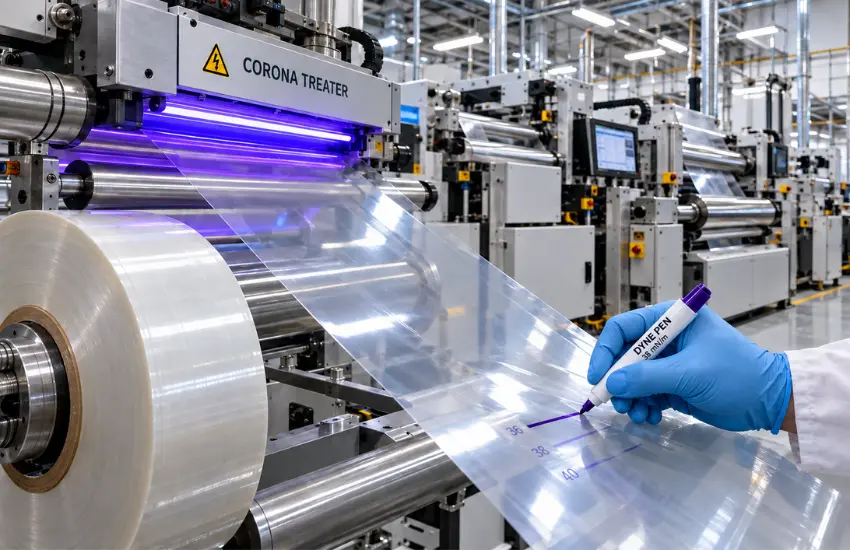
Both PET and BOPP require corona or flame treatment to accept ink, and treatment is not permanent. Surface energy decays in storage, and BOPP typically loses treatment faster than PET, particularly in warm warehouses. A dyne pen check on incoming rolls is a two-minute test that prevents a scrapped run — ask your supplier for the treatment level at manufacture and the recommended shelf window.
Primers, topcoats, and press compatibility
Many digital presses require a primed or print-treated grade rather than plain treated film — toner and electro-ink systems are especially sensitive to surface chemistry. A digital printing machine for flexible packaging — such as the wide-web ArrowJet Aqua 800M aqueous inkjet press — prints CMYK on corona- or flame-treated PET, BOPP, PVC, and other film webs up to 800mm wide, but the surface treatment itself happens offline before the roll reaches the press — the same dyne-level and shelf-window check applies whichever press runs the job. Confirm whether your press vendor lists the exact grade as qualified.
Ink chemistry and anchorage
Water-based, UV, toner, and electro-ink systems anchor differently on the same web. UV inks can cure hard and brittle on a stiff web and crack at fold lines; water-based systems need adequate drying without overheating the film. Run a tape pull or crosshatch adhesion test on every new film, ink, and profile combination before committing production.
Metallized and matte surfaces
Metallized webs usually need a white ink layer to render brand colors accurately; without it, color reads dark and shifted. Matte and soft-touch BOPP absorbs and scatters light differently than gloss, so expect flatter color and validate small mandatory copy and barcode contrast on the actual substrate.
Heat, tension, and static
Thin PET is dimensionally stable but static-prone, which causes web wander, ink misting, and debris pickup. BOPP is more forgiving on static but far less tolerant of heat: dryer temperatures and seal-jaw settings that PET shrugs off can shrink or bow an OPP web. Web tension profiles rarely transfer cleanly between the two substrates.
Practical incoming checks: dyne level, roll telescoping and edge condition, treated-side verification, tape adhesion after print, and a first-article seal check at production line speed.
Cost and Availability: Sourcing Realities
BOPP is generally the lower-cost, more widely stocked web; PET-based and foil laminates carry higher cost and longer lead times.
BOPP is generally the lower-cost web and the more widely stocked one. PET-based structures — especially foil or EVOH-containing laminates — carry higher material cost and can carry longer lead times. That is real exposure if a jurisdiction changes artwork requirements mid-quarter.
Custom structures also carry MOQs. A converter may need several thousand pounds to run a bespoke laminate, and that inventory is committed to one gauge, one width, and often one artwork if it is pre-printed. Standardizing on a small number of gauges and roll widths across SKUs is one of the cheapest sourcing improvements available.
Illustrative example, not a benchmark: a brand carrying 18 SKUs on pre-printed film with two artwork revisions per year may scrap a meaningful share of that inventory at each revision. Printing digitally on unprinted stock roll reduces that exposure, because the barrier decision and the artwork decision are decoupled. Converters running smaller flexible packaging volumes can cover this with an entry-level digital press such as the ArrowJet Eco 330R, which also runs film and flexible packaging substrates at a lower throughput tier than a wide-web press. Build the model with your own MOQs, revision cadence, and film pricing.
Operations discipline matters as much as substrate choice here. When substrate lot, print profile, and artwork revision live in the same job record and travel together into scheduling, operators stop guessing which profile matched which roll — a common source of misprints on short runs.
Matching Substrate to Application
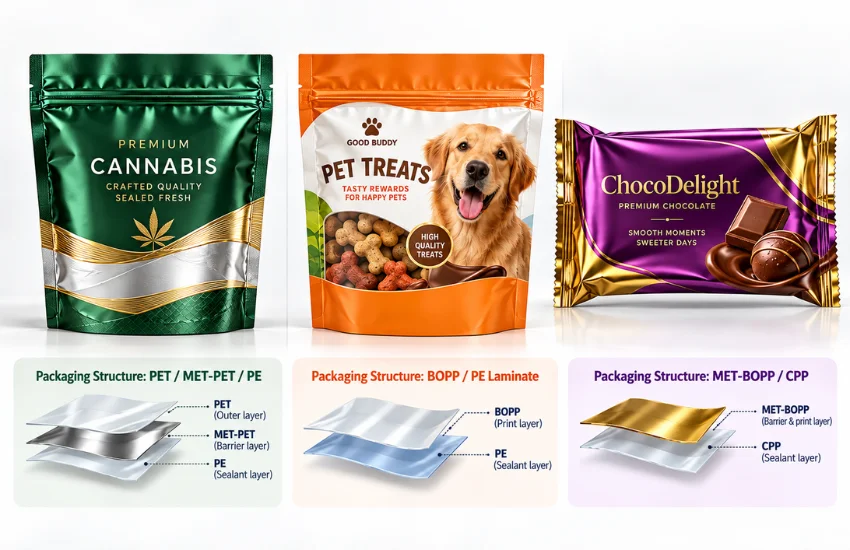
Aroma, light, grease, and heat-seal requirements differ by application — cannabis, pet, and confectionery each favor different structures.
Cannabis Flower and Edible Pouches
Flexible cannabis packaging carries some of the toughest barrier demands in this guide. Aroma containment runs in both directions: terpene retention inside, odor control outside. That pushes most cannabis pouches toward PET-based laminates with a metallized or foil layer, because oxygen and aroma barrier are the governing requirements.
Light protection is the second driver. Cannabinoid stability degrades under UV exposure, so opaque or metallized structures are common even when brands would prefer a window. Full opacity also creates a larger printable panel — useful, because cannabis SKUs carry dense mandatory copy, warning symbols, QR codes, and lot identifiers that compete directly with brand graphics.
Two operational notes: child-resistant pouch hardware such as zippers and sliders adds seal complexity, so qualify seal integrity with the hardware installed, not on a plain pouch. Packaging and labeling requirements vary by state and change frequently — verify current requirements with your regulator or counsel before locking artwork.
Recommended fit — cannabis flower and edibles
PET-based metallized or foil laminate, opaque, digitally printed for jurisdiction-specific artwork versions.
Pet Food and Treat Bags
Pet food packaging puts grease and oil resistance first — true across formats, but especially for pet food flexible packaging like stand-up pouches and gusseted bags. High-fat kibble, jerky, and freeze-dried treats can wick oil into a structure, causing delamination, ink lift, or a translucent stain on the panel. Confirm grease resistance and food-contact suitability against your supplier’s documentation for the specific structure and product type.
Format and fill weight drive the rest of flexible pet packaging. Larger gusseted, quad-seal, and flat-bottom bags need stiffness for shelf presentation and puncture and scuff resistance for palletized distribution. BOPP’s stiffness-to-cost ratio and its performance with matte tactile finishes make it a common choice, typically laminated to a sealant web and metallized when oxidation control is needed.
Distribution abrasion deserves a real test on any pet food pouch or bag format. Reverse-printed structures protect ink under the outer web; surface-printed structures need an overlacquer or lamination, or the graphics will scuff in transit.
Recommended fit — pet food and treat bags
BOPP-based laminate (clear or metallized), matte or gloss, reverse-printed for abrasion resistance on larger formats.
Confectionery Flexible Films
Chocolate is a moisture and temperature problem: fat bloom and sugar bloom both trace to moisture migration and thermal cycling, so moisture barrier and a controlled heat-seal window carry more weight than oxygen barrier alone. Gummies and hard candy bring stickiness and moisture pickup, which again favors a strong moisture barrier.
The heat-seal window is the constraint most teams underestimate. Heat-sensitive product limits how hot and how long you can seal, and BOPP’s own heat sensitivity narrows the window further. PET-based structures tolerate more aggressive sealing, which can be the deciding factor on high-speed lines.
Shelf impact and SKU churn round it out. High-gloss and metallic BOPP delivers strong shelf presence, and BOPP’s dead-fold behavior suits twist-wrap and flow wrap packaging alike. Seasonal and promotional runs turn over fast, which makes short-run digital printing on a standardized web far more practical than committing pre-printed film per variant.
Recommended fit — confectionery flexible films
Metallized or clear BOPP laminate for most wraps and bags; PET-based structure where oxygen sensitivity or seal-window headroom governs.
Cannabis packaging and labeling requirements vary by state and change frequently. Verify current requirements with your regulator or legal counsel before finalizing artwork. Arrow Systems sells digital flexible packaging printing hardware; Arrow does not provide regulatory or compliance advisory services.
A Practical Substrate Qualification Workflow
Run this seven-step workflow before committing to a roll or a print profile — from shelf-life target to a locked, version-controlled profile.
Step 1: Define shelf-life target and distribution profile
Note product sensitivity (oxygen, moisture, light, grease), fill weight, expected temperature and humidity range, transit mode, and time to shelf.
Step 2: Shortlist two or three candidate structures
For example, a PET-based metallized laminate and a metallized BOPP option. Request supplier documentation for barrier values, food-contact suitability, and treatment level at manufacture.
Step 3: Confirm press, ink, and finishing compatibility
Verify the exact grade against your press vendor’s qualified list. Check dryer and cure temperatures against the film’s heat tolerance, and confirm sealant compatibility with your sealing equipment.
Step 4: Print and adhesion test
Print representative artwork — including mandatory copy, barcodes, and QR codes — on each candidate. Run dyne pen checks on incoming rolls, tape or crosshatch adhesion tests after cure, and barcode verification on the actual substrate.
Step 5: Seal, drop, and abrasion test
Seal filled pouches with the real hardware (zipper, valve, laser score) on the real equipment, then run seal integrity, drop, and transit simulation testing on filled units.
Step 6: Pilot run at realistic length
Run a production-representative quantity to expose web handling, static, registration drift, and changeover issues that a short sample never reveals.
Step 7: Lock the print profile and version control
Record substrate grade and supplier lot, treatment window, ink set, cure settings, tension profile, and artwork revision as one linked record so the next run reproduces the approved result.
Frequently Asked Questions — Mylar vs BOPP Flexible Packaging
Common questions from packaging engineers, QA leads, and brand owners on choosing between PET (Mylar) and BOPP flexible packaging film.
No. PET generally provides a stronger oxygen and aroma barrier than BOPP at comparable gauge, while BOPP generally provides a stronger moisture barrier. For chocolate, gummies, or any moisture-driven product, BOPP may be the better base film. Both films are usually laminated anyway, and the metallized layer, foil, EVOH, or barrier coating typically determines real-world performance more than the base web. Compare complete structures using supplier-tested values, not film names.
Both print well on qualified grades, but they behave differently. PET is dimensionally stable under heat and tension, which supports tight registration and tolerates hotter drying and curing. BOPP is more prone to heat distortion and its corona treatment decays faster in storage, so incoming dyne checks matter more. Metallized versions of either film usually require a white ink layer for accurate color. Use the specific grade your press vendor has qualified, and adhesion-test every new film, ink, and profile combination.
Monoweb films can work for short-shelf-life, low-sensitivity products such as some candy wraps and single-serve items. But monowebs generally cannot deliver both a strong oxygen barrier and reliable heat sealing, and they offer no light blocking without a pigmented or metallized grade. If your product is sensitive to oxygen, aroma loss, light, or grease, or needs multi-month shelf life, plan on a laminate. Define the shelf-life target first, then let the requirement determine the structure.
Standardize the substrate and vary the print. Pick one or two qualified structures that cover your product sensitivities across SKUs, then print artwork digitally on unprinted stock instead of committing pre-printed film per variant. This is especially valuable for cannabis SKUs facing jurisdiction-specific copy changes and for confectionery seasonal promotions. Keep substrate lot, print profile, and artwork revision linked in one record so scheduling pulls the correct combination and short runs do not turn into scrap.
Get a Flexible Packaging Press Assessment from Arrow Systems
If your team is weighing PET, BOPP, or a laminate structure for cannabis, pet, or confectionery pouches — and which digital press can actually run your candidate substrates — Arrow Systems manufactures the ArrowJet Aqua 800M and ArrowJet Eco 330R, digital presses built to print on PET, BOPP, and other film webs.
Bring two or three candidate structures and a representative artwork file with mandatory copy and codes, and we’ll walk through substrate width and thickness range, treatment requirements, and which ArrowJet platform fits your run lengths.
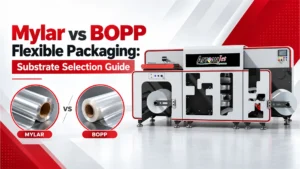
Mylar vs BOPP Flexible Packaging: Substrate Selection Guide
Table of Contents Mylar vs BOPP Flexible Packaging: Substrate Selection Guide PET (Mylar) leads on oxygen and aroma barrier and heat tolerance; BOPP leads on
When to Add a Second Label Printer: Capacity Decision Guide
Table of Contents When to Add a Second Label Printer: Capacity Decision Guide Three measurable signals decide it — sustained utilization above your scheduling ceiling,
Diagnosing Supplement Label Peeling HDPE Bottle Failures
Table of Contents Diagnosing Supplement Label Peeling HDPE Bottle Failures HDPE label peeling traces to low surface energy, an adhesive mismatch, or moisture exposure —
Roll-to-Roll vs. Sheet-Fed Label Printing: Throughput & Cost
Table of Contents Roll-to-Roll vs. Sheet-Fed Label Printing: Throughput & Cost Rolls win on cost per applied label with an automatic applicator; sheets win on
Pet Food Brand Label Supplier Problems: 5 Signs to Print In-House
Table of Contents Pet Food Brand Label Supplier Problems: 5 Signs to Print In-House Most pet food label supplier problems are a model mismatch: flexo’s
Coffee Roaster Flexible Pouch Printing Workflow: Roll to Bag
Table of Contents Coffee Roaster Flexible Pouch Printing Workflow: Roll to Bag In-house coffee pouch printing runs five stages — substrate loading, queue setup, the