When to Add a Second Label Printer: Capacity Decision Guide
Table of Contents When to Add a Second Label Printer: Capacity Decision Guide Three measurable signals decide it — sustained utilization above your scheduling ceiling,

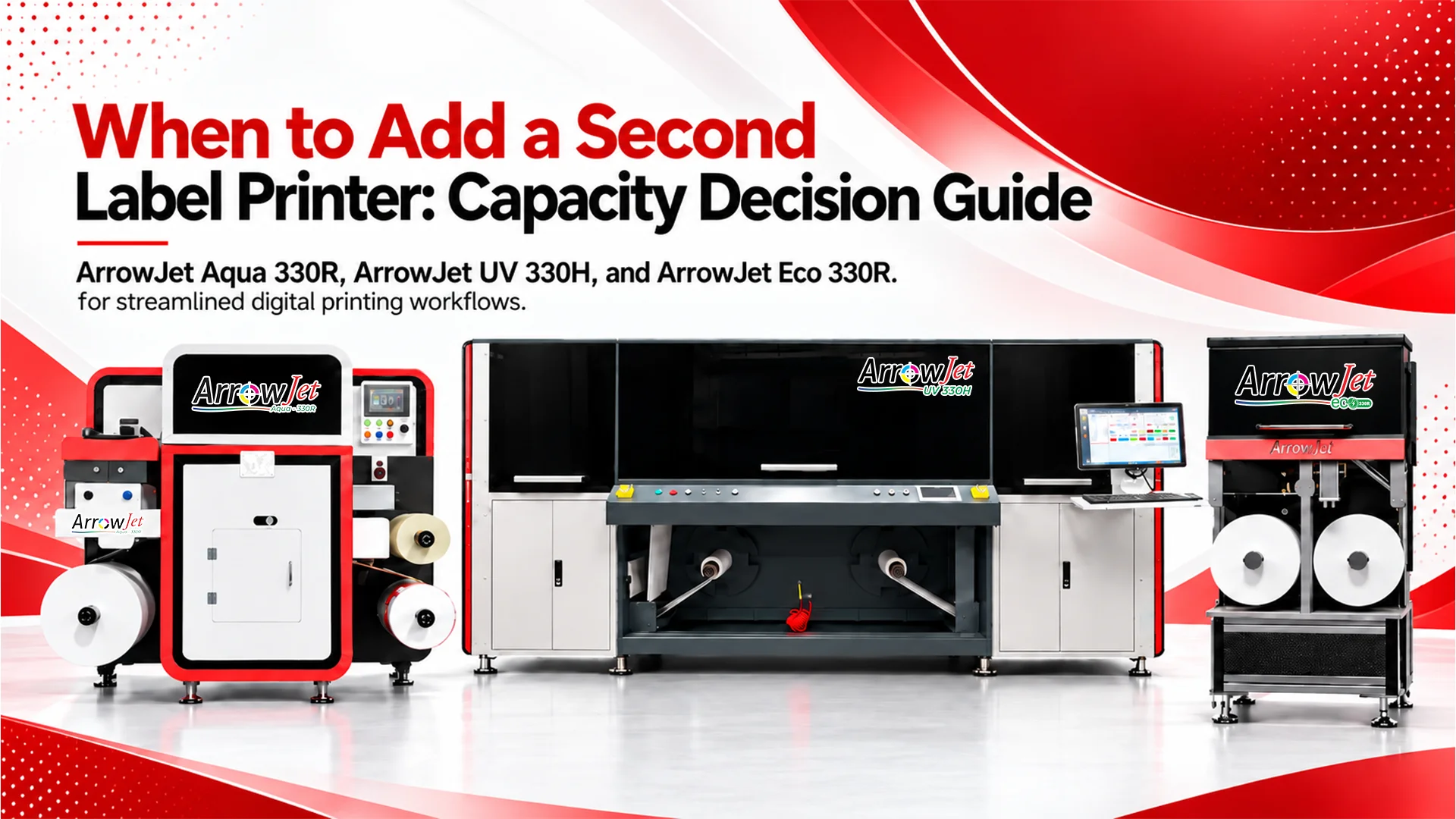
Three measurable signals decide it — sustained utilization above your scheduling ceiling, priced downtime exposure, and a job mix one press can’t cover.
Every second-press request is really either a capacity case or a risk case — and most are written as the wrong one.
There are really just two business drivers behind a second label press decision: capacity growth, where you need more label output than one press can produce inside your available hours, and risk mitigation, where you need a second path to labels so a single press failure doesn’t halt packaging. Almost every capital request gets written as a capacity case because volume charts are easy to defend.
In practice, the risk case is often the real motivation and the format case is often the real constraint. When finance rejects a second-press request, it is usually because the request argued volume while the plant floor was actually solving a reliability or changeover problem. The strongest business cases combine at least two of the three signals — one signal alone, especially volume, rarely survives scrutiny.
Utilization equals productive run hours divided by available scheduled hours — measure it, don’t estimate it from how busy the line feels.
Utilization = productive run hours ÷ available scheduled hours
This single ratio is the starting point for label press capacity planning — everything below breaks it down so the number is one you can trust.
“Productive run hours” means the press is actually imaging saleable labels. Everything else gets broken out separately into its own category, because lumping them together is exactly what hides the real constraint:
Run time
The press is actively producing approved output. This is the only category that counts as productive utilization.
Changeover and setup
Substrate swaps, width changes, color checks, and first-article approval. This is where most operations lose more hours than they realize.
Maintenance
Planned preventive maintenance plus unplanned service. Track both separately since unplanned service is also an input to the downtime worksheet below.
Idle time
The press is available, but there is no job queued or no operator assigned. Idle time signals a scheduling problem, not a capacity problem.
A press that feels 90 percent busy often lands far lower in true utilization once changeover, setup, and waiting-for-approval hours are isolated. That operation does not have a capacity problem — it has a scheduling and finishing problem, and a second press would simply inherit it.
The ranges below are illustrative planning estimates, not industry benchmarks — use them to frame your own measured data.
Peak-Week Utilization | What It Signals | Recommended Action |
Above roughly 75-80%, with a growing backlog | A genuine capacity threshold | Schedules have no absorption left — this is a real second-press signal |
Roughly 60-75% | Borderline | Examine changeover load and shift structure before requesting equipment |
Below roughly 60% | A workflow issue | Fix sequencing, prepress approvals, finishing, or operator coverage first |
Average-week demand never breaks a schedule — peak weeks do. Pull your busiest four weeks of the past year and calculate utilization against those weeks alone. If peak weeks require overtime, weekend runs, or outside converters just to stay on time, you have found your practical throughput ceiling even when the annual average looks relaxed.
If finishing turns out to be the real bottleneck, adding a dedicated finishing line — such as Arrow’s label finishing systems — is usually a smaller capital outlay than a second press, and worth pricing before you request a press quote.
Label printer redundancy is a delivery-reliability decision, not an insurance purchase — price it in dollars before deciding.
If labels are the last step before product ships, press availability sets your on-time performance ceiling. Teams often find the cost of a single-press stoppage is larger than assumed — not because of the press itself, but because of everything that stops behind it.
Estimate your label press downtime cost as an hourly exposure by adding these line items:
Idle downstream labor
Packaging, filling, and case-pack crews waiting on labels. Calculate as fully loaded hourly rate multiplied by headcount.
Expedited outside label purchases
Premium per-thousand pricing versus your in-house cost, plus any plate or setup charges the outside converter bills.
Freight upgrades
Air or expedited ground freight required to recover a missed shipping window.
Missed ship dates
Retailer or customer chargebacks, late-delivery penalties, and rescheduled delivery appointments.
Held finished product
Dated, lot-coded, or batch-released goods that cannot practically move without the correct labels applied.
Recovery overtime
Hours spent catching the schedule back up after the press returns to service.
Annual exposure ≈ hourly exposure × realistic annual unplanned outage hours
Use your own service history for outage hours — parts lead times, printhead events, and technician wait time all count. Any figure you plug in here is an illustrative planning estimate, so run a conservative case and an aggressive case and present both. Exposure runs highest in single-shift plants with no catch-up window, operations shipping dated or lot-coded product, and anyone serving tight retail delivery appointments.
Sometimes the constraint isn’t hours at all — it’s physics, when a label press job mix pulls in opposite directions on a single press.

Web width
Narrow-web drug facts panels alongside wide-format case and pail labels pull toward opposite ends of a press’s capability.
Substrate family
Coated paper, BOPP and PE films, and durable synthetics behave differently under tension and cure, often on the same schedule.
Finish and durability
Matte versus gloss, varnish or lamination requirements, freezer-grade adhesives, and chemical- or abrasion-resistant stocks each demand different finishing paths.
Variable data
Batch codes, lot numbers, and date-coding jobs colliding with long-run brand work on the same schedule — the single most common changeover bottleneck, since short variable-data batches interrupt long runs and each interruption costs setup time that never shows up in a volume report.
Cross-vertical examples of a bimodal job mix:
When the mix is bimodal like this, a complementary second press — a different width range, a different substrate envelope, or a separate finishing path — often outperforms an identical twin. An identical twin maximizes interchangeability; a complementary configuration removes the changeovers that were eating your hours.
Frame second-press ROI as incremental capacity value measured against total cost of ownership — not a single payback number.
Operator coverage is the line item teams forget most often: a second press without a second trained operator is a second bottleneck. You have bought capacity you cannot schedule. Payback on a second digital press varies widely with job mix and shift pattern, so treat any published range as an illustrative planning estimate and build yours from your own outsourcing invoices, overtime ledger, and declined-quote log — those three documents usually hold more of the business case than the volume report does.
Once the decision is made, a two press label operation succeeds or fails on how work gets routed between the two lines.
What that looks like with specific ArrowJet configurations depends on whether your job mix is homogeneous or bimodal:
Identical twin: two ArrowJet Aqua 330R presses for interchangeable long-run work
Running two ArrowJet Aqua 330R presses side by side maximizes interchangeability: a shared 380mm maximum media width, matched speed tiers of 90, 150, and 195 ft/min, and one color and substrate profile across both lines. Any job can run on either press, which simplifies scheduling, training, and spares inventory. This fits a homogeneous job mix — largely paper and film labels across the Aqua 330R’s verified verticals of food & beverage, cosmetics, pharmaceutical, nutraceutical, and flexible packaging — where the goal is throughput, not format diversity.
Complementary substrate range: pairing the ArrowJet Aqua 330R with the ArrowJet UV 330H
When the job mix pulls toward films, foils, and synthetic stocks needing scratch- and chemical-resistant chemistry, pairing the Aqua 330R with the hybrid roll-to-roll and flatbed ArrowJet UV 330H covers a wider substrate range than two identical presses would. The UV 330H’s CMYK + White and CMYK + Varnish configurations also reach embellishment work the Aqua 330R’s aqueous chemistry doesn’t produce. This pairing suits the bimodal scenarios above — a food co-packer alternating paper day-labels with freezer-grade film, or a beverage producer mixing decorative primary labels with dated case labels.
Dedicated short-run or variable-data line: adding an ArrowJet Eco 330R
Short variable-data batches — lot numbers, batch codes, date coding — are the most common changeover bottleneck when they interrupt long brand runs on a single press. Dedicating an entry-level ArrowJet Eco 330R to that short-run workload frees the primary press for uninterrupted long-run production, and gives the operation a lower-cost second line for proofing and sampling rather than a second full-capability press.
Run your utilization and downtime exposure for one full quarter, then pressure-test the result against your actual job mix before you request a quote.
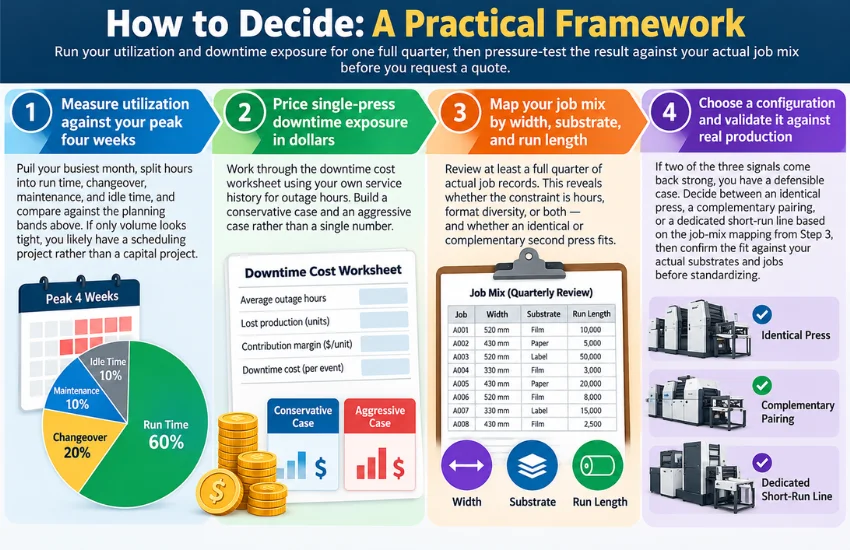
Step 1: Measure utilization against your peak four weeks
Pull your busiest month, split hours into run time, changeover, maintenance, and idle time, and compare against the planning bands above. If only volume looks tight, you likely have a scheduling project rather than a capital project.
Step 2: Price single-press downtime exposure in dollars
Work through the downtime cost worksheet using your own service history for outage hours. Build a conservative case and an aggressive case rather than a single number.
Step 3: Map your job mix by width, substrate, and run length
Review at least a full quarter of actual job records. This reveals whether the constraint is hours, format diversity, or both — and whether an identical or complementary second press fits.
Step 4: Choose a configuration and validate it against real production
If two of the three signals come back strong, you have a defensible case. Decide between an identical press, a complementary pairing, or a dedicated short-run line based on the job-mix mapping from Step 3, then confirm the fit against your actual substrates and jobs before standardizing.
Common questions from production managers, operations leads, and finance approvers evaluating a second label press.
As an illustrative planning estimate, sustaining a label printer utilization rate above roughly 75-80% of available scheduled hours — productive run hours divided by available hours — combined with a growing backlog signals a real capacity ceiling. Below about 60%, the constraint is usually scheduling, prepress, finishing, or operator coverage rather than press hours. Calculate utilization against your peak four weeks, not your annual average, because peak demand is what breaks delivery schedules. Isolate changeover and setup time from run time first.
It can be, when the downtime exposure math supports it. Build the hourly exposure figure from idle downstream labor, expedited outside label purchases, freight upgrades, chargebacks, and product that cannot ship without correct dated or lot-coded labels. Multiply by realistic annual outage hours drawn from your own service history. Operations shipping dated product on single-shift schedules with tight retail windows tend to carry the highest exposure, and for them redundancy alone can justify the investment.
Match when the job mix is homogeneous, because two identical ArrowJet Aqua 330R presses maximize interchangeability, and simplify training, spares, and color management. Choose a complementary configuration when the mix is bimodal — pairing the Aqua 330R with the hybrid ArrowJet UV 330H covers a wider substrate range, while dedicating an ArrowJet Eco 330R to short-run and variable-data work removes the changeovers that were eating your hours. Review at least a full quarter of actual job records by width, substrate, and run length before deciding.
It depends on which format-diversity gap the second press needs to close. The ArrowJet UV 330H adds film, foil, and synthetic substrate range plus CMYK + White and Varnish configurations for durability and embellishment work the Aqua 330R’s aqueous chemistry cannot produce. The ArrowJet Eco 330R is the lower-cost option for dedicating a line to short-run and variable-data jobs, freeing the primary press for uninterrupted long-run production. Map your actual job mix by width, substrate, and run length before choosing between the two.
Once you’ve run the utilization and downtime numbers above, Arrow Systems can walk through configuration options for your specific web width, substrate, and job-mix requirements — an identical ArrowJet Aqua 330R, a complementary ArrowJet UV 330H, or a dedicated ArrowJet Eco 330R — and provide specifications and a quote for the press that fits.
Request a press consultation:
Table of Contents When to Add a Second Label Printer: Capacity Decision Guide Three measurable signals decide it — sustained utilization above your scheduling ceiling,
Table of Contents Diagnosing Supplement Label Peeling HDPE Bottle Failures HDPE label peeling traces to low surface energy, an adhesive mismatch, or moisture exposure —
Table of Contents Roll-to-Roll vs. Sheet-Fed Label Printing: Throughput & Cost Rolls win on cost per applied label with an automatic applicator; sheets win on

Table of Contents Pet Food Brand Label Supplier Problems: 5 Signs to Print In-House Most pet food label supplier problems are a model mismatch: flexo’s
Table of Contents Coffee Roaster Flexible Pouch Printing Workflow: Roll to Bag In-house coffee pouch printing runs five stages — substrate loading, queue setup, the
Table of Contents Overlaminate vs. Varnish Labels: How to Choose Protection Film overlaminate protects against immersion, wash-down, and solvents; UV and aqueous varnish suit retail