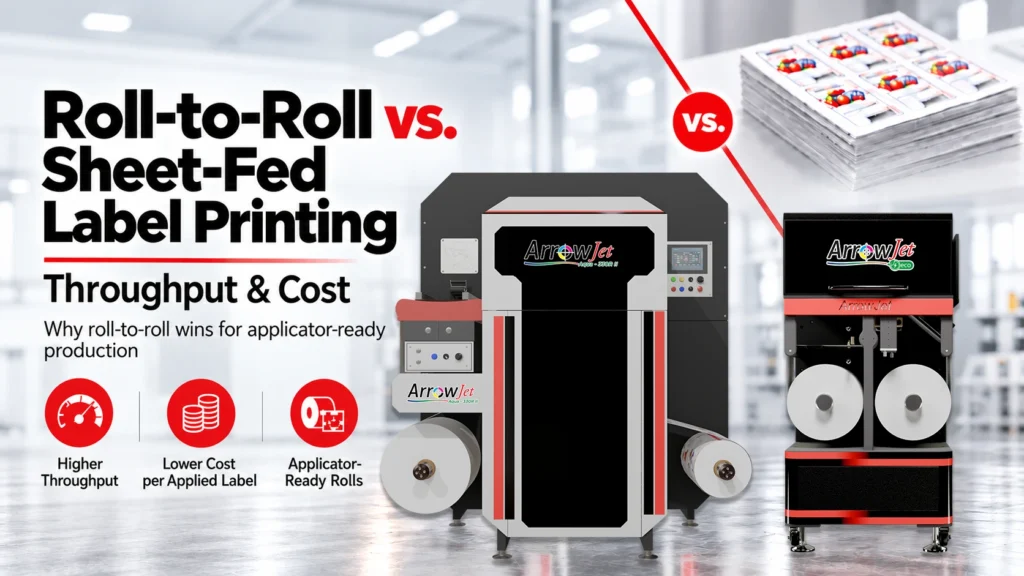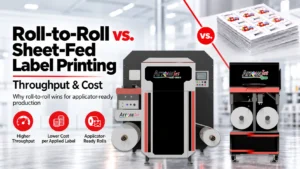
Roll-to-roll versus sheet-fed label printing production comparison.

Table of Contents

Roll-to-Roll vs. Sheet-Fed Label Printing: Throughput & Cost

Rolls win on cost per applied label with an automatic applicator; sheets win on prototypes, proofs, and one-off runs.
Key Takeaways

  • A continuous liner web is a mechanical requirement for every automated label applicator and print-and-apply head — sheets cannot feed that machine without re-converting into rolls first.
  • Cost per applied label, not cost per printed label, is the number that actually decides format; application labor is typically the largest hidden cost variable in the comparison.
  • Digital roll-to-roll printing removed the plate-based economics that made short runs sheet-only, pushing the practical breakeven run length down substantially.
  • Applicator-ready rolls depend on getting unwind direction, core ID, maximum roll OD, and label pitch specified correctly before ordering — not after the roll arrives.
  • Most label operations run hybrid: sheets for proofs, pilots, and regulatory review copies; rolls for everything that touches a production line.

How Roll-to-Roll Label Production Works

A roll-to-roll press images a continuous web under tension, then finishes it inline or near-line into applicator-ready rolls.

A roll-to-roll label press treats label stock as a continuous web. Material unwinds from a parent roll of pressure-sensitive facestock under controlled tension, passes the print engine, then moves into finishing — either inline on the same pass or near-line on a separate finishing unit.
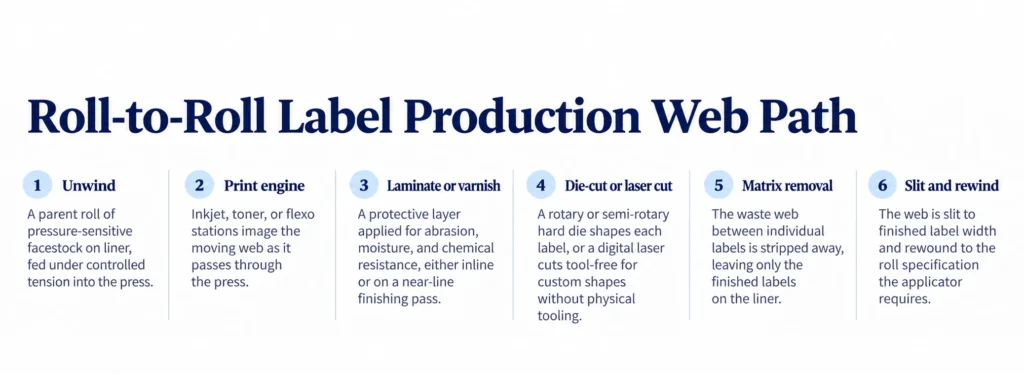
Typical Web Path

Unwind
A parent roll of pressure-sensitive facestock on liner, fed under controlled tension into the press.
Print engine
Inkjet, toner, or flexo stations image the moving web as it passes through the press.
Laminate or varnish
A protective layer applied for abrasion, moisture, and chemical resistance, either inline or on a near-line finishing pass.
Die-cut or laser cut
A rotary or semi-rotary hard die shapes each label, or a digital laser cuts tool-free for custom shapes without physical tooling.
Matrix removal
The waste web between individual labels is stripped away, leaving only the finished labels on the liner.
Slit and rewind
The web is slit to finished label width and rewound to the roll specification the applicator requires.
Roll-to-roll label production web path diagram from unwind through print, laminate, die-cut, matrix removal, slit, and rewind.
Finished roll specifications are where roll production earns its throughput advantage — and where it fails if they are wrong:

Finished Roll Specifications an Applicator Requires

Unwind/exit direction
Commonly numbered 1–8, this must match what the applicator head expects. A wrong-direction roll idles the line rather than running it.
Core ID
The label applicator core ID is usually 1″, 3″, or 6″, dictated by the applicator’s mandrel.
Maximum roll OD
Limited by the applicator’s unwind arm and enclosure clearance.
Labels per roll
Drives roll-change frequency, and therefore how often the line stops.
Label pitch and gap consistency
The applicator’s sensor reads the gap between labels, so inconsistent pitch causes missed or double-fed labels.
A continuous liner web is the native input format for every automatic pressure-sensitive applicator and print-and-apply head on the market. That is not a preference; it is a mechanical requirement.

How Sheet-Fed Label Production Works

Sheet-fed production images individual sheets with multiple labels imposed per sheet, then finishes and hand-applies them off the press.

Where Sheet-Fed Genuinely Excels

  • Prototypes, artwork proofs, and retail mock-ups.
  • Very low counts — a 25-label pilot batch for a nutraceutical stability study.
  • Unusual die shapes where tooling is not justified.
  • One-off variable pieces, such as sample kits or trade-show comps.
  • Substrates or thicknesses that do not web well.

Structural Limits of Sheet-Fed Production

  • Sheets must be handled, stacked, and squared, and handling introduces edge damage.
  • Sheet-to-sheet registration varies more than a tension-controlled web.
  • No continuous liner means no way to feed an automatic applicator.
  • Labels are peeled off by hand, one at a time.

Application Speed: Where Roll Format Separates Itself

Automatic applicators require a continuous web, so sheet-fed output nearly always means labor-bound hand application in production.

This is the part most format comparisons skip, and it is usually the deciding factor.

Print and apply label applicators pull a liner web across a peel plate at controlled speed, use a gap sensor to index each label, and wipe it onto the container. They need a continuous web, consistent pitch, and the correct rewind direction. Sheets cannot feed that machine. Running sheet-fed output on an applicator means re-converting it into rolls, which means paying twice for finishing or shipping the job out.

So sheet-fed labels in production almost always mean hand application. That step is operator-paced and labor-bound: throughput scales only by adding people or hours, and consistency depends on the individual. Roll-fed labels on an applicator are machine-paced and continuous: throughput scales with line speed, and the only planned interruptions are roll changes and splices.

Illustrative example only: if hand application takes roughly 6–10 seconds per unit including peel, align, and wipe, one operator handles a few hundred units per hour. An applicator running in line clears that in minutes. Treat these as directional figures, not measured results — actual rates depend on container geometry, label size, and operator skill.

How This Plays Out Across Verticals

Beverage
High-speed bottling and canning lines cannot absorb an operator-paced step anywhere in the flow. Roll, always.
Nutraceutical
Bottle lines with wrap or front/back applicators need matched rolls in the correct unwind direction; a wrong-direction roll idles the line.
Contract packaging
Frequent SKU swaps make roll-change discipline and labels-per-roll planning a scheduling variable, not an afterthought.
Industrial goods
Drum, pail, and carton labeling often uses print-and-apply heads that require specific core IDs and maximum roll OD.
Personal care
Decorative shapes and clear-on-clear films still run roll-fed in production, with sheets reserved for design review.

Cost Per Label: The Full Cost Stack

A quoted price per printed label omits application labor, finishing, waste, and rework — the full stack decides the true cost per applied label.

A quoted price per printed label is only the first line item. A defensible cost-per-label calculation includes:

Substrate and ink or toner
Per square inch of web or sheet consumed.
Plates, dies, and setup
Amortized over the run, and zero for many digital jobs.
Makeready and web waste
Startup material consumed before the run stabilizes.
Finishing labor
Matrix removal, slitting, and rewinding, or sheet trimming and stacking.
Application labor per unit
The largest hidden variable in the entire comparison.
Inventory carrying and obsolescence
Space, tracking, and scrap when artwork or a regulatory panel changes.
Rework
Misapplied, skewed, or illegible labels, plus any line stoppage they cause.

Illustrative Cost-Per-Applied-Label Example

Cost per printed label vs applied label is the core comparison — the two numbers rarely match, and only one of them reflects what the label actually costs to put in a customer’s hands.

This is a hypothetical model with stated assumptions, not measured data. Substitute your own figures. Assume a 10,000-unit run and fully loaded labor at $30 per hour ($0.50 per minute):

Cost elementSheet-fed + hand applyRoll-fed + applicator
Printed label cost$0.030$0.038
Finishing/convertingincluded$0.004
Application labor8 sec/unit = $0.067negligible per unit
Waste + rework allowance$0.004$0.002
Illustrative cost per applied label~$0.101~$0.044

Sheet-fed wins on price per printed label and loses badly on cost per applied label. Drop the volume to 200 units and the picture reverses: application labor is trivial at that scale, and no tooling or roll setup is justified.
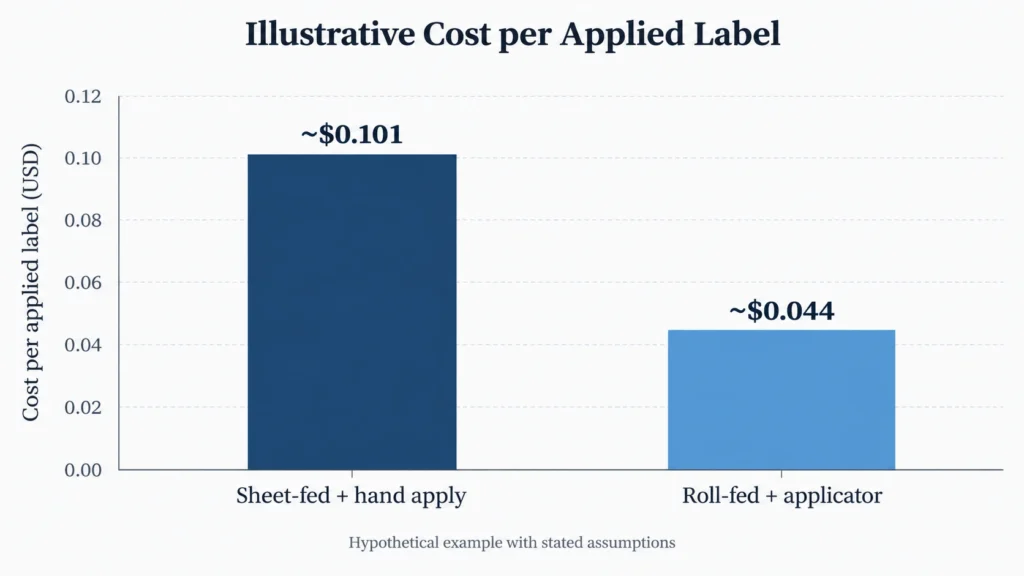
Cost per applied label comparison chart for sheet-fed versus roll-fed label production.

Two costs deserve specific attention: re-converting sheets into rolls so they will run on an applicator, and overbuying to hit converter minimums on low-volume or seasonal SKUs. Both are common, and neither appears in a per-label quote.

What Digital Printing Changed

Digital roll-to-roll production removed most of the plate-based economics that made short runs sheet-only, moving the practical breakeven down.

The old rule — short run means sheets — was built on plate-based economics. Roll to roll digital printing removed most of what made short roll runs expensive:

No plates, and with laser cutting, no hard dies
On many jobs, so tooling cost stops driving the breakeven.
Near-zero setup between SKUs
A file change instead of a plate change and washup.
Variable data and versioning inside one run
Lot codes, language versions, or a dozen SKUs on a single web.
Inline or near-line finishing
Laminate, cut, strip, slit, and rewind to applicator-ready rolls without an outside converter.

The practical effect: teams typically find the breakeven run length moves down substantially, and roll format becomes viable at quantities that would have been sheet-only under flexo. Treating “short run” as automatic justification for sheets is no longer a safe default.

Digital roll production also fits cleanly into operations automation. Label jobs can be triggered by the production schedule rather than a separate purchase order, variable fields can be pulled from a system of record so lot and date data is never retyped, and inline verification can check codes before the web reaches rewind.

Decision Framework: Lean Roll or Lean Sheet

Eight criteria — from annual volume to lead-time sensitivity — determine whether an operation should lean roll or lean sheet.

CriterionLean roll when…Lean sheet when…
Annual volumeTens of thousands or moreHundreds to low thousands
Typical run lengthRepeatable, a few hundred or more per SKUOne-off or under roughly 100
SKU countHigh mix with repeat ordersA handful of experimental items
Revision frequencyFrequent — print on demand, no obsolete stockRare, or single-use proofs
Application methodAutomatic applicator or print-and-applyHand application, no applicator on site
Substrate/finishFilms, laminates, specialty adhesives at volumeOdd thicknesses, unusual finishes, small counts
Shape complexityRepeating shape suited to a die or laser cutGenuinely one-off shapes
Lead-time sensitivitySame-day or next-day turns needed in-houseNo urgency

Most operations end up hybrid, and that is the correct answer: sheets for proofs, samples, and regulatory review copies; rolls for everything that touches a production line.

ArrowJet Systems for Roll-to-Roll Production

Arrow Systems manufactures ArrowJet roll-to-roll presses and finishing hardware built to produce applicator-ready rolls in-house.

Arrow Systems, a manufacturer of digital label printing and finishing hardware, builds each ArrowJet as a roll to roll digital inkjet label printer configured around what happens after the print — producing rolls an applicator can actually run.

ArrowJet Press Platforms by Volume and Speed

Whichever volume tier fits, each is a genuine roll to roll label printer built to hand off applicator-ready rolls — not a sheet-fed system adapted after the fact.

ArrowJet Eco 330R — entry-level press for lower-volume production
The Eco 330R is a compact, single-pass digital roll to roll label printer running on single-phase power with no air compressor required. It prints up to 324 mm wide at up to 20 m/min and 1600 × 1600 dpi on a Memjet DuraFlex® engine — a lower-cost entry point for shops moving label work off desktop printers and onto a true roll-to-roll production line.
ArrowJet Aqua 330R — mid-tier press across three speed tiers
The Aqua 330R runs at 90, 150, or 195 ft/min depending on configuration, at up to 380 mm max media width on three-phase 220V/400V power. It runs across food & beverage, nutraceutical, cosmetic, pharmaceutical, and flexible packaging production — the range of verticals where roll-fed applicator readiness matters most.
ArrowJet Aqua 330R Hybrid Pro M — inline primer and varnish stations
The Hybrid Pro M adds inline primer and varnish stations with an inline IR dryer ahead of the print engine, at speeds up to 195 ft/min and up to 400 mm max media width. For operations that need lamination or varnish protection built into the web path — rather than added as a separate finishing pass — this is the roll to roll label printing machine built for it.
ArrowJet Aqua 330R II — the highest-throughput platform in the line
Built on Memjet’s DuraCore™ engine, the Aqua 330R II prints up to 220 ft/min at 322 mm width and up to 1600 × 1600 dpi. For teams whose format call comes down to raw throughput, this is the fastest press in Arrow’s roll-to-roll lineup.

Arrow Finishing Systems for Applicator-Ready Rolls

Arrow’s full range of label finishing systems handles the laminate, die-cut, matrix removal, and slit-and-rewind steps that turn a printed web into a roll an applicator can actually run.

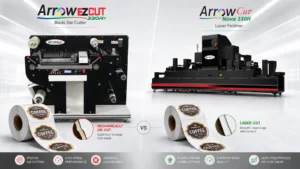
Arrow EZCut 330R+ — flatbed and roll-to-roll hybrid die cutting
The EZCut 330R+ cuts up to 350 mm wide at up to 150 cuts/minute with ±0.1 mm accuracy, and handles self-adhesive, PP synthetic, PET, PVC, and aluminum plastic film. Inline cold lamination plus automatic matrix removal and rewinding cover three of the six web-path steps — laminate, die-cut, and matrix removal — in one machine.
Arrow EZCut 350R — higher-throughput multi-blade cutting for core SKUs
The EZCut 350R runs up to six cutting heads with automatic distance adjustment, cutting at 9 m/min, slitting at up to 100 m/min, and die-cutting to ±0.1 mm repeat precision across a 330 mm max label width. Barcode-triggered automatic job changeover suits repeat production runs rather than one-off specialty jobs.
ArrowCut Nova 330R — laser finishing at up to 10,000 labels per hour
The ArrowCut Nova 330R is a roll to roll label cutter that laminates, die-cuts, removes matrix, and slits in one pass with a 150W CO₂ laser — no physical die required. It can also run inline with Memjet print engines at 30 ft/min for a fully automated print-and-finish workflow, and handles up to five slitting knives on a 13.7″ web.
ArrowCut Nova 250R — compact laser finisher for lower-volume runs
The ArrowCut Nova 250R uses a 125W CO₂ Galvano laser to kiss-cut, full-cut, perforate, and etch in a single pass, in a footprint compact enough for an office rather than a dedicated production floor — a fit for lower-volume or frequently changing SKU runs.
ArrowJet Nova 250R — print and cut consolidated into one inline pass
The ArrowJet Nova 250R pairs a single-pass Memjet inkjet engine with an inline laser cutter (up to 150W), printing at 10–60 ft/min with inline slitting and dual rewinders. Where the web path calls for print and finish inline on the same pass rather than near-line on a separate unit, this is the platform that does both in one machine.

Specifications vary by configuration. Validate print, substrate, adhesive, and finishing performance against your actual label sizes, materials, and line conditions before committing to a build.

Compare ArrowJet roll-to-roll configurations against your current converter spend.

Frequently Asked Questions — Roll-to-Roll vs. Sheet-Fed Label Printing

Common questions from packaging engineers, ops and line managers, and QA or compliance leads evaluating label format.
Yes — on very low counts and one-off work. For prototypes, artwork proofs, retail mock-ups, regulatory review copies, sample kits, and unusual die shapes that do not justify tooling, sheet-fed production skips roll setup and converting entirely. That advantage disappears once volume, repeat frequency, or automated application enters the picture, because hand-application labor per unit typically outweighs the lower printed-label cost. Compare cost per applied label, not cost per printed label, and the crossover point becomes visible quickly.
Not without re-converting them. Automatic pressure-sensitive applicators and print-and-apply heads index labels off a continuous liner web using a gap sensor, and they require consistent label pitch plus the correct rewind direction. Stacked sheets provide none of that. Converting sheet output into applicator-ready rolls means paying for finishing a second time or sending the job outside. If your line has an applicator, specifying roll format from the start is almost always the simpler and lower-cost path.

Lower than most teams assume. Because digital roll production eliminates plates, needs little or no setup between SKUs, and can finish to applicator-ready rolls in-house, the practical breakeven usually sits well below traditional flexo thresholds. Many operations find that repeat runs in the few-hundred-label range already favor roll format once application labor and inventory obsolescence are counted. The exact point depends on label size, substrate, finishing requirements, and how much hand-application labor the sheet alternative would demand.

Five things, specified before ordering: unwind or exit direction matching what the applicator head expects, core ID sized to the applicator’s mandrel (commonly 1, 3, or 6 inches), maximum roll OD within the unwind arm’s clearance, labels per roll, and consistent label pitch and gap so the applicator’s sensor indexes each label correctly. Getting any one of these wrong idles the line rather than running it.
Shift toward shorter, demand-aligned print runs using on-demand digital label printing, implement version-controlled artwork workflows, and synchronize label reorder triggers with production planning rather than long-range forecasts. Digital presses such as the ArrowJet Aqua 330R print from approved digital files with no minimum order quantity — so when a rule or formula changes, the revised label is in production within hours, with no pre-printed stock to scrap.
 

Next Step

What to carry into your own review:

  • Decide on cost per applied label, not the printed-label quote.
  • If an applicator is in the line, roll format is a mechanical requirement, not a preference.
  • Spec unwind direction, core ID, maximum roll OD, and labels per roll before ordering, not after.
  • Keep sheets for proofs, pilots, and odd shapes; move repeat production to rolls.
  • Re-test your breakeven against digital roll economics, not plate-based assumptions.

Get a Roll-vs-Sheet Format Review from Arrow Systems

Pick two or three real SKUs — ideally one high-volume item, one frequently revised item, and one you currently hand-apply — and let Arrow Systems run a format and cost-per-applied-label review for packaging, operations, and QA teams.

We map current run lengths, revision frequency, substrate and finish requirements, and your applicator specs (unwind direction, core ID, maximum roll OD, label pitch), then show where sheets are costing you labor. You get a clear roll-versus-sheet recommendation and an ArrowJet configuration path — press and finishing — that can be phased in on one line first.

Book a 20-Minute Labeling Format Review →