Table of Contents
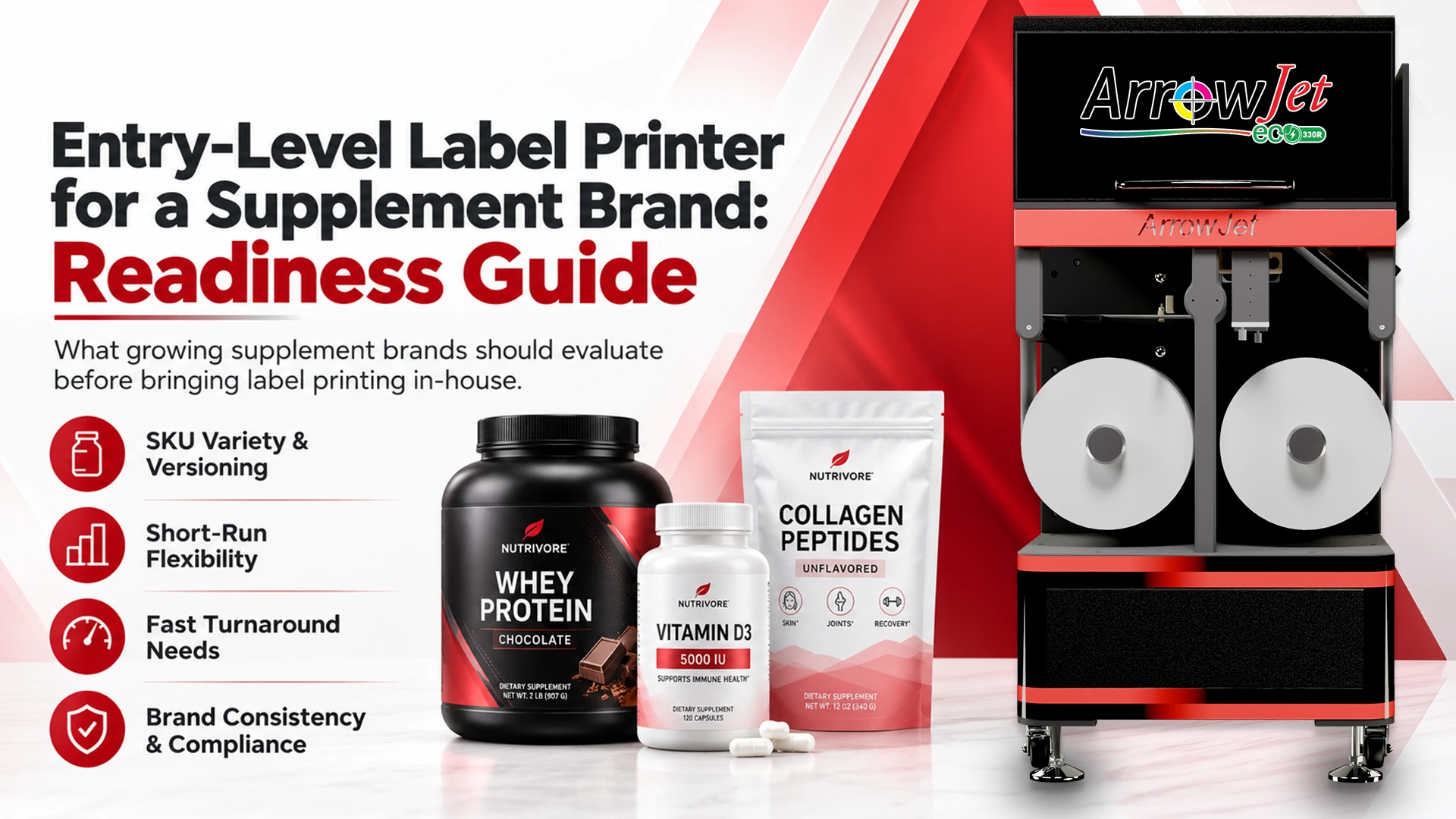
Entry-Level Label Printer for a Supplement Brand: Readiness Guide
A supplement brand is ready for an entry-level label printer when it passes four tests: volume, SKU count, revision frequency, and team ownership.
Key Takeaways
- Compare loaded monthly cost, not per-label price: minimum-order overbuy, obsolescence, expedite fees, and carrying cost all belong on the outsourced side of the comparison.
- Revision frequency predicts payback better than raw SKU count, because every supplement facts panel edit turns minimum-order label inventory into scrap.
- Staffing is the test most first-press decisions fail: a trained primary operator, a cross-trained backup, and named owners for artwork approval and preflight must exist before install.
- A hybrid model that moves high-revision, low-volume SKUs in-house first is the lowest-risk entry point for most emerging supplement brands.
- The ArrowJet Eco 330R is a compact single-pass digital label press that runs on single-phase 230 V power with no air compressor, printing up to 20 meters per minute at 1600 x 1600 dpi.
Outsource, Hybrid, or In-House: The Approaches for a New Private Label Supplement Brand

Outsourcing trades low per-label cost for minimums and scrap; an in-house press trades lead time savings for staffing and utilization risk.
This guide is for founders, operations leads, and quality or compliance owners at private label supplement brands weighing flexo runs from a converter against a first in-house digital press. Some brands clear all four readiness tests and should move now. Others are better served by a hybrid approach for another six to twelve months. Both answers are defensible.
Outsource-only label production
The brand sends artwork to a converter, the converter prints and ships rolls, and labels are applied in-house or at a co-packer. Outsourcing works well when the SKU list is short, formulas are stable, and volume per SKU is high enough to consume a minimum order before the next revision lands.
Risks of outsource-only for supplement brands
Minimum order quantities force a brand to buy a year of labels for a formula that may change in a quarter. Lead times measured in weeks push launch dates, and expedite fees appear whenever a retailer moves up a reset. When a supplement facts panel edit or an ingredient sourcing swap lands, label inventory already in the rack becomes scrap.
In-house entry-level digital label press
The brand prints short runs on demand, roll-to-roll, then laminates, die-cuts, slits, and rewinds labels for its applicator. Lead time drops from weeks to hours or days, and obsolete label inventory largely disappears because each run prints only what a batch needs.
Risks of an in-house label press
An underutilized press is capital sitting idle. Prepress, color approval, and finishing land on a team that may already be stretched across compliance, co-packer management, and sales. A single trained operator is a single point of failure: when that person is out, label production stops.
Decision factor | Outsource-only | Hybrid (outsource + in-house short runs) | In-house entry-level press |
Lead time | Weeks, typically | Days for short runs, weeks for bulk | Hours to days |
Minimum run size | Converter minimum per SKU | Minimum for core SKUs, near-zero for the rest | Effectively a single roll |
Cost behavior | Low per label at volume, high obsolescence | Mixed; obsolescence concentrated in core SKUs | Fixed equipment cost plus consumables and labor |
Version-control risk | High: multiple printed versions sit in inventory | Moderate | Low when one approved-file source is enforced |
Internal effort | Low | Moderate | Highest: operator, prepress, finishing, and QC |
Volume Readiness: What Monthly Label Count Justifies an Entry-Level Press?
Volume readiness means enough labels to keep a press busy, spread across SKUs that each order below converter minimums.
Volume readiness
Volume readiness is less about a single label count and more about cost structure. Monthly label volume must be large enough to absorb equipment and labor cost, yet fragmented enough across SKUs that converter minimums force overbuying. A brand crosses that line when a press would stay meaningfully utilized while most SKUs individually order below minimum.
How to size monthly label count from finished-unit output
Take monthly finished units by SKU (bottles, jars, pouches, and stick packs) and multiply by labels per unit. Then add applicator and print setup waste from your own scrap history rather than a rule of thumb, because waste tracks closely with applicator type and label size.
Compare Loaded Monthly Cost, Not Per-Label Price
A converter quote of a few cents per label looks unbeatable until you account for what you paid versus what you actually applied. Four hidden costs distort the per-label comparison:
Minimum-order overbuy
Labels purchased above forecasted 12-month demand to meet a converter minimum order.
Label obsolescence
Label rolls scrapped after supplement facts panel edits, reformulation, or SKU discontinuation.
Expedite and rush fees
Premiums paid to a converter to protect product launch and retail reset dates.
Label inventory carrying cost
Warehouse space, cycle counting, and roll-matching labor spent storing pre-printed labels.
Outsourced monthly cost lines | In-house monthly cost lines |
Average monthly converter invoices | Consumables: ink, label stock, and laminate |
Scrapped label value | Die and finishing wear |
Expedite and rush fees | Operator labor allocated to printing and prepress |
Estimated inventory carrying cost | Monthly equipment finance or lease payment |
Treat these lines as cost structures to populate with your own invoices, not as benchmarks. Volume readiness is met when your loaded outsourced monthly cost meaningfully exceeds your projected in-house monthly cost, with press capacity left over for growth.
Not-yet signal: If two or three high-volume SKUs represent most of your label spend and rarely change, a press will sit idle most of the month. Keep those SKUs on flexo.
SKU and Revision Readiness: How Many Formulas Before In-House Starts Saving Money?
Revision frequency predicts payback better than raw SKU count, because frequently revised SKUs generate the most obsolete label inventory.
Revision frequency, not raw SKU count, is the stronger predictor of whether in-house supplement label printing pays back. Fifty stable SKUs running steady volume can be served efficiently by a converter. Twelve SKUs that change several times a year cannot.
Supplement Label Version Drivers to Count
In nutraceuticals, label versions multiply faster than most founders expect. Count every driver below for each formula:
- Flavor variants and count sizes, such as 30, 60, and 120 count bottles.
- Dosage tiers and potency variants of the same formula.
- Marketplace-specific versions, such as Amazon-required elements versus retail artwork.
- Retailer-specific artwork and chain-mandated changes.
- Private label customers, each with separate branding on a shared formula.
- Supplement facts panel edits caused by ingredient or excipient changes.
- Sourcing swaps that alter the ingredient statement.
- Allergen statement updates and claim wording revisions.
High-revision, low-volume SKU
A formula that sells a modest monthly unit count but is reformulated or re-panelled several times a year. Under minimum-order purchasing, nearly every revision of this SKU creates scrap. Printed on demand, the same revision costs only a file update, which makes this the profile that pays back fastest.
SKU readiness threshold
SKU readiness is met when a substantial share of active SKUs (roughly a third or more, as a working rule to test against your own data) revise more than once a year and order below converter minimums.
SKU not-yet signal
If revisions are rare and driven mostly by rebrand cycles the brand schedules itself, the digital advantage shrinks substantially.
Supplement labeling requirements and claim language change over time, and obligations vary by channel and market. Confirm current requirements with regulatory counsel or a qualified labeling consultant rather than relying on prior artwork. Arrow Systems sells label printing hardware; Arrow does not provide regulatory or compliance advisory services.
Operational Readiness: What Your Team Needs to Run a Digital Label Press
Most first-press decisions fail on staffing: you need a trained operator, a backup, and named owners for artwork approval and preflight.
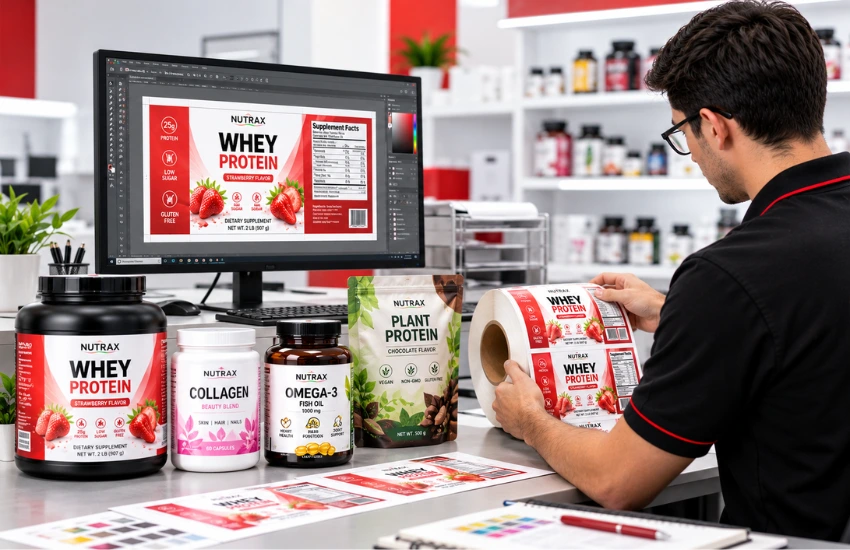
The equipment is the smaller half of a first-press project. The team, workflow ownership, and material decisions determine whether in-house label production runs reliably.
Minimum viable label press team
One trained primary operator who owns press setup, printing, and finishing, plus one cross-trained backup who can run a shift without supervision. Single-operator setups are a common failure mode, because vacations, turnover, and illness all become label production stoppages.
Artwork approval gate
A named person who signs off that a label file is releasable, including supplement facts panel and claim review.
Preflight owner
A named person who checks fonts, bleeds, color space, barcode quiet zones, and minimum type sizes on dense supplement facts panels before files reach the press.
Single source of truth for approved artwork
One defined location for the current approved PDF of each SKU, with superseded versions archived and a check that confirms the operator pulled the right file.
Substrate and adhesive selection
HDPE bottles, glass jars, PET tubs, and flexible pouches all behave differently. Squeeze bottles, cold-chain storage, and oily topicals affect adhesive and laminate selection. Build a short approved substrate list and test each material before committing.
Color approval standard
Digital printing delivers strong run-to-run repeatability when color profiles and process controls are maintained. Brand-critical spot colors need a documented approval standard and a retained reference sample, so approvals do not depend on memory.
Finishing and waste plan
Lamination, die-cutting, slitting, and rewinding are separate steps with their own setup time and scrap. Decide where label production sits in the weekly schedule so it does not collide with bottling runs, and size finishing equipment alongside the press using Arrow’s range of label finishing systems.
Linking label printing to production planning
Triggering label jobs from the production schedule and pulling the approved artwork version automatically removes the two most common sources of mislabeling: wrong quantity and wrong revision.
You are operationally ready when a named primary operator and a cross-trained backup exist, artwork approval and preflight have owners, and one approved-file location is enforced.
Not-yet signal: If label printing would default to “whoever has time,” wait. Hire or train first, then buy.
The Four-Test Readiness Scorecard for Supplement Brands
Grade each of the four readiness tests as pass or not-yet before budgeting for an entry-level label press.
Readiness test | Pass signal | Not-yet signal |
1. Monthly label volume | Loaded outsourced monthly cost meaningfully exceeds projected in-house cost, with press capacity left for growth | Two or three stable, high-volume SKUs account for most label spend |
2. Active SKU and formula count | Many SKUs each order below converter minimums, forcing overbuying | A short SKU list where each SKU consumes a minimum order before it changes |
3. Revision frequency | Roughly a third or more of active SKUs revise more than once a year | Revisions are rare and follow self-scheduled rebrand cycles |
4. Team ownership | Named operator and backup, owners for approval and preflight, one approved-file location | Label printing would default to whoever has time |
Clear all four tests and an entry-level press typically pays back through eliminated obsolescence and compressed lead times. Miss one, most often team ownership, and run a hybrid model for another six to twelve months, moving high-revision, low-volume SKUs in-house first.
Your 30-Day Readiness Check
Seven steps over 30 days turn purchase history, revision counts, and substrate tests into a go, hybrid, or wait decision.
Run this check before you talk to any equipment vendor.
Step 1: Pull 12 months of label purchase history
Record, by SKU, the quantity ordered, quantity applied, unit price, and rush charges for the last 12 months.
Step 2: Count label revisions per SKU
Over the same 12 months, tag each revision by cause: panel edit, sourcing change, claim revision, rebrand, or retailer request.
Step 3: Quantify scrapped label inventory at cost
Include rolls still on the shelf that you know will never be applied.
Step 4: List substrate and finishing requirements
Document label materials across bottles, jars, and pouches, including laminate and adhesive needs.
Step 5: Run the monthly break-even comparison
Compare loaded outsourced cost against estimated in-house consumables, labor, and equipment financing.
Step 6: Sample-test your two most complex artworks
Print them on your actual target substrates and check supplement facts panel legibility, barcode scan rate, and adhesion.
Step 7: Decide go, hybrid, or wait
If the answer is hybrid, name which SKUs move in-house first. Bring the completed worksheet to a labeling review with an Arrow Systems specialist before you request quotes.
ArrowJet Eco 330R: An Entry Point for Supplement Label Production
The ArrowJet Eco 330R is a compact single-pass inkjet label press built for short and medium runs, with single-phase power and no air compressor.
For brands that clear the four tests, the ArrowJet Eco 330R from Arrow Systems, an industrial label printer and labeling systems integrator, is worth evaluating as a first supplement label printer. It sits between desktop label printers and full-scale production presses within Arrow’s range of digital label printers, and nutraceutical labels, short-run and customized jobs, and in-house label printing are among its listed applications.
Short-run and on-demand printing
The ArrowJet Eco 330R prints the quantity a batch requires instead of a converter minimum. That matches the workload of an early-stage supplement portfolio, where one batch may need a few hundred labels and the next revision is already in review.
Resolution for supplement facts panels and barcodes
The press prints at 1600 x 1600 dpi, producing dense supplement facts panel text and scannable barcodes.
Installation and facility requirements
The ArrowJet Eco 330R runs on single-phase 230 V power, requires no air compressor, and has a 78 x 106 x 168 cm footprint. For a supplement brand adding label production to an existing facility, this lowers the electrical and compressed-air work required before install.
Media compatibility
The press uses CMYK water-based pigment inks and runs common pressure-sensitive substrates used for bottle, jar, and pouch applications.
Registration and waste control
Gap and black mark sensors provide accurate registration on pre-cut labels, and dual servo motors with automatic trace-back restart minimize waste. An adjustable printhead height handles varying substrate thickness.
Scaling path for growing supplement portfolios
A brand starting with a handful of formulas can add flavors, count sizes, marketplace variants, and private label customers on the same press, since each new version is a file rather than a new converter order.
ArrowJet Eco 330R specification | Details |
Print technology | Single-pass digital inkjet |
Print engine | Memjet DuraFlex® |
Ink set | CMYK water-based pigment |
Max print width | 324 mm |
Max printing speed | Up to 20 meters per minute |
Resolution | 1600 x 1600 dpi |
Max media roll size | 385 mm |
Max media diameter | 350 mm |
Max media roll weight | 40 kg |
Drying system | IR dryer (optional) |
RIP software | Xitron / Arrow RIP |
Power requirement | Single-phase 230 V; no air compressor required |
Machine dimensions | 78 cm (L) x 106 cm (W) x 168 cm (H) |
Machine weight | 430 kg |
Confirm configuration, substrate compatibility, and finishing requirements with Arrow Systems against your specific volume, SKU mix, and adhesive needs before you budget.
Frequently Asked Questions — Entry-Level Label Printers for Supplement Brands
Common questions from supplement founders, operations leads, and quality owners evaluating a first in-house label press.
There is no universal minimum, because the deciding factor is cost structure rather than raw label count. The case is strongest when monthly volume would keep a press meaningfully utilized and is spread across many SKUs that each order below converter minimums. Run your own loaded-cost comparison, including obsolescence and expedite fees, instead of comparing per-label quotes.
Yes. Fifty stable SKUs running steady volume can be served efficiently by a converter, while twelve SKUs that change several times a year cannot. Every supplement facts panel edit, sourcing swap, or claim revision turns minimum-order label inventory into scrap, so frequently revised, low-volume SKUs are the profile where in-house printing pays back fastest.
Yes. Keep stable, high-volume core SKUs with your converter and move high-revision, low-volume SKUs in-house first. Samples, influencer runs, and new launches also belong in the first wave. For most emerging brands this hybrid model is the lowest-risk entry point, because it builds operator skill on lower-stakes work before core production moves.
The team needs prepress file handling, basic color management, press operation and maintenance, and finishing skills covering lamination, die-cutting, slitting, and rewinding. It also needs disciplined version control: one approved-file location and a documented approval gate. Train a primary operator and a cross-trained backup before install, so the first production week is not also the first training week.
The ArrowJet Eco 330R is a single-pass digital inkjet label press powered by the Memjet DuraFlex engine. It prints CMYK water-based pigment inks at up to 20 meters per minute, with a print width of up to 324 mm and 1600 x 1600 dpi resolution. It runs on single-phase 230 V power and does not require an air compressor.
Request a Label Readiness Assessment from Arrow Systems
Bring your own numbers. Arrow Systems runs a structured, no-obligation label readiness assessment using your 12 months of label purchase history, active SKU list, revision counts, and substrate requirements, mapping current label spend and obsolescence against an in-house press scenario.
You leave with a recommendation: outsource, hybrid, or an in-house entry-level press. If the numbers say not yet, Arrow will tell you. If they support moving, the ArrowJet Eco 330R is one press configuration to evaluate against your volume and SKU profile.
Entry-Level Label Printer for a Supplement Brand: Readiness Guide
Table of Contents Entry-Level Label Printer for a Supplement Brand: Readiness Guide A supplement brand is ready for an entry-level label printer when it passes
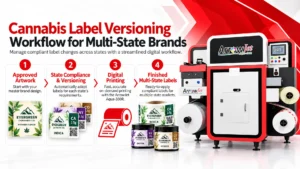
Cannabis Label Versioning Workflow for Multi-State Brands
Table of Contents Cannabis Label Versioning Workflow for Multi-State Brands A cannabis label versioning workflow produces state-specific labels from one master template by moving state-variable
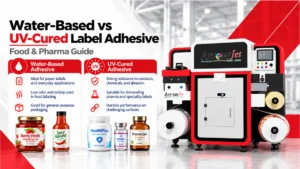
Water-Based vs UV-Cured Label Adhesive: Food & Pharma Guide
Table of Contents Water-Based vs UV-Cured Label Adhesive: Food & Pharma Guide Water-based adhesives suit dry, ambient containers; UV-cured hot melts suit cold, wet, curved
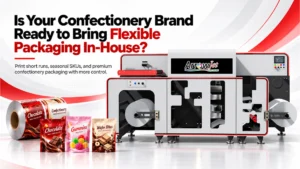
Is Your Confectionery Brand Ready to Bring Flexible Packaging In-House?
Table of Contents Is Your Confectionery Brand Ready to Bring Flexible Packaging In-House? In-house flexible packaging pays off for confectionery brands with many SKUs, short
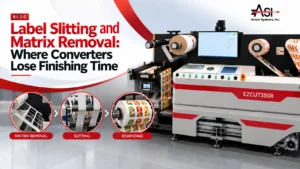
Label Slitting and Matrix Removal: Where Converters Lose Finishing Time
Table of Contents Label Slitting and Matrix Removal: Where Converters Lose Finishing Time Label slitting and matrix removal, plus rewinding, cost converters more finishing time
Limited Edition Spirits Label Printing: 4 Holiday Delay Fixes
Table of Contents Limited Edition Spirits Label Printing: 4 Holiday Delay Fixes Limited edition spirits label printing runs late because of the calendar, not the