Table of Contents
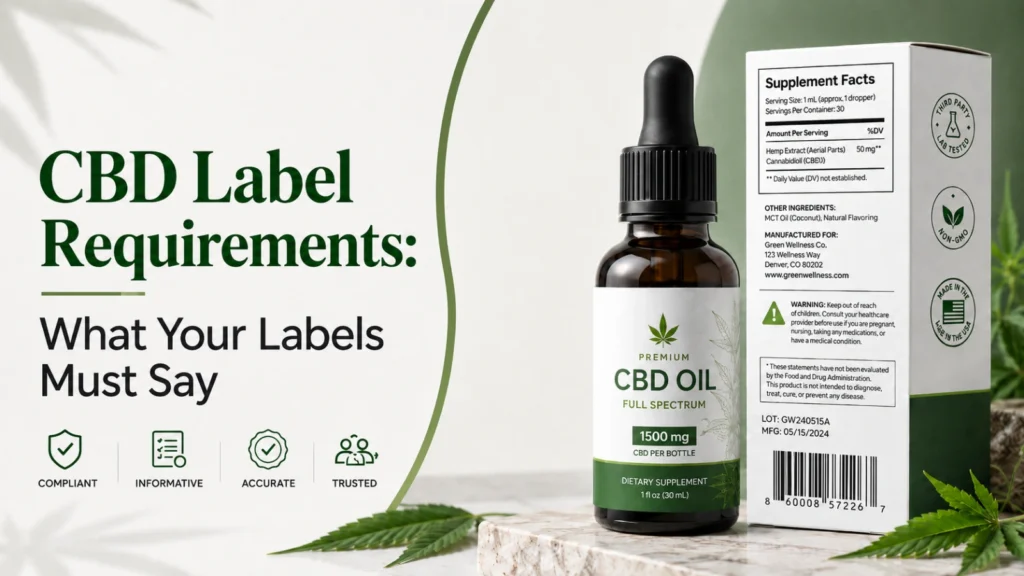
CBD Label Requirements: What Your Labels Must Say
CBD labels must carry truthful product information, avoid medical or therapeutic claims, and comply with both federal guidance and applicable state rules before any print run is committed.
This article is a practical starting point — not legal advice. CBD labeling rules vary by product type, regulatory category, state, and sales channel. Always verify applicable requirements with qualified counsel, relevant regulators, and current FDA and state guidance before finalizing label copy.
Key Takeaways
- CBD label information must not be false or misleading — package copy should match actual ingredients, contents, and intended use.
- Labels that make claims about treating, preventing, or curing a disease or condition can trigger drug classification under FDA oversight — consult counsel before using any health-related language.
- Required statements must be easy to find and read — information buried in fine print does not adequately serve the consumer and may create regulatory exposure.
- State-level CBD labeling rules can differ significantly from federal guidance — verify requirements in every state and sales channel before committing to a print run.
- CBD labeling rules continue to evolve; in-house digital label printing with equipment such as the ArrowJet Aqua 330R, ArrowJet Eco 330R, or ArrowJet Aqua 330R Hybrid Pro M lets brands reprint updated labels on demand without outsourcing delays or minimum order commitments.
Required Elements on a CBD Label
The specific elements required on a CBD label depend on the product’s regulatory category — whether it is sold as a cosmetic, food, dietary supplement, or another product type — as well as the markets where it will be offered. While requirements vary, the following label areas are commonly relevant for CBD-infused health, beauty, and wellness-adjacent products.
Label Element | What It Typically Covers | Notes |
Product identity | The common or usual name of the product | Should accurately describe what the product is |
Net contents | Weight, volume, or count of the product | Format and placement requirements may apply |
Business name and place of business | Manufacturer, packer, or distributor name and address | Required on most consumer product labels |
Ingredient information | Listing of ingredients in the product | Order and format requirements may apply by product category |
Material facts | Information a buyer needs to understand and safely use the product | Varies by product type; may include serving size, use instructions, or storage conditions |
Warning and caution statements | Required advisories relevant to the product | Specific language and placement requirements may apply depending on product type |
The label information requirements for any specific CBD product should be confirmed against the regulatory category applicable to that product and the markets where it will be sold. Use a qualified regulatory attorney or compliance consultant to verify what your product requires before finalizing label design and going to press.
Avoiding Medical and Therapeutic Claims
When packaging states or implies that a product treats a disease, prevents a medical condition, or “affects the structure or function of the body,” that language can cause the FDA to classify the product as a drug. Drug classification triggers a different and substantially more demanding regulatory pathway than a cosmetic or general wellness product.
This is not limited to the product label itself. Warning letter histories from regulatory agencies show that claims made on websites, social media, product inserts, and marketing materials are reviewed alongside label copy. A brand keeping its label copy conservative while making strong health claims on a product detail page is not necessarily protected.
Therapeutic or medical claim
Language that states or implies a product diagnoses, cures, treats, mitigates, or prevents a disease or condition, or that it affects the structure or function of the body. On CBD labels, examples include phrases referencing anxiety relief, pain reduction, inflammation treatment, or sleep disorder management. All such language should be reviewed by qualified counsel before use.
Structure/function claim
A statement about how a product ingredient affects normal body structure or function (e.g., “supports healthy sleep” or “promotes relaxation”). These claims are regulated differently depending on whether the product is a dietary supplement, food, or other category. Requirements differ significantly by product type — verify the applicable standard before using this type of language on a CBD label.
Review all label copy, insert copy, and marketing language as a complete set — not in isolation — before committing to production. Inconsistencies across channels can create avoidable compliance risk even when the label itself uses careful language
Making Required Information Easy to Find
Placement, type size, and contrast all affect whether required information is considered “prominently displayed” under applicable standards. A caution statement printed at 5-point type on the inside of a fold-over label is not serving its purpose, and it may not satisfy the visibility standard that applies to your product.
Planning label layout early — before brand design is fully locked — makes it much easier to accommodate required text alongside creative elements. Leaving space in the wireframe stage avoids the common problem of compliance copy getting squeezed into awkward locations once the design is nearly complete.
Principal display panel (PDP)
The portion of the label most likely to be seen by consumers at the point of sale. Certain product identity and net content information is typically required to appear on the PDP. Check applicable requirements for your product type to determine what must appear here versus what may appear elsewhere on the label.
Information panel
The label panel immediately to the right of the PDP, or the panel that follows in label copy sequence. Ingredient lists, manufacturer information, and other required disclosures are often required to appear here on food, supplement, or cosmetic products. Confirm applicable placement rules with counsel for your specific product category.
Checking State-Specific CBD Labeling Rules
Federal agency guidance provides a baseline, but it does not override or replace state-level requirements. States with active cannabis or CBD regulatory programs — including California, Colorado, and several others — have developed their own rules that can be more specific and more demanding than what federal guidance alone requires.
Before committing to any print run, confirm the applicable requirements for every state and sales channel where the product will be offered. Key questions to answer for each market:
- Does the state require specific warning language beyond what is federally required?
- Are there state-mandated QR code or batch number requirements on the label?
- Does the state limit or restrict certain claims that would be permissible in other markets?
- Are there state-level child-resistant packaging rules that affect label placement or format?
- Does the state require registration or pre-approval of label copy before distribution?
For brands selling in multiple states, the most practical approach is often to identify the most restrictive applicable requirements across all target markets and design a single label that satisfies all of them — rather than managing a matrix of regional label variants. Verify this approach is appropriate for your products and markets with qualified counsel.
CBD Label Design: Compliance and Shelf Presence Together
CBD is a crowded shelf category. Brands that treat the label purely as a compliance document miss a significant opportunity; those that treat it purely as a brand canvas and add required content as an afterthought create compliance problems. The goal is to design a label system that does both jobs well.
Practical approaches that help compliance and design coexist:
Label material and finish
BOPP (biaxially oriented polypropylene) and polyester (PET) film stocks support clear, matte, metallic, and gloss finishes that give CBD labels a premium appearance. Both substrates are compatible with water-based inkjet printing and handle well in retail environments. Substrate choice affects both print quality and the tactile feel of the final label — consider both factors in the design brief.
White space and information hierarchy
White space is not wasted space — it makes required text more readable and the overall label easier to scan. Plan the information hierarchy so the product identity and brand design lead the eye, with required disclosures placed in clearly legible positions rather than competing with decorative elements for space.
Type legibility
Regulatory guidance and consumer expectations both favor readable type sizes. On small-format CBD labels — tincture bottles, topical tubes, and similar formats — space is tight. Use a minimum type size that ensures required statements are genuinely readable without a magnifier, and check contrast ratios between text and background colors before finalizing.
Variable and versioned printing
CBD products often span multiple SKUs — different concentrations, formulations, or product types that share a brand identity but require distinct label copy per variant. Digital label printing systems handle variable data and versioned print runs without the per-version plate cost that makes SKU proliferation expensive on traditional presses.
Printing CBD Labels In-House
The regulatory environment for CBD is still developing. When FDA guidance shifts, when a state adds a new required statement, or when a formula change requires an updated ingredient declaration, brands that depend on pre-printed label inventory face a specific problem: they may have thousands of labels in a warehouse that are no longer correct. Ordering a revised run from an outside converter typically means weeks of lead time and a minimum order quantity that forces overproduction.
In-house digital label printing removes both constraints. The label file is updated in-house, reviewed against the revised requirements, and the press runs the corrected version that day. There are no plates to make and no MOQ floor.
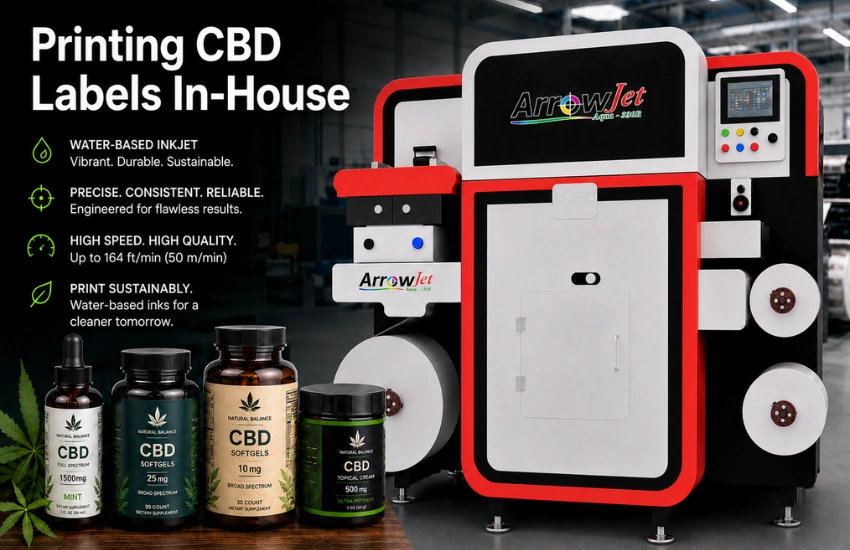
A high-speed water-based pigment inkjet label press for roll-label production. Prints at up to 150 ft/min at 1600 × 1600 dpi on BOPP, polyester, coated paper, and other pressure-sensitive substrates. Suited for CBD brands producing labels across multiple SKUs or concentrations with frequent revision cycles. Supports short and mid-volume runs without plates or minimum order constraints.
A compact industrial single-pass digital label press designed for brands moving label production in-house for the first time. Powered by the Memjet DuraFlex® engine, it prints at up to 20 m/min at 1600 × 1600 dpi with a 324 mm max print width. Runs on single-phase power with no air compressor required — lower infrastructure cost and faster installation for operations that are not set up for a full production press environment. A practical starting point for smaller CBD brands managing short runs and variable product lines.
ArrowJet Aqua 330R Hybrid Pro M
A high-output label press built for high-volume CBD operations that need speed, integrated finishing, and inline quality in a single system. Prints at up to 195 ft/min at 1600 × 1600 dpi on BOPP, PET, coated paper, Tyvek, Mylar, and other substrates, with a 12.75″ (324 mm) max print width. Includes inline primer and varnish stations with an inline IR dryer and digital tension control — features that matter for high-throughput label lines where finishing is managed at the press rather than as a separate step. Supports optional inline rotary slitting or lamination, and is configurable with a 10L bulk ink system for continuous high-volume production. The right choice for CBD brands running large SKU catalogs, high daily volumes, or label formats that require primer or varnish inline.
All three systems produce labels from controlled digital files — the same approved artwork file is used for every run, which supports version control in operations where label accuracy is a documented compliance requirement. When the label needs to change, the file is updated, approved, and reprinted. No obsolete inventory accumulates.
Frequently Asked Questions — CBD Label Requirements
Required elements vary by product type and regulatory category, but CBD labels commonly need to include product identity, net contents, business name and place of business, ingredient information, material facts, and applicable warning or caution statements. Requirements differ depending on whether the product is regulated as a food, dietary supplement, cosmetic, or other category. Always verify the specific requirements for your product, market, and sales channel with qualified regulatory counsel.
Brands should be very cautious. Language that implies a product treats, prevents, or cures a disease or that it affects the structure or function of the body can trigger drug classification under FDA oversight, which carries substantially more demanding regulatory requirements. Consult qualified counsel before finalizing any health-related language on labels, inserts, or marketing materials linked to the product.
Yes. State-level rules vary significantly. Some states — including California — have requirements that go beyond federal baseline guidance. Before committing to a print run, verify applicable rules in every state and sales channel where the product will be offered. For brands selling across multiple states, designing to the most restrictive applicable standard is a common approach, but confirm this strategy with counsel for your specific product and markets.
Required statements should appear where consumers can easily find and read them. Information buried in fine print or placed on an inaccessible panel does not adequately communicate the content to the buyer and may create regulatory exposure. Plan label layout early so required text, brand design, and readable white space can coexist — type size, contrast, and placement all affect whether a statement is considered prominently displayed under applicable requirements.
CBD labeling rules are still evolving at the federal and state level. Brands using pre-printed inventory face cost and delay when requirements change. In-house digital label printers — such as the ArrowJet Aqua 330R, ArrowJet Eco 330R, or ArrowJet Aqua 330R Hybrid Pro M — allow brands to update and reprint label copy the same day a change is needed. No plates, no minimum order quantities, no converter lead times. The right system depends on production volume, SKU count, and whether integrated finishing inline is a requirement.
Print CBD Labels In-House — On Demand, When Requirements Change
Arrow Systems manufactures digital label presses used by brands across the health, wellness, and CBD category to produce accurate, on-demand labels without outsourcing delays or minimum order commitments. See which system fits your production volume and format requirements.
CBD Label Requirements: What Your Labels Must Say
Table of Contents CBD Label Requirements: What Your Labels Must Say CBD labels must carry truthful product information, avoid medical or therapeutic claims, and comply
Medical Device Labels: UDI Requirements, FDA 21 CFR Part 801, and Printing Considerations
Table of Contents Medical Device Labels: UDI Requirements, FDA 21 CFR Part 801, and Printing Considerations FDA 21 CFR Part 801 and the UDI rule
USDA Food Label Guidelines: Six Common FSIS Labeling Mistakes to Avoid
Table of Contents USDA Food Label Guidelines: Six Common FSIS Labeling Mistakes to Avoid USDA FSIS food label approval is blocked most often by six
Beauty Product Labels: INCI Names, Formatting & FDA Rules
Table of Contents Beauty Product Labels: INCI Names, Formatting & FDA Rules Beauty product labels must list every ingredient by INCI name in descending order
GHS Label Printing: HazCom 2012 Compliance for Chemical Manufacturers
Table of Contents GHS Label Printing: HazCom 2012 Compliance for Chemical Manufacturers OSHA HazCom 2012 requires six GHS label elements on every shipped chemical container
Cosmetic Label Printing: 6 Tips for Materials, Design, In-House Production, and Finishing
Table of Contents Cosmetic Label Printing: 6 Tips for Materials, Design, In-House Production, and Finishing The most important decisions in cosmetic label printing are substrate