Table of Contents
USDA Food Label Guidelines: Six Common FSIS Labeling Mistakes to Avoid
USDA FSIS food label approval is blocked most often by six recurring mistakes — all avoidable before artwork goes to print.
Key Takeaways
- USDA FSIS governs labeling for meat, poultry, catfish, and processed egg products and requires label pre-approval before products enter commerce. The FDA governs most other food categories and does not require pre-market label approval.
- The most common source of FSIS label rejection is a mismatch between what the label says and what the formulation, ingredient list, or supporting application documents show.
- Nutrient content claims — including terms like “leaner,” “low carbohydrate,” and “very low in fat” — must be defined under USDA regulations and fully supported by the product before they appear on a label.
- Compliance review should happen before final artwork approval. Catching errors at the design stage costs only revision time; catching them after pre-printed labels are ordered can cost reprinting fees, wasted stock, and production delays.
- In-house digital label printing with equipment such as the ArrowJet Aqua 330R or ArrowJet Eco 330R lets food manufacturers correct and reprint labels on demand — eliminating plate charges, minimum order quantities, and the inventory risk of obsolete pre-printed label stock.
- For meat and poultry labels that must withstand cold storage, condensation, or high-contact handling, the ArrowJet UV 330H produces UV-cured labels with the surface durability and moisture resistance those packaging environments require.
This article is a practical reference and does not constitute legal or regulatory advice. Always confirm current USDA, FSIS, FDA, and applicable state requirements with qualified counsel or regulatory experts before printing labels or submitting label applications.
USDA vs. FDA: Which Agency Governs Your Product Label?
Before reviewing specific labeling requirements, food brands need to confirm which agency has jurisdiction over their product. Applying FDA rules to an FSIS-regulated product — or vice versa — creates compliance gaps that can surface during label review and delay approvals.
USDA Food Safety and Inspection Service (FSIS)
Governs labeling for meat products (including beef, pork, and lamb), poultry products (including chicken and turkey), catfish products, and processed egg products. FSIS requires pre-market label approval for most products in these categories — labels must be submitted, reviewed, and approved before they can be used in commerce. This makes early-stage compliance review especially important: a rejected label application extends the timeline and can delay production scheduling.
FDA (Food and Drug Administration)
Governs labeling for virtually all other food products sold in the US, including packaged grocery items, dietary supplements, beverages under 7% ABV, and most seafood other than catfish. Unlike FSIS, the FDA does not require pre-market label approval — but FDA regulations are still mandatory, and non-compliant labels can result in warning letters, recalls, or import alerts.
Alcohol and Tobacco Tax and Trade Bureau (TTB)
Governs labeling for most alcoholic beverages above 7% ABV through the Certificate of Label Approval (COLA) process. Wine, spirits, and malt beverages each have distinct requirements. TTB jurisdiction is separate from both USDA and FDA.
Products with dual jurisdiction
Some products may involve both FSIS and FDA oversight — for example, a frozen dinner containing both a meat component and non-meat ingredients. In these cases, the labeling requirements for the meat component fall under FSIS, while other labeling elements may involve FDA requirements. Dual-jurisdiction products benefit most from integrated regulatory review before final artwork is prepared.
The Six Common FSIS Food Label Mistakes
The following table summarizes each mistake, illustrates how it typically appears on a label or application, and describes the correction required to resolve it.
# | Labeling Mistake | How It Typically Appears | What Is Required |
1 | Documentation and label copy do not agree | Label claims a spice or flavoring (e.g., “lemon, thyme, pepper”) but the formulation or application form does not confirm those ingredients are present | All ingredients, flavors, and claims on the label must be listed and validated in the formulation documentation and application form |
2 | Inconsistent product name | Product is called one name on the label copy and a different name in the application materials or supporting documents | The same product name must be used consistently throughout the label copy and all application materials submitted to FSIS |
3 | Ingredient statement errors | Ingredients listed by trade name rather than common name, or listed out of order relative to their weight in the formulation | Ingredients must be listed using their appropriate common names and in descending order by predominance (most to least by weight) |
4 | Nutrition facts problems | Nutrient amounts are listed without accounting for all required macro and micro nutrients; incorrect values appear for listed nutrients | Ensure proper nutrient amounts are listed as required; the Nutrition Facts panel must include all required macro and micro nutrients with accurate values |
5 | Incomplete nutrient content claims | Comparative nutrient content claims are missing a required reference statement or the quantitative information required for the claim type | Claims must include all required elements under the applicable regulations, including reference statements and quantitative comparisons where required. Note: FSIS does not allow nutrient additive claims for meat and poultry products |
6 | Undefined or unsupported nutrient claims | Terms such as “leaner,” “low carbohydrate,” or “very low in fat” appear on the label without a regulatory definition or supporting nutrient data | All nutrient content claims must be defined under the applicable USDA regulations and supported by the product’s actual nutrient levels before the label is submitted |
Keep Label Copy, Formula, and Documentation Aligned
Labels and application materials are reviewed together. If label copy references an ingredient, flavor, spice, or claim, the underlying formulation documentation must confirm that ingredient or claim is present and accurate. Common examples include:
- A label identifying a specific seasoning blend (e.g., “lemon, thyme, pepper”) where the formulation documentation does not confirm all listed components are included in the product
- A label claim about a processing method or characteristic that is not supported by the accompanying process documentation
- Discrepancies between the ingredient list on the label and the ingredients listed in the application form
The practical fix is to treat the label copy and the formulation documentation as a single, synchronized document set. Any change to one — a reformulation, a new flavor system, a packaging update — must be reflected in the other before the label goes to review or print.
Ingredient Statements and Nutrition Facts
Ingredient Statement Requirements
Ingredient statements must use each ingredient’s appropriate common name — not a trade name, brand name, or proprietary designation. They must also be listed in descending order by weight, from the most predominant ingredient to the least. Common errors include:
- Using a supplier’s trade name for a flavoring or spice blend instead of its common name components
- Listing ingredients alphabetically rather than by weight order
- Omitting sub-ingredients for composite ingredients (e.g., listing “seasoning” without declaring its components)
Nutrition Facts Panel Requirements
The Nutrition Facts panel must account for all required nutrients and include accurate values. Two problems appear regularly in FSIS label reviews:
Inaccurate nutrient amounts
The amounts listed for calories, total fat, sodium, or other nutrients do not reflect the actual composition of the product as formulated. Values must be based on laboratory analysis or validated formula calculations, not estimated or carried over from a similar product.
Missing required macro or micro nutrients
The panel omits one or more nutrients that are required to be declared for the product category. All required macro and micro nutrients must appear with correct values. Omitting a nutrient — even one present in a small amount — is a citable deficiency.
Nutrient Content Claims: Defined and Undefined
Nutrient content claims are marketing-facing language — terms that characterize the level of a nutrient in a product — and they are subject to strict regulatory definitions. Using a claim that has no regulatory definition, or that is not supported by the product’s actual formulation, creates a basis for FSIS to reject the label.
Comparative nutrient content claims
Claims that compare a product’s nutrient level to a reference product (e.g., “less fat than our original recipe”) require both a reference statement identifying the comparison product and the quantitative difference between the two. Missing either element makes the claim incomplete and non-compliant.
Undefined nutrient claims
Terms such as “leaner,” “low carbohydrate,” and “very low in fat” are only compliant when they are defined under USDA regulations and the product’s nutrient values support the use of that definition. Using these terms as descriptors without verifying their regulatory status is one of the most common FSIS label mistakes.
Prohibited claim types
FSIS regulations prohibit certain types of claims entirely for specific product categories. For example, FSIS does not allow nutrient additive claims for meat and poultry products. Marketing language that implies a nutrient has been added to a product to achieve a claimed level may be prohibited, regardless of whether the claim is otherwise accurate.
Every nutrient content claim on a label should be reviewed against the current USDA regulatory definitions as a required step in the label approval workflow — before artwork is finalized, not after FSIS has flagged a deficiency.
Build Compliance Review Into the Print Workflow
The cost of a labeling mistake is directly proportional to how late in the process it is caught. A regulatory question identified during the claim-drafting stage requires only a copywriting revision. The same issue identified after pre-printed labels have been ordered requires reprinting fees, potential production downtime, and a new FSIS review cycle.
Regulatory review should be a formal checkpoint that occurs before final artwork approval — not an afterthought once design is complete. Practical steps to build this into the workflow:
Workflow Stage | Compliance Check | Who Should Review |
Formulation finalization | Confirm all ingredients have common names, are in correct order, and are documented in the application form | R&D and regulatory team |
Claim drafting | Verify every nutrient content claim against current USDA regulations; confirm the product’s nutrient values support each claim | Regulatory team before marketing copy is set |
Artwork design | Cross-check label copy, product name, and ingredient statement against formulation documentation and the draft application | Regulatory + design team review together |
Pre-submission review | Full label review against FSIS requirements before submission; include Nutrition Facts validation | Qualified regulatory counsel |
Pre-print authorization | Do not order print production until FSIS approval is received or confirmed in writing | Operations and procurement team |
A slower front-end review is nearly always less expensive than a correction after pre-printed label inventory has been produced. Building a formal compliance gate before the print order is placed is the highest-leverage process change most food brands can make.
How In-House Label Printing Reduces the Cost of Label Corrections
For FSIS-regulated brands, label corrections are an operational reality — formulations change, regulation updates require copy revisions, and FSIS may request amendments during the review process. Each correction that requires a new external print order adds cost and delay to the production timeline.
In-house digital label printing changes this dynamic. When a correction is required, the operations team updates artwork and reprints only the affected labels — the same day if needed. There are no plate setup costs, no minimum order quantities, and no dependency on an outside vendor’s lead time. Pre-printed label inventory that would otherwise become obsolete after a formulation or regulatory change is never ordered in the first place.
For meat and poultry operations specifically, label substrate durability is also a consideration. Labels applied to products stored in cold rooms, freezers, or high-humidity environments — or that pass through wet processing areas — need to maintain legibility and adhesion under those conditions. UV-cured label inks offer a performance advantage in these environments over standard aqueous inks.
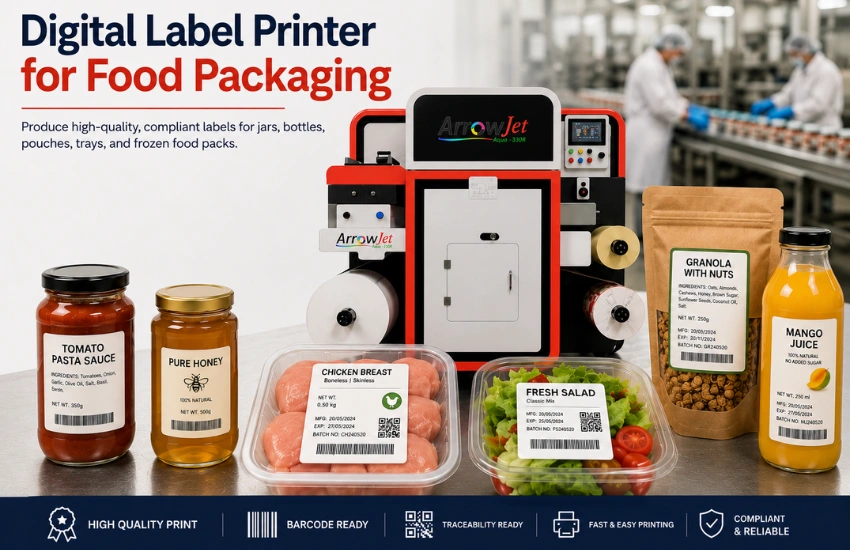
ArrowJet Aqua 330R — Roll-Label Production for Food Manufacturers
The ArrowJet Aqua 330R is Arrow Systems’ high-speed aqueous inkjet label press designed for roll-label production in food manufacturing environments. It prints on standard label substrates including BOPP, PP, PET, PVC, and coated paper — the materials most commonly used for food product labels across the meat, poultry, and packaged goods categories.
For food brands managing frequent label revisions — whether due to FSIS review responses, formulation updates, or seasonal product changes — the Aqua 330R’s on-demand print capability means corrected label runs can be produced immediately without reordering from an external print supplier.
ArrowJet Eco 330R — Entry-Level In-House Label Printing for Smaller Food Producers
The ArrowJet Eco 330R is Arrow Systems’ compact entry-level label press, designed for smaller food manufacturers and specialty producers entering in-house label production for the first time. It brings the same on-demand printing capability — no plates, no minimums, no external vendor dependency — in a more compact footprint suited to smaller production operations.
For specialty meat, poultry, or prepared food brands where product variety is high and label run quantities are lower, the Eco 330R provides an accessible path to in-house production without the capital cost of a larger press.
ArrowJet UV 330H — UV-Cured Labels for Cold Storage and High-Contact Meat & Poultry Packaging
The ArrowJet UV 330H is Arrow Systems’ UV inkjet label press, producing labels with UV-cured inks that deliver surface durability, moisture resistance, and chemical resistance beyond what standard aqueous inks provide.
For FSIS-regulated meat and poultry operations where labels are exposed to condensation, freezer temperatures, or wet processing environments, UV-cured labels maintain print quality and adhesion under conditions that can cause aqueous-printed labels to degrade. The UV 330H is the appropriate choice when label durability — in addition to label compliance — is a production requirement.
Arrow Systems sells digital label printing and finishing hardware. The ArrowJet Aqua 330R Lite, Eco 330R, and UV 330H are equipment purchases — Arrow does not print labels on your behalf. All three machines are designed for operation by your team, on your schedule, in your facility.
Frequently Asked Questions
USDA’s Food Safety and Inspection Service (FSIS) regulates labeling for meat products, poultry products, catfish products, and processed egg products. Most other food categories — packaged grocery items, dietary supplements, and beverages under 7% ABV — fall under FDA jurisdiction. Always confirm with qualified regulatory counsel for your specific product category, particularly for composite or multi-ingredient products.
Yes. Unlike FDA-regulated food labels, FSIS-regulated labels for meat, poultry, and egg products generally require pre-market approval before they can be used in commerce. FSIS reviews label applications and can request changes before issuing approval. This makes early compliance review particularly important — rejection extends the review timeline and can delay production scheduling significantly.
The six most common FSIS label approval problems are: (1) mismatches between label claims and supporting documentation or formulation, (2) inconsistent product name usage, (3) ingredient statement errors, (4) Nutrition Facts panel inaccuracies, (5) incomplete nutrient content claims, and (6) undefined or unsupported nutrient claims such as “leaner,” “low carbohydrate,” or “very low in fat.” Each of these is preventable with a structured pre-submission compliance review.
A nutrient content claim is non-compliant when it is not defined under applicable USDA regulations, when the product’s actual nutrient levels do not support the claim, or when required elements — such as a reference statement or quantitative comparison — are missing. FSIS also prohibits certain types of claims for specific product categories, including nutrient additive claims for meat and poultry products. Every claim should be validated against current regulatory definitions before it appears on a label.
Yes. In-house digital label printing equipment — such as the ArrowJet Aqua 330R, ArrowJet Eco 330R, or ArrowJet UV 330H — lets food manufacturers print on demand without plates, minimum orders, or extended lead times. When a label correction is required due to a formulation change, regulatory update, or FSIS revision request, the brand updates artwork and reprints corrected labels immediately — eliminating the cost of obsolete pre-printed inventory and reducing per-correction costs across the product line. For meat and poultry operations with cold storage or high-humidity packaging requirements, the UV 330H produces UV-cured labels with the moisture resistance and surface durability those environments demand.
Compliance review should happen before final artwork is approved — not after labels are printed. Catching a claim error or documentation mismatch at the design stage costs only revision time. Catching it after pre-printed label stock has been ordered adds reprinting fees, wasted materials, and production delays. Front-loading regulatory review is the lowest-cost approach regardless of printing method.
In-house label printing gives your team control over label corrections, revision cycles, and compliance adjustments — without waiting on external print vendors.
Arrow Systems manufactures digital label printing equipment for food manufacturers. Explore the ArrowJet Aqua 330R, explore the ArrowJet Eco 330R, explore the ArrowJet UV 330H, or contact the Arrow Systems team to request a label sample printed on your target substrate.
USDA Food Label Guidelines: Six Common FSIS Labeling Mistakes to Avoid
Table of Contents USDA Food Label Guidelines: Six Common FSIS Labeling Mistakes to Avoid USDA FSIS food label approval is blocked most often by six

Beauty Product Labels: INCI Names, Formatting & FDA Rules
Table of Contents Beauty Product Labels: INCI Names, Formatting & FDA Rules Beauty product labels must list every ingredient by INCI name in descending order

GHS Label Printing: HazCom 2012 Compliance for Chemical Manufacturers
Table of Contents GHS Label Printing: HazCom 2012 Compliance for Chemical Manufacturers OSHA HazCom 2012 requires six GHS label elements on every shipped chemical container

Cosmetic Label Printing: 6 Tips for Materials, Design, In-House Production, and Finishing
Table of Contents Cosmetic Label Printing: 6 Tips for Materials, Design, In-House Production, and Finishing The most important decisions in cosmetic label printing are substrate

Specialty Coffee Packaging Trends Roasters Are Printing in 2026
Table of Contents Specialty Coffee Packaging Trends Roasters Are Printing in 2026 In 2026, specialty coffee packaging tells the brand story that a brochure once

The Membrane Switch Market in 2026: What Manufacturers Need to Know
Table of Contents The Membrane Switch Market in 2026: What Manufacturers Need to Know The global membrane switch market reaches USD 9.42 billion in 2026,