Table of Contents
Cosmetic Label Printing: 6 Tips for Materials, Design, In-House Production, and Finishing
The most important decisions in cosmetic label printing are substrate moisture resistance, finish and brand alignment, container fit, production method, and finishing equipment selection.
Key Takeaways
- BOPP and PET film substrates are the standard for cosmetic labels — both resist moisture and handling better than paper, and are suited to the humid environments where most cosmetics are stored and used.
- Label finish communicates brand positioning before a consumer reads a single word — gloss, matte, soft-touch, and spot UV effects each carry distinct brand signals that should be selected intentionally.
- Label dimensions and adhesive spec must be verified on the actual container — a proof test on the real bottle, jar, or tube is the only reliable way to catch fit, curvature, and adhesion issues before a production run.
- The ArrowJet Eco 330R and ArrowJet Aqua 330R support in-house cosmetic label printing for standard pressure-sensitive roll label production — eliminating converter lead times and minimum order quantities.
- The ArrowJet UV 330H enables premium cosmetic label effects in-house: opaque white ink for clear and metallic substrates, spot UV varnish, and multi-layer printing — all from a single hybrid press rated for cosmetic and personal care applications.
- Finishing equipment — the Arrow EZCut 350R, Aries, and Taurus — completes the in-house workflow by handling laminating, die cutting, waste removal, and slitting after the print step.
Tip 1: Choose Moisture-Resistant Label Materials
Most cosmetics are stored and used near sinks, showers, and humid bathroom shelves. Paper label stocks absorb moisture, causing edges to lift, print to fade, and surfaces to wrinkle. For a consumer purchasing a repeat product, a degraded label reduces the product’s perceived quality and reduces the likelihood they will identify it correctly when reordering.
Planning for moisture exposure begins with substrate selection, not finishing. The two most common film options for cosmetic labels are:
Biaxially Oriented Polypropylene (BOPP)
A semi-rigid, moisture-resistant film widely used for cosmetic, personal care, and food product labels. BOPP accepts high-quality inkjet print output, laminates well, and conforms to curved surfaces such as bottles and tubes. It is cost-effective for both short and medium production runs and is the standard starting point for most cosmetic label programs.
Polyester (PET)
A dimensionally stable film with higher chemical and temperature resistance than BOPP. PET is preferred for labels that may contact aggressive cosmetic ingredients such as retinoids, exfoliating acids, or alcohol-based formulations, or for products stored in environments with significant temperature variation. It provides a more rigid label surface suited to premium packaging formats.
Adhesive Specification for Cosmetic Label Stock
The adhesive specification is equally important. A moisture-resistant adhesive matched to the container material and surface energy is required to keep the label bonded under use conditions. For products with oily or cream-based formulations, confirm adhesive compatibility with the specific ingredients before finalizing the label construction. An adhesive that performs well on a smooth glass bottle may lift prematurely on a soft-touch HDPE tube.
For ingredient declaration, claim language, and regulatory labeling requirements applicable to cosmetic products, verify current rules with qualified counsel and the relevant regulators, including the FDA under the Modernization of Cosmetics Regulation Act (MoCRA) as applicable. This article covers practical label planning, material, and production considerations only.
Tip 2: Express Brand Identity Through Material and Finish
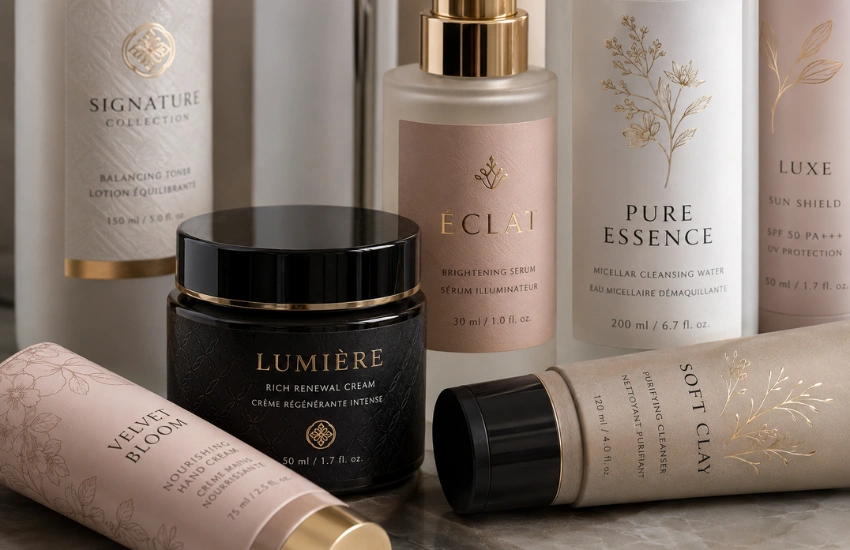
A cosmetic label does more than carry product information — it signals the brand’s market position within the first second of visual contact. The material and finish combination determines whether a product reads as natural, clinical, luxury, playful, or mass-market before the shopper engages with typography or copy.
Finish Type | Brand Signal | Common Application |
High-gloss laminate | Premium, polished, aspirational | Perfume, color cosmetics, anti-aging skincare |
Matte laminate | Natural, understated, clinical | Organic skincare, dermatological products, men’s grooming |
Soft-touch laminate | Tactile luxury, high-end personal care | Premium serum, high-end body care, spa products |
Spot UV varnish | Selective emphasis, visual depth | Logo highlight, graphic accent on premium SKUs |
Opaque white ink layer | Enabling effect for clear or metallic substrates | Clear bottles, frosted glass, metallic packaging |
Premium Finish Capability With the ArrowJet UV 330H
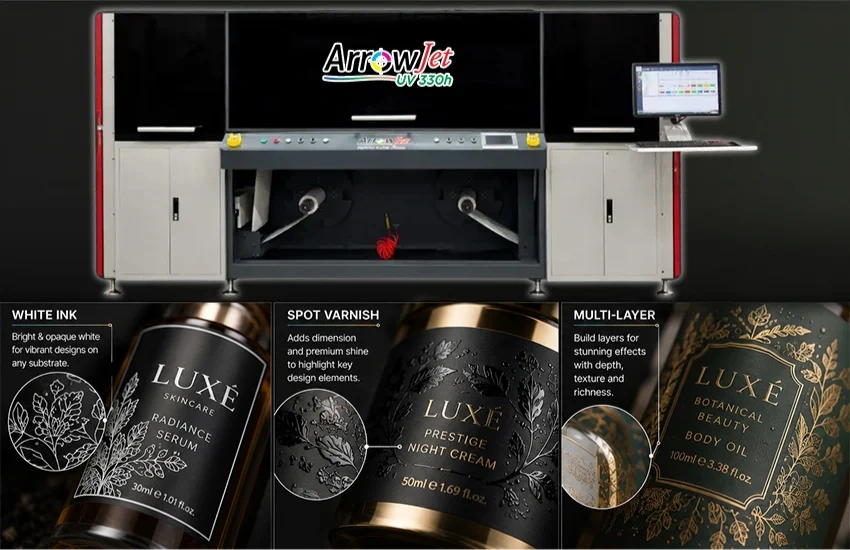
For brands printing cosmetic and personal care labels in-house, the ArrowJet UV 330H supports CMYK plus white ink and varnish configurations — including spot varnish and opaque white for clear or dark substrates. This allows cosmetic label producers to replicate premium converter output, including multi-layer effects and tactile finishes, directly from a single in-house press. The UV 330H is a hybrid roll-to-roll and flatbed system explicitly rated for cosmetic and personal care label applications.
Tip 3: Match the Label to the Container
Cosmetic packaging comes in a wide variety of geometries: narrow-neck bottles, wide-mouth jars, squeezable tubes, rigid cartons, and flat pump dispensers. Each creates different labeling challenges in terms of curvature, seam placement, and the label’s ability to conform without wrinkling, lifting, or misaligning at the overlap.
Bottles and tubes
Cylindrical surfaces require labels that conform to curvature without lifting at the edges. The narrower the container diameter, the shorter the maximum label horizontal dimension before the label must wrap, creating a seam. Confirm where the seam will land and whether it conflicts with any primary visual or regulatory element on the face.
Wide-mouth jars
Flat-faced or low-curvature jars generally present fewer conformability challenges, but their visible top surface often calls for a second label. Confirm that both the side label and lid label are specified in the artwork brief before the design is approved.
Squeezable tubes
Flexible tube materials require a film substrate and adhesive combination that flexes without cracking or delaminating under repeated squeezing. Verify the adhesive’s flexibility rating against the tube material before production approval — a standard pressure-sensitive adhesive designed for rigid containers may fail on flexible substrates.
Test the Proof on the Actual Package
The single most effective quality check before production approval is a physical proof on the actual container. Confirm label size, color appearance against the container material, edge adhesion, and overall visual balance after application. Problems caught at the proof stage cost a fraction of what they cost after a full print run is committed and packed.
Tip 4: Design Graphics With Purpose
Bold, distinctive graphics give cosmetic products shelf presence and help them stand apart in crowded categories. The risk with highly graphic cosmetic labels is visual complexity that obscures the product’s name, primary function, or key claims — the information a consumer needs to make a purchase decision in seconds.
A useful test before sign-off: hold the label at arm’s length for three seconds. If the product name and its primary function are not both immediately clear, the graphic hierarchy needs adjustment before the label is considered print-ready.
Design Elements That Support a Strong Cosmetic Label System
Typographic contrast
Product name and key claims should be set at a size and weight that remains readable at shelf distance. Decorative typography around secondary information should not compete for attention with the primary text elements — if the brand name and product type are not the two most visible things on the label, the hierarchy needs revision.
Color contrast
Product name and key claims should be set at a size and weight that remains readable at shelf distance. Decorative typography around secondary information should not compete for attention with the primary text elements — if the brand name and product type are not the two most visible things on the label, the hierarchy needs revision.
Image and icon use
Imagery and icons should reinforce the product’s primary benefit or ingredient story. Decorative images that do not communicate a product attribute add production complexity and cost without improving the label’s commercial function. If an image cannot be explained in one sentence tied to the product benefit, it likely does not belong on the primary face panel.
Tip 5: Consider Bringing Cosmetic Label Production In-House
Many cosmetic operations that currently outsource label production to a converter are paying for minimum order quantities, absorbing 2–4 week lead times, and carrying pre-printed label inventory that becomes obsolete every time a formula, ingredient list, or marketing claim changes. Digital in-house label printing eliminates each of these constraints and gives the brand direct control over every label revision cycle.
Three ArrowJet systems are directly suited to cosmetic label production needs, covering entry-level, mid-to-high volume, and premium-effects requirements:
ArrowJet Eco 330R — Entry-Level In-House Cosmetic Label Press
The ArrowJet Eco 330R is a compact, single-pass digital label press rated for cosmetic label production. It runs CMYK water-based pigment inks at up to 20 m/min on a 324 mm print width, requires no air compressor, and operates on single-phase power — making it practical for cosmetic brands bringing label printing in-house for the first time. It handles paper labels, coated papers, and inkjet-treated substrates including flexible packaging materials.
- Print speed: up to 20 m/min | Print width: 324 mm | Resolution: 1600 x 1600 dpi
- CMYK water-based pigment inks — no air compressor, single-phase power
- Compact footprint — practical for first-time in-house cosmetic label operations
- Eliminates converter minimum order quantities and 2–4 week lead times for short-run cosmetic SKUs
ArrowJet Aqua 330R — High-Speed Roll Label Press for Mid-to-High Volume Cosmetic Production
The ArrowJet Aqua 330R is a high-speed, single-pass digital label press powered by the Memjet DuraFlex engine, delivering print speeds up to 195 ft/min at a 12.75″ print width. It is suited for cosmetic brands operating at higher production volumes who need fast turnaround on pressure-sensitive roll labels without the minimum order constraints or plate costs of conventional converter jobs.
- Print speed: up to 195 ft/min | Print width: 12.75″ (324 mm)
- Memjet DuraFlex single-pass engine — CMYK water-based pigment inks
- Handles short, medium, and longer runs — suited to high-SKU cosmetic product ranges
- Practical anchor press for operations managing frequent label revisions across a large number of cosmetic SKUs
ArrowJet UV 330H — Premium Cosmetic Label Press With Hybrid UV Capability
The ArrowJet UV 330H is a true hybrid UV label press combining roll-to-roll and flatbed printing in one system. It is explicitly rated for cosmetic and personal care label applications, and supports CMYK plus white ink, plus varnish configurations — enabling opaque white layers for clear and metallic substrates, spot UV varnish for tactile and visual effects, and multi-layer printing for premium label output.
- True hybrid system: roll-to-roll and flatbed printing in one press — rigid media up to 50 mm thickness in flatbed mode
- CMYK + White (WW), CMYK + Varnish (VV), CMYK + White + Varnish (WV) ink configurations
- Opaque white ink for clear, metallic, and dark substrates — spot varnish for texture and tactile effects
- Explicitly rated for cosmetic and personal care label applications — supports short-run prototypes and high-margin SKUs alongside standard runs
Choosing the Right Press for Your Cosmetic Label Program
Factor | ArrowJet Eco 330R | ArrowJet Aqua 330R | ArrowJet UV 330H |
Best-fit operation | First-time in-house, small brand | Mid-to-high volume, multi-SKU | Premium effects, specialty substrates |
Ink chemistry | CMYK water-based pigment | CMYK water-based pigment (Memjet DuraFlex) | UV LED-cured (CMYK + W + V options) |
Print speed | Up to 20 m/min | Up to 195 ft/min | Roll-to-roll and flatbed modes |
Print width | 324 mm | 12.75″ (324 mm) | Up to 330 mm |
White ink / varnish | No | No | Yes — CMYK+W, CMYK+V, CMYK+W+V |
Flatbed mode | No | No | Yes — rigid media up to 50 mm |
Arrow Systems sells label printing hardware — the Eco 330R, Aqua 330R, and UV 330H are machines that cosmetic producers purchase and operate in-house. To evaluate which press fits your operation, request a sample or speak with the Arrow team.
Tip 6: Complete the Workflow With Label Finishing Equipment
Printing the label is only part of a complete in-house label production workflow. After printing, cosmetic labels typically require laminating for surface protection and durability, die cutting or laser cutting to shape, waste matrix removal, and slitting or sheeting to final roll or sheet format. The finishing step determines edge quality, surface durability, and application readiness — and the right equipment depends on run volume, label shape complexity, and job changeover frequency.
Arrow Systems offers three finishing systems suited to cosmetic label production workflows:
Arrow EZCut 350R — Multi-Blade Digital Label Cutter for Short to Medium Run Cosmetic Labels
The Arrow EZCut 350R is a multi-blade digital die cutter equipped with up to six individually controlled cutting heads, with head distance automatically adjustable via software control. A CCD camera and positioning sensor system scans registration marks from the printed web to drive precise digital cutting — eliminating the need to order physical die tools entirely.
- Up to 6 independent cutting heads — head spacing fully auto-adjustable via software
- CCD identify system — reads registration marks for precise digital cutting without physical dies
- Single-pass workflow: laminating, die cutting, waste removal, slitting, and auto-sheeting
- Max cutting speed: up to 9 m/min — suited for short to medium run cosmetic label jobs with frequent job changeovers
- Cold laminating included — label surface protection without special media requirements
Aries Semi-Rotary Label Finisher — High-Volume Cosmetic Label Finishing With Magnetic Die Plates
The Aries is a semi-rotary label finishing machine designed for high-volume label production. It handles laminating, die cutting, waste removal, slitting, and roll preparation in a single streamlined pass, with a magnetic die plate system enabling precise full-bleed and die-cut label output. Touchscreen PC control and a quick-changeover snap-in design support fast job setup across production runs.
- Single-pass: laminating, die cutting, waste removal, slitting, and roll preparation
- Flexible magnetic die plate system — full-bleed and die-cut label production with precise offset adjustment
- Cutting speed: up to 30 m/min — suited for high-volume cosmetic operations running established SKUs at consistent volume
- Touchscreen PC interface with Arrow Cutting Manager software for speed, precision, and waste control
- Supports both printed and unprinted media — paper and plastic films
Taurus Laser Finisher — No-Die CO₂ Laser Finishing for Agile Cosmetic Label Operations
The Taurus is a CO₂ laser label finishing system that eliminates the need for physical die tools entirely. Powered by a 350W sealed CO₂ laser, the Taurus supports kiss-cut, full cut, perforation, and engraving on paper and plastic film substrates. A single-pass workflow handles unwinding, laminating, digital cutting, waste removal, rewinding, and slitting.
- 350W sealed CO₂ laser — no die tools required, no die ordering lead time
- Cutting speed: up to 70 m/min on the Plus configuration
- Cut types: kiss-cut, full cut, perforation, engraving — compatible with paper and plastic film substrates
- Single-pass: unwinding, laminating, digital cutting, waste removal, rewinding, and slitting
- Suited for cosmetic operations producing short-run labels with variable shapes, specialty die-cut profiles, or frequent design changes
Matching Finishing Equipment to Your Cosmetic Label Operation
Factor | Arrow EZCut 350R | Aries Semi-Rotary | Taurus Laser |
Cutting method | Multi-blade digital — up to 6 heads | Magnetic die plate (semi-rotary, blade) | 350W CO₂ laser — no dies |
Max cutting speed | Up to 9 m/min | Up to 30 m/min | Up to 70 m/min (Plus) |
Die tools required | No — CCD digital registration | Yes — magnetic die plates | No — fully die-free |
Best-fit operation | Short-to-medium run, high job variety | High-volume, consistent shapes at scale | Short-run, variable shapes, frequent changes |
Cut types supported | Die cut, slit, sheet | Die cut, laminate, slit, waste removal | Kiss-cut, full cut, perforation, engraving |
The right finishing equipment for a cosmetic label operation depends on run volume, label shape complexity, and how frequently jobs change. Arrow Systems can advise on matching finishing equipment to a specific production workflow — contact the Arrow team to discuss your requirements.
Frequently Asked Questions — Cosmetic Label Printing
Biaxially oriented polypropylene (BOPP) and polyester (PET) films are the most widely used substrates for cosmetic labels. Both resist moisture and household ingredients better than paper, making them well-suited for products stored near sinks or used in humid environments. The right choice between BOPP and PET depends on the container shape, adhesive requirements, and the specific ingredients the label may contact.
Label finishes shape how a product feels and looks on shelf. Gloss finishes project a premium, polished image; matte finishes suggest natural or clinical positioning; soft-touch laminates add a tactile luxury element. UV varnish can be applied as a flood or spot coating to add visual dimension. White ink enables printing on clear or metallic substrates, making it essential for cosmetic and personal care labels where transparent or foil packaging is common.
Yes. Testing a label proof on the actual bottle, jar, or tube is the most reliable way to catch fit, curvature, color, and adhesion issues before committing to a full production run. Container geometry varies significantly — a label that looks correct on a flat artwork proof may pucker or lift at the seam on a narrow-neck bottle or buckle on a sharply curved jar.
Bringing cosmetic label production in-house with a digital label press reduces dependency on outside converters, eliminates minimum order quantities, and allows fast label revisions without reprinting an entire inventory. Brands managing multiple SKUs, seasonal variants, or frequent formula updates can respond to changes within hours rather than waiting weeks for converter lead times.
Yes. The ArrowJet UV 330H, a hybrid UV label press, supports CMYK plus white ink and varnish configurations — enabling opaque white layers for clear or metallic substrates, spot UV varnish for texture effects, and multi-layer printing for tactile depth. These are the same effect types used in premium cosmetic and personal care label production, delivered from a single in-house press.
Label costs vary with substrate, adhesive, finish, special effects such as spot varnish or multi-layer ink, and run quantity. The key principle is intentional selection — choose finishes that reinforce the product’s market position rather than adding complexity for novelty. In-house digital printing with a press such as the ArrowJet Eco 330R or ArrowJet Aqua 330R can reduce per-label cost on short and medium runs by removing plate charges and minimum order requirements associated with conventional converter jobs.
Label finishing equipment for cosmetic labels includes digital die cutters, semi-rotary finishers, and laser finishing systems. The Arrow EZCut 350R is a multi-blade digital cutter handling laminating, die cutting, slitting, and auto-sheeting with no physical die tools. The Aries is a semi-rotary finishing machine suited to high-volume consistent-shape cosmetic label production at up to 30 m/min. The Taurus is a no-die CO₂ laser finisher capable of kiss-cut, full cut, perforation, and engraving at up to 70 m/min — suited for short-run agile cosmetic label operations with variable shapes or frequent design changes.
See What In-House Cosmetic Label Printing Looks Like
Arrow Systems manufactures digital label presses and finishing equipment for cosmetic, personal care, and packaging operations that want to bring label production in-house. Whether you need standard pressure-sensitive roll labels or premium effects including white ink and spot varnish on clear substrates, the ArrowJet range covers the full cosmetic label spectrum.
Request a printed label sample to evaluate output quality on the substrates and finishes relevant to your product line — or speak with the Arrow team about matching the right press and finishing system to your specific production requirements.
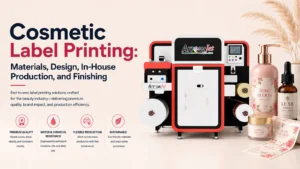
Cosmetic Label Printing: 6 Tips for Materials, Design, In-House Production, and Finishing
Table of Contents Cosmetic Label Printing: 6 Tips for Materials, Design, In-House Production, and Finishing The most important decisions in cosmetic label printing are substrate

Specialty Coffee Packaging Trends Roasters Are Printing in 2026
Table of Contents Specialty Coffee Packaging Trends Roasters Are Printing in 2026 In 2026, specialty coffee packaging tells the brand story that a brochure once
The Membrane Switch Market in 2026: What Manufacturers Need to Know
Table of Contents The Membrane Switch Market in 2026: What Manufacturers Need to Know The global membrane switch market reaches USD 9.42 billion in 2026,

UV vs. Aqueous Inkjet for Custom Cosmetic Labels: A Buyer’s Guide
Table of Contents UV vs. Aqueous Inkjet for Custom Cosmetic Labels: A Buyer’s Guide UV and aqueous inkjet serve different cosmetic label scenarios — UV
Vintage Label Design Styles: A Reference Guide for Producers and Brand Owners
Table of Contents Vintage Label Design Styles: A Reference Guide for Producers and Brand Owners Vintage label design draws from a specific visual history. The
Label Adhesive Types, Properties & Selection Guide
Table of Contents Label Adhesive Types, Properties & Selection Guide The right label adhesive depends on the surface, temperature, shape, and conditions of the application