Table of Contents
FSMA 204 Traceability: Food Label Requirements for 2026
FSMA 204 is a recordkeeping rule, not a packaging mandate — but printing the Traceability Lot Code on the label is the operationally sound way to maintain lot linkage to January 20, 2026.
Key Takeaways
- FSMA 204 is primarily a recordkeeping and information-sharing rule — it does not require every Key Data Element to appear on the physical consumer label.
- The Traceability Lot Code must travel with the product and remain linkable to all KDEs; most producers print the TLC directly on the label or shipping case.
- Pre-printed label inventory becomes a structural liability under FSMA 204 because it has no mechanism to carry lot-specific variable data.
- Variable data digital label printing — generating the TLC, production date, and barcode from your ERP or MES at production speed — is the practical path to compliance for most FTL producers.
- The ArrowJet Aqua 330R is the digital label press most commonly specified for small-to-mid-size FTL producers managing frequent lot changes and high SKU mix.
- The compliance date is January 20, 2026. Operations managing FTL-covered SKUs should have their TLC format, records system, and label print workflow aligned well before that date.
What FSMA 204 Is and Why It Changes Food Label Requirements
FSMA 204 — the FDA Food Traceability Rule — establishes additional recordkeeping requirements for producers of higher-risk foods, with a January 20, 2026 compliance deadline.
Formally titled the FDA Food Traceability Rule under Section 204 of the Food Safety Modernization Act, FSMA 204 requires entities that manufacture, process, pack, or hold foods on the Food Traceability List (FTL) to capture, retain, and share specific data about those foods as they move through the supply chain. The rule’s purpose is to accelerate identification and removal of potentially contaminated foods during outbreaks and recalls — from weeks to days. For a broader look at how digital printing for food labels intersects with regulatory requirements, see Arrow’s overview of digital printing for food packaging and labels.
Who Is Covered: The Food Traceability List
The FTL targets categories of foods with elevated foodborne illness risk — check every SKU and ingredient against the current published list.
The FTL identifies higher-risk food categories. Examples include:
- Certain fresh-cut fruits and vegetables
- Fresh leafy greens and herbs
- Shell eggs
- Nut butters
- Cucumbers, tomatoes, peppers, melons, and sprouts
- Finfish, crustaceans, and molluscan shellfish (with some exceptions)
- Ready-to-eat deli salads
- Soft, semi-soft, and fresh soft cheeses
If your facility produces, packs, or transforms any food on the FTL — including FTL ingredients within a multi-component product — FSMA 204 likely applies. Confirm SKU-level coverage against the current published list at FDA.gov.
Critical Tracking Events Most Producers Own
FSMA 204 organizes data capture around seven Critical Tracking Events; most manufacturers are primarily responsible for Initial Packing and Transformation.
Critical Tracking Events (CTEs)
FSMA 204 defines seven CTEs where specific data must be captured: Harvesting, Cooling, Initial Packing, First Land-Based Receiving, Shipping, Receiving, and Transformation. Each CTE has its own Key Data Element set. Most food manufacturers and co-packers will primarily own Initial Packing and Transformation.
Initial Packing
The first time a raw agricultural commodity on the FTL is packed into a container for distribution — for example, leafy greens packed into clamshells. The entity performing Initial Packing is responsible for assigning the first Traceability Lot Code to that lot.
Transformation
When an FTL food is changed in a way that creates a new product or a new lot — for example, combining multiple FTL ingredients into a deli salad. A new TLC must be assigned to the output, and the TLC(s) of the inputs must be captured and retained in records.
Label vs. Records: What the Rule Actually Requires On-Pack
FSMA 204 requires KDEs in records and the TLC to travel with the product — not every KDE on the consumer label.
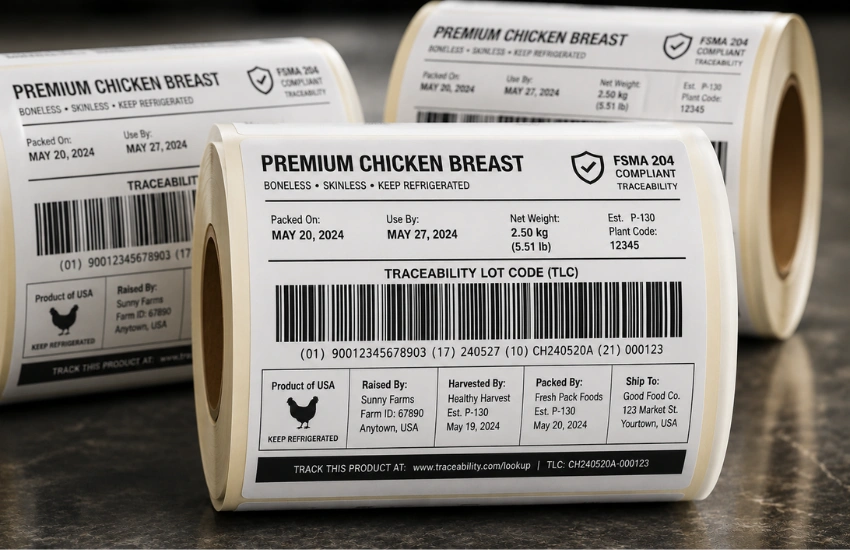
The rule requires producers to maintain KDEs in records and share them with the next recipient in the supply chain upon request. It does not generally require every KDE to appear on the physical consumer label. What must travel with the product is the Traceability Lot Code — or a reliable means to link the physical product back to its TLC and the records behind it. In practice, printing the TLC directly on the label or case is the most durable way to maintain that linkage across the downstream chain.
Key Data Elements (KDEs) Food Producers Must Capture
KDEs are the specific data fields producers must record and retain at each applicable Critical Tracking Event — the exact set varies by event type.
KDEs for Initial Packing of a Raw Agricultural Commodity
Key Data Element | Description | On-Pack vs. Records |
Traceability Lot Code | Unique identifier assigned to the lot at Initial Packing | On-pack — label or case |
Commodity and variety | The type and specific variety of the food packed | Records |
Date of initial packing | Calendar date when packing of the lot occurred | Records (pack date sometimes on-pack) |
Quantity and unit of measure | Total amount packed in the lot with a defined unit | Records |
Location description — harvest source and packer | Where the food was harvested and where it was packed | Records |
TLC Source or Source Reference | Identifies where and by whom the TLC was assigned | Records (linkable via TLC) |
KDEs for Transformation
Key Data Element | Description | On-Pack vs. Records |
Input TLC(s) | Traceability Lot Code(s) of all FTL ingredients used in the transformation | Records |
New output TLC | New TLC assigned to the transformed product lot | On-pack — label or case |
Date of transformation | Calendar date when transformation occurred | Records |
Description of food produced | Commodity, variety, and output product description | Records |
Quantity and unit of measure | Total output quantity with a defined unit | Records |
Transformation location | Location description for where transformation occurred | Records |
What Commonly Goes On-Pack vs. In Records
Most KDEs live in records and electronic systems — what travels on-pack is primarily the TLC and identifiers that anchor the product to those records.
Traceability Lot Code — on label or case
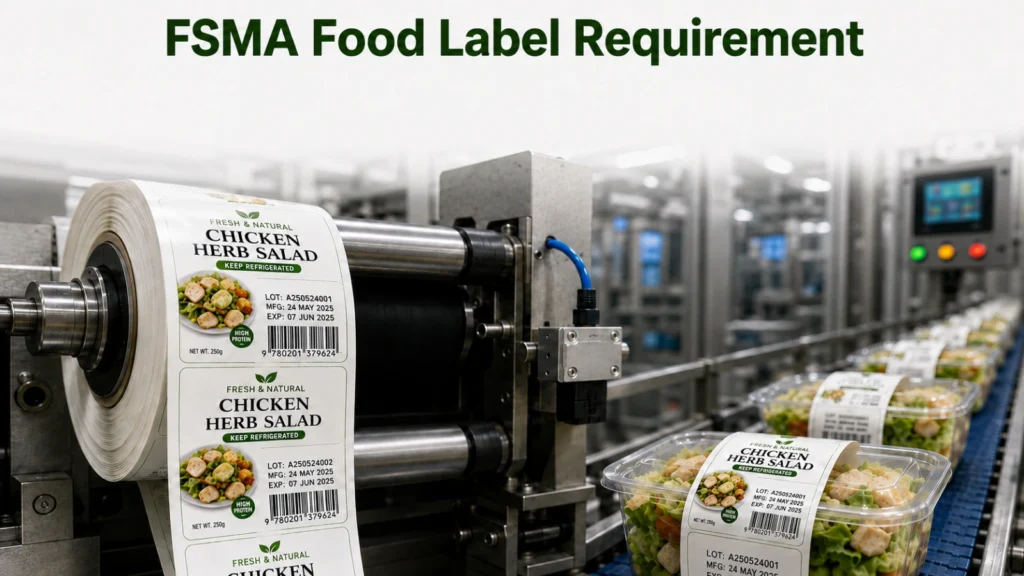
The TLC is the single most important element to carry on the physical unit. Most producers print it as both human-readable text and a barcode or 2D code to support manual handling and automated scanning by downstream receivers and inspectors.
Product identifier or SKU
Ties the physical label to the product record in your ERP or MES, enabling downstream partners to cross-reference the TLC against the correct SKU-level data.
Pack date or production date
Commonly printed on the consumer unit or case for downstream reference, even though the formal KDE version lives in records. Variable data printing generates this on-demand per lot.
Case-level identifiers
For operations where the consumer unit is not individually serialized, the shipping case label carries the TLC and any case-level KDEs required for the Shipping CTE when product moves to the next recipient.
Most KDEs stay in records — but on-pack lot linkage is operationally critical because every downstream receiver must be able to tie the physical product back to your records within 24 hours as the rule contemplates.
Traceability Lot Codes: Format and Printing Requirements
The TLC is the linchpin of FSMA 204 — the identifier that ties a specific lot of FTL food to all the KDEs associated with it across the supply chain.

What a TLC Is and Who Assigns It
Traceability Lot Code (TLC)
A TLC is an identifier assigned to a specific lot of FTL food at Initial Packing, First Land-Based Receiving (for seafood obtained from a vessel), or Transformation. Once assigned, the TLC stays with that lot as it moves downstream. Receivers do not reassign the TLC unless they perform a Transformation that creates a new lot.
TLC Source
The location description for where the food was assigned its TLC — typically the packer, first receiver, or transformer. The TLC Source helps receivers and FDA investigators trace a lot back to the point where it received its identifier.
TLC Source Reference
An alternative way to identify the TLC Source — such as an FDA Food Facility Registration number or a web address where the source location can be looked up. Producers can use either the TLC Source location description or a TLC Source Reference in their records.
Practical TLC Format Guidance
FSMA 204 does not prescribe a specific TLC format — most producers build a structured code combining facility, date, and lot sequence.
A practical TLC format typically includes a facility or line identifier, a production date (Julian or YYMMDD), and a sequence or batch number. This structure makes each TLC unique, human-readable for operators, and traceable to a specific production event without additional lookup.
Best practice is to print the TLC in both human-readable text and a scannable format. GS1-128 and GS1 DataMatrix barcode formats are the most common choices in food. This supports manual reading by inspectors and operators as well as automated scanning by downstream trading partners and warehouse management systems.
Where to Place the TLC
Primary label on the consumer unit
The most durable form of lot linkage — the TLC travels with the individual unit from production to point of use. Requires variable data printing capability on the label press, as the TLC changes with every lot.
Secondary label applied at the case or pallet level
Practical for foodservice and bulk packs where the consumer unit is not individually labeled. The case label carries the TLC and any case-level KDEs for the Shipping CTE, enabling downstream receivers to link the shipment to the production record.
Shipping case label combining TLC with case-level KDEs
Common where the consumer unit carries only a generic label. The case label becomes the primary lot linkage document — it must be generated variably per lot, not pre-printed.
Common TLC Printing Pitfalls
Pre-printed label inventory with no variable TLC field
Operations that stock large quantities of pre-printed labels have no on-label mechanism to carry lot-specific data. Adding a TLC through a separate inkjet coder introduces a second print step, a second verification point, and a second failure mode — and creates reconciliation complexity between two separate print records.
Illegible or unscannable codes
TLCs printed at insufficient resolution, on incompatible substrates, or with incorrect ink profiles produce codes that downstream scanners cannot read. Food-appropriate substrates — BOPP, polyester, paper — print reliably at 1600 dpi on production-grade digital label presses without illegibility issues.
Transcription errors from manual lot entry
Operators manually entering a TLC into a label template introduce transcription risk. ERP-to-print integration eliminates manual entry by passing the lot assignment directly to the print system — the correct TLC is in the label before a single unit is labeled.
TLC reassignment errors at transformation events
Transformation events require assigning a new TLC to the output and capturing input TLC(s) in records. If the label print workflow is not aligned with the ERP transformation event, mismatches between the physical label and the production record create traceability gaps.
Variable Data Printing for FSMA 204 Compliance
Variable data digital label printing — generating lot-specific label content at the moment of production — is the practical execution path for most FTL producers preparing for January 2026.
Why Pre-Printed Label Inventory Becomes a Liability
If your current label workflow relies on ordering large quantities of pre-printed labels and applying them to whatever runs that day, you have no on-label mechanism to carry lot-specific variable data. The TLC changes with every lot — a pre-printed label cannot accommodate that unless a separate coder adds the code in a second pass. That second pass adds equipment, adds failure modes, and splits the print record across two systems. Moving to in-house label production with a digital press resolves this structurally rather than as a workaround.
Integrating ERP and MES Lot Data with the Print Workflow
The most reliable TLC print workflows pass lot assignments directly from the ERP or MES to the label press — eliminating manual entry and creating an auditable print-to-record loop. See Arrow’s guide to label production automation for a broader walkthrough of ERP integration options.
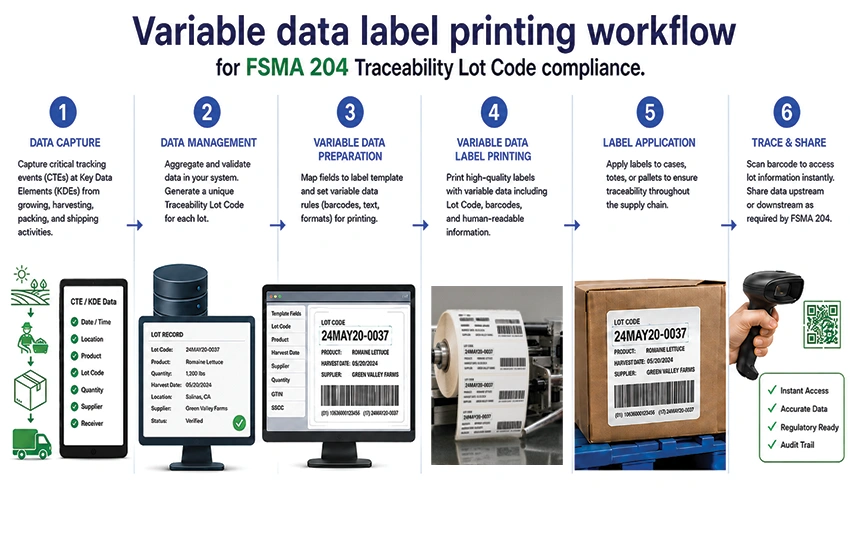
The integration pattern most producers adopt:
Step 1: Production schedule and lot assignment originate in the ERP or MES
The system of record for lot assignments is your ERP or MES — not the label template. Every new lot receives its TLC in that system before the first label is printed.
Step 2: Lot data is passed to the label print system
The newly assigned TLC, production date, and any other lot-linked content are transmitted to the label press — either through direct ERP integration or a label management middleware layer.
Step 3: The press generates labels with correct variable content for that run
The digital label press prints the TLC, barcode, and date variably on every label for that lot — at production speed, with no operator re-entry.
Step 4: Vision verification confirms each label is readable and matches the expected lot
Inline vision systems verify that printed TLCs are present, legible, and match the active lot record. Units with unreadable or mismatched codes are flagged or rejected before reaching finished goods.
Step 5: Print records are written back to the records system
The completed print run writes label output data back to the FSMA records system — closing the loop between assigning a lot and recording what was labeled. This produces the auditable trail the rule contemplates.

Choosing a Digital Label Press for FSMA 204 Readiness
For FTL producers, press selection comes down to throughput, SKU diversity, and lot frequency — the defining characteristics of FSMA 204 label production.
The structural requirement FSMA 204 creates for label production is the same regardless of producer size: labels must be generated variably, per lot, at production speed, with lot-specific TLC content drawn from the records system. Pre-printed inventory stocking is incompatible with that requirement at any scale. The question is which digital label press fits the operation’s actual volume, SKU mix, and lot frequency.
ArrowJet Aqua 330R: Digital Label Press for Small-to-Mid-Size FTL Producers
The ArrowJet Aqua 330R is a roll-to-roll digital inkjet label press built for short-to-mid-run production — the profile that defines most FTL-covered food operations managing frequent lot changes and high SKU mix.
Variable TLC and date printing, on demand
The ArrowJet Aqua 330R generates each label — including the TLC, production date, and barcode — variably at production speed using Memjet DuraFlex® technology at up to 1600 × 1600 dpi. There is no pre-plate setup between lot changes. The correct TLC is in the label from the first print of the run.
High SKU mix and frequent lot turnover
Operations managing multiple FTL-covered SKUs alongside non-covered products benefit from a press that changes jobs quickly, without physical plate changes or extended makeready. The Aqua 330R’s digital architecture means a SKU or lot change is a software action, not a mechanical one — directly reducing the risk of applying an incorrect pre-printed label to the wrong lot.
Food-appropriate substrates
The Aqua 330R prints on coated paper, BOPP, PP, PET, PVC, Mylar, Tyvek, and similar materials up to 12.75″ (324mm) wide — covering the full range of substrates used for primary food labels and case labels on FTL-covered products.
Eliminates pre-printed label inventory
For mid-size FTL producers, the Aqua 330R means printing the exact label quantity needed for a specific lot — with the correct TLC, production date, and barcode — rather than over-ordering pre-printed inventory and discarding obsolete stock when codes or claims change. For context on how short-run food label production benefits small and emerging brands, see Arrow’s dedicated guide.
Production Profile | ArrowJet Aqua 330R Fit |
Small and mid-size FTL producers managing multiple covered SKUs | Strong fit — high SKU mix, frequent lot changes, on-demand variable TLC printing |
Co-packers and contract manufacturers serving multiple brands | Strong fit — job changes are software-driven; each brand and lot gets correct labeling without plate changes |
Operations transitioning away from pre-printed inventory | Strong fit — digital production eliminates minimum order quantities and inventory obsolescence from lot-specific label stocking |
Teams needing variable TLC and barcode printing without a high-volume press | Strong fit — production-grade output at a footprint and capital level accessible to mid-size food operations |
FSMA 204 compliance, including KDE capture, records retention, and information-sharing obligations, is the responsibility of the covered entity and should be confirmed with qualified regulatory counsel. Arrow Systems manufactures label printing hardware; Arrow does not provide regulatory or compliance advisory services.
Pre-2026 FSMA 204 Label Readiness Checklist
Use this checklist to align your TLC workflow, label content, and recordkeeping system before January 20, 2026.
Confirm FTL-covered SKUs
Map every product and ingredient against the current Food Traceability List. Document which SKUs are covered and which are not. Multi-component products containing FTL ingredients may be covered even if the finished product is not itself on the list.
Define your TLC format
Decide on a consistent TLC structure — facility identifier + production date + sequence — and document it as an internal standard. Consistency across SKUs and production lines simplifies both printing and downstream record retrieval.
Assign TLC authority to a single system
Identify which system — ERP, MES, or label management software — is the source of truth for assigning TLCs. A TLC assigned in one system and manually re-entered into another creates reconciliation risk and audit exposure.
Decide label vs. case placement
Determine where the TLC and related identifiers will appear: primary consumer label, case label, or both. Document this decision by SKU so that changeovers on shared lines apply the correct labeling approach to each product.
Audit pre-printed label inventory
Identify SKUs where pre-printed stock cannot carry variable lot data. Plan the transition to on-demand digital label production for those SKUs before the compliance date, not after.
Validate the variable data print workflow
Test ERP-to-press integration, vision verification, and reject handling under production conditions — not just in a lab environment. A workflow that passes a bench test but fails under production speed, humidity, or substrate variation is not a compliant workflow.
Align records to label output
Confirm that every TLC printed is captured in records with KDEs linked, and that records are retrievable within 24 hours as the rule contemplates. The label print record and the FSMA records system should share a common lot identifier — the TLC.
Train operators and QA on FTL procedures
Document changeover procedures for FTL versus non-FTL SKUs on shared lines. Operators need clear, step-by-step guidance on when to apply the variable TLC workflow and how to flag and isolate any mislabeled units before they reach finished goods.
Frequently Asked Questions — FSMA 204 Food Label Requirements
Common questions from food producers, co-packers, and operations leaders evaluating FSMA 204 compliance requirements and label printing workflows for 2026.
No. FSMA 204 requires producers to maintain KDEs in records and share them with the next recipient upon request. The Traceability Lot Code must travel with the product — on the label or case — so it can be linked back to those records. Most other KDEs, including quantities, source references, harvest dates, and location descriptions, live in records rather than on-pack.
A TLC is the identifier assigned to a lot of FTL food at Initial Packing, First Land-Based Receiving, or Transformation. The entity performing that Critical Tracking Event is responsible for assigning the TLC. Once assigned, the TLC stays with the lot downstream unless a Transformation creates a new lot — at which point the transformer assigns a new TLC to the output and records the input TLC(s).
The compliance date is January 20, 2026. Producers handling foods on the Food Traceability List should have their TLC format, KDE recordkeeping, information-sharing workflows, and label print infrastructure operational by that date — not in the weeks immediately before it.
FSMA 204 does not mandate a specific machine-readable format. Including both human-readable text and a barcode or 2D code — GS1-128 and GS1 DataMatrix are the most common choices in food — is widely considered best practice. Barcode formats support automated scanning by downstream receivers, warehouse systems, and FDA inspectors, in addition to manual reading by operators.
Most small FTL producers move from large pre-printed label runs to on-demand digital label production. A digital label press eliminates the structural problem of pre-printed inventory: each lot gets labels printed with the correct TLC, production date, and barcode already in place — without retrofitting the line or maintaining a large inventory of lot-specific pre-printed stock. The transition is operational rather than structural for most small-to-mid-size producers.
Plan Your FSMA 204 Label Readiness Path with Arrow Systems
If your operation produces foods on the Food Traceability List, the time to align your TLC workflow, label content, and label press configuration is now — well ahead of January 20, 2026.
Arrow Systems works with food producers and co-packers to map FTL-covered SKUs, define TLC printing workflows, and match the right digital label press to the production profile — starting with the ArrowJet Aqua 330R for small and mid-size FTL operations.

FSMA 204 Traceability: Food Label Requirements for 2026
Table of Contents FSMA 204 Traceability: Food Label Requirements for 2026 FSMA 204 is a recordkeeping rule, not a packaging mandate — but printing the

White Space in Label Design: How to Use Negative Space Effectively
Table of Contents White Space in Label Design: How to Use Negative Space Effectively White space — the open area around and between design elements

Cannabis Label Compliance in 2026: State Rules, Variable Data, and In-House Printing
Table of Contents Cannabis Label Compliance in 2026: State Rules, Variable Data, and In-House Printing U.S. cannabis label compliance has no federal baseline — each

The American Bumper Sticker: A Brief History
Table of Contents The American Bumper Sticker: A Brief History The American bumper sticker is a small adhesive label that became one of the most

Durable Equipment Labels: Polycarbonate vs Polyester
Table of Contents Durable Equipment Labels: Polycarbonate vs Polyester vs Metal Polycarbonate and polyester each fail in predictable ways when misspecified — this guide maps

CBD Label Requirements: What Your Labels Must Say
Table of Contents CBD Label Requirements: What Your Labels Must Say CBD labels must carry truthful product information, avoid medical or therapeutic claims, and comply