
Table of Contents
Tamper-Evident Label Printing: Types, Applications & In-House Options
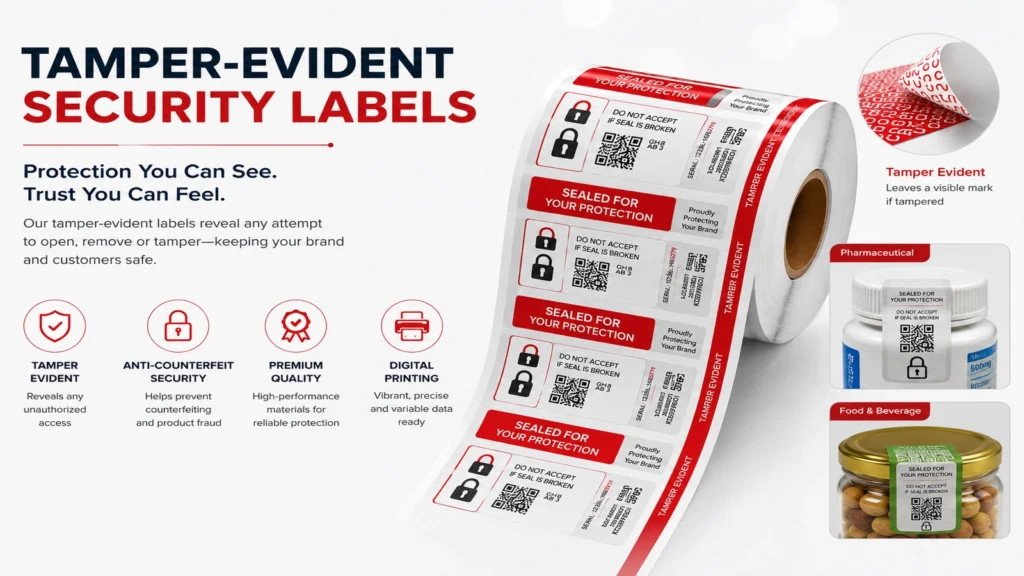
Tamper Evident Label Printing provide visible proof of unauthorized opening — protecting consumers, brands, and supply chains across pharma, food, and personal care.
Key Takeaways
- Tamper-evident labels show visible evidence of interference — they do not prevent tampering, only reveal it.
- FDA regulations mandate tamper-evident packaging for OTC drug products; food, cannabis, and personal care requirements vary by jurisdiction and sales channel.
- Common formats include void labels, destructible vinyl, breakaway seals, and perforated cap bands — each suited to different container shapes and use cases.
- The right material depends on substrate, storage temperature, container surface energy, and the type of evidence required.
- Digital in-house printing on tamper-evident facestock eliminates minimum order quantities and enables same-run revisions without plate costs or obsolete pre-printed stock.
- Arrow sells label printing presses — not label printing services. Brands use Arrow hardware to produce tamper-evident labels on their own production floor.
What Are Tamper-Evident Labels?
Tamper-evident labels are adhesive labels or package seals engineered to reveal visible evidence — a broken pattern, a missing piece, or a surface change — if the package has been opened or disturbed before use.
The term “tamper-evident” is distinct from “tamper-proof.” No label fully prevents a determined person from accessing a product. What tamper-evident labels do is make unauthorized access visible — so consumers, retailers, and brand owners can detect interference before the product is used.
Tamper-evident labels serve five confirmed operational purposes for brands that use them:
- Protecting consumers from unknowingly using compromised products
- Reducing manufacturer and retailer liability exposure
- Supporting brand integrity and consumer confidence at shelf
- Providing chain-of-custody evidence for recalls and returns investigations
- Deterring unauthorized opening, refilling, or substitution of contents
This article is general packaging guidance, not legal or regulatory advice. Verify current obligations for your product category and jurisdiction with qualified counsel and your regulatory team before printing.
Why Tamper Evidence Became a Mainstream Requirement
The 1982 Tylenol poisonings were the catalyst that transformed tamper-evident packaging from an optional brand practice into a regulatory expectation for OTC pharmaceuticals.
Before the 1982 incident, over-the-counter medications in the United States were commonly sold without meaningful tamper-evident features. When potassium cyanide-laced capsules were found in Tylenol products on store shelves in the Chicago area, seven people died. The subsequent federal response reshaped packaging law — the FDA moved quickly to require tamper-resistant packaging for OTC drug products, and the broader industry followed.
The food industry, cannabis sector, personal care manufacturers, and electronics brands have since adopted tamper-evident practices for their own product safety, liability, and consumer confidence reasons — extending far beyond pharmaceutical regulation into everyday retail packaging.
Types of Tamper-Evident Label Formats
Four primary tamper-evident label formats cover most packaging applications — each works by a different physical mechanism and suits different container types and use cases.
Format | How It Works | Best For | Considerations |
Void Labels | Reveals a “VOID,” “OPENED,” or patterned text on the package surface when the label is removed | Electronics, software, retail goods, warranty seals | Requires a compatible surface; residue remains on package after removal |
Destructible Vinyl | Facestock shatters or tears into fragments when peeled — cannot be removed intact | Pharmaceuticals, supplements, cannabis, security seals | Cannot be reprinted at room temperature if laminated; test adhesion on curved surfaces |
Breakaway / Cap Seals | Perforated band affixed over a bottle cap or lid tears visibly when the cap is twisted or lifted | Bottles, jars, caps on OTC medications, food condiments | Sizing and perforation placement critical to function; test on actual cap geometry |
Perforated Shrink Sleeves | Heat-shrink sleeve wraps the entire container with a perforated tear strip that must be broken to open | Beverages, premium food, personal care, wines and spirits | Requires separate shrink equipment; higher cost per unit than pressure-sensitive labels |
Security Seals (Holographic / Sequential) | Serialized or holographic labels used across closures, shipping cartons, or high-value items | High-value retail, supply chain documentation, authentication | Often combined with void features; serialization may require variable data printing |
Not every format requires the same printing capability. Void labels and destructible vinyl are pressure-sensitive roll stock — the tamper-evident property is built into the substrate material, not the ink. The label press prints variable data, brand graphics, barcodes, and compliance text onto the tamper-evident facestock using standard inkjet or UV-curable inks.
Industries That Require or Commonly Use Tamper-Evident Labels
Tamper-evident labels are mandatory in some sectors and broadly adopted by practice in others — understanding which obligations apply to your product category is a prerequisite to label specification.
Pharmaceuticals and OTC Medications
FDA regulations under 21 CFR Part 211 require tamper-evident packaging for OTC drug products sold to consumers. Products must use a tamper-evident feature that is distinctive to the product or package, and labeling must include a statement alerting consumers not to use the product if the tamper-evident feature appears to be broken or missing.
Food and Beverage
No single federal rule mandates tamper-evident features for all food products, but FSMA (Food Safety Modernization Act) and retail buyer requirements have pushed broad adoption. Condiments, dressings, pickled products, and premium foods commonly use breakaway seals or induction seals. Foodservice and co-packing contracts frequently specify tamper-evident packaging as a buyer-side requirement.
Cannabis and Hemp Products
State cannabis regulations in most legal markets require child-resistant and tamper-evident packaging for cannabis products sold at retail. Requirements vary significantly by state — California, Colorado, Massachusetts, and others each publish their own specifications. Verify current requirements for each state in which product will be sold before printing.
Dietary Supplements and Nutraceuticals
FDA does not mandate tamper-evident packaging for dietary supplements under the same rules that apply to OTC drugs, but GMP guidelines under 21 CFR Part 111 require controls over product integrity, and many retailers and distributors require tamper-evident features as a supplier qualification condition. Consumer expectation in the supplement category strongly favors tamper evidence.
Personal Care and Cosmetics
No federal tamper-evident mandate applies specifically to personal care or cosmetic products under MoCRA (Modernization of Cosmetics Regulation Act of 2022). However, brands in the personal care space widely use breakaway seals and void labels for brand protection and retail shrink reduction, particularly on higher-margin SKUs.
Electronics and High-Value Consumer Goods
Warranty void seals are common on electronics to detect unauthorized disassembly before warranty claims. These are typically void-pattern pressure-sensitive labels applied over screws, seams, or battery compartments. The tamper-evidence function here is brand protection and warranty administration rather than consumer safety.
Regulatory Overview by Product Category
No single regulation governs tamper-evident packaging across all product categories — requirements differ by agency, product type, and sales channel.
Product Category | Primary Regulatory Framework | Tamper-Evident Status |
OTC Drug Products | FDA — 21 CFR Part 211.132 | Mandatory for retail products accessible to consumers |
Food Products | FDA — FSMA; retail buyer specs vary | Not universally mandated; broadly adopted by practice and buyer requirement |
Dietary Supplements | FDA — 21 CFR Part 111 (GMP); retailer requirements | Not federally mandated; widely required by retailers and distributors |
Cannabis Products | State-level regulation (varies by state) | Required in most legal retail cannabis markets; specifications vary by state |
Personal Care / Cosmetics | FDA — MoCRA (2022); no specific tamper-evident rule | Not federally mandated; commonly adopted for brand protection |
Electronics / Consumer Goods | No applicable federal tamper-evident regulation | Voluntary; used for warranty and brand protection purposes |
This table is a general reference only. Regulatory requirements change. Verify current obligations with qualified legal counsel and your regulatory team before committing to a label specification or production run.
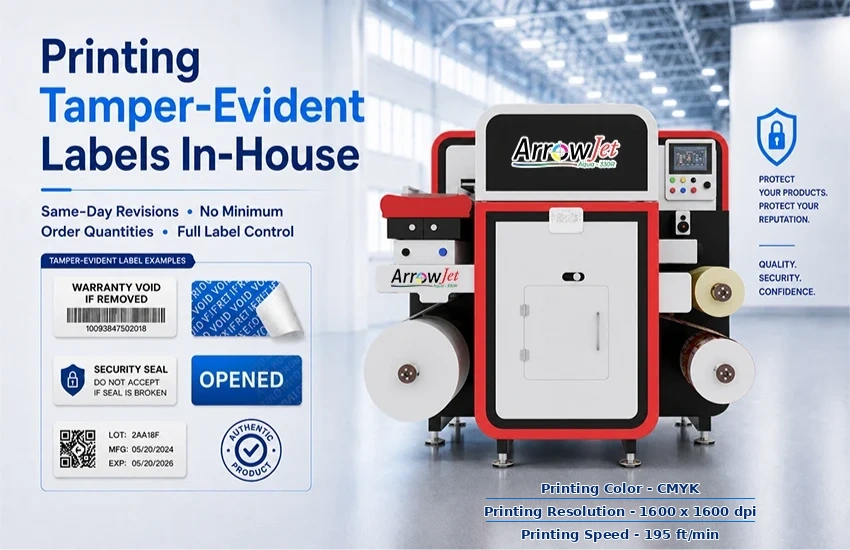
Printing Tamper-Evident Labels In-House
Brands that print tamper-evident labels in-house on digital label presses gain same-day revision capability and eliminate minimum order quantities — two operational advantages that matter most when formulas or regulations change.
The tamper-evident property of void, destructible vinyl, and security seal labels is built into the facestock material — not applied by the printer. Tamper-evident label stock is available on rolls from specialist substrate suppliers and prints on the same roll-to-roll digital presses used for standard pressure-sensitive labels. The press applies brand graphics, variable data, barcodes, compliance text, and lot codes onto the pre-engineered tamper-evident substrate.
Two operational models exist for in-house tamper-evident label production:
High-Volume In-House Label Production
Operations running multiple label SKUs, frequent regulatory revisions, or compliance-driven reprints benefit from a production-grade roll-to-roll press. The ArrowJet Aqua 330R is a high-speed single-pass aqueous pigment press printing at up to 150 ft/min (45.7 m/min) at 1600 × 1600 dpi, with a 12.75″ (324 mm) max print width. It handles standard label substrates including BOPP, PET, and specialty security stocks, and supports a bulk 10L ink system for extended production runs.
For pharmaceutical, supplement, or food brands managing a large label portfolio with GMP version control requirements, in-house printing on a press like the Aqua 330R Lite provides traceability: each print run is executed from the current approved file, eliminating the risk of applying pre-printed labels that are no longer current.
Entry-Level In-House Label Production
Converters and brand operations scaling up from desktop printers — or those bringing label production in-house for the first time — can enter digital label printing at lower capital and operating cost. The ArrowJet Eco 330R is a compact industrial single-pass press running at up to 20 m/min with 1600 × 1600 dpi resolution, 324 mm max print width, single-phase power (no air compressor required), and a footprint that fits production environments where space is limited. It handles CMYK water-based pigment inks on the same roll-format tamper-evident substrates used on larger presses.
For operations producing a moderate volume of tamper-evident labels across a manageable SKU count, the Eco 330R offers production-grade output without the infrastructure requirements of a larger press.
Matching the Right Format to the Right Package
No single tamper-evident format works for every container — the correct choice depends on container shape, surface energy, closure geometry, storage conditions, and the type of evidence required.
Before committing to a label specification or placing a production order, test the chosen label or seal on the actual packaging substrate under production and storage conditions. Confirm that it:
- Adheres properly to the container material and geometry (curved bottles, flat cartons, and irregular shapes each behave differently)
- Reveals tampering as intended under normal handling — and does not trigger false-positive evidence from ordinary stacking, shipping vibration, or temperature change
- Does not interfere with normal customer opening — excessive difficulty opening a legitimate seal creates user experience problems without security benefit
- Remains legible after adhesion — barcodes, lot codes, and expiration dates printed on the label must scan and read cleanly after application
Material selection follows from these requirements. Destructible vinyl adheres best to smooth, relatively flat surfaces and is well suited to capsule bottles, flat-panel closures, and secondary seals on boxes. Void labels require a substrate with sufficient surface energy to retain the transfer layer when the label is removed — test on the actual container material. Breakaway cap seals require precise sizing to the cap diameter and torque profile; off-the-shelf sizing rarely works without fitment verification.
Tamper-evident labels are a packaging tool — not a guarantee of product safety, authenticity, or legal compliance. Use them as part of a broader packaging and quality system, and confirm all applicable regulatory requirements before production.
Frequently Asked Questions — Tamper-Evident Labels
A tamper-evident label includes a physical feature designed to show visible evidence if the package has been opened, altered, or disturbed before it reaches the end user. Common mechanisms include void patterns revealed on removal, destructible vinyl that cannot be peeled intact, and breakaway perforations that cannot be resealed.
Requirements vary by product category and jurisdiction. OTC drug products in the United States are subject to FDA tamper-evident packaging regulations under 21 CFR Part 211.132. Food, cannabis, and personal care products face different — and sometimes overlapping — obligations depending on the sales channel, state, and federal rules in effect. Verify current obligations for your specific product category with qualified legal counsel before printing.
The most common formats are void labels (which reveal a “VOID” or “OPENED” pattern on removal), destructible vinyl seals (which shatter when peeled), breakaway cap seals (which tear at a perforation when the cap is twisted), and full-body shrink sleeves with perforations. The right format depends on container shape, substrate, storage conditions, and product category requirements.
Yes. Digital roll-to-roll label presses such as the ArrowJet Aqua 330R and the ArrowJet Eco 330R print on tamper-evident facestock substrates — including destructible vinyl, void material, and security seal stock — supplied on rolls by substrate vendors. In-house printing eliminates minimum order quantities, reduces revision turnaround from weeks to hours, and removes the risk of applying outdated pre-printed labels when formulas or regulations change.
Common tamper-evident facestock materials include destructible vinyl (shatters when peeled), void polyester (reveals a hidden pattern on removal), ultra-removable adhesive films (adheres strongly to the container but releases cleanly from the label face), and high-tack polypropylene with tear-at-opening perforations. Material selection depends on container surface, storage temperature, and the type of evidence the label is intended to provide.
Tamper-evident labels are standard in pharmaceuticals and OTC medications (FDA-regulated), food and beverage (retail and foodservice), dietary supplements and nutraceuticals, cannabis and hemp products (state-regulated), personal care and cosmetics, and electronics or high-value consumer goods. Each industry applies different specifications and regulatory frameworks.
Print Tamper-Evident Labels In-House
Arrow Systems manufactures digital label presses used by pharmaceutical, food, supplement, and consumer goods brands to print tamper-evident labels on-demand — no plates, no minimums, no obsolete pre-printed inventory. The ArrowJet Aqua 330R and the ArrowJet Eco 330R are available for evaluation with sample print runs on your own substrate.
Cannabis Label Versioning Workflow for Multi-State Brands
Table of Contents Cannabis Label Versioning Workflow for Multi-State Brands A cannabis label versioning workflow produces state-specific labels from one master template by moving state-variable
Water-Based vs UV-Cured Label Adhesive: Food & Pharma Guide
Table of Contents Water-Based vs UV-Cured Label Adhesive: Food & Pharma Guide Water-based adhesives suit dry, ambient containers; UV-cured hot melts suit cold, wet, curved
Is Your Confectionery Brand Ready to Bring Flexible Packaging In-House?
Table of Contents Is Your Confectionery Brand Ready to Bring Flexible Packaging In-House? In-house flexible packaging pays off for confectionery brands with many SKUs, short
Label Slitting and Matrix Removal: Where Converters Lose Finishing Time
Table of Contents Label Slitting and Matrix Removal: Where Converters Lose Finishing Time Label slitting and matrix removal, plus rewinding, cost converters more finishing time
Limited Edition Spirits Label Printing: 4 Holiday Delay Fixes
Table of Contents Limited Edition Spirits Label Printing: 4 Holiday Delay Fixes Limited edition spirits label printing runs late because of the calendar, not the
Section 179 Label Printer Timing: Install Before December 31
Table of Contents Section 179 Label Printer Timing: Install Before December 31 A section 179 label printer purchase counts for 2026 only if the press