In-House Label Printing vs. Print on Demand: Cost by Volume
Table of Contents In-House Label Printing vs. Print on Demand: Cost by Volume In-house label printing vs. print on demand comes down to a cost-per-label
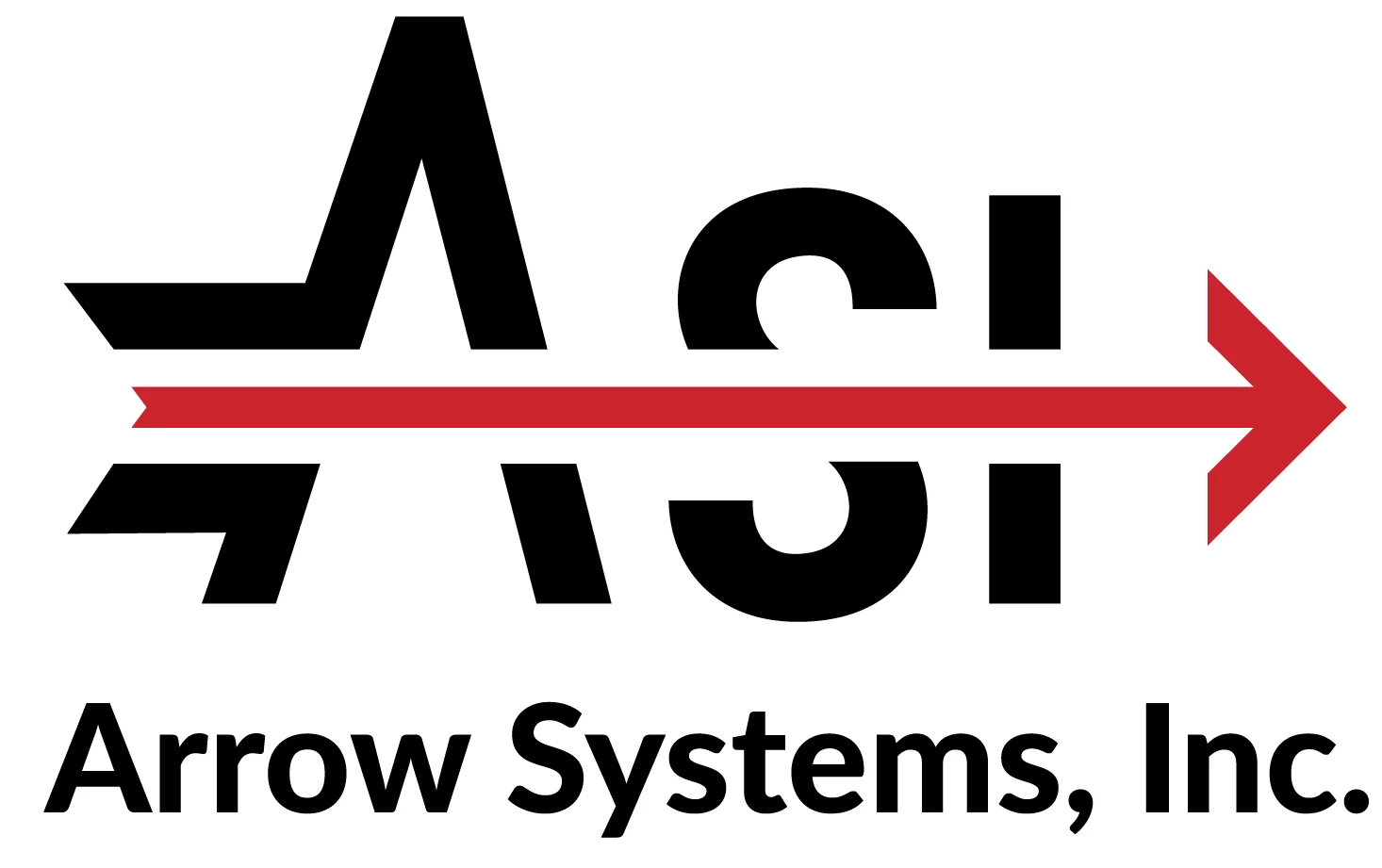

Nutraceutical packaging digital printing eliminates plates, setup charges, and MOQs — so supplement brands and contract manufacturers print only the quantity each SKU run actually requires.
The supplement category runs faster than most CPG segments — SKU proliferation, frequent panel revisions, and short product lifecycles make label overproduction a structural cost and compliance problem.
For nutraceutical brands, the label is where operational speed and regulatory discipline meet. Every dosage format, flavor, count size, and bundle variation is its own label. Supplement facts panels change when formulations change. Allergen statements update when sourcing changes. Barcodes refresh for new retail channels. Each of these events can render bulk pre-printed stock obsolete — turning a procurement decision into a compliance liability. Digital label printers built for in-house production eliminate this exposure structurally, not case by case.
SKU proliferation
Every dosage format, flavor, count size, retailer variant, and bundle is its own label version. A brand managing a dozen core products can carry several times that many active label variants once retailer-specific, sample, and bundle configurations are counted. Each variant has its own revision cadence and compliance requirements.
Frequent content changes
Supplement facts panels, structure/function claims, allergen statements, and barcodes change for reasons large and small — a sourcing change, a claim refinement, an updated retailer requirement. Each change can render pre-printed label stock obsolete before the inventory is consumed, creating both waste and the risk that an outdated label is applied to a compliant product.
Private-label complexity
Contract manufacturers managing multiple client brands across supplement private label programs juggle dozens or hundreds of independent label designs, each with its own revision schedule, approval chain, and compliance posture. A single production day may require artwork from four different clients to be separated, versioned, and applied without cross-contamination.
Short product lifecycles
Trend-driven nutraceutical ingredients can spike and fade within a season, leaving bulk-printed labels in the scrap pile. Digital printing eliminates the tooling investment in labels for products that may not complete their first inventory cycle.
The traditional flexographic model compounds all of this. Flexographic minimum order quantity thresholds typically reach thousands of labels per SKU — for a rapidly revised or low-volume product, that MOQ guarantees overproduction. Operations teams either absorb the waste or delay updates to consume existing stock, quietly increasing compliance exposure with every week that passes.
Digital label printing removes plates and dies from the equation, turning supplement facts panel updates and SKU versioning into file changes rather than new tooling orders — collapsing both cost and lead time.
No plate, no minimum order quantity
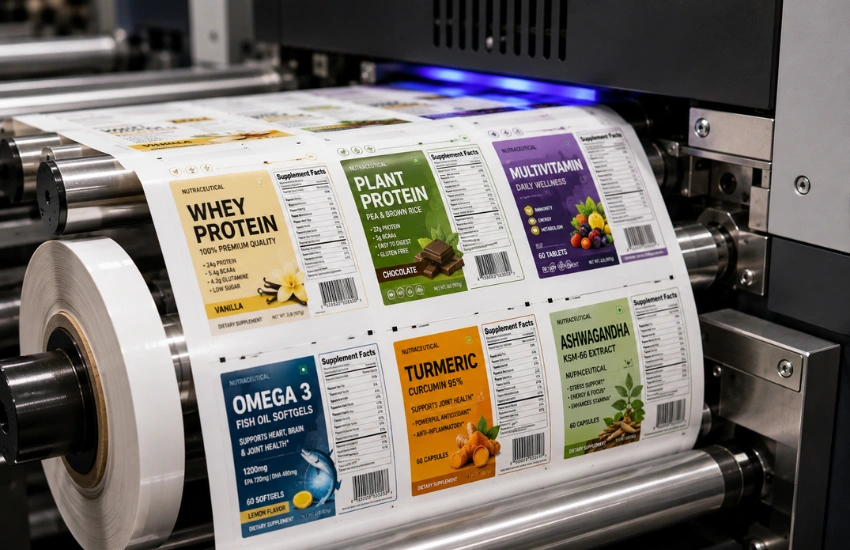
Because there is no tooling to amortize across a run, you can print the quantity a production run actually requires — whether that is 300 labels for a limited-release SKU or 30,000 for a core product line — without MOQ-driven overproduction. Each SKU’s label quantity becomes a planning decision rather than a procurement constraint.
Versioning becomes a file change
Updating a supplement facts panel, swapping an allergen statement, refreshing a barcode, or applying a different client logo is a digital file revision — not a new plate order. You can run one SKU’s updated version while leaving dozens of others untouched. This is the core efficiency of digital label printing supplements operations: every revision costs the time to edit a file, not the lead time to remake a plate. The cost and lead time of a change collapse toward the cost of editing an artwork file and queuing a job.
Lead time compression
With on-demand nutraceutical packaging, the path from approved artwork to finished, slit, and rewound rolls can compress from weeks to hours for short runs and reorders — removing the dependency on external converter scheduling for routine production.
Consider what happens when a regulatory team finalizes a revised supplement facts panel for a single magnesium SKU. In a flexographic workflow, that change triggers new plates, a setup charge, and an MOQ that forces you to scrap or store the old stock and overbuy the new version. In a digital workflow, the process looks like this:
Step 1: File update
The updated artwork replaces the prior version in the managed asset library.
Step 2: Automated scheduling
The next production schedule entry for that SKU pulls the current file automatically.
Step 3: On-demand print run
The press produces only the quantity the upcoming production run requires.
Step 4: Version retirement
The previous version is retired in the system, reducing the risk that an operator pulls outdated stock from inventory.
That same logic scales across hundreds of variants without changing how the team operates. The workflow is identical whether the operation manages 12 SKUs or 1,200.
Both workflows use the same digital press; the difference is governance — brand-name labels are managed internally, while contract manufacturers must keep client designs cleanly separated across independent revision schedules and approval chains.
Internal version control
Marketing, regulatory, and operations own the artwork lifecycle. Changes cluster around reformulations, claim updates, seasonal runs, and limited-release launches. The priority is launching new SKUs quickly and implementing compliance changes without scrapping bulk inventory.
Revision triggers
Sourcing changes that affect ingredient origins, FDA guidance updates affecting structure/function claims, and retailer-specific barcode or format requirements are the most common revision triggers for brand-name nutraceutical operations.
Parallel design families
Each client brand maintains independent branding, revision schedules, and approval gates. A contract manufacturer running labels for private label dietary supplement clients manages many design families in parallel — often with client-specific compliance content, barcodes, and distributor-specific variants. Cross-contamination of designs is an operational risk that version governance must prevent.
Priority: clean separation
The core operational goal is ensuring the current approved file prints for the correct client run, in the right quantity, without manual reconciliation. The wrong label on the right product — or the right label in a superseded version — creates a compliance problem regardless of how the error occurred.
The shared enabler for both workflows is on-demand production driven from a disciplined, versioned file library. Private label nutraceutical operations benefit most from connecting the label system to production schedules or ERP — so the correct version and quantity are triggered by the manufacturing run rather than reconciled manually. This reduces both the warehousing overhead of holding client-specific roll inventory and the risk of a superseded version reaching the production floor.
The ArrowJet Aqua 330R is a water-based inkjet press purpose-built for short-run, high-mix supplement bottle label production — no plates, no MOQ, no converter dependency for version changes or reorders.
On-demand production without MOQ constraints
The Aqua 330R produces the quantity each SKU run requires — from 300 labels for a limited-edition launch to high-volume runs for core products — without minimum order quantities or plate charges. Each production run is a planning decision, not a procurement constraint.
Fast supplement facts panel versioning
Panel revisions, allergen updates, and barcode changes are digital file swaps. The revised artwork is queued and the press runs the current version for that SKU while other SKUs in the job queue remain unchanged. For operations managing frequent compliance updates, this eliminates the weeks-long lead time a flexographic plate order imposes on every revision cycle.
Water-based inkjet output
The Aqua 330R produces labels using water-based inkjet chemistry — without solvent-based inks — simplifying workplace safety compliance and aligning with the sustainability messaging many nutraceutical brands communicate to retail and direct-to-consumer customers.
Multi-SKU production efficiency
For operations managing 20 or more active label SKUs, the cumulative effect of removing plate costs, setup time, and minimum orders from every version change compounds across the full label portfolio. The economic advantage is not a single dramatic saving — it is the elimination of a recurring cost structure that penalizes every revision and every new SKU launch.
The Aqua 330R fits nutraceutical operations where label production runs alongside manufacturing rather than being managed through converter procurement lead times. For a multi-SKU supplement brand or a contract manufacturer running many private-label designs, this is the primary press for vitamin and supplement bottle label production where mix is high and individual run sizes are modest. Operations producing in a regulated environment should also review Arrow’s guide to GMP label printing for supplements. For a broader look at in-house label production economics and workflow integration, see Arrow’s guide to in-house label production.
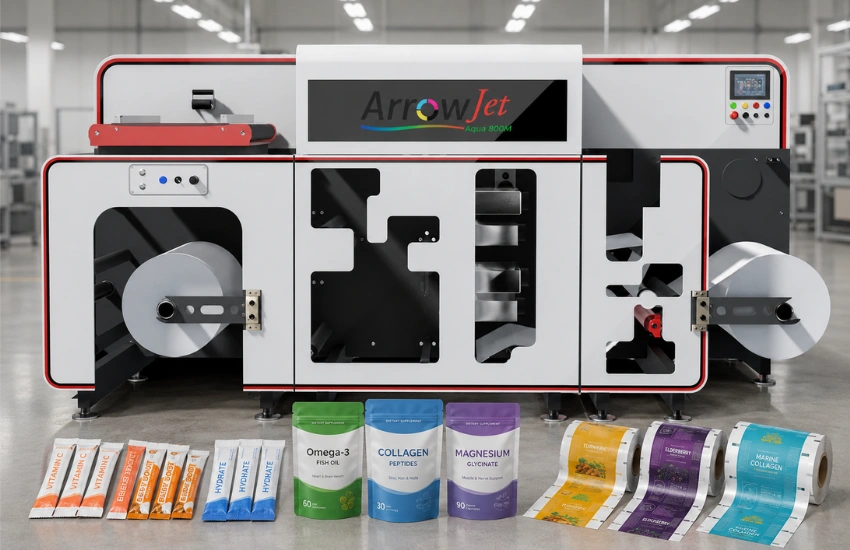
The ArrowJet Aqua 800M is designed for flexible substrate nutraceutical packaging — sachets, stick packs, and stand-up pouches — addressing formats that rigid bottle label presses cannot reliably produce.
Flexible substrate capability
The Aqua 800M is engineered for film-based flexible packaging materials — including PET/PE laminates and foil-based pouch substrates — that roll-label presses optimized for rigid supplement bottles cannot reliably handle. This makes it directly applicable to single-serve sachet, stick pack, and stand-up pouch formats in nutraceutical production environments. Film substrates requiring pre-treatment should be prepared offline before press loading.
SKU agility across single-serve formats
Nutraceutical brands expanding into sachets and pouches frequently launch with multiple SKU variants — different flavors, dosages, or sampling configurations. The Aqua 800M handles artwork changeovers without mechanical setup or plate costs, supporting rapid SKU iteration across a growing flexible packaging portfolio. Version changes follow the same file-based workflow as bottle label production. Sachet label printing nutraceutical operations integrate into the same digital workflow — no separate system, setup charge, or plate order required.
Eliminated outsourcing dependency for flexible formats
Flexible packaging converters typically require high minimum order quantities and multi-week lead times for short-run nutraceutical work. The Aqua 800M brings this capability in-house, removing MOQ constraints and compressing the production timeline to the same day that artwork is approved — consistent with how the Aqua 330R handles bottle label production.
Contract manufacturing environments
Contract manufacturers running private-label supplement pouches and sachets for multiple brand customers can switch between brand-specific artwork on the same production day, without plates or setup waste. This directly reduces scheduling complexity and per-run cost for multi-customer flexible packaging operations.
For nutraceutical operations where single-serve flexible packaging represents a significant or growing share of the product portfolio, the ArrowJet Aqua 800M provides the substrate capability and production flexibility that rigid bottle label presses are not designed to deliver. See Arrow’s full range of digital flexible packaging printers for a broader view of flexible format production options. Both presses — the Aqua 330R for bottle labels and the Aqua 800M for flexible formats — use the same digital, file-based versioning workflow, so the operational discipline built around one carries forward to the other.
Three operating variables determine the fit: SKU count, revision frequency, and per-run volume — and your packaging formats (bottles vs. flexible) determine whether one press or both are required.
Operating reality | Packaging format | Recommended fit |
Many SKUs, frequent revisions, modest per-run quantities | Supplement bottles (pressure-sensitive roll labels) | ArrowJet Aqua 330R — short-run, on-demand digital label production |
Sachet, stick pack, or pouch formats — any volume | Flexible packaging (PET/PE laminates, foil substrates) | ArrowJet Aqua 800M — flexible substrate digital production |
Mixed portfolio — bottles and flexible formats | Both rigid bottle and flexible packaging | Both presses, within one digital file-based workflow |
Private-label contract manufacturing, multiple client brands | Dependent on client packaging format mix | Aqua 330R for bottle labels; Aqua 800M if flexible formats are in scope |
The decision rests on three variables: how many distinct labels you manage, how often content changes, and which packaging formats your product portfolio uses. For operations transitioning from high-MOQ flexographic procurement to on-demand digital, the directional benefit — reduced inventory carrying costs, faster version updates, eliminated converter lead times — stays consistent across SKU counts and volume tiers.
Operational note: Digital printing supports faster content updates but does not by itself ensure regulatory conformance. Labeling content and claims should still be reviewed against applicable requirements by your regulatory function. The advantage digital provides is operational — implementing an approved change quickly and printing only the current version.
Common questions from supplement brand operations teams and contract manufacturers evaluating digital printing for short-run nutraceutical label and flexible packaging production.
Digital inkjet printing is generally cost-competitive with flexographic printing at run lengths below approximately 5,000–15,000 labels, because there are no plate or setup charges to amortize. For multi-SKU supplement brands with frequent revisions, the economics tilt further toward digital as SKU count rises and per-run quantities shrink — the eliminated overproduction waste and avoided inventory carrying cost matter as much as the per-label price.
A supplement facts panel revision is a file update, not a new tooling order. You replace the artwork in your managed file library and the next production run prints the current version, while all other SKUs in the queue remain unchanged. This lets you implement an approved compliance change without scrapping bulk inventory or meeting a new minimum order quantity from a converter.
Yes. The press and production process are the same; the difference is governance. With disciplined version control — ideally connected to production scheduling or ERP through operations automation — the correct approved file and quantity are triggered for each run, keeping client designs cleanly separated from your own brand SKUs without manual reconciliation.
The ArrowJet Aqua 330R is designed for pressure-sensitive roll label production for supplement bottles — the standard format for capsule, tablet, and powder container labeling. The ArrowJet Aqua 800M is a wide-web press built for flexible substrate formats — sachets, stick packs, and stand-up pouches — that rigid bottle label presses cannot reliably produce. They serve different packaging formats within the nutraceutical segment, and can operate as a complementary pair for operations that produce both.
If your nutraceutical label operation is shaped by SKU proliferation, frequent supplement facts panel revisions, multi-client private-label complexity, or a growing flexible packaging portfolio, the right starting point is a structured assessment matched to your actual formats, SKU mix, versioning frequency, and production volumes.
Arrow Systems can help map short-run bottle label production (ArrowJet Aqua 330R) and flexible sachet and pouch production (ArrowJet Aqua 800M) into a unified, file-driven workflow — so labels are produced in the right quantity, in the current version, triggered by your production schedule rather than a converter lead time.
Table of Contents In-House Label Printing vs. Print on Demand: Cost by Volume In-house label printing vs. print on demand comes down to a cost-per-label
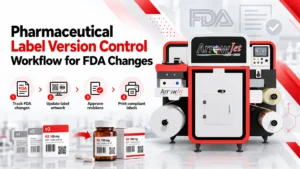
Table of Contents Pharmaceutical Label Version Control Workflow for FDA Changes A GMP label version control workflow moves an approved revision to the line: change
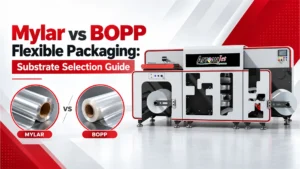
Table of Contents Mylar vs BOPP Flexible Packaging: Substrate Selection Guide PET (Mylar) leads on oxygen and aroma barrier and heat tolerance; BOPP leads on
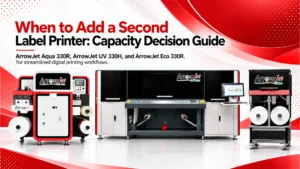
Table of Contents When to Add a Second Label Printer: Capacity Decision Guide Three measurable signals decide it — sustained utilization above your scheduling ceiling,
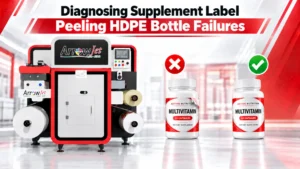
Table of Contents Diagnosing Supplement Label Peeling HDPE Bottle Failures HDPE label peeling traces to low surface energy, an adhesive mismatch, or moisture exposure —
Table of Contents Roll-to-Roll vs. Sheet-Fed Label Printing: Throughput & Cost Rolls win on cost per applied label with an automatic applicator; sheets win on