Pet Food Label Design

Table of Contents

Pet Food Label Design: AAFCO Compliance & Printing Guide

Pet food labels must satisfy specific AAFCO label requirements — guaranteed analysis, net quantity, and calorie content each have fixed placements.

Key Takeaways

  • Treat AAFCO compliance declarations as structural layout inputs from the first wireframe — not artwork added afterward.
  • The guaranteed analysis belongs on the information panel in aligned tabular format, separated from the calorie statement and ingredient list, with space reserved for future guarantees.
  • The principal display panel (PDP) carries two required elements — product identity and net quantity — with net quantity in the lower third, kept clear of imagery.
  • Legibility failures are more common than content failures: small type, low contrast, and condensed typefaces on information panels cause most compliance problems.
  • Functional ingredient claims must be truthful, substantiated, and consistent with the product’s formulation — build them as modular, independently approvable blocks.
  • The ArrowJet Aqua 330R handles cans, jars, and bottles; the ArrowJet Aqua 800M handles flexible packaging up to 638mm; the ArrowJet Eco 330R is the entry-level path into in-house production.

The AAFCO and FDA Framework for Pet Food Label Design

Pet food label design follows FDA expectations and AAFCO label standards, including AAFCO dog food standards, adopted variably by state.

Requirements vary by product type, species, and market, so treat the points below as general guidance to verify against current sources. The compliance challenge isn’t knowing the required elements — it’s placing each one correctly, at legible size, without crowding the brand’s shelf presence.

Product identity

The product name and species statement appear on the principal display panel and set the context for all other declarations.

Net quantity of contents

Appears on the principal display panel, typically lower third, in both U.S. customary and metric units. Decorative elements must not overlap this zone.

Guaranteed analysis

Lists minimum or maximum percentages of crude protein, fat, fiber, and moisture, plus additional guarantees for specific claims. Belongs on the information panel as an aligned table.

Ingredient list

Listed in descending order of pre-processing weight, on the information panel alongside the guaranteed analysis.

Nutritional adequacy statement

States whether the product is complete and balanced for a life stage, or intended for supplemental feeding — wording must match how it was formulated or tested.

Feeding directions

Quantity and frequency guidance for the species and product type, on the information panel.

Calorie content statement

Metabolizable energy per kilogram and per a household measure, on the information panel, separated from the guaranteed analysis.

Manufacturer or distributor information

Name and address of the responsible party. For private label products, confirm who that responsible party is.

Effective AAFCO pet food label design treats compliance as a structural input from the first wireframe, not artwork added afterward.

Guaranteed Analysis: How to Display It Correctly

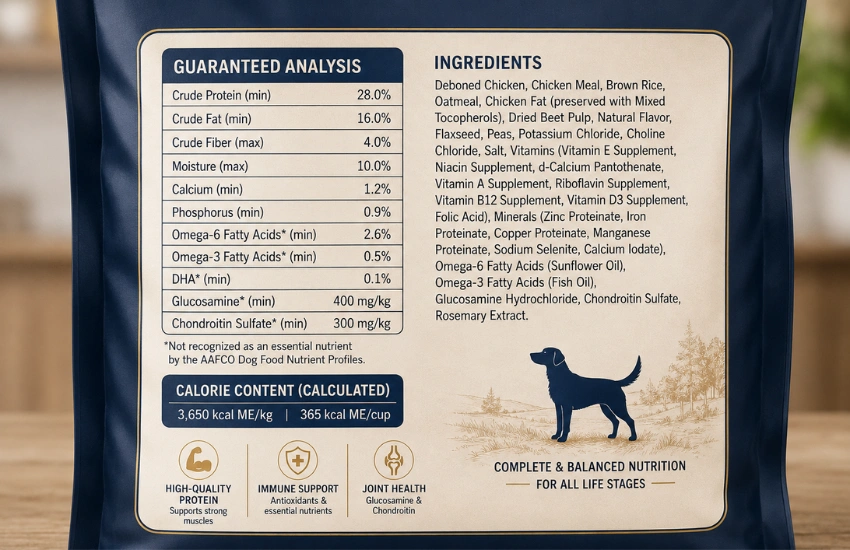
Guaranteed analysis pet food panels belong on the information panel in tabular format, with room reserved for future claim guarantees.

Panel placement

The guaranteed analysis belongs on the information panel, not the front panel — a common first-time mistake that creates compliance exposure.

Tabular format

Use a tabular or stacked format with each nutrient and percentage aligned in separate rows — easier to scan and audit than running text.

Type legibility

Avoid reversing small numerals out of busy imagery. Test legibility at actual print size on the real substrate, not just on screen.

Building in room to grow

Reserve extra rows for future functional claims (joint support, digestive health). A table built with room to grow absorbs reformulation changes as a file edit, not a layout rebuild.

Dog food vs. cat food panels

Guaranteed analysis dog food panels carry the highest SKU volume for most brands, since dog food is the largest pet food segment. Cat food guaranteed analysis panels follow the same rules but often add taurine and other feline-specific guarantees — confirm species-specific requirements before finalizing either.

Pet Food Guaranteed Analysis Label

Calorie Statement, Net Quantity, and Nutritional Adequacy Placement

Three declarations frequently cause first-submission failures because their placement and wording are specific.

Calorie statement

Expressed as metabolizable energy in kcal per kilogram and per a household measure such as a cup or treat. Give it its own labeled line — “Calorie Content” — separated from the guaranteed analysis.

Net quantity

Belongs on the PDP, lower third, in both U.S. customary and metric units, scaled to package size. One of the most frequently cited placement violations in retailer audits.

Nutritional adequacy statement

Must match how the product was formulated or tested — cannot make a life-stage claim the substantiation method doesn’t support.

The practical fix: map a dedicated “regulatory column” on the information panel where these declarations live in a predictable, repeatable order.

Designing the Principal Display Panel for Pet Food

The PDP must carry product identity and net quantity while leaving room for brand storytelling within those constraints.

Visual hierarchy

Sequence: brand mark, product name and identity, species statement, then net quantity — each visually distinct.

Species statement clarity

Buyers must immediately identify the intended species at arm’s length. Small-type species statements are a top retailer compliance concern.

Net quantity zone

Lower third, with clear space around it — no overlapping badges or decorative elements. Non-negotiable in retailer planogram reviews.

Claim discipline

Keep the front clean; push detail to the information panel. One or two substantiated claims is manageable — four or five degrades legibility.

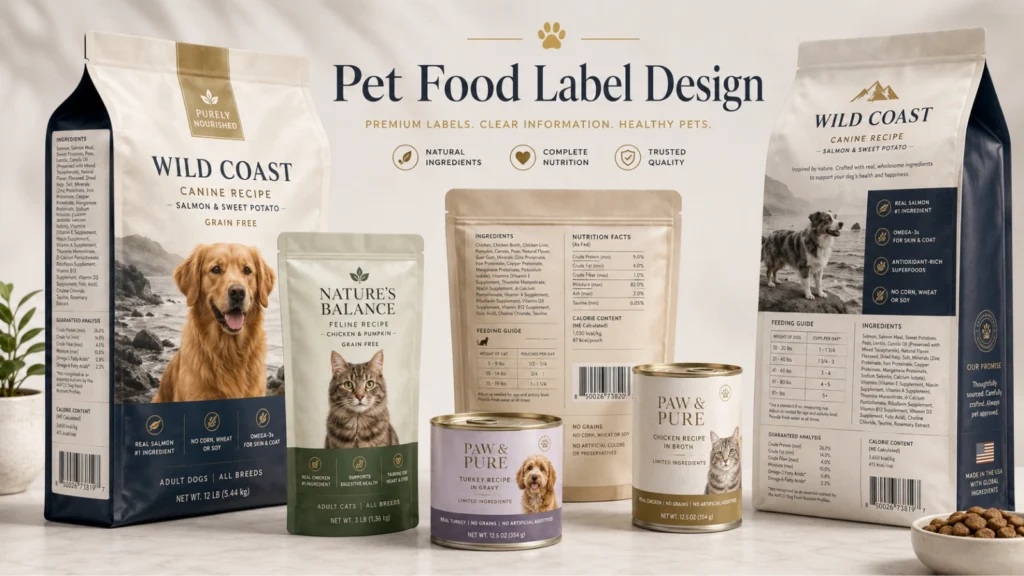
A worked PDP sequence: top third — brand logo and hero image; middle band — product name and species/intent line with one supporting claim; lower third — net quantity, clear of imagery.

Typography and Color Considerations for Regulatory Text

Compliance text fails most often on legibility, not content — correct data in unreadable type is functionally non-compliant.

Typeface selection

Use a clean, neutral typeface for regulatory blocks. Save display fonts for brand elements.

Contrast

Dark type on a light, solid field outperforms text over imagery or textured backgrounds — a top issue in retailer compliance audits.

Line spacing

Maintain generous spacing in dense blocks so rows and ingredients stay individually scannable, especially on long ingredient lists.

Avoid condensed type

If content doesn’t fit, expand the panel or reduce front-panel clutter — don’t compress type to force a fit.

Substrate selection also shapes legibility: textured, recycled, or specialty facestocks respond differently to fine regulatory text than standard coated paper. Review Arrow’s label substrate range to match facestock to your regulatory text requirements. Minimum type sizes vary by declaration and package size — verify current requirements for your markets.

Handling Functional Ingredient Claims Without Overstating

Functional ingredient claims drive purchase decisions but carry the highest compliance risk in pet food labeling.

Truthfulness and substantiation

Every claim must be truthful, substantiated, and consistent with the formulation — supported by the guaranteed analysis or ingredient list.

Medical implication risk

“Supports joint health” is a structure-function claim; “treats arthritis” is a drug claim. Crossing that line carries significant regulatory consequences.

Modular claim blocks

Build claim text as independent layout blocks so one formula change doesn’t require re-laying the entire label.

Supplement and treat differences

Required elements and adequacy wording can differ from complete-and-balanced foods — confirm the right framework per product type.

Regulatory validation — including AAFCO substantiation and FDA compliance — is the brand’s responsibility. Arrow Systems manufactures printing hardware; Arrow does not provide regulatory or compliance advisory services.

Matching the Press to Your Package Format

On-demand digital printing supports rigid and flexible pet food formats — short runs, fast versioning, and multi-SKU agility.

Pet food portfolios typically span rigid containers (cans, jars, bottles for wet food and supplements) and flexible substrates (bags, pouches, sachets for dry food and treats). Matching equipment to format is the first decision in a digital workflow.

ArrowJet Aqua 330R for Pressure-Sensitive Can and Bottle Labels

Rigid format applications

Wet food, broth, and supplement formats need pressure-sensitive labels that hold fine text through distribution and handling. The ArrowJet Aqua 330R delivers the resolution needed for legible guaranteed analysis tables and dense ingredient lists.

Short runs and fast versioning

For multi-SKU portfolios, digital production eliminates plate costs and minimum order quantities. An updated guaranteed analysis or new claim block becomes a file change, not a plate reorder with weeks of lead time.

ArrowJet Aqua 800M for Flexible Bags and Stand-Up Pouches

Flexible substrate support

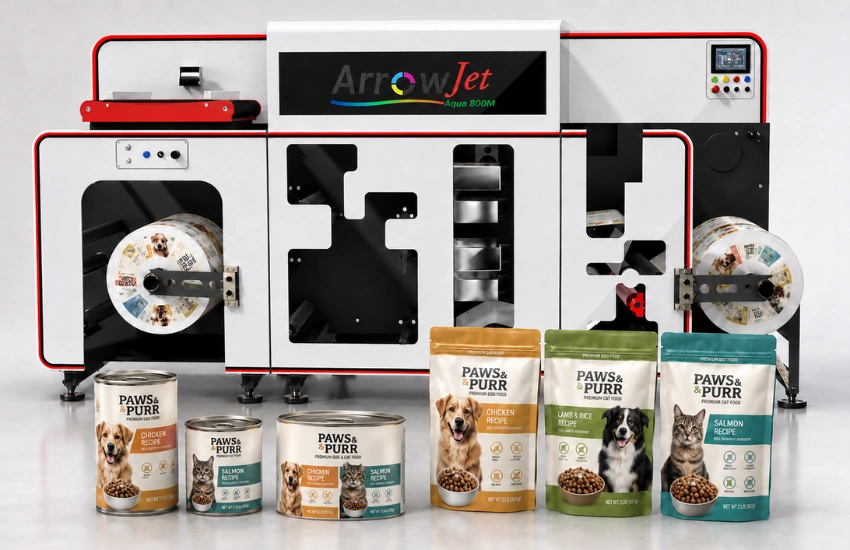
The ArrowJet Aqua 800M handles coated paper, PP, PET, PVC, BOPP, Mylar, Tyvek, and laminate materials at a maximum printing width of 638mm — covering most dry food bags, stand-up pouches, and treat bags.

Resolution and throughput

At 1600 × 1600 dpi and 90–195 ft/min, the Aqua 800M produces legible fine text on large-format panels at volumes suited to sustained flexible packaging production.

ArrowJet Eco 330R for Entry-Level In-House Production

Entry-level capability

The ArrowJet Eco 330R runs on single-phase 230V power with no air compressor needed, producing up to 20 m/min across label and flexible packaging formats at 1600 × 1600 dpi, 324mm max width. See Arrow’s guide to in-house label production for the operational case.

Revision cycle control

Smaller brands lack the volume to negotiate flexible converter minimums. The Eco 330R puts an updated label into production the same day a change is approved.

Press Comparison: Aqua 330R vs. Aqua 800M vs. Eco 330R for Pet Food

Use this table to match a press to your dominant pet food package family before evaluating specifications in detail.

Consideration

ArrowJet Aqua 330R

ArrowJet Aqua 800M

ArrowJet Eco 330R

Primary package family

Rigid: cans, jars, bottles

Flexible: bags, stand-up pouches, sachets

Label and flexible packaging (narrower range)

Typical pet food products

Wet food, broth, liquid supplements

Dry kibble, treats, freeze-dried, pouches

Smaller volume runs across both formats

Max printing width

324 mm

638 mm

324 mm

Print resolution

1600 × 1600 dpi

1600 × 1600 dpi

1600 × 1600 dpi

Printing speed

Up to 195 ft/min

90–195 ft/min

Up to 20 m/min (~65 ft/min)

Power requirements

Single-phase

Three-phase 220V / 400V

Single-phase 230V, no air compressor

Best fit for

Dominant rigid can/bottle portfolio, frequent reformulation

High-volume flexible packaging needs

Growing brands building first in-house capability

Use this table as a starting filter, not a final configuration decision. Brands with mixed portfolios sometimes run the Aqua 330R and Aqua 800M in parallel. Request free label samples to pilot on your substrates before committing.

Frequently Asked Questions — Pet Food Label Design and Printing

Common questions from pet food brand owners, packaging designers, and operations teams.

Generally on the information panel, formatted as an aligned table separated from the calorie statement and ingredient list — not on the principal display panel. Verify against current AAFCO model regulations and applicable state rules.

AAFCO label requirements generally include product identity, net quantity, guaranteed analysis, ingredient list, nutritional adequacy statement, feeding directions, calorie content, and manufacturer information — each with specific placement rules. Confirm current AAFCO label requirements for your markets before finalizing artwork.

Model regulations generally require a calorie statement expressed as metabolizable energy per kilogram and per a household measure. Format and placement can vary by product type and state — confirm current requirements.

Claims must be truthful, substantiated, and consistent with the formulation and adequacy basis. Disease treatment or prevention claims raise significant regulatory risk. Build claims as modular, independently approvable blocks.

It supports short runs without plate costs, fast versioning, and multi-SKU production for seasonal, regional, and private-label portfolios — reducing obsolete label waste and shortening revision turnaround.

The ArrowJet Aqua 330R suits pressure-sensitive labels on rigid formats; the ArrowJet Aqua 800M is built for flexible packaging up to 638mm; the ArrowJet Eco 330R provides an entry-level path across both formats up to 324mm.

Get a Pet Food Label Printing Assessment from Arrow Systems

If your team is managing AAFCO compliance across a growing SKU portfolio — or evaluating on-demand digital printing for rigid and flexible formats — Arrow Systems can run a structured assessment of your package formats, SKU complexity, and revision cadence.

Explore Arrow’s digital label printers and flexible packaging printers, or contact Arrow Systems directly.