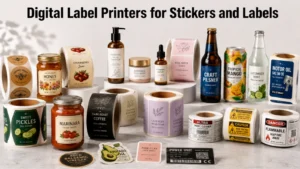
Digital Label Printers for Stickers and Labels: How to Choose the Right Press
Table of Contents Digital Label Printers for Stickers and Labels: How to Choose the Right Press The right printer for stickers and labels depends on
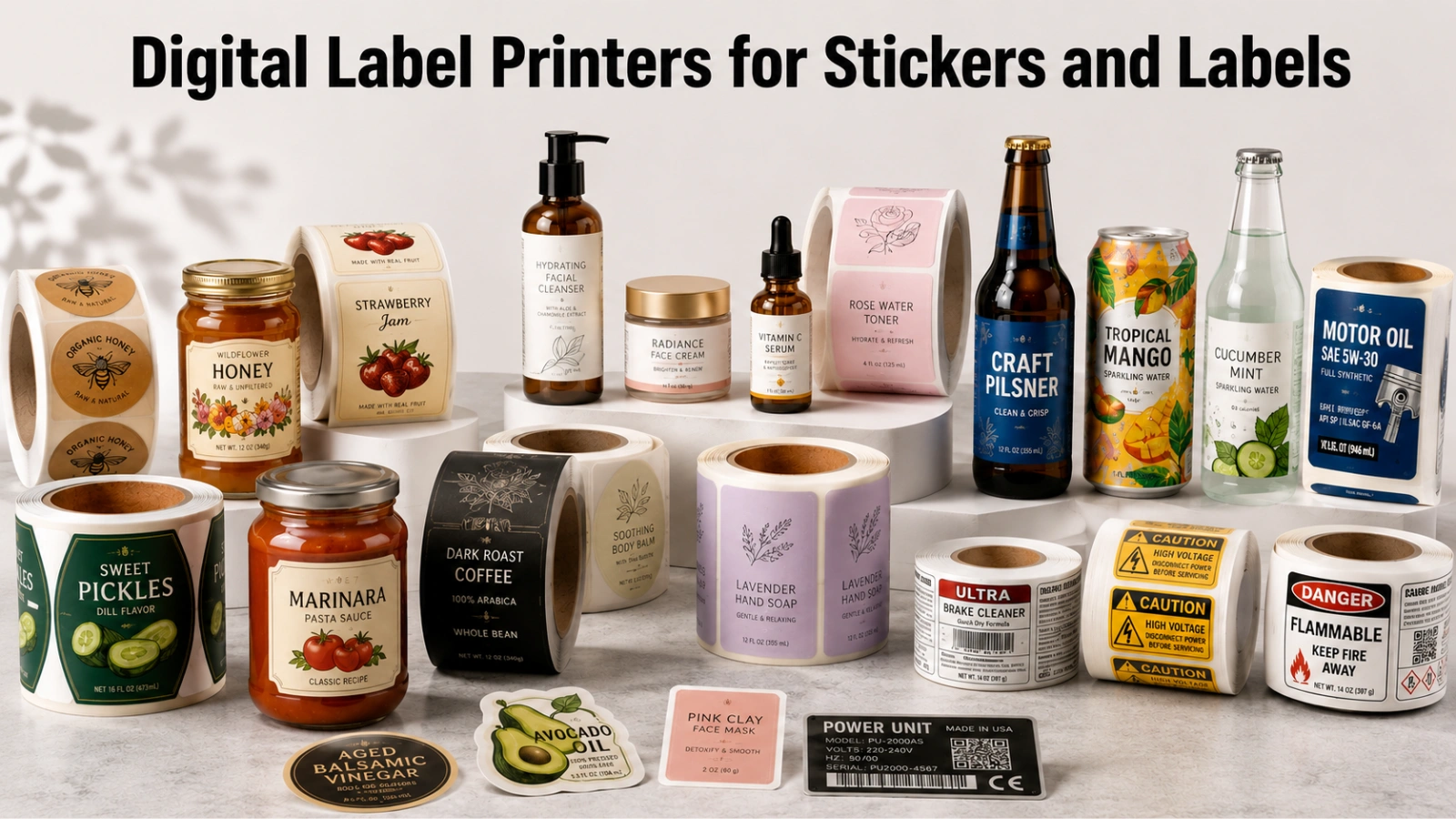
Choosing a label printer without first defining the application is the most common — and most costly — mistake buyers make.
A sticker on a promotional item has entirely different requirements than a label on a beverage bottle, a cosmetic jar, a pharmaceutical package, or a chemical container. Before comparing printer specifications, define the conditions the label will face after it leaves the press.
Ask these questions before shortlisting equipment:
The answers narrow your printer category immediately. A short-run promotional sticker with basic CMYK art sits in a completely different equipment tier than a durable, variable-data food-safety label printed at volume across multiple SKUs.
Six variables govern nearly every printer selection decision in label and sticker production.
Factor | What It Determines | Why It Matters |
Print Volume | Equipment tier: desktop, benchtop, or industrial | Sustained production demands industrial-grade duty cycles; low volume doesn’t justify the investment |
Print Width | Maximum label size and roll format | Printer must accommodate your widest format without wasted media |
Resolution and Color | Fine detail, small type, gradients, brand color accuracy | High-resolution output (1600 × 1600 dpi) is critical for premium shelf presentation |
Ink Chemistry | Durability, water resistance, substrate compatibility | Aqueous pigment and UV inks behave differently across substrates and end-use environments |
Substrate Compatibility | Which label stocks and films the printer can handle | Mismatch between printer, ink, and media causes print quality failures or adhesion problems |
Finishing Needs | Die cutting, lamination, slitting, waste removal | If labels need custom shapes, the finishing workflow must be planned alongside the printer |
Printer categories differ in duty cycle, roll capacity, speed, and total cost of ownership — not just price.
Desktop Color Label Printers
Suited to offices, micro-brands, and very low-volume label work. Easy to install and operate, but not designed for continuous production. Ink costs per label are typically high at scale, and roll capacity is limited.
Benchtop and Entry-Level Production Presses
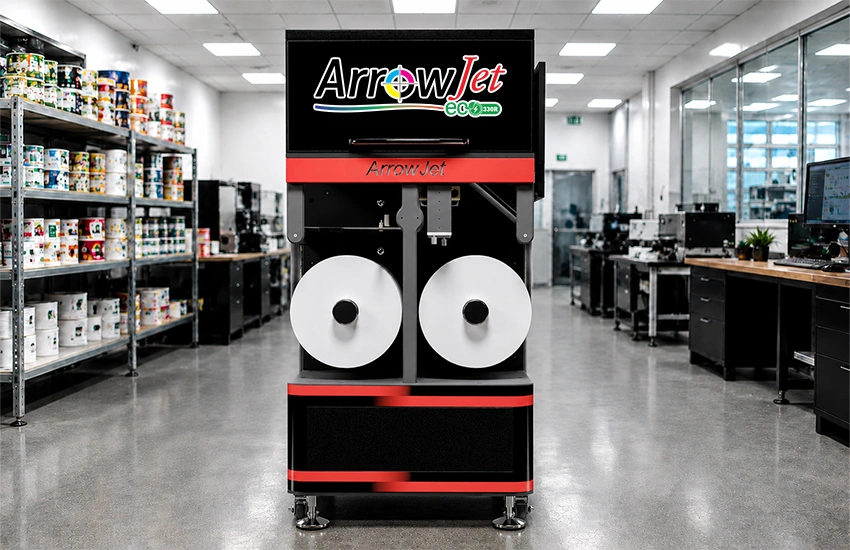
The step up from desktop for growing businesses that have outgrown low-volume systems but don’t require a large-format industrial footprint. Compact industrial presses — like the ArrowJet Eco 330R — run on single-phase power, require no air compressor, and deliver production speeds up to 20 m/min with a 324 mm print width at 1600 × 1600 dpi. They’re designed for short-to-medium runs with low operating cost and an easy installation footprint.
Industrial Digital Label Presses
Roll-to-roll machines built for sustained, high-throughput label production. They support larger media rolls, faster print speeds, and integration with digital or analog finishing equipment. Industrial presses reduce per-unit cost at volume and maintain consistent quality across long runs. Single-pass architecture — where the entire printhead spans the media width — eliminates the speed penalty of multi-pass systems.
Ink chemistry is one of the most consequential decisions in label press selection — it determines substrate options, durability, color performance, and the type of labels you can produce.
Water-based pigment inks are the most widely used technology in industrial digital label production. Pigment particles are suspended in a water carrier and bond to the coating on the substrate surface. They deliver strong color gamut, durability relative to dye-based alternatives, and consistent performance on coated papers, BOPP, PP, PET, and inkjet-treated films.
Aqueous pigment presses are the right choice when the priority is cost-effective, high-speed production of standard labels on treated media. The ArrowJet Aqua 330R uses Memjet DuraFlex® technology to deliver print speeds up to 150 ft/min at 1600 × 1600 dpi, with a 12.75″ maximum print width. It supports a 2L or 10L bulk ink option and is Nestlé Guidance compliant — making it a production workhorse for food, beverage, cosmetic, pharmaceutical, and nutraceutical label runs.
ArrowJet Aqua 330R at a glance: Single-pass CMYK aqueous pigment inkjet · Up to 150 ft/min · 1600 × 1600 dpi · 12.75″ max print width · Memjet DuraFlex® · NIR drying option · 2L or 10L ink system · Nestlé Guidance compliant. View specifications →
UV inkjet cures instantly under UV light rather than drying via evaporation. This makes it compatible with a far wider range of substrates — including untreated films, clear PET, metallic stocks, thicker boards, and rigid materials — without requiring offline pre-treatment. UV inks also enable premium effects: white ink layers for printing on clear or dark substrates, gloss varnish for spot coating, and matte varnish for tactile finishes.
A UV hybrid label press like the ArrowJet UV 330H combines roll-to-roll label production with flatbed printing capability in a single system — removing the need for a second machine when specialty or rigid-substrate jobs come in. It supports CMYK + White, CMYK + Varnish, or CMYK + White + Varnish configurations, with a maximum print width of 330 mm and flatbed capability for media up to 50 mm thick.
ArrowJet UV 330H at a glance: True hybrid UV label press · Roll-to-roll + flatbed in one system · CMYK + White + Varnish configurations · Up to 330 mm print width · Flatbed area 350 mm × 1500 mm · Supports rigid media to 50 mm thick · Ricoh Gen6 piezo printheads. View specifications →
Factor | Aqueous Pigment Inkjet | UV Inkjet |
Substrate range | Coated papers, treated films (BOPP, PP, PET) | Broader — untreated films, clear PET, metallic, thick board, rigid |
White ink / varnish | Not standard | Yes — CMYK+W, CMYK+V, or CMYK+W+V |
Print speed | Very high (up to 150–195 ft/min on some models) | Moderate — typically up to 20 ft/min on hybrid systems |
Ink cost per label | Lower at high volume | Higher, offset by substrate flexibility and premium applications |
Best for | High-volume standard label runs on treated media | Short-to-medium runs, specialty substrates, premium label effects |
A printer is one component of a label system — and the weakest link in that system determines the quality of the finished label.
The label stock, adhesive, coating, ink, and finishing method all affect the end result. Choosing the wrong combination produces labels that smear, fade, delaminate, or fail adhesion testing in real-world use.
Common label substrates and their typical applications:
For aqueous pigment printers, untreated film substrates require offline pre-treatment (corona or chemical) before press loading. UV systems cure directly onto most substrates without this step, which simplifies workflow but at a higher per-unit equipment cost.
The economics of in-house label production shift in your favor earlier than most buyers expect — particularly when variable data, multiple SKUs, or fast turnaround are recurring requirements.
In-house printing eliminates minimum order quantities, plate and setup charges, and the lead times associated with outsourced print. It makes product launches more flexible, supports private-label programs, and gives operations direct control over label inventory. Common triggers for moving production in-house include:
Outsourcing may still make commercial sense for very large, stable, long-run jobs where a prepress investment in plates and setup is recovered at volume. A hybrid approach — outsourcing stable high-volume work while printing variable and short-run labels in-house — is common and practical for growing operations.
Arrow Systems manufactures industrial digital label and flexible packaging presses under the ArrowJet brand
Arrow sells hardware that operations own and operate in their own facilities. The ArrowJet digital label press range covers three distinct buyer needs:
Press | Best For | Key Specs |
ArrowJet Eco 330R | Entry to mid-level production; teams moving off desktop equipment | Up to 20 m/min · 324 mm print width · 1600 × 1600 dpi · Single-phase power · No air compressor |
ArrowJet Aqua 330R | High-volume standard label production on treated media | Up to 150 ft/min · 12.75″ print width · 1600 × 1600 dpi · Memjet DuraFlex® · Nestlé Guidance compliant |
ArrowJet UV 330H | Short-to-medium runs on specialty substrates; premium effects | CMYK + W + V · Roll-to-roll + flatbed · 330 mm print width · Rigid media to 50 mm · Ricoh Gen6 printheads |
All three presses are available with configurations for offline finishing or integration with Arrow’s digital finishing equipment — including roll-to-roll die cutters and laser finishing systems — to complete the label production workflow.
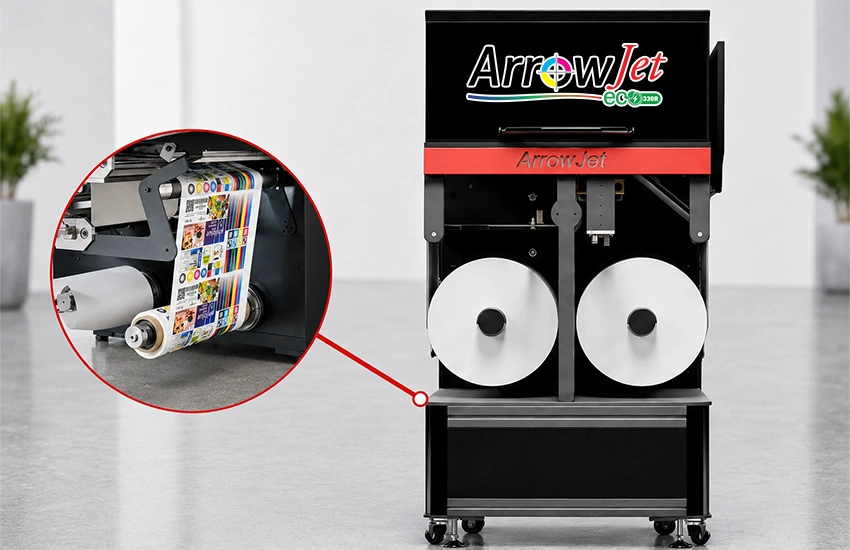
The right printer depends on your monthly volume, label size, required durability, ink type, and substrate. Entry-level operations benefit from compact industrial inkjet presses. Mid-to-high-volume producers typically use high-speed aqueous pigment systems. Operations producing premium labels on specialty substrates — clear films, metallics, white ink — benefit from a UV hybrid press. There is no single best answer; the application defines the specification.
Aqueous pigment inkjet uses water-based inks that bond to coated or treated substrates and deliver strong color and durability at production speeds. UV inkjet cures ink instantly under UV light, enabling printing on untreated films, clear PET, metallic stocks, and rigid materials — and supports white ink and varnish layers for premium effects. Aqueous systems offer lower cost per label at high volume on standard stocks; UV systems unlock specialty effects and broader substrate flexibility.
Yes. Printer, ink, and label stock must be matched as a system. Aqueous inkjet printers require coated or inkjet-treated substrates; untreated films require offline pre-treatment. UV printers have broader compatibility but still require materials to fall within the machine’s supported thickness and flatness range. Running incompatible materials causes print quality failures, adhesion issues, and printhead damage.
In-house printing pays off fastest for operations running multiple SKUs, short-to-medium runs, variable data (barcodes, lot numbers, expiry dates), or frequent artwork changes. The elimination of minimum order quantities, plate charges, and supplier lead times can offset equipment investment relatively quickly — particularly when time-to-shelf and inventory control are competitive priorities.
Many industrial single-pass digital label presses print at 1600 × 1600 dpi. This resolution supports fine text, QR codes, detailed barcodes, complex gradients, and brand artwork at a level consistent with premium shelf presentation. ArrowJet aqueous and UV label presses operate at this resolution.
Arrow Systems manufactures industrial digital label and flexible packaging presses — equipment your team owns and operates in your own facility. If you’re evaluating a move to in-house label printing or scaling up an existing operation, we can help you match the right press to your application, volume, and substrate requirements.
Table of Contents Digital Label Printers for Stickers and Labels: How to Choose the Right Press The right printer for stickers and labels depends on
Table of Contents Blade vs. Laser Label Die Cutting: Accuracy, Speed, and Cost per Label Blade die-cutting suits simple shapes and long runs; CO2 laser
Table of Contents Custom Food Packaging: Key Questions Answered for Food Brands Custom food packaging shapes how shoppers recognize, evaluate, and choose a product —
Table of Contents GHS Label Durability Failure: 4 Causes and Practical Fixes GHS label durability failures trace to four causes: aqueous ink chemistry, paper face

Table of Contents White Ink Clear Label Printing: When You Need It and Why White ink under clear film keeps brand color, mandatory copy, and
Table of Contents GHS Label Compliance: A Practical Guide for Chemical Label Printing GHS label compliance is a safety-critical requirement for any business that manufactures,