Table of Contents
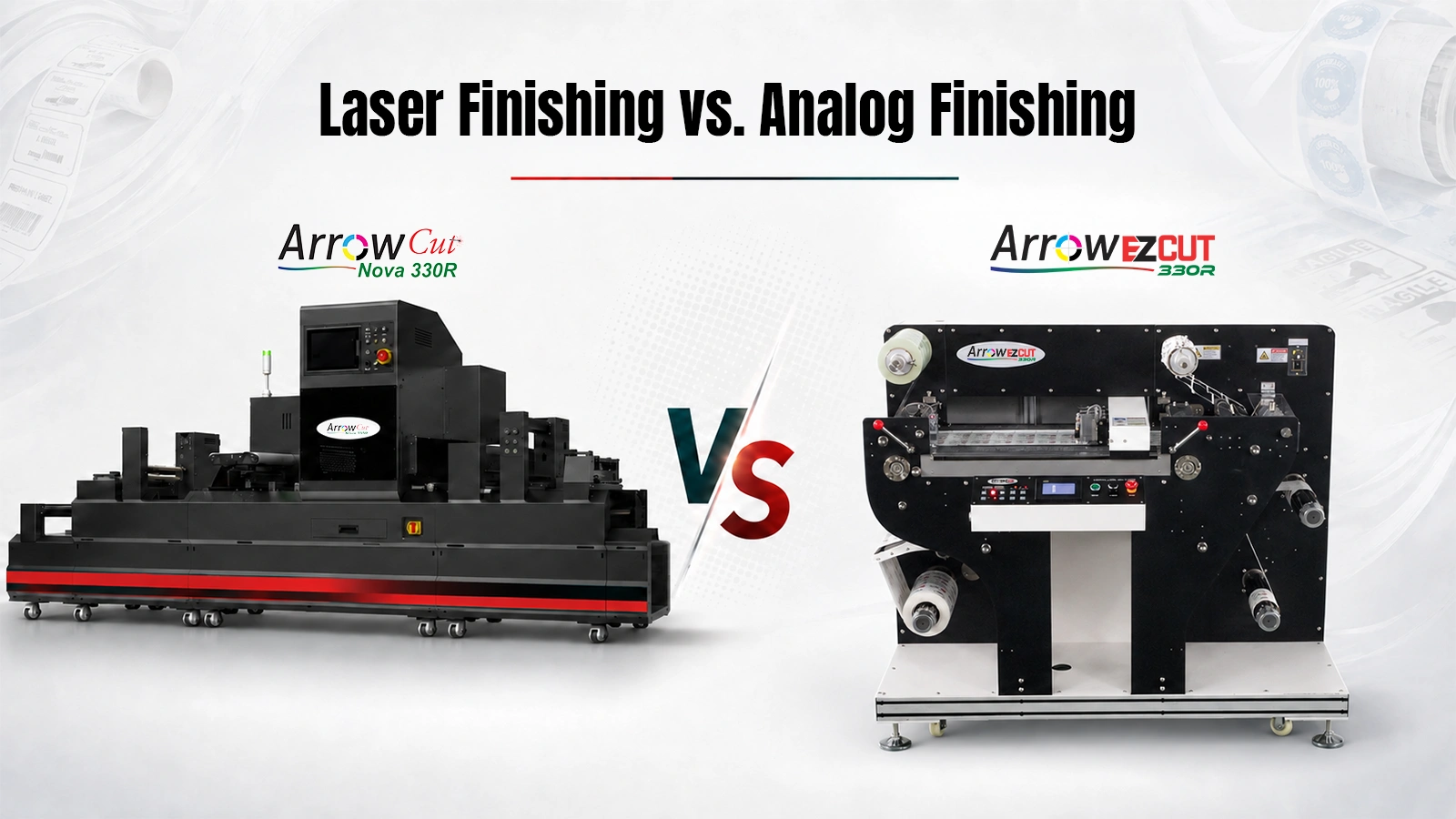
Laser Finishing vs. Analog Finishing for Labels: A Complete Comparison Guide
Laser finishing uses digital cut files with no physical dies; analog finishing uses rotary or semi-rotary tooling — the right choice depends on run length, shape complexity, changeover frequency, and total workflow cost.
Key Takeaways
- Laser finishing uses a digital cut file instead of a physical die, reducing setup time and eliminating die procurement and storage costs.
- Analog finishing uses rotary or semi-rotary physical tooling; semi-rotary systems are the more common choice for operations producing labels in multiple sizes.
- Laser finishing suits short-to-medium runs, custom shapes, and frequent changeovers; analog finishing is most efficient for long, repeatable runs with stable label dimensions.
- Both methods can be configured inline with a digital printer or offline as a separate finishing step.
- Total workflow cost — not machine price alone — is the correct comparison metric: tooling, changeover time, waste, operator hours, and job mix all affect the true cost-per-label.
- Arrow Systems produces laser finishers (Taurus, ArrowCut Nova 330R, ArrowCut Nova 250R) and analog or blade-die finishers (Aries, EZCut 330R+, EZCut 350R) for label operations across a range of run profiles.
What Is Laser Finishing?
Laser finishing uses a digital cut file to control a CO₂ or galvo laser beam — eliminating physical dies and enabling fast job changeovers and flexible shape cutting.
Instead of ordering a die for each label shape, the operator loads a digital cut file. The laser processes the material according to that file, performing kiss cuts, full cuts, perforations, slitting, and matrix removal in a single pass. Switching from one job to the next requires only a file change — not a tooling change.
Laser finishing is well suited to digital print workflows because both systems use file-based job management. A roll of printed labels coming off a digital press can move directly to a laser finisher with a matching cut file, enabling an on-demand, short-run workflow without the lead time or cost of die procurement.
CO₂ Galvo Laser
A sealed CO₂ laser beam directed by a galvanometer mirror scanning system. Galvo scanning enables high-speed positioning across the cut area, making it the standard laser mechanism in label finishing equipment. Arrow Systems laser finishers — including the Taurus, ArrowCut Nova 330R, and ArrowCut Nova 250R — use CO₂ galvo laser technology.
Kiss Cut
A cut that penetrates the label facestock and adhesive layer but stops short of the liner, leaving the label on the roll for easy peel-and-apply dispensing. Kiss cuts can be performed at precise depths by adjusting laser power and speed settings.
Full Cut
A cut that penetrates all layers including the liner, producing individually separated labels. Useful when labels need to be separated from the roll entirely rather than dispensed from a liner.
Matrix Removal
The automated removal of excess label material (the waste web) surrounding the cut labels. Matrix removal can be performed inline with laser cutting, eliminating manual waste stripping and reducing operator labor.
What Is Analog Finishing?
Analog finishing uses physical rotary or semi-rotary dies to cut label shapes — a reliable, high-throughput method for operations running the same label dimensions at volume.
A physical die cuts the label shape on every pass of the material. The die must match the exact cut pattern required; a new die is needed for each different label size or shape. Once a job is set up, analog systems can produce labels at consistent speed without the job-to-job variability associated with file-based laser systems.
Rotary Die
A cylindrical cutting tool that rotates continuously as the label web passes underneath. The die circumference is sized to the exact label repeat length. Rotary dies offer the highest throughput speeds and are best suited for very high-volume production of a single label shape.
Semi-Rotary Die
A flexible die plate mounted to a magnetic cylinder. The magnetic design allows the same cylinder to accept different die plates, reducing the cost of switching between label shapes. Semi-rotary systems — such as the Aries — adjust the repeat length digitally, making them practical for operations producing labels in multiple sizes without investing in a new cylinder for each format.
Magnetic Cylinder
A precision roller with a magnetized surface that holds flexible die plates in place during cutting. The magnetic cylinder can accept different die plate designs, supporting job-to-job flexibility that fully rotary systems do not provide. The Aries semi-rotary finisher uses a magnetic cylinder for die plate mounting.
Cold Lamination
A finishing step that applies a protective film over printed labels using pressure rather than heat. Cold lamination adds durability, scratch resistance, and moisture protection. Both analog and laser finishers in Arrow’s range support cold lamination inline.
Inline vs. Offline Finishing
Finishing can run inline with a digital printer for a continuous single-pass workflow, or offline as a separate step — each approach suits different production environments.
The choice between inline and offline finishing is separate from the choice between laser and analog finishing. Either method can be deployed in either configuration.
|
Configuration |
How It Works |
Best For |
Trade-Offs |
|
Inline Finishing |
The finisher is connected directly to the digital printer output. Labels are printed and finished in a single pass. |
Short-run, on-demand production; operations with a single printer; time-sensitive jobs with minimal handling requirements. |
Finisher throughput must match printer output speed. If one system has downtime, both processes stop. |
|
Offline Finishing |
Printed rolls are produced first, then moved to a standalone finishing system for cutting, laminating, and slitting as a separate production step. |
Operations with multiple printers sharing a single finisher; longer runs where finishing can be batched; environments needing independent throughput management. |
Additional roll handling steps; requires storage space for printed-but-unfinished rolls between steps. |
Arrow finishing equipment supports both configurations. The ArrowCut Nova 330R can be used inline with Memjet print technology for a fully automated print-and-cut workflow, or deployed offline to finish rolls produced by any compatible digital printer. The Taurus Laser Finisher is designed as a standalone offline finishing system, making it well suited for operations that need to centralize finishing for multiple print devices.
Where Laser Finishing Excels
Laser finishing performs at its best in operations where flexibility, changeover speed, and job variety are the primary production requirements.
- Short and medium runs. Because there are no dies to order or store, laser systems have no per-die cost for short jobs. A run of 200 labels or 2,000 labels carries the same tooling overhead: none. This changes the economics significantly for operations managing many SKUs at low quantities.
- Frequent changeovers. Switching from one label shape to the next requires a file change, not a tooling change. On a laser finisher, operators can move between shapes in minutes rather than the setup time required to change physical dies.
- Custom and complex shapes. Die-cut shapes are constrained by the ability to manufacture a physical die to that geometry. Laser finishing eliminates this constraint — complex contour cuts, irregular outlines, and variable shapes can all be cut from the same digital file.
- Variable data and personalization. Digital laser finishing pairs naturally with digital variable-data printing. When print content changes from label to label, the laser can match the cutting pattern to each job without tooling changes.
- Multiple cutting functions in one pass. Systems such as the ArrowCut Nova 250R can perform full cuts, kiss cuts, perforations, hatching, and etching simultaneously in a single pass — tasks that would require separate tooling or multiple passes on analog equipment.
- Reduced consumable costs. Laser systems eliminate die plate procurement and replacement. The laser source itself has a service interval, but there are no per-job cutting consumables equivalent to replacing worn blade edges on die-cutting equipment.
Where Analog Finishing Excels
Analog finishing is most cost-effective when operations run the same label shape repeatedly at high volume with minimal changeover requirements.
- Long, repeatable runs. When the same label shape is produced in volumes of tens of thousands of labels per run, the per-job die cost amortizes quickly. Analog systems can sustain consistent high throughput on established formats without file management overhead.
- Stable label formats. Brands with fixed label dimensions across a long product lifecycle benefit from investing in a die that will be used repeatedly without modification. The die becomes an asset, not an overhead.
- Established production workflows. Operations already equipped with analog finishing infrastructure can leverage that investment for consistent-format jobs while evaluating laser systems for the variable or short-run portion of their job mix.
- Cold lamination and slitting integrated inline. Arrow analog finishers — including the Aries semi-rotary finisher and the EZCut 330R+ — include cold lamination and slitting in the same pass as die cutting, making them complete label finishing solutions for operations processing consistent formats.
Laser vs. Analog Finishing: Side-by-Side Comparison
This comparison covers the key operational and economic differences between laser and analog finishing for label production.
|
Criteria |
Laser Finishing |
Analog Finishing |
|
Tooling required |
No physical die — uses a digital cut file |
Physical rotary or semi-rotary die required per cut pattern |
|
Job changeover |
File change only — minutes between jobs |
Die change required — additional setup time per shape change |
|
Optimal run length |
Short to medium runs (typically below 15,000 labels per shape where job mix is varied) |
Long, repeatable runs with stable label dimensions |
|
Shape flexibility |
Any shape defined in a digital cut file, including complex contours and variable outlines |
Limited to shapes for which a physical die has been manufactured |
|
Cutting functions |
Full cut, kiss cut, perforation, etching, hatching, engraving, slitting — simultaneously in one pass |
Die cut (full or kiss), slitting, laminating — multiple passes or additional tooling for combined functions |
|
Die/tooling cost |
No per-shape die cost |
Die cost incurred per unique cut pattern; semi-rotary die plates are lower cost than full rotary cylinders |
|
Equipment upfront cost |
Typically higher initial equipment investment |
Can have lower entry-level equipment cost; ongoing die spend should be factored in |
|
Inline / offline |
Both configurations supported |
Both configurations supported |
|
Material compatibility |
Paper, PET, PP, BOPP, Lexan, metalized films, and others — media test recommended |
Paper, plastic films — determined by die and blade specifications |
|
Arrow equipment examples |
Taurus Laser Finisher, ArrowCut Nova 330R, ArrowCut Nova 250R |
Aries semi-rotary finisher, EZCut 330R+, EZCut 350R |
Cost and Changeover Considerations
Total workflow cost — not equipment price alone — is the correct basis for comparing laser and analog finishing investments.
Laser finishing systems typically carry a higher upfront equipment cost than entry-level analog systems. However, the total cost comparison becomes more complex when die procurement, die storage, changeover labor, and setup waste are factored in. Operations managing a high number of unique label shapes — even at moderate volumes per shape — can offset the laser system cost premium through eliminated die expenses and faster job turnaround.
Analog finishing involves lower initial equipment cost in many configurations, but each unique cut pattern requires its own die. Semi-rotary systems such as the Aries reduce the cost per die compared to full rotary cylinders, because the magnetic die plate design allows the same magnetic cylinder to carry different die plates. Even with this advantage, operations with frequently changing label shapes will accumulate tooling costs that compound over time.
The most useful calculation is not machine price vs. machine price. It is the total cost per finished label roll across the actual job mix: tooling procurement, setup time, operator hours, scrap from changeovers, and the time value of faster turnaround on short-run orders.
Many operations with a varied job mix find the most practical answer is to run both methods: laser finishing for short-run, variable, and custom-shape work; analog finishing for high-volume established SKUs. Arrow Systems supplies both, making it possible to build a finishing capability that matches the full range of a label operation’s requirements. Browse the Arrow label finishers range to see the complete product line.
Arrow Laser Finishing Equipment
Arrow Systems manufactures three CO₂ laser finishers that cover a range of web widths, throughput speeds, and production environments.
Taurus Laser Finisher
The Taurus Laser Finisher is Arrow’s high-performance laser finishing system for production-volume label operations. Built on a three-axis galvo scanner with a 350W CO₂ sealed laser source, the Taurus Plus model reaches cutting speeds up to 70 m/min depending on cut pattern and material. The system performs unwinding, cold laminating, digital laser cutting, matrix removal, slitting, and rewinding in a single pass.
The Taurus uses a 3-axis scanning system that provides X, Y, and Z register control, enabling different power levels on the same label and supporting higher precision on label edge quality. It is available in two configurations — TRS25PL (9.84″ × 9.84″ cutting area, 30 m/min) and TRS35PL / TRS35PL-PLUS (13″ × 13″ cutting area, 30 m/min / 70 m/min) — making it scalable across production volume requirements.
Cutting Speed
Up to 70 m/min (TRS35PL-PLUS model); 30 m/min (TRS25PL and TRS35PL models) — speed varies by laser power, cut pattern, and material.
Laser Source
350W CO₂ sealed single-head laser at 10.25 µm wavelength.
Cut Types
Kiss cut, full cut, perforation, engraving — both printed and unprinted media supported.
Inline Functions
Unwinding, cold laminating, web guide, digital cutting, matrix removal, slitting, and rewinding — all in one pass.
Materials
Paper, plastic films. Media test recommended. No need to pre-order die-cut label rolls.
ArrowCut Nova 330R
The ArrowCut Nova 330R is a modular roll-to-roll or roll-to-part laser finisher designed for 13″ media. Equipped with a 150W CO₂ galvo laser, the system processes up to 10,000 labels per hour and handles lamination, die cutting, matrix removal, slitting, and rewinding in a single in-line pass. An integrated web guide system maintains media registration to ±0.02 mm tolerance.
The ArrowCut Nova 330R can also be configured inline with Memjet printing technology for a fully automated print-and-cut workflow at 30 ft/min. Its modular design allows components to be separated for transport, and an integrated touchscreen displays system status in real time.
Web Width
Up to 13.7″ (348 mm).
Laser
150W CO₂ galvo laser.
Throughput
Up to 10,000 labels per hour.
Cut Modes
Split cut, full cut, kiss cut, perforation, hatching, etching, marking — multiple modes simultaneously in one pass.
Inline Capability
Compatible with Memjet printing technology for inline print-and-cut at 30 ft/min.
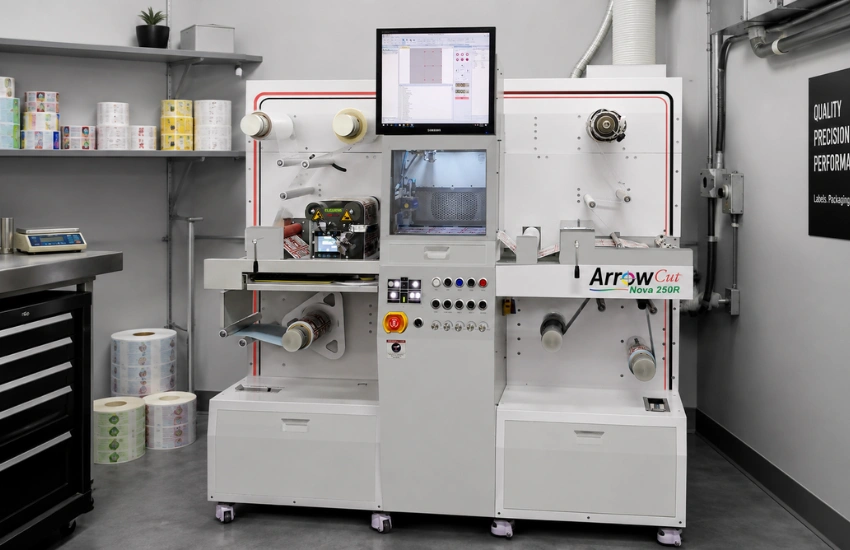
ArrowCut Nova 250R
The ArrowCut Nova 250R is a compact laser finisher designed for a small footprint, making it suitable for in-office or space-constrained production environments. Using a 125W CO₂ galvo laser, it performs full cuts, kiss cuts, perforations, etching, and hatching in a single pass — including metalized and reflective materials. Matrix removal, slitting (up to 7 knives), and rewinding are all handled inline.
The Auto Job Changeover (AJC) function allows one operator to manage the full finishing process from start to end, reducing labor requirements. The compact web path design reduces setup waste for each new job.
Web Width
Up to 9.84″ (250 mm).
Laser
125W CO₂ galvo laser.
Cut Modes
Full cut, kiss cut, perforation, etching, hatching — simultaneously in one pass.
Slitting
Up to 7 knives for inline slitting.
Footprint
Compact enough for office or small facility installation; includes integrated fume extractor.
Arrow Analog and Blade-Die Finishing Equipment
Arrow’s analog and blade-die finishers serve label operations running consistent formats at volume, with cold lamination, slitting, and waste removal built into the same pass.
Aries Semi-Rotary Finisher
The Aries is a single-pass semi-rotary label finisher designed for industrial production volumes across short, medium, and long runs. It uses a flexible magnetic die plate mounted to a magnetic cylinder, allowing different die plate designs to be swapped without replacing the cylinder. The system processes laminating, die cutting, waste removal, slitting, and roll preparation in one pass at speeds up to 30 m/min.
A touchscreen PC interface with Arrow Cutting Manager software controls speed adjustment, cutting precision, and material waste reduction. The quick changeover snap-in die plate design minimizes setup time between jobs compared to full rotary die systems.
Media Width
Up to 13″ (330 mm).
Die System
Flexible magnetic die plates on a magnetic cylinder — supports multiple plate designs on a single cylinder.
Cutting Speed
Up to 30 m/min.
Inline Functions
Cold lamination, die cutting, waste removal, slitting, and rewinding in a single pass.
Blades
Up to 12 or 15 blades depending on configuration.
Arrow EZCut 330R+
The Arrow EZCut 330R+ is a roll-to-roll digital label die cutter that combines flatbed and roll-to-roll cutting in a single machine. It uses blade die heads with real-time cutting pressure control per head, CCD mark registration, and automatic deviation correction to maintain ±0.1 mm cutting accuracy across the full label web.
The EZCut 330R+ supports cold lamination, automatic matrix removal, and one-click repeat cutting. Standard configuration includes 2 cutting heads expandable to 4, with slitting up to 15 blades. At up to 150 cuts per minute, it is well suited for consistent-format label production where digital blade die cutting is the preferred method.
Cutting Media Width
100–350 mm.
Max Label Width
350 mm.
Cutting Speed
Up to 150 cuts/minute (paper media).
Cutting Accuracy
±0.1 mm (repeat).
Cutting Heads
Standard 2 heads, expandable to 4 heads.
Slitting
Standard 4 blades, expandable to 15 blades.
Materials
Self-adhesive, PP, aluminum plastic film, PET, PVC, white card, copper plate, flexible materials.
Arrow EZCut 350R
The Arrow EZCut 350R is a multi-head digital blade die cutter with individual head control for varying material thicknesses and label sizes. Standard configuration includes 4 cutting heads (expandable to 6), with automatic head distance adjustment and CCD camera-based registration for cutting accuracy of ±0.1 mm repeat. An optional sheeting system allows the EZCut 350R to be used inline with cutting for roll-to-sheet production, or offline to cut roll products to a specified length.
Cutting Speed
Up to 9 m/min (cutting 7 cm × 15 cm square label).
Max Label Width
330 mm.
Cutting Heads
Standard 4 heads, expandable to 6 heads with automatic distance adjustment.
Registration
Electric eye + CCD camera; dot marks + number codes for mark types.
Slitting
Round knife slitting system, up to 15 slitters; slitting width 10–330 mm.
Materials
Stickers, paper, PR BOPP, PET, PVC, and more.
How to Choose the Right Finishing Method
The decision between laser and analog finishing comes down to five operational variables: run length, changeover frequency, shape variety, material range, and total workflow cost across your current job mix.
|
Your Operation Looks Like This |
Recommended Approach |
|
Many different label shapes, runs under 5,000–10,000 labels per SKU, frequent design changes |
Laser finishing — Taurus, ArrowCut Nova 330R, or ArrowCut Nova 250R |
|
Few label shapes, long production runs, stable label dimensions, low changeover frequency |
Analog finishing — Aries (semi-rotary) or EZCut 330R+ / 350R (blade die) |
|
Mixed job profile — some high-volume consistent formats and some short-run variable work |
Both systems deployed together: analog for established SKUs, laser for variable and custom work |
|
Tight floor space; finishing needs to pair with a compact digital printer |
ArrowCut Nova 250R — compact footprint, inline or offline, 9.84″ web width |
|
High-volume production environment where finishing capacity must match fast print output |
Taurus Laser Finisher (up to 70 m/min) or Aries (up to 30 m/min) depending on whether die-free flexibility or repeatable die cutting is the priority |
For operations assessing how finishing fits into a broader in-house label production strategy, the finishing equipment decision should be evaluated alongside the print platform choice, substrate requirements, and expected job mix evolution over the next 24–36 months.
Frequently Asked Questions
Common questions about laser and analog finishing for label production.
No. Laser finishing performs best for short runs, frequent shape changes, and custom die-free cutting. Analog finishing — using rotary or semi-rotary dies — can be more cost-effective for long, repeatable runs where the same label shape is produced at high volume and changeover frequency is low. Many operations use both methods, deploying laser for flexible on-demand jobs and analog for established high-volume SKUs.
Most CO₂ laser label finishers can perform multiple cutting functions in a single pass: full cut, kiss cut, perforation, engraving, hatching, etching, and slitting. Systems such as the ArrowCut Nova 330R and Taurus Laser Finisher can also laminate and remove matrix waste inline, completing the entire finishing workflow without changing tooling between cut types.
A rotary die uses a fixed cylindrical cutting tool sized to the exact label repeat length. It is best suited for very high-volume, single-shape production. A semi-rotary system — such as the Aries — uses flexible magnetic die plates mounted to a magnetic cylinder. The magnetic design adjusts repeat length without a new cylinder, making it more economical for operations producing labels across a range of sizes.
Yes. Laser finishing can be configured either inline with a digital printer or offline as a standalone finishing step. An inline configuration feeds printed rolls directly into the laser finisher, enabling a continuous print-and-cut workflow well suited for short-run, on-demand production. Offline laser finishing is a common choice when finishing capacity needs to serve multiple print devices. The ArrowCut Nova 330R supports inline configuration with Memjet printing technology.
Exploring finishing options for your label production operation?
Arrow Systems manufactures a complete range of laser and analog label finishing equipment — from compact in-office laser finishers to high-speed production systems. Browse the Arrow label finishers range or contact our team to discuss which finishing configuration fits your run profile and production requirements.
Laser Finishing vs. Analog Finishing for Labels: A Complete Comparison Guide
Compare laser and analog label finishing by tooling, changeovers, materials, run length, quality, workflow, and total cost before selecting equipment.
Arrow Systems to Exhibit at LOUPE Americas 2026
Table of Contents Arrow Systems to Exhibit at LOUPE Americas 2026 Chicago, IL — Arrow Systems Inc. will exhibit at LOUPE Americas 2026, taking place
Overlaminate vs. Varnish Labels: How to Choose Protection
Table of Contents Overlaminate vs. Varnish Labels: How to Choose Protection Film overlaminate protects against immersion, wash-down, and solvents; UV and aqueous varnish suit retail

Digital Label Printers for Stickers and Labels: How to Choose the Right Press
Table of Contents Digital Label Printers for Stickers and Labels: How to Choose the Right Press The right printer for stickers and labels depends on
Blade vs. Laser Label Die Cutting: Accuracy, Speed, and Cost per Label
Table of Contents Blade vs. Laser Label Die Cutting: Accuracy, Speed, and Cost per Label Blade die-cutting suits simple shapes and long runs; CO2 laser
Custom Food Packaging: Key Questions Answered for Food Brands
Table of Contents Custom Food Packaging: Key Questions Answered for Food Brands Custom food packaging shapes how shoppers recognize, evaluate, and choose a product —