What Is Flexible Packaging? Formats, Materials, and Digital Printing
Learn how flexible packaging is used, how pouches and rollstock differ, which barrier and seal questions matter, and where digital printing fits.
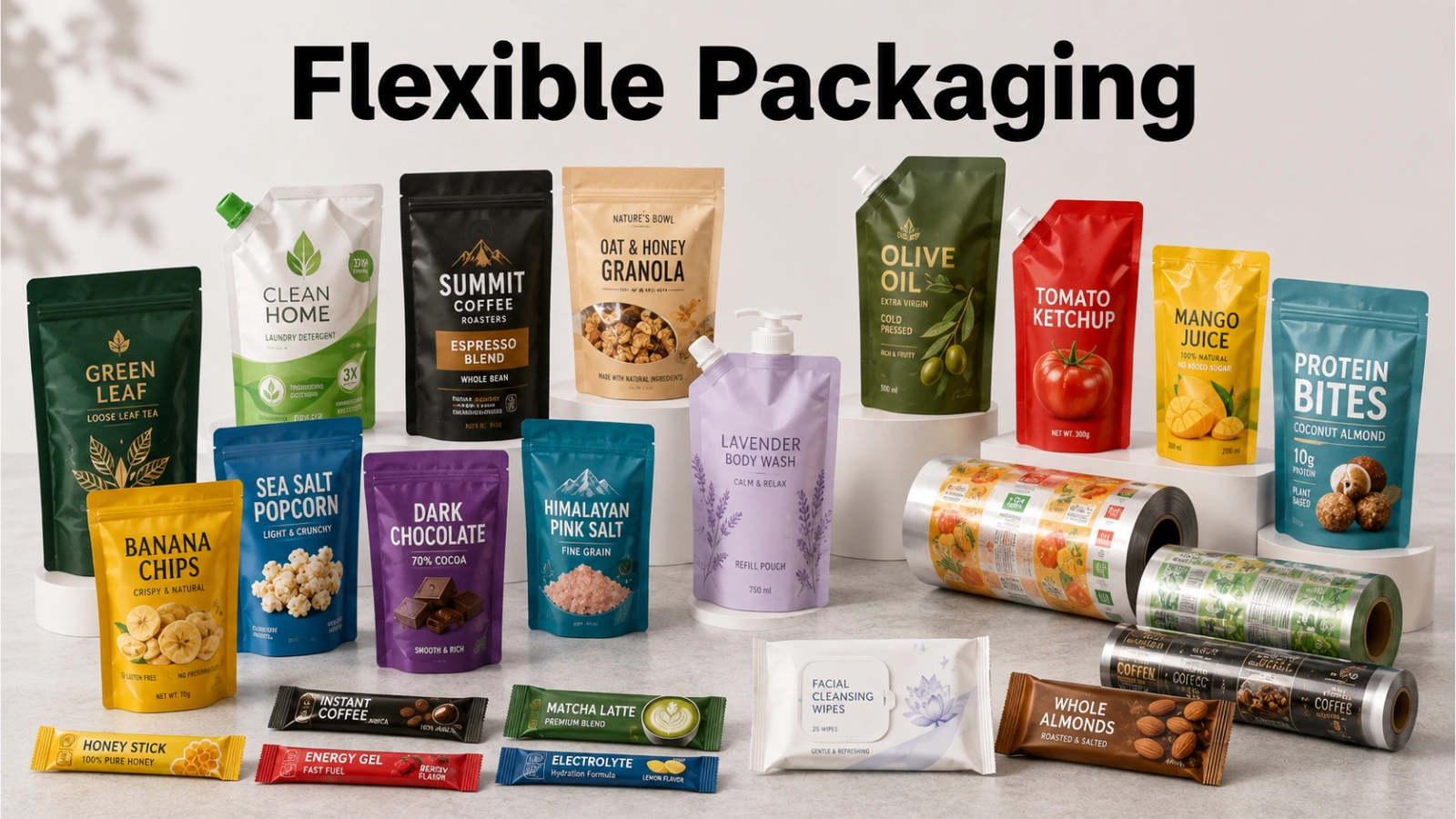
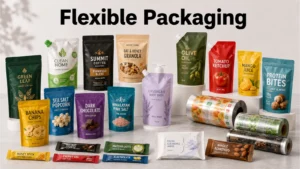
Flexible packaging is the broad category of packages made from pliable materials that conform around a product — as opposed to rigid containers like boxes, tubs, or glass jars.
Flexible packaging is any package constructed from lightweight materials — including plastic film, paper, aluminum foil, polypropylene, polyester film, or multi-layer laminates — that can be shaped, folded, or sealed around a product. Because the materials are not rigid, the package conforms to the product rather than requiring a fixed, pre-formed container.
These packages are typically sealed with heat or pressure, then printed or labeled to identify the product and communicate brand information on shelf. The pliable nature of the material allows flexible packaging to use significantly less space than boxes, tubs, or rigid containers when stored, shipped, or displayed.
Flexible packaging is not a single format — it is a category that spans dozens of structures, closures, barrier combinations, and material stacks. The common thread is that the package itself bends and flexes rather than holding a predetermined rigid shape.
The term “flexible packaging” covers a wide range of physical formats, each suited to different products, shelf environments, and consumer use cases.
Format | Description | Common Uses |
Stand-Up Pouch | Gusseted base allows the pouch to stand upright on shelf | Coffee, pet food, snacks, powders, supplements |
Zipper Pouch | Resealable zipper closure built into the pouch | Granola, dried fruit, protein powder, cannabis |
Flat Pouch / 3-Side Seal | Sealed on three sides, no gusset or base; flat profile | Single-serve portions, condiments, sachets |
Sachet | Small, single-use sealed pouch — typically flow-wrap or 3-side seal | Spices, sugar, instant coffee, supplement samples |
Vacuum Bag | Air-evacuated and heat-sealed to extend shelf life | Cured meats, cheese, fish, coffee |
Rollstock | Unformed film supplied in rolls — formed, filled, and sealed on VFFS/HFFS equipment | Snack food production lines, bulk industrial packaging |
Spouted Pouch | Stand-up pouch with a reclosable spout for liquid or semi-liquid products | Baby food, beverages, sauces, liquid supplements |
Stick Pack | Narrow, elongated single-serve sealed pack | Protein powders, instant drinks, sugar, nutraceuticals |
Flexible packaging is especially common in categories where barrier performance, resealability, weight, or shelf impact are all part of the packaging decision.
The industries that rely most heavily on flexible packaging share a common need: packaging that protects the product from its environment while also communicating the brand clearly at the point of sale. Rigid packaging can do one or the other well; flexible packaging is often expected to do both at once, at lower material cost and with less shipping weight.
Food and Snack Brands
Flexible packaging dominates in ambient snack, frozen food, coffee, grain, and baked good categories. Barrier properties — resistance to oxygen, moisture, and light — are critical for preserving freshness and meeting shelf-life requirements.
Pet Food and Treats
Stand-up pouches and zipper bags are standard across premium pet food. Resealability is a key consumer requirement; barrier performance matters for preservation. The growing premium pet food segment has also driven demand for higher-quality graphics on flexible formats.
Nutritional Supplements and Nutraceuticals
Sachets, stick packs, and stand-up pouches are used for protein powders, pre-workouts, vitamins, and herbal products. This segment also has regulatory labeling requirements that make short-run digital printing attractive — SKUs change frequently, and label updates need to happen quickly.
Cannabis and Hemp Products
Opaque barrier pouches with tamper-evident and child-resistant features are increasingly common in this category. State-by-state regulatory variation means brands often need different packaging versions for different markets — a strong use case for short-run digital printing.
Cosmetics and Personal Care
Single-serve sachets, sample packs, and refill pouches appear across skincare, haircare, and personal care. The premium shelf presentation possible with digital full-color printing makes flexible packaging an attractive option in this visually competitive category.
Healthcare and Pharmaceuticals
Sachets, blister-adjacent formats, and unit-dose pouches appear in over-the-counter and some pharmaceutical applications. Barrier and tamper-evidence requirements are particularly strict in this segment.
Household and Cleaning Products
Refill pouches and lightweight bags are being used in laundry, cleaning, and home goods categories as brands move toward lower-plastic or lighter-weight packaging formats.
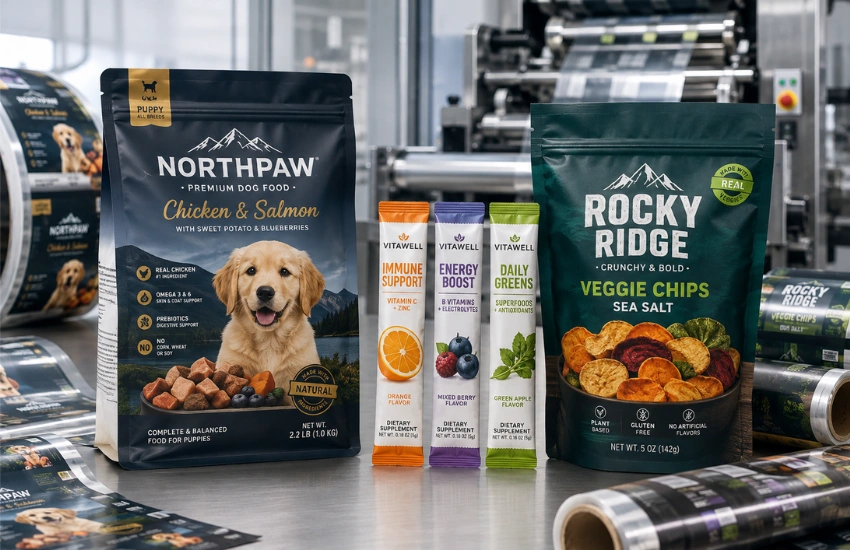
Mylar is a brand name that has become a shorthand for a specific class of high-barrier metallized film — and understanding the distinction matters when specifying packaging for products that need strong protection.
Mylar is a registered trademark for a family of polyester films (BOPET — biaxially-oriented polyethylene terephthalate) developed by DuPont. In everyday use, “Mylar bag” has come to describe any metallized polyester or foil-laminate barrier bag, regardless of the specific film manufacturer.
What distinguishes Mylar-style packaging from a standard plastic bag is the barrier performance of the metallized layer. These films offer resistance to:
Mylar-style bags are used for dry foods, whole grains, coffee, nutritional supplements, powders, and other products where standard polyethylene bags would not provide sufficient shelf-life or environmental protection. The exact material specification — laminate stack, film thickness, and barrier coating — should always be matched to the product’s storage requirements, intended shelf life, and any applicable food-contact or regulatory standards.
From a printing standpoint, metallized and foil-laminate films behave differently from coated paper or standard film stocks. The surface treatment, ink adhesion characteristics, and post-print durability of the finished package all need to be considered when specifying a digital press for this substrate type.
The choice of substrate determines barrier performance, printability, sealability, and whether the finished package can be recycled or composted — making material selection one of the most consequential early decisions in flexible packaging development.
Material | Properties | Typical Applications |
BOPP (Biaxially-Oriented Polypropylene) | Clear or white film; good moisture resistance; printable surface; low cost | Snack bags, bakery packaging, candy wrappers |
PET / Polyester Film | High tensile strength; heat resistant; good gas barrier in laminate structures | Vacuum bags, retort pouches, lidding film |
Metallized BOPET (Mylar-style) | Excellent barrier to O₂, moisture, and light; reflective appearance | Supplement pouches, dry food bags, coffee bags |
Aluminum Foil Laminates | Highest barrier performance; opaque; heat-sealable in multi-layer constructions | Pharmaceutical sachets, coffee pods, retort packaging |
PE (Polyethylene) | Flexible; heat-sealable; low barrier on its own; widely recyclable | Inner layers of laminates; produce bags; bread bags |
Kraft Paper / Paper Laminates | Natural appearance; printable; used with PE or film layers for sealing | Coffee bags, pet food, eco-positioned packaging |
Tyvek | High-density polyethylene; tear-resistant; breathable; printable | Medical device packaging; specialty industrial pouches |
Most functional flexible packaging is not a single material — it is a laminate structure combining two or more layers for specific performance properties. A coffee bag might use a metallized BOPET outer layer for barrier and printability, bonded to a PE inner layer for heat-sealing and food contact compatibility. The total laminate stack determines what digital press configurations and ink chemistries will work reliably on the substrate.
Flexible packaging graphics have historically been produced through plate-based processes, but digital inkjet printing has created a shorter-run, faster-changeover alternative that is increasingly practical for brands managing multiple SKUs or frequent design revisions.
The established methods for flexible packaging printing are flexography, rotogravure, and offset lithography. Each is a plate- or cylinder-based process optimized for high-volume, long-run production of a single design. Setup costs and minimum run commitments are high, which means pre-printed flexible packaging has traditionally required brands to order in large quantities and carry significant inventory.
Digital inkjet printing approaches the same substrate differently. Because there are no plates or cylinders to prepare, each print run can be a different design, a different SKU, or a different version of the same artwork — without additional setup cost. This structural difference has practical implications for brands that operate in categories where:
Digital flexible packaging printing does not replace high-volume conventional printing for brands running millions of the same unit at consistent designs. But for brands managing complex, variable, or rapidly-evolving packaging portfolios, digital production provides a level of operational flexibility that plate-based printing cannot match.
Arrow Systems manufactures digital inkjet presses designed to bring flexible packaging printing in-house — giving brands direct control over print scheduling, run lengths, and design revisions without relying on converter lead times or minimum order commitments.
Two ArrowJet presses are well-suited to flexible packaging production, each addressing a different output width and production scale:
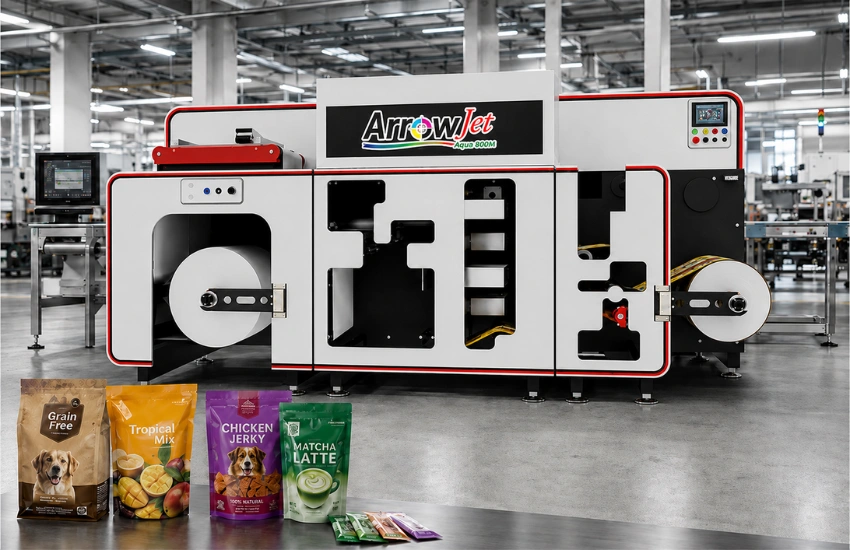
The ArrowJet Aqua 800M is Arrow’s dedicated wide-web inkjet solution for flexible packaging. Built on Memjet DuraCore™ technology with a dual carriage, modular printhead design, the Aqua 800M supports a maximum printing width of 638 mm (25.1″) across a broad range of film substrates — including coated paper, PP, PET, PVC, BOPP, Mylar, Tyvek, wallpaper, woven materials, and laminate papers.
Print resolution
Up to 1600 × 1600 dpi with water-based pigment inks (CMYK)
Print speed
90 ft/min, 150 ft/min, or 195 ft/min depending on resolution mode
Max media width
800 mm with maximum printing width of 638 mm
Substrate range
Coated paper, PP, PET, PVC, BOPP, Mylar, Tyvek, woven materials, laminate papers, and more. Film substrates may require offline pre-treatment before press loading — confirm with Arrow team for substrate-specific guidance.
Applications
Stand-up pouches, sachets, rollstock, flat bags, stick packs, and other wide-format flexible packaging structures
The Aqua 800M is designed for in-house production environments where flexible packaging print volume justifies a dedicated wide-web press. It suits brands in food and beverage, pet, supplement, cosmetic, and cannabis categories that want to bring short-to-medium flexible packaging runs inside their own operation.
For brands whose flexible packaging needs are narrower in format — sachets, narrow stand-up pouches, or flexible label stock — the ArrowJet Aqua 330R supports a maximum printing width of 324 mm (12.75″) across the same class of film-based substrates, including Mylar, BOPP, PET, and PP. Running on Memjet DuraFlex® technology, the Aqua 330R prints at up to 195 ft/min at 1600 × 1600 dpi resolution.
The Aqua 330R suits operations that produce both labels and narrower flexible packaging formats on a single press, or where production volume does not yet justify a dedicated wide-web system.
Arrow Systems manufactures digital inkjet presses for in-house flexible packaging production. Browse the full range of ArrowJet flexible packaging printers or contact the Arrow team to discuss your substrate, run volume, and format requirements.
Flexible packaging has grown steadily across consumer product categories because it addresses multiple practical problems at once — and because digital printing has made it more accessible for brands of all sizes.
The case for flexible packaging is made by the format itself. It is lighter than most rigid alternatives, takes up less space in transit and storage, and can be designed for tamper evidence, child resistance, or resealability depending on the product and regulatory requirements. For brands, the shelf presentation — full-bleed, high-resolution graphics on a large, consumer-facing surface — makes flexible packaging a strong visual marketing asset as well.
Several structural trends have reinforced growth across the category:
Flexible packaging is not a single decision — it is a set of interconnected material, format, compliance, and production choices. Working through these questions early reduces costly design revisions later.
Common questions about flexible packaging formats, materials, and digital production.
Flexible packaging is any package made from pliable materials — plastic film, foil, paper, or laminated combinations of these — that can be shaped, filled, and sealed around a product. It includes stand-up pouches, sachets, zipper bags, vacuum bags, rollstock, and stick packs. The defining characteristic is that the material bends and conforms rather than holding a fixed rigid shape.
No. Food is one of the largest use cases, but flexible packaging is widely used for pet products, nutritional supplements, cosmetics, personal care items, cannabis products, healthcare goods, and household cleaning products. Any product category where barrier protection, lightweight format, or resealability matters is a candidate for flexible packaging.
Mylar-style bags are one type of flexible packaging. Mylar is a trademarked polyester film (BOPET) known for its barrier properties. In common usage it describes any metallized or foil-laminate barrier pouch. Flexible packaging is the broader category that includes Mylar-style bags alongside many other formats and material constructions.
Traditional printing methods — flexography and gravure — use plates or engraved cylinders. They perform well at very high volumes with stable, unchanging designs, but require significant setup investment and minimum run commitments. Digital inkjet printing uses no plates, so each run can be a different design or SKU at the same cost. This makes it well-suited to shorter runs, multi-SKU production, and packaging that changes frequently.
Yes, with the right equipment. Digital inkjet presses designed for flexible packaging — such as the ArrowJet Aqua 800M — are built specifically for in-house flexible packaging production across film-based substrates. The appropriate configuration depends on substrate type, film treatment requirements, production volume, and finished format. Arrow’s team can advise on the right press for a given application.
ArrowJet flexible packaging presses support a broad range of film-based and laminate substrates, including coated paper, PP, PET, PVC, BOPP, Mylar, Tyvek, and laminate papers. Film substrates may require offline pre-treatment depending on the specific material. Confirm substrate compatibility with Arrow before specifying a production workflow.
Learn how flexible packaging is used, how pouches and rollstock differ, which barrier and seal questions matter, and where digital printing fits.
Compare laser and analog label finishing by tooling, changeovers, materials, run length, quality, workflow, and total cost before selecting equipment.
Table of Contents Arrow Systems to Exhibit at LOUPE Americas 2026 Chicago, IL — Arrow Systems Inc. will exhibit at LOUPE Americas 2026, taking place
Table of Contents Overlaminate vs. Varnish Labels: How to Choose Protection Film overlaminate protects against immersion, wash-down, and solvents; UV and aqueous varnish suit retail
Table of Contents Digital Label Printers for Stickers and Labels: How to Choose the Right Press The right printer for stickers and labels depends on
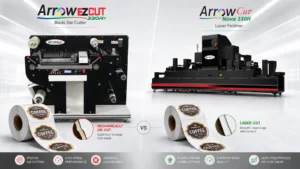
Table of Contents Blade vs. Laser Label Die Cutting: Accuracy, Speed, and Cost per Label Blade die-cutting suits simple shapes and long runs; CO2 laser