Table of Contents
Tamper-Evident Label Printing: How to Choose the Right System
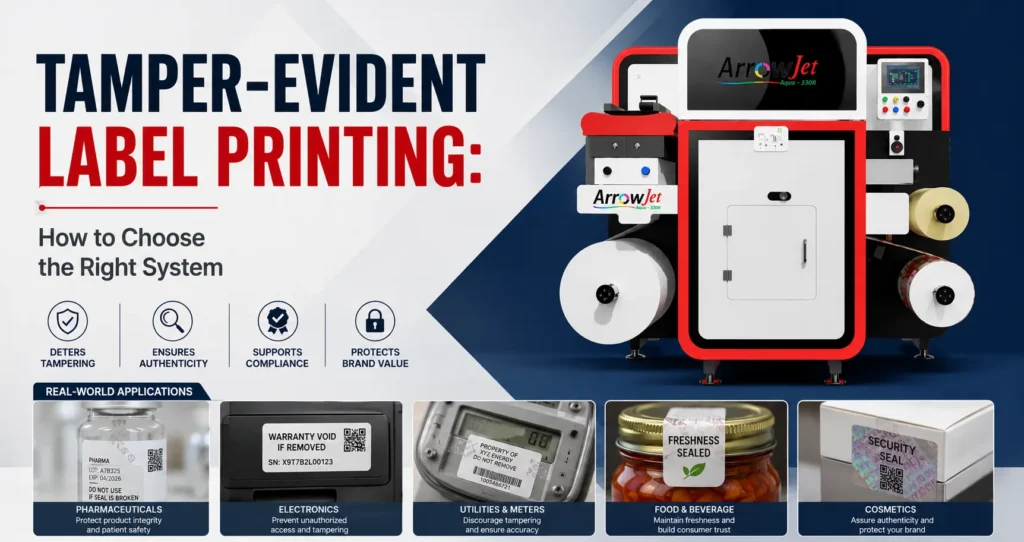
Match tamper-evident label type — void, breakaway, or destructible — to product risk, substrate, and FDA requirements, then pair with the right digital press.
Key Takeaways
- Three tamper-evident label types cover most pharma applications: void labels for cartons and cap seals, breakaway neckbands for liquid OTC bottles, and destructible vinyl for vials and high-risk SKUs.
- FDA requires OTC drug products to carry tamper-evident packaging that makes tampering reasonably likely to leave visible evidence of entry (21 CFR 211.132); labeling must also identify the tamper-evident feature.
- Material choice must start with the container substrate — HDPE bottles, glass vials, paperboard cartons, and PET bottles each have different surface energy and adhesive compatibility profiles.
- The ArrowJet Aqua 330R handles in-house pharma label printing for void seals, breakaway neckband content, and standard pressure-sensitive labels on paper, coated paper, and many PP/PE films.
- Destructible vinyl labels require UV-cured ink adhesion — outside the water-based inkjet range. Contact Arrow Systems for platform guidance if destructible vinyl is your application.
- Any change in film, adhesive, or label supplier in a regulated pharma environment is a change-control event requiring documentation, qualification, and possible re-validation.
Why Tamper-Evident Label Printing Is Non-Negotiable in Pharma
Tamper-evident labeling is a patient safety control first — a bottle reaching a pharmacy shelf or a consumer’s medicine cabinet must show visible, irreversible evidence of any unauthorized opening.
In pharma, the question for packaging engineers, QA managers, and operations directors is rarely whether your product requires tamper-evident labels. The real questions are which type fits the product, how to print it reliably, and whether to keep that printing in-house or depend on a converter. Pharmaceutical labeling requirements from distributors and major retailers frequently layer additional tamper-evidence and serialization standards on top of FDA minimums — and any labeling change tied to a formula revision or regulatory update must reach production quickly without generating obsolete pre-printed inventory.
This guide covers the three dominant tamper-evident label categories — void, breakaway, and destructible — maps them to FDA expectations under 21 CFR 211.132, and shows where each construction fits on a digital label press.
Types of Tamper-Evident Labels: Void, Breakaway, and Destructible
Each tamper-evident label type solves a different failure-mode problem — choosing well starts with understanding how the label is supposed to fail when someone attempts to defeat it. If you need to clarify the terminology first, our overview of tamper-evident, tamper-proof, and tamper-resistant labels — what’s the difference covers the key distinctions.
Void Labels (Hidden Message Reveal)
Void labels use a multi-layer construction. When the label is lifted, a hidden pattern — typically the word “VOID” or a checkerboard — transfers to the substrate or remains on the label face, leaving an unmistakable visual signal that cannot be concealed after the fact.
- Typical pharma applications
- Carton seals on unit cartons for OTC solid-dose products; closure seals across tablet bottle caps; audit and inspection seals on returned or quarantined inventory.
- Best-fit substrates
- HDPE bottles and paperboard cartons. Void films release cleanly while leaving evidence behind — they are typically the most cost-effective entry point into tamper-evident packaging.
Breakaway and Perforated Neckband Labels
A breakaway label — sometimes called a perforated neckband — is engineered to fracture along a defined line when the closure is opened. The label cannot be removed and reapplied without obvious physical damage.
- Typical pharma applications
- Bottle neckbands on liquid OTC products and supplement-style HDPE bottles; vial closures where a tear strip indicates first-open status; dropper and dispenser caps in consumer pharma.
- Accessibility benefit
- Breakaway labels add a tactile cue in addition to a visual one — an advantage when end users are older or visually impaired and may not readily distinguish a subtle void pattern.
Destructible Vinyl and Film Labels
Destructible vinyl labels are formulated to fragment into small pieces on any peel attempt. They cannot be removed intact, which makes them effective on smaller, high-value, or higher-risk SKUs where the mere attempt at removal must be immediately evident.
- Typical pharma applications
- Vial and ampoule closures for sterile or controlled products; calibration and chain-of-custody seals on instrumentation and lab kits; diversion-resistant seals on controlled or high-cost Rx packaging. For a broader look at how security labels and counterfeit prevention intersect with tamper-evident requirements, see our dedicated guide.
- Print process demands
- Destructible films are the strongest visible deterrent of the three categories, but they demand more from the printing process — particularly ink adhesion to the fragile face stock and clean die-cutting that does not pre-stress the material before application. Destructible vinyl requires UV-cured ink chemistry to anchor reliably; water-based inkjet presses are not suited to this substrate. If destructible vinyl is your application, contact Arrow Systems to discuss the right platform for your requirements.
Side-by-Side Comparison
| Label Type | Failure Mechanism | Best-Fit Substrates | Typical Pharma Use | Relative Cost |
|---|---|---|---|---|
| Void | Hidden message reveals on lift | HDPE bottles, paperboard cartons | Carton and cap seals, audit seals | Lowest |
| Breakaway / Neckband | Fractures along perforation on opening | HDPE, PP, PE films | Bottle neckbands, vial tear strips | Moderate |
| Destructible Vinyl | Fragments on peel attempt | Glass vials, ampoules, rigid surfaces | High-risk and controlled SKU closures | Highest |
FDA and Legal Requirements for Tamper-Evident Packaging
FDA expects OTC drug products to be packaged so that tampering is reasonably likely to leave visible evidence of entry, and that labeling alerts consumers to the tamper-evident feature (21 CFR 211.132).
"Visible evidence of entry" is a functional standard
Whether you use void, breakaway, or destructible construction, the feature must work on the actual container, closure, and substrate combination you ship to market — not just in isolation on a test bench.
Labeling must reference the tamper-evident feature
OTC products are generally required to alert consumers to the tamper-evident feature so it is recognizable. A label that employs void film but does not identify the feature as tamper-evident may not satisfy this expectation.
Change control matters more than most teams expect
Switching label suppliers, films, adhesives, or print methods typically triggers documentation, qualification, and sometimes re-validation. Teams routinely underestimate the scope of this work when bringing in-house printing online for the first time.
Distributor and pharmacy expectations may exceed the regulatory floor
Major retailers and chain pharmacies often layer their own tamper-evidence and serialization standards on top of FDA requirements. Confirm both regulatory and customer-specific requirements before finalizing label specifications.
Choosing the Right Tamper-Evident Material
Tamper-evident label substrate selection is where pharma label projects succeed quietly or fail expensively — start with the container substrate, then validate across the worst expected environmental conditions. Our guide to choosing the right label material provides a broader reference across label stock types.
Start with the Container Substrate
- HDPE bottles (solid-dose OTC and supplements)
- Lower surface energy — adhesive selection matters significantly. Void films and breakaway neckband constructions are most common. Confirm adhesive is rated for the specific HDPE formulation and bottle geometry before qualifying.
- PETG and PET bottles
- Higher surface energy than HDPE, generally more forgiving for pressure-sensitive films. Paper and PP face stocks with standard permanent adhesive typically perform reliably on PET containers.
- Glass vials and ampoules
- Smooth, rigid, often refrigerated. Destructible vinyl performs well on glass — adhesive must be specified for the temperature profile, including any cold-chain storage between filling and dispensing.
- Paperboard cartons
- Void films and tamper-evident seal strips are standard. Ink and adhesive must not damage the carton surface during legitimate consumer opening; test the peel force on the actual board grade you use.
Consider Environmental Exposure
Cold-chain storage, condensation, and long shelf life all stress adhesives and inks beyond what ambient testing reveals. Validate the complete label construction — face stock, ink, adhesive, release liner — across the worst expected conditions, not just at room temperature.
Match Destructibility to Diversion Risk
- Low-to-moderate diversion risk
- Void labels are typically sufficient. They meet FDA’s visible-evidence standard at the lowest label cost and are compatible with the widest range of digital inkjet systems.
- Visible “first open” signal required
- Breakaway neckbands add a tactile cue. They are appropriate for liquid OTC products and supplement HDPE bottles where a consumer must be able to confirm the product is sealed before use.
- High-value, high-risk, or controlled products
- Destructible vinyl. Any attempt to remove the label produces irreversible, visible fragmentation — the standard for vials, ampoules, and controlled-substance packaging.
Confirm Legibility Survives the Mechanism
A destructible film that fragments before the patient can read the lot number is a compliance failure. Layout, varnish, and label size must allow critical content — NDC, lot, expiration, barcode — to remain legible throughout normal handling and storage, not just at the point of initial application.
ArrowJet Aqua 330R for Standard Tamper-Evident Label Printing In-House
For most standard pressure-sensitive tamper-evident work — void films, paper-based seals, and many breakaway constructions — the ArrowJet Aqua 330R is the practical system for in-house pharma label printing.
Water-based inkjet ink chemistry
The Aqua 330R uses Memjet DuraFlex water-based pigment inkjet technology — aligning with pharma’s general preference for lower-migration ink chemistries, which is particularly relevant for secondary packaging that lives close to primary containers. Memjet’s inks carry compliance documentation relevant to food contact, nutraceuticals, and wine and spirits applications.
Compatible substrates for tamper-evident work
Paper, coated paper, and many PP/PE films used in void and breakaway constructions — printed at up to 1600×1600 dpi with a 12.75″ (324 mm) maximum print width. This covers the majority of standard carton seals, bottle-cap closures, and neckband label content.
Variable data and serialization support
Clean, consistent CMYK output supports lot codes, serialization-ready content, and short-run SKU variants — critical for pharma operations where batch-specific variable data must be incorporated into the label at print time.
In-house production economics
Pharma SKUs are increasingly short-run, serialized, and frequently revised. Outside converters carry minimum order quantities, plate or setup costs, and lead times — switching from flexographic to digital printing eliminates those constraints and the obsolete inventory created when the next artwork or regulatory change renders pre-printed stock unusable. Our breakdown of printing tamper-evident labels in-house vs. outsourcing covers the full cost comparison. Bringing production in-house on the Aqua 330R collapses lead times from weeks to hours and removes the scrap from label revisions at the source.
Typical ArrowJet Aqua 330R Pharma Label Applications
- Void label printing for OTC carton seals and bottle-cap closure seals
- Breakaway label printing for perforated neckband content on HDPE liquid OTC bottles
- Standard pharma cartoning labels and quarantine/audit inspection seals
- Short-run, serialized, and SKU-variant label sets for regulated pharma operations
ArrowJet Aqua 330R: Tamper-Evident Application Scope
| Tamper-Evident Application | Aqua 330R | Typical Substrate | Notes |
|---|---|---|---|
| Void label printing — carton seals | ✓ Supported | Paper, coated paper | Most cost-effective entry point; prints at up to 1600×1600 dpi |
| Void label printing — HDPE bottle cap closures | ✓ Supported | PP/PE films, coated paper | Confirm adhesive rated for HDPE formulation before qualifying |
| Breakaway label printing — perforated neckbands | ✓ Supported | PP, PE films | Variable data (lot, serialization) supported in-line at production speed |
| Standard pharma cartoning and audit inspection seals | ✓ Supported | Paper, coated paper | Short-run and SKU-variant printing — no minimum order quantities |
| Destructible vinyl (vials, ampoules, high-risk Rx) | — Not applicable | Destructible vinyl face stock | Requires UV-cured ink adhesion — outside water-based inkjet range. Contact Arrow Systems for platform guidance. |
Change Control for In-House Tamper-Evident Label Printing
In regulated pharma environments, any change in label film, adhesive, or supplier triggers documentation, qualification, and sometimes re-validation — regardless of how routine the change appears. Teams routinely underestimate this scope when first bringing production in-house. Staying current on packaging ink regulations to know in 2025 should be part of ongoing label qualification planning. The Aqua 330R’s water-based pigment ink platform comes with Memjet compliance documentation relevant to regulated secondary packaging applications, which simplifies the documentation portion of any change-control process.
Frequently Asked Questions — Tamper-Evident Label Printing
Common questions from pharma packaging engineers, QA managers, and operations directors evaluating tamper-evident label types, FDA requirements, and in-house printing systems.
- A void label uses a multi-layer construction that leaves a hidden “VOID” message or pattern behind on the substrate or the label face when someone attempts to remove it — the label itself may come away, but the evidence stays. A destructible label physically fragments into small pieces on any peel attempt, making removal without visible evidence impossible. Void labels are most common on OTC cartons and bottle-cap closures. Destructible vinyl is the standard for vials, ampoules, and high-risk or controlled-substance packaging where any removal attempt must be unmistakable and irreversible.
- Under 21 CFR 211.132, the FDA expects OTC drug products to be packaged so that tampering is reasonably likely to leave visible evidence of entry before use by the consumer. Labeling is also generally required to alert consumers to the tamper-evident feature so it is recognizable as such. The FDA does not prescribe a specific construction — void, breakaway, and destructible approaches can all qualify when properly applied to the actual container and closure combination. Any strategy should be confirmed by your regulatory and quality functions against current FDA expectations and your specific product classification.
- Outsourcing to converters makes sense for very long, stable runs with infrequent artwork revisions. In-house digital printing typically wins when SKUs are short-run, frequently revised, serialized, or regionally variant. Bringing tamper-evident label printing in-house tightens chain-of-custody for label stock, collapses lead times from weeks to hours, and eliminates the scrap generated when pre-printed inventory becomes obsolete after a regulatory or artwork change. The economics generally favor digital for run lengths below approximately 5,000–15,000 labels per SKU.
- Substrate selection depends on the tamper-evident mechanism. Paper and coated paper face stocks work well for void carton seals on solid-dose OTC products. PP and PE films suit many breakaway and void neck seals on HDPE bottle applications. Destructible vinyl is the standard for vial and high-risk closures — its formulation causes fragmentation rather than clean peeling, making removal detectable. Adhesive must be matched to the container surface energy and the full environmental range the label encounters from manufacturing through consumer use, including cold chain and cleaning exposure.
Get a Tamper-Evident Label Printing Assessment for Your Pharma Operation
If your team is evaluating in-house tamper-evident label printing — whether for void carton seals, breakaway neckbands, or standard pressure-sensitive pharma labels — Arrow Systems can walk through your substrates, run lengths, and validation requirements in a structured discovery conversation.
Arrow Systems builds and supports digital label presses for regulated pharma environments. A 20-minute pharma label printing assessment will help determine whether the ArrowJet Aqua 330R is the right fit for your tamper-evident application — or point you toward the right platform if your requirements fall outside the water-based inkjet range.
Book Your 20-Minute Pharma Label Printing Assessment →
Cannabis Label Versioning Workflow for Multi-State Brands
Table of Contents Cannabis Label Versioning Workflow for Multi-State Brands A cannabis label versioning workflow produces state-specific labels from one master template by moving state-variable
Water-Based vs UV-Cured Label Adhesive: Food & Pharma Guide
Table of Contents Water-Based vs UV-Cured Label Adhesive: Food & Pharma Guide Water-based adhesives suit dry, ambient containers; UV-cured hot melts suit cold, wet, curved
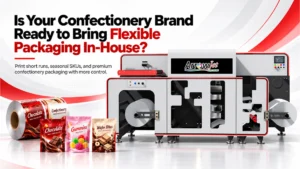
Is Your Confectionery Brand Ready to Bring Flexible Packaging In-House?
Table of Contents Is Your Confectionery Brand Ready to Bring Flexible Packaging In-House? In-house flexible packaging pays off for confectionery brands with many SKUs, short
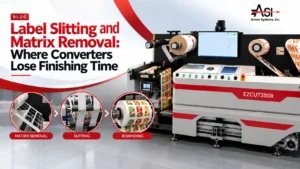
Label Slitting and Matrix Removal: Where Converters Lose Finishing Time
Table of Contents Label Slitting and Matrix Removal: Where Converters Lose Finishing Time Label slitting and matrix removal, plus rewinding, cost converters more finishing time
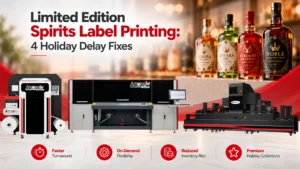
Limited Edition Spirits Label Printing: 4 Holiday Delay Fixes
Table of Contents Limited Edition Spirits Label Printing: 4 Holiday Delay Fixes Limited edition spirits label printing runs late because of the calendar, not the
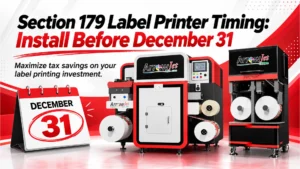
Section 179 Label Printer Timing: Install Before December 31
Table of Contents Section 179 Label Printer Timing: Install Before December 31 A section 179 label printer purchase counts for 2026 only if the press