Digital vs. Analog Label Printing: Key Differences Explained

Digital vs Analog Label Printing

Table of Contents

Digital vs. Analog Label Printing: Key Differences Explained

The choice between digital and analog label printing comes down to how your production is structured — how often artwork changes, how many SKUs you manage, and whether your runs are short and variable or long and repeatable. Both processes produce finished labels, but they do so through fundamentally different mechanisms, and those differences have real implications for cost, speed, and operational flexibility.

Key Takeaways

  • Analog printing uses physical plates; digital printing starts from an electronic file with no plates required.
  • Digital eliminates makeready time and plate costs, making short runs and fast job changes practical.
  • Variable data — unique serial numbers, batch codes, personalized content — is only possible with digital.
  • Analog printing can be more cost-efficient for very large, stable, rarely-changing runs.
  • Digital supports just-in-time production, reducing label inventory and the risk of obsolete stock.

How Each Process Works

Understanding the mechanical difference between digital and analog label printing is the starting point for evaluating which fits your operation.

Analog label printing

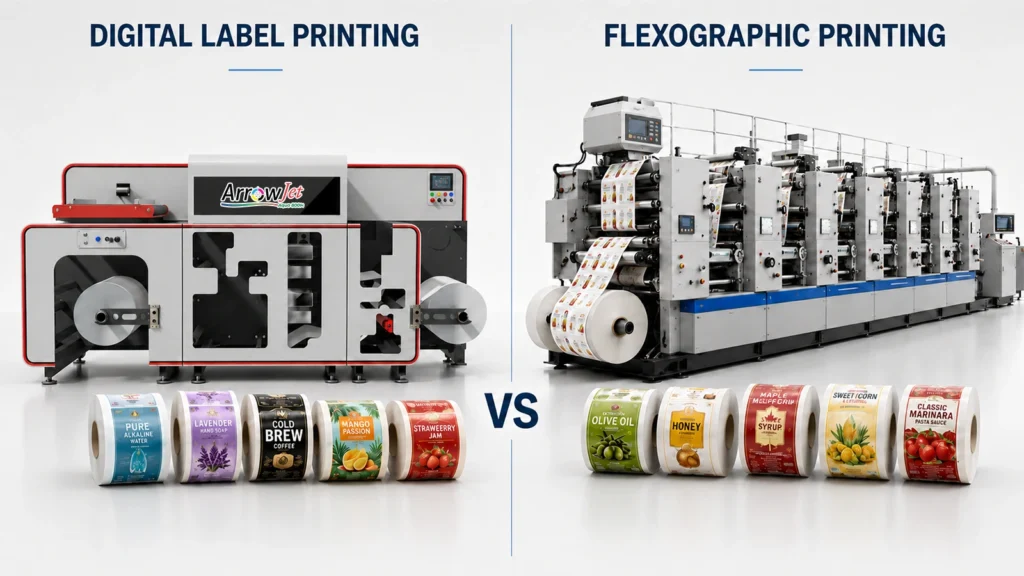
Analog printing — which includes flexographic printing, offset, and screen printing — works by creating a master image on a physical image carrier. In flexography, the most common analog method for labels, that carrier is a raised printing plate. The plate transfers ink to the substrate in repeated passes, reproducing an identical design at high volume.

Before production begins, plates must be made, mounted, and calibrated. Ink stations must be set up for each color. This make-ready process takes time and materials, and those costs must be recovered across the print run — which is why analog printing is most economical at high volumes where setup is amortized over many units.

Digital label printing

Digital label printing starts with an electronic file. The design data is processed and transferred directly to the print engine — typically an inkjet system — without any intermediate physical plate or image carrier. Each label in the run can be identical, or each one can contain unique information. Setup is largely software-driven and can be completed in minutes.

The absence of plates changes the economics entirely. There are no plate costs, no minimum run requirements tied to setup recovery, and no delay between job changeovers. A new label file can be loaded and printing can begin almost immediately.

Digital vs. Analog Label Printing: Side-by-Side Comparison

Factor

Digital Label Printing

Analog Label Printing

Image carrier

Electronic file — no plates

Physical plate (flexo, offset, screen)

Setup time

Minutes — software-driven

Hours — plate mounting, ink station setup

Setup cost per job

None

Plate cost per job (varies by color count)

Minimum run length

No enforced minimum — economical from 1 label

Practical minimum typically several thousand labels

Variable data

Yes — unique content per label within a single run

No — fixed image reproduced identically

Artwork change speed

Immediate — update the file, print

Requires new plate; lead time of days to weeks

Ink system

Inkjet — water-based pigment common

Flexo, UV, or conventional inks by station

High-volume cost efficiency

Competitive; lower per unit at very high volumes vs. analog

Strongest at high volume where setup cost is amortized

Inventory model

Print on demand — minimal pre-printed stock

Typically requires pre-printed label inventory

Footprint

Generally compact — single-pass press

Larger — multiple ink stations and ancillary equipment

Key Advantages of Digital Label Printing

The following advantages apply broadly to digital label printing workflows, regardless of the specific press or brand.

No plates, no chemicals, no minimum order

Because digital printing requires no plates, every job starts with the same low setup overhead. This makes it equally practical to print 50 labels for a product test or 5,000 for a production run. There is no minimum quantity tied to plate cost recovery, and no chemical plate-making process to manage between jobs.

Variable data and personalization

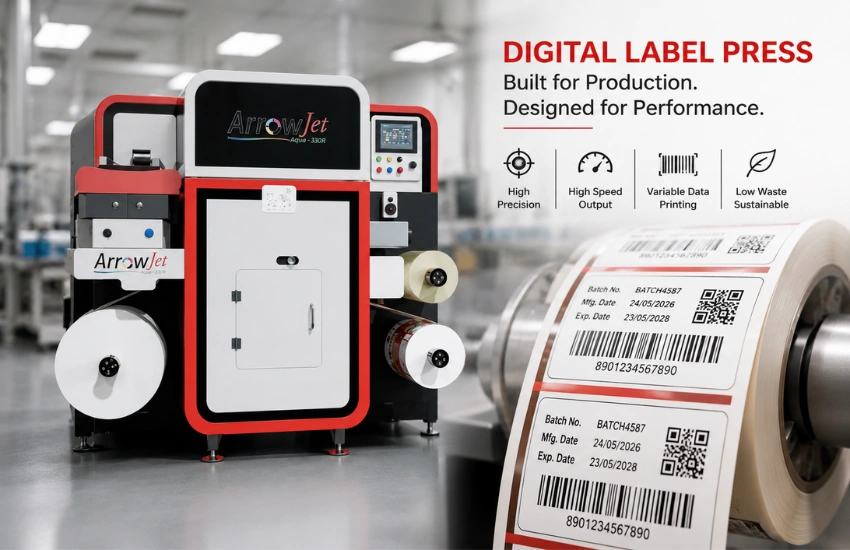
Digital presses support variable data printing — the ability to change content from one label to the next within the same run. Batch numbers, expiry dates, serial codes, QR codes linked to individual products, or personalized names in promotional campaigns can all be embedded at print time. This capability is not available in analog printing, where every copy is identical to the plate.

Fast response to artwork changes

When a label design needs to change — regulatory update, ingredient revision, rebranding, or seasonal variant — a digital file can be updated and sent to the press without additional cost or lead time. The same change with a flexographic press requires ordering new plates, which can take days to weeks and adds direct cost per color.

Just-in-time label production

Digital printing makes it practical to produce labels closer to actual demand rather than forecasting large quantities in advance. This supports reducing label inventory costs by eliminating the risk of pre-printed stock becoming obsolete due to design changes, regulatory updates, or product discontinuation — a recurring cost for operations using analog converters.

Compact production environment

Digital label presses typically occupy a smaller footprint than multi-station analog systems. For operations bringing label production in-house — production facilities, contract manufacturers, or brand owners — this makes installation more practical without requiring a dedicated pressroom.

Digital label printing press producing short-run labels with variable data for in-house brand production.

When Analog Label Printing May Still Make Sense

A complete comparison acknowledges where analog printing still holds its ground. Flexographic printing remains cost-competitive — and sometimes clearly advantageous — for operations producing very large volumes of labels with stable, rarely-changing designs.

If your label design has not changed in years, your quantities run into the millions per year, and you have a long-term supply relationship with a converter, the per-unit cost of analog production may be lower than digital at that scale.

The more practical question is not which process is universally better. It is which process better matches your actual production profile: how often your labels change, how many SKUs you manage, whether variable data matters to your operation, and whether you are printing to order or to stock.

Best-Fit Scenarios for Digital Label Printing

Digital label printing is most often the right fit when one or more of the following apply:

  • Operations where short-run label printing is the norm — typically under 5,000–10,000 labels per job
  • Frequent artwork or content changes across jobs
  • Multiple SKUs that require distinct label versions
  • Variable data requirements — serial numbers, batch codes, personalized content
  • Demand-driven or just-in-time production rather than inventory-based supply
  • In-house label production where eliminating converter lead times is a priority
  • Regulatory environments where label content may need rapid revision

Choosing a Digital Label Press for In-House Production

For operations moving label production in-house, press selection depends on production volume, substrate requirements, and the output quality the application demands.

The ArrowJet Aqua 330R is a high-speed, water-based pigment inkjet label press designed for roll-to-roll production. It prints at up to 150 ft/min at 1600 × 1600 dpi and supports a wide range of pressure-sensitive substrates. It is built for operations where production speed and image quality need to coexist with the flexibility of short-run, on-demand job changes.

Teams at an earlier stage of bringing label production in-house may find the ArrowJet Eco 330R a more practical entry point. It runs on single-phase power, requires no air compressor, and fits into smaller production environments. It prints at up to 20 m/min at 1600 × 1600 dpi using CMYK water-based pigment inks — production-grade output in a compact, lower-complexity platform.

Both systems operate without plates, support on-demand job changes, and are sold as hardware for in-house production. You own the press, control the output, and eliminate converter lead times entirely. See the full ArrowJet digital label printer range to compare specifications across the product line.

Thinking about bringing label production in-house?

Arrow Systems manufactures digital label printing equipment for in-house label production. Request a sample to evaluate print quality on your substrates before committing to a press.

Frequently Asked Questions

Analog label printing uses a physical image carrier — such as a flexographic plate — to transfer a fixed image onto a substrate in high-volume repeated passes. Digital label printing transfers an electronic file directly to the print process with no plates, meaning each label in a run can be different and setup for a new job takes minutes rather than hours. The practical result is that digital supports short runs, fast artwork changes, and variable data; analog is optimized for very large, stable, repeatable runs.

Yes, in most cases. Because digital printing requires no plates or makeready, the per-label cost at short quantities is typically lower than analog, where plate and setup costs are spread across the full run. Digital becomes increasingly competitive below approximately 5,000–15,000 labels per job, though the exact crossover depends on label size, ink coverage, and substrate. For operations managing multiple SKUs, frequent design changes, or demand-driven production, digital is almost always the more cost-efficient choice.

Variable data printing (VDP) is a digital capability that allows content — such as serial numbers, batch codes, expiry dates, personalized names, or promotional codes — to change on individual labels within a single print run, without stopping the press. This is not possible with analog processes, where every copy is identical to the plate. For operations managing product traceability, lot-level compliance, or personalized packaging campaigns, VDP is a significant operational advantage only available through digital printing.

No. Digital label printing works from electronic files. There are no printing plates to create, store, or replace between jobs, and no chemical developers or plate-making processes are required. This reduces cost and lead time for new label artwork, simplifies the production environment, and eliminates the plate storage and management burden associated with analog converter relationships.

Analog printing — particularly flexography — remains efficient for very large, stable, high-volume runs where the label design rarely changes and quantities are consistent over time. For brands with a single core product, fixed artwork, and production volumes in the millions per year with a stable converter relationship, analog may still offer a per-unit cost advantage. The decision depends on actual run profiles, change frequency, and whether the operational flexibility of digital justifies any per-unit cost difference at your volume.