Digital Label Printing: What It Is and Why It Matters
Table of Contents Digital Label Printing: What It Is and Why It Matters Digital label printing gives product teams direct control over how quickly, economically,
Digital label printing gives product teams direct control over how quickly, economically, and creatively they bring labeled products to market — without the plate costs and minimum orders that define conventional label production.
Digital label printing uses an inkjet press to deposit ink onto label substrate directly from a digital file — no plates, no minimum run lengths, and no tooling to change between jobs.
In a plate-based process such as flexographic printing, a separate plate is created for each ink color. Those plates are mounted on the press, inked, and pressed against the substrate to transfer the image. Every color change or design revision requires new plates — which add cost, lead time, and setup before any labels print.
In a digital inkjet process, the press reads the artwork file and applies ink in a single pass using fixed print heads. There are no plates to make or swap. A file change is all that is needed to change what is printed — which is the key operational difference that shapes everything downstream.
Plate-based printing (flexographic)
Uses a separate polymer or metal plate for each ink color. Efficient at high volumes; setup cost per color is typically $200–$800+. Design changes require new plates and additional lead time of 1–4 weeks.
Digital inkjet printing
Deposits ink directly from a digital file through fixed print heads. No plates required. Any design change is made at the file level — no tooling change needed. Minimum run length: one label.
Single-pass inkjet
All ink colors are applied in one pass as the substrate moves through the press. Most industrial digital label presses use single-pass architecture for production-speed output.
Variable data printing (VDP)
Each label in a run can carry unique information — barcodes, serial numbers, lot codes, regional text variants — because the digital file is updated dynamically per label, not printed from a fixed plate.
Removing plates from the label workflow reduces both cost and lead time at the start of every job — a file change is all that is needed to switch designs or correct an error.
For flexographic label production, each color in a design requires its own plate. A four-color label requires four plates. Those plates cost money to produce, take days to arrive from the platemaker, and add mounting and registration time on press before the run starts. Every design revision resets that process.
Digital label printing starts from a file. That means jobs can launch the same day artwork is approved, runs can be as short as one label, and a design change between jobs requires no press modifications. For operations managing multiple SKUs, seasonal packaging updates, or regulatory label revisions, that flexibility directly reduces production downtime and planning complexity.
Faster job setup also supports leaner label inventory. Instead of ordering labels months in advance to justify minimum flexographic order quantities, brands can print closer to the point of use — reducing the risk of stranded label stock when ingredients, compliance language, branding, or product formulations change before a large batch is consumed.
Industrial digital label presses reproduce fine detail, sharp text, smooth gradients, and rich color at resolutions that meet commercial label standards — up to 1600 × 1600 dpi on production-grade equipment.
For brands competing in categories where shelf presence matters — food and beverage, personal care, nutraceuticals, spirits — the label creates the first impression before a customer reads the product details or tries the product. Digital inkjet printing translates detailed artwork accurately into the final label, with consistent color reproduction across a run that does not drift the way long analog runs can.
Early digital printing had visible quality limitations compared to offset or flexographic output. Current industrial digital presses have largely closed that gap for label applications, with consistent output that meets the requirements of most commercial label categories.
Digital printing makes short-run label testing practical — brands can produce 100 or 200 samples of each design variant before committing to a full production run.
Label design rarely settles on the first version. A brand introducing a new product or refreshing its packaging may need to evaluate multiple color treatments, compare claims placement options, or test how artwork reads under retail shelf lighting conditions. With plate-based printing, even a small test run requires producing and mounting plates for each color — which makes small-batch testing expensive enough that many brands skip it and go directly to full production.
Digital printing changes that decision. A brand can produce samples of each design variant, test them under real conditions, collect feedback, and finalize artwork before committing to a production run. For teams in competitive categories where packaging needs to evolve quickly, the ability to iterate without large upfront tooling costs compresses the time between design and decision.
Because digital presses read from a digital file, each label in a run can carry different information — serial numbers, batch codes, regional variants — without stopping or changing press setups.
Variable data printing (VDP) in label production supports:
Achieving any of these with plate-based printing requires separate plate sets for each variation — which becomes logistically and financially impractical as the number of variations grows. Digital printing handles variation natively, because the artwork is defined in software rather than in fixed tooling.
Digital label printing has the clearest advantage for short runs, frequent design changes, multiple SKUs, and in-house production — where flexibility and speed outweigh the per-label cost advantage of flexographic at high volumes.
|
Scenario |
Why Digital Wins |
|
Short and medium label runs (under ~10,000–15,000 labels per design) |
No plate cost to amortize; total job cost is lower than flexographic at these volumes |
|
Frequent design changes — seasonal, regulatory, formula revisions |
File change only; no new plates, no added lead time |
|
Multiple SKUs with distinct label artwork |
Job changeover is fast; no press reconfiguration between designs |
|
Same-day or next-day production requirements |
Setup starts from an approved file — no platemaking lead time |
|
Variable data within a run |
Each label can carry unique information with no tooling changes |
|
In-house label production |
Eliminates dependency on external print suppliers; tighter control over timing and inventory |
Flexographic printing typically remains cost-effective for very long, stable runs — particularly where label designs are fixed, volumes exceed 25,000–50,000 labels per SKU, and unit-cost optimization outweighs flexibility. Many label converters run both technologies and route jobs to whichever process fits the run length and design requirements.
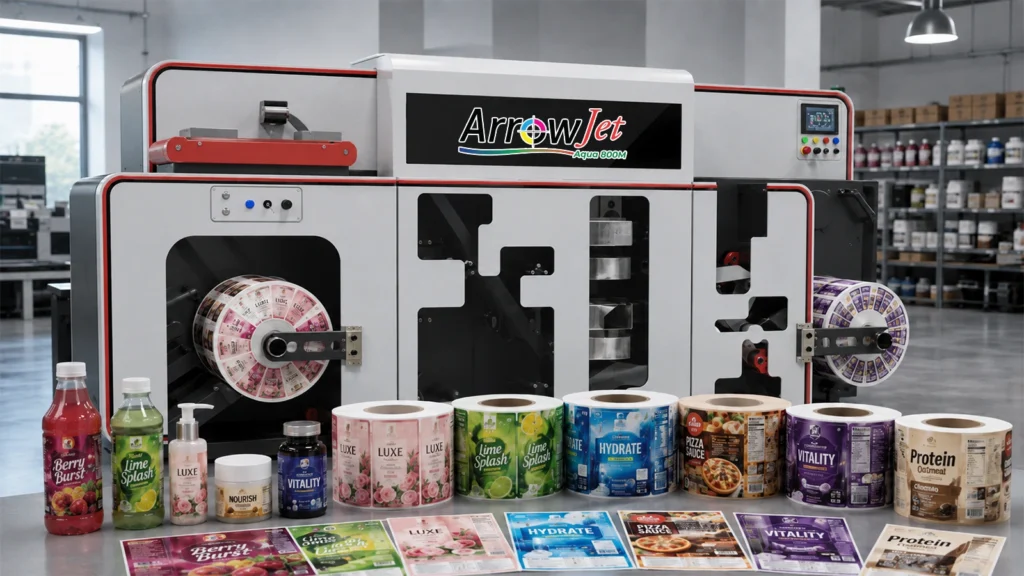
Arrow Systems manufactures the ArrowJet range of digital label presses — roll-fed inkjet systems designed for in-house label production across food, beverage, cosmetics, nutraceutical, and industrial applications.
Arrow Systems builds digital label printing hardware — not a service. ArrowJet presses are sold to businesses that want to own and operate their own label production capability. The equipment is designed around the demands of in-house label printing: roll-to-roll production, wide substrate compatibility, and print speeds suited to short-and-medium run volumes without the plate costs or minimum orders that define outsourced production.
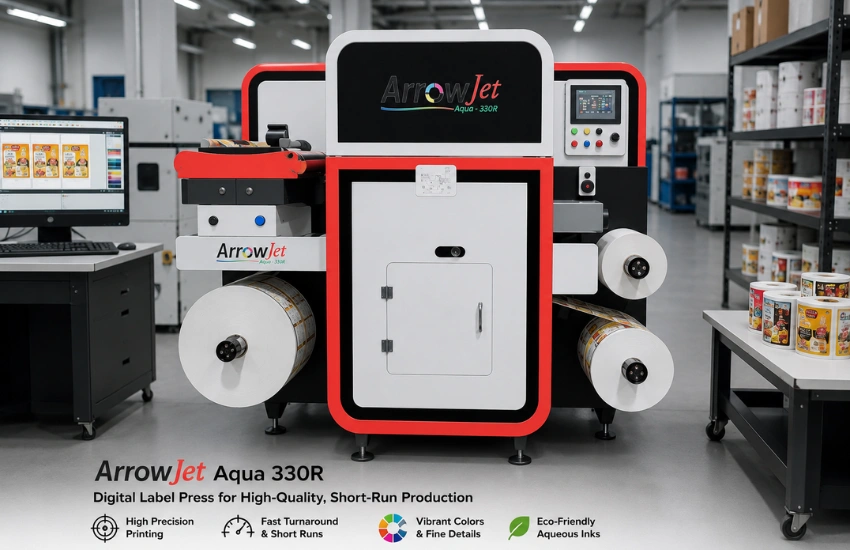
The ArrowJet Aqua 330R is a roll-to-roll aqueous pigment inkjet label press built for industrial in-house production. It uses Memjet DuraFlex technology, prints at up to 1600 × 1600 dpi, and handles a range of pressure-sensitive label substrates including coated paper, BOPP, PET, PVC, and specialty films — covering the materials used across food, beverage, cosmetics, nutraceutical, and industrial label applications.
Its production speeds and substrate flexibility make it a strong fit for converters and in-house teams running short-to-medium label volumes across multiple SKUs, with no plates to change and no minimum quantities per job.
The ArrowJet Eco 330R is designed for businesses entering in-house label production for the first time. It uses a single-pass digital inkjet engine powered by the Memjet DuraFlex® platform, printing at up to 20 meters per minute at 1600 × 1600 dpi on a 324 mm print width. Single-phase power and no air compressor requirement simplify installation and reduce infrastructure demands compared to production-tier presses.
For operations currently outsourcing all label production, the Eco 330R provides a practical starting point: a compact footprint, lower entry cost, and immediate elimination of supplier lead times and minimum order requirements on the jobs it handles.
See the full ArrowJet digital label printer range to compare models, specifications, and configurations for your production requirements.
Arrow Systems manufactures digital label presses designed for businesses that want to own their label production capability. Browse the ArrowJet range above — or contact the Arrow team to request a sample and evaluate print quality for your application.
No. Digital label printing is used by businesses of all sizes. Smaller brands benefit from low minimum run lengths and low per-job setup costs. Larger organizations use digital workflows alongside flexographic production — for testing, SKU variation, limited-edition runs, and fast-turnaround projects where conventional press setup would be inefficient or cost-prohibitive at low quantities.
Not always, and for many operations, not at all. Flexographic printing remains cost-effective for long, stable runs at high volume — particularly above 25,000–50,000 labels per SKU with fixed designs. Digital printing is strongest when run flexibility, fast turnaround, or the ability to change designs without new plates are the priority. Many label converters run both technologies and use each for the jobs it handles best.
In-house digital label production requires a roll-to-roll digital label press, pressure-sensitive label stock or film substrate suited to the product, RIP software to drive the press, and a finishing system for die-cutting, slitting, and rewinding finished label rolls. Arrow Systems manufactures industrial digital label presses — including the ArrowJet Aqua 330R and the ArrowJet Eco 330R — for in-house production at a range of scales.

Table of Contents Digital Label Printing: What It Is and Why It Matters Digital label printing gives product teams direct control over how quickly, economically,

Table of Contents Digital vs. Analog Label Printing: Key Differences Explained The choice between digital and analog label printing comes down to how your production

Table of Contents Food-Safe Label Inks: What “Food Contact Compliant” Really Means Food safe label inks are formulations evaluated against food contact regulations so migrating

Table of Contents In-House Label Printing vs. Outsourcing: Costs, Control & When to Switch In-house label printing gives businesses faster turnaround, no minimum order quantities,

Table of Contents When to Add Label Finishing Equipment: ROI & Volume Triggers In-house label finishing pays off past a specific break-even volume — this

Table of Contents Energy Efficiency in Label Printing Operations Energy efficiency in label printing operations means producing the same output with less energy, less waste,