Food-Safe Label Inks: What “Food Contact Compliant” Really Means

food-safe-label-ink-food-contact-compliance

Table of Contents

Food-Safe Label Inks: What "Food Contact Compliant" Really Means

Food safe label inks are formulations evaluated against food contact regulations so migrating substances stay within accepted safety limits.

Key Takeaways

  • “Food safe” is marketing shorthand; “food contact compliant” should reference a specific regulatory framework, contact scenario, and substrate — ask for the specifics behind any claim.
  • Direct food contact (label touches food) and indirect food contact (a barrier separates label from food) carry different requirements — map each label placement before evaluating an ink.
  • The Nestlé Guidance on Packaging Inks is corporate guidance, not law. It frames positive/exclusion substance lists and migration principles, but it doesn’t replace your own regulatory confirmation.
  • Aqueous pigment inks remove reactive monomers and photoinitiators from the migration equation; UV-cured inks depend on complete, verified cure to control the same risks.
  • The ArrowJet Aqua 330R is a Nestlé Guidance–compliant digital label press built around water-based pigment inks, giving quality teams a defined benchmark to request documentation against.
  • The ArrowJet Aqua 800M uses the same water-based pigment ink platform for flexible packaging (pouches, sachets, stand-up bags) and partially aligns with the Nestlé Guidance alongside other standards — a distinction worth confirming before you rely on it.

What "Food Contact Compliant" Ink Actually Means

Food contact compliant ink is evaluated against food contact regulations for a defined use scenario — the claim means little without that context.

When a supplier stamps “food safe” on a datasheet, the compliance question can feel settled. It isn’t. The marketing shorthand often blurs distinctions that matter during an audit or a supplier qualification review. The phrase alone tells you almost nothing about your specific substrate, placement, or applicable regulations.

Food contact compliant ink

A formulation whose chemistry and intended use have been evaluated against relevant food contact material regulations, so any substances migrating from the printed label into food stay within acceptable safety limits. Compliance is tied to intended use, not to the ink alone — an ink can be compliant for one packaging construction and unsuitable for another.

Migration

The movement of ink components — solvents, photoinitiators, pigments, additives — through the substrate and into the food or beverage. Migration is the core safety concern behind every food contact ink claim.

A responsible “food contact compliant” claim should be backed by:

  • A statement of the regulatory framework it was assessed against — for example, applicable FDA food contact regulations or relevant regional food contact material rules.
  • The intended contact scenario (direct or indirect) and any barrier assumptions.
  • A supplier declaration and, where relevant, a migration test summary.

Without those specifics, “food safe” is a slogan, not evidence. The most common buyer mistake is accepting a general claim and assuming it covers every label placement and substrate in the plant.

Direct vs. Indirect Food Contact: Different Rules for Different Placements

Where the printed surface sits relative to the food determines which rules apply — this is the distinction most often misread.

Direct food contact

The printed layer physically touches the food or beverage. This is the strictest requirement tier and applies to any label surface that touches product directly.

Indirect food contact

The printed layer is separated from the food by a functional barrier, but migration can still occur through the packaging over time. “Separated” does not mean “exempt.”

Consider how placement changes the risk profile. Working through direct vs indirect food contact scenario by scenario, before evaluating any ink, is the single most useful habit a quality team can build:

  • Label on the outside of a rigid bottle or jar. The container wall (glass, PET, HDPE) acts as a barrier. This is typically an indirect food contact scenario, but migration through some plastics is still possible and shouldn’t be dismissed.
  • Wrap-around film or sleeve on a beverage container. Depending on construction and whether ink sits on the reverse (set-off risk) or outer surface, this may be evaluated as an indirect food contact label with specific migration considerations.
  • Secondary packaging (cartons, shippers, cluster packs). Generally furthest from the food, but ink can transfer to primary packaging through stacking, set-off, or gas-phase migration.
  • Any label surface that touches product directly. This pushes you into the strictest direct food contact requirements.

Two practical takeaways follow. First, “it’s only on the outside” is not an automatic exemption — migration through the substrate and set-off during winding or stacking are real pathways. Second, map each label placement to its contact scenario before you evaluate an ink, because the same ink may qualify for one placement and not another.

Nestlé Guidance for Packaging Inks: What It Covers and Why It Matters

The Nestlé Guidance is a widely used supplier-facing benchmark for packaging ink safety — corporate guidance, not law.

The Nestlé Guidance on Packaging Inks is a supplier-facing document that many food and beverage brands treat as a de facto benchmark for printing ink safety, even though it is corporate guidance rather than law.

Positive and exclusion lists

The guidance frames which substance categories are acceptable for use in packaging inks and which should be excluded or restricted, guiding formulators toward lower-risk chemistries.

Migration principles

It emphasizes that inks should be selected and constructed so migration of ink components into food is controlled and stays within safety thresholds for the intended packaging.

Supplier declarations and traceability

It reinforces the expectation that ink suppliers document what’s in their formulations and provide declarations that downstream users can rely on.

Why does this matter to you? Because “compliant with the Nestlé Guidance” is a claim you can actually interrogate. It signals that the ink was formulated with an exclusion-list mindset and migration control in view. It does not replace your obligation to confirm suitability for your specific substrate, contact scenario, and applicable regulations, and it is not a legal guarantee. Treat it as a strong starting screen, then verify with documentation.

Quality teams researching nestlé guidance packaging inks often start from a supplier’s own nestle guidance note on packaging inks — the declaration or datasheet section where a supplier states its position against the guidance. Request that note directly rather than relying on a one-line marketing claim.

One caution: don’t cite specific substances as “on the list” or “banned” unless you are reading the current guidance directly. The document is revised over time, and specifics change.

Aqueous Pigment Inks vs. UV-Cured Inks: Food Safety Compared

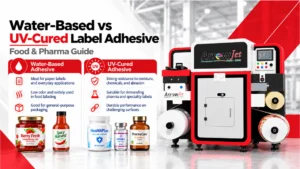
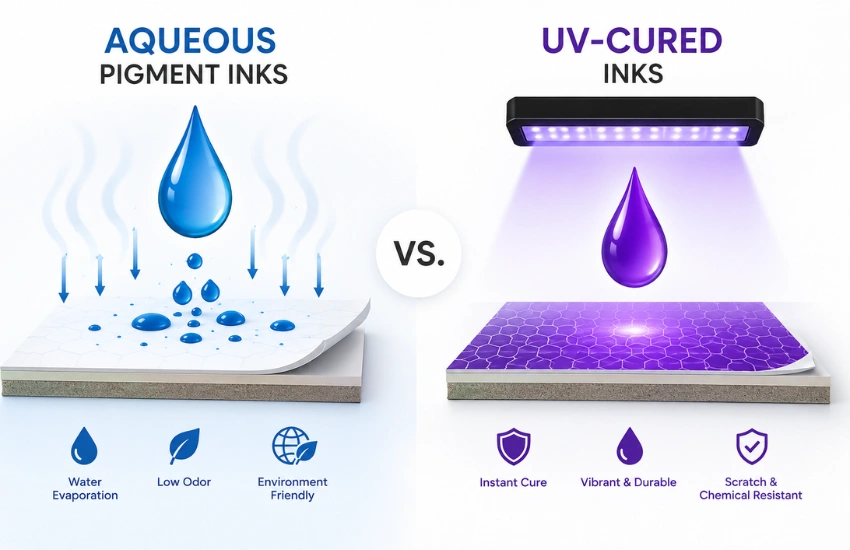
Aqueous and UV-cured inks manage migration risk differently, and neither is universally “the food-safe choice.”

Aqueous pigment inks

Use water as the primary carrier. As the ink dries, water evaporates and the pigment fixes to the substrate. Because the carrier is water rather than reactive monomers or solvents, the residual chemistry left on the label is comparatively simple.

UV-cured inks

Liquid formulations containing monomers, oligomers, and photoinitiators that polymerize (harden) when exposed to UV light. Cure quality is critical: a fully cured film locks components in place, but incomplete cure can leave uncured monomers or photoinitiators available to migrate.

Factor

Aqueous Pigment Inks

UV-Cured Inks

Migration risk drivers

Avoid reactive monomers and UV photoinitiators entirely, removing two of the most scrutinized migration concerns

Depend on complete, verified cure to control migration of monomers and photoinitiators

Cure / dry chemistry

Water evaporation

Photopolymerization; cure consistency varies with lamp condition, line speed, ink film thickness, and substrate

Typical suitability by scenario

Frequently preferred for sensitive direct-contact or low-barrier indirect scenarios due to a simpler residual profile

Acceptable in many indirect scenarios with adequate barriers, low-migration formulations, and validated cure; demands tighter process control

Documentation burden

Supplier declarations and migration data

Supplier declarations, migration data, and closer attention to cure verification records

Treat this table as a starting filter, not a verdict. Aqueous pigment inks reduce the number of migration variables you have to manage, while UV inks can perform well in the right constructions provided cure is validated and low-migration formulations are specified. Match the technology to the placement and barrier, not to a blanket rule. Framed as a single aqueous vs UV ink migration decision, the honest answer is scenario-dependent, not universal.

Ink selection also intersects with operations automation. In automated digital label printing and verification workflows, ink chemistry affects drying and curing throughput, inline inspection compatibility, and the documentation that flows into your quality records. A cleaner ink chemistry can simplify the compliance evidence your automated system needs to capture.

How the ArrowJet Aqua 330R Uses Water-Based Inks

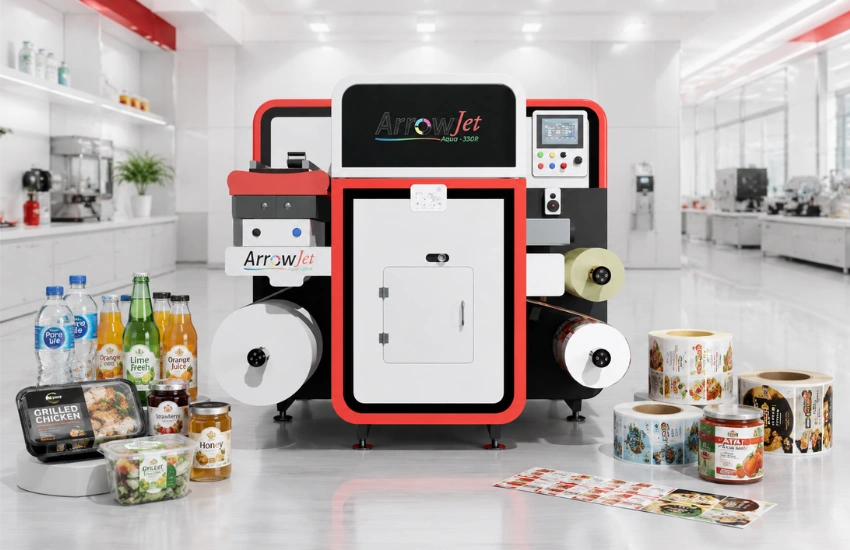
The ArrowJet Aqua 330R is a Nestlé Guidance–compliant digital label press built around water-based pigment ink chemistry, reducing migration variables at the source.

For teams that want to reduce migration variables at the source, water-based digital label systems are worth evaluating. The ArrowJet Aqua 330R is a digital label press built around water-based (aqueous) pigment inks, formulated to align with the Nestlé Guidance for packaging inks and verified for food and beverage label applications.

Aqueous pigment chemistry

The Aqua 330R uses water-based pigment inks, avoiding the reactive monomers and photoinitiators associated with UV migration concerns.

Nestlé Guidance–compliant positioning

The Aqua 330R is positioned as a Nestlé Guidance–compliant water-based ink system, giving quality teams a defined benchmark to request documentation against.

Fit within automated verification workflows

The press fits into automated digital printing and inline verification workflows, where consistent ink chemistry supports repeatable compliance records.

This doesn’t remove your responsibility to confirm suitability for your specific substrates, contact scenarios, and applicable regulations. Always request declarations and migration summaries from your ink supplier before finalizing a press decision. For the full range of Arrow’s water-based platforms, see the ArrowJet digital label printer line.

Regulatory validation — including FDA food contact compliance, applicable regional food contact material rules, and alignment with guidance such as the Nestlé Guidance — is the customer’s responsibility and should be confirmed with qualified regulatory counsel and the ink supplier’s documentation. Arrow Systems sells digital label printing hardware; Arrow does not provide regulatory or compliance advisory services.

The ArrowJet Aqua 800M: Water-Based Ink Compliance for Flexible Packaging

The ArrowJet Aqua 800M is a wide-web flexible packaging press built on the same water-based pigment ink platform, partially aligning with the Nestlé Guidance alongside its other compliance references.

Sachets, stick packs, pouches, and stand-up bags are a growing share of food and beverage packaging, and printed film in these formats can sit in direct or close indirect contact with the product. The ArrowJet Aqua 800M prints these flexible substrates using the same water-based pigment ink chemistry Arrow uses on its label presses.

Water-based pigment ink platform

The Aqua 800M uses Memjet water-based pigment ink chemistry across coated paper, PP, PET, PVC, BOPP, Mylar, and laminate film substrates commonly used for flexible food and beverage packaging.

Compliance references for the ink platform

The Aqua 800M’s ink platform is engineered against compliance references spanning several industries, including food and beverage. These include California Proposition 65, the Model Toxics in Packaging legislation, ASTM Toy Safety standards, REACh, the RoHS 3 Directive, the EUPIA Exclusion Policy, China RoHS 2, and the JPIMA Negative List, along with partial alignment to GMP guidelines, the Swiss Ordinance, and the Nestlé Guidance.

Fit for flexible packaging formats

Because flexible film packaging often places the printed surface closer to the food than a rigid bottle label does, migration considerations apply at least as much here as on rigid-container labels — map the contact scenario for each pouch or sachet construction independently rather than assuming rigid-label conclusions carry over.

This doesn’t replace your own regulatory review. Confirm current status directly against the cited standards and the Nestlé Guidance itself, since both are revised over time.

The compliance references above for the Aqua 800M’s ink platform — Proposition 65, Model Toxics in Packaging legislation, ASTM Toy Safety, REACh, RoHS 3, EUPIA Exclusion Policy, China RoHS 2, JPIMA Negative List, and partial alignment with GMP guidelines, the Swiss Ordinance, and the Nestlé Guidance — should be confirmed for current applicability with your regulatory team before relying on them for a specific product or jurisdiction.

Frequently Asked Questions — Food-Safe Label Inks

Common questions from packaging engineers and quality leads evaluating ink chemistry against food contact requirements.

Not necessarily. “Food safe” is often marketing language with no fixed definition. “Food contact compliant” should mean the ink was evaluated against specific food contact regulations for a defined use scenario. Always ask which framework the claim references and for what contact scenario and substrate.

Usually you’re dealing with an indirect food contact scenario, but “outside” is not an automatic exemption. Migration through the substrate and ink set-off during winding or stacking can still transfer components toward the food. Map each placement to its actual contact scenario and barrier before concluding which rules apply.

Yes, in many indirect scenarios with adequate barriers, when low-migration formulations are specified and cure is properly validated. The key risk is incomplete cure leaving uncured monomers or photoinitiators available to migrate. UV systems demand tighter process control and cure verification than aqueous systems.

Ask for a supplier compliance declaration naming the regulatory framework and intended contact scenario, a statement of Nestlé Guidance alignment where claimed, and a migration test summary relevant to your substrate. Independent, third-party migration testing ink results carry more weight than a supplier’s own ink migration testing data alone. For UV systems, also request cure validation guidance. Route these to quality for review and retain them in your audit file.

Often the underlying ink platform is shared, but the compliance claims should be read carefully. The ArrowJet Aqua 800M, a wide-web flexible packaging press, partially aligns with the Nestlé Guidance rather than fully complying with it. Partial alignment is a materially different claim than full compliance, so confirm exactly which provisions are met before relying on it in your own compliance records.

Talk to Arrow Systems About Water-Based Label Printing Hardware

If your team is mapping label or flexible packaging placements, substrates, and ink chemistry against food contact requirements, Arrow Systems can walk packaging engineering and quality teams through how the ArrowJet Aqua 330R (rigid-container labels) and ArrowJet Aqua 800M (flexible pouches, sachets, and stand-up bags) fit your production line — and what documentation is available for each.

Bring your label placements, substrates, and open questions — Arrow’s team will size the right digital label press configuration for your operation. Regulatory sign-off remains with your quality and legal teams.

Leave a Comment

Your email address will not be published. Required fields are marked *