Table of Contents
How Industrial Inkjet Printers Work: Technology, Ink Types, and Single-Pass Explained
An industrial inkjet printers creates an image by ejecting precisely controlled droplets of ink onto a substrate without the printhead ever making physical contact with the surface. Those droplets — typically 1 to 100 picoliters in volume — land in a pattern governed by the printer’s digital file and, combined, form text, graphics, barcodes, or full-color packaging artwork.
Key Takeaways
- Inkjet printing is a non-contact process: the printhead ejects droplets that land on the substrate rather than pressing ink into or onto it.
- Single-pass inkjet keeps the printhead fixed and moves the media — enabling high throughput for label and packaging production. Scan (multi-pass) systems move the head, which is slower but suitable for lower volumes or wide-format work.
- Two printhead technologies dominate industrial inkjet: thermal bubble (heat-driven) and piezoelectric (crystal-driven). Piezo is more common in production label presses because it supports more ink chemistries without heat exposure.
- Ink type — dye-based, pigment-based, UV-curable, or solvent — determines how the printed image adheres, dries, and performs on the substrate over time.
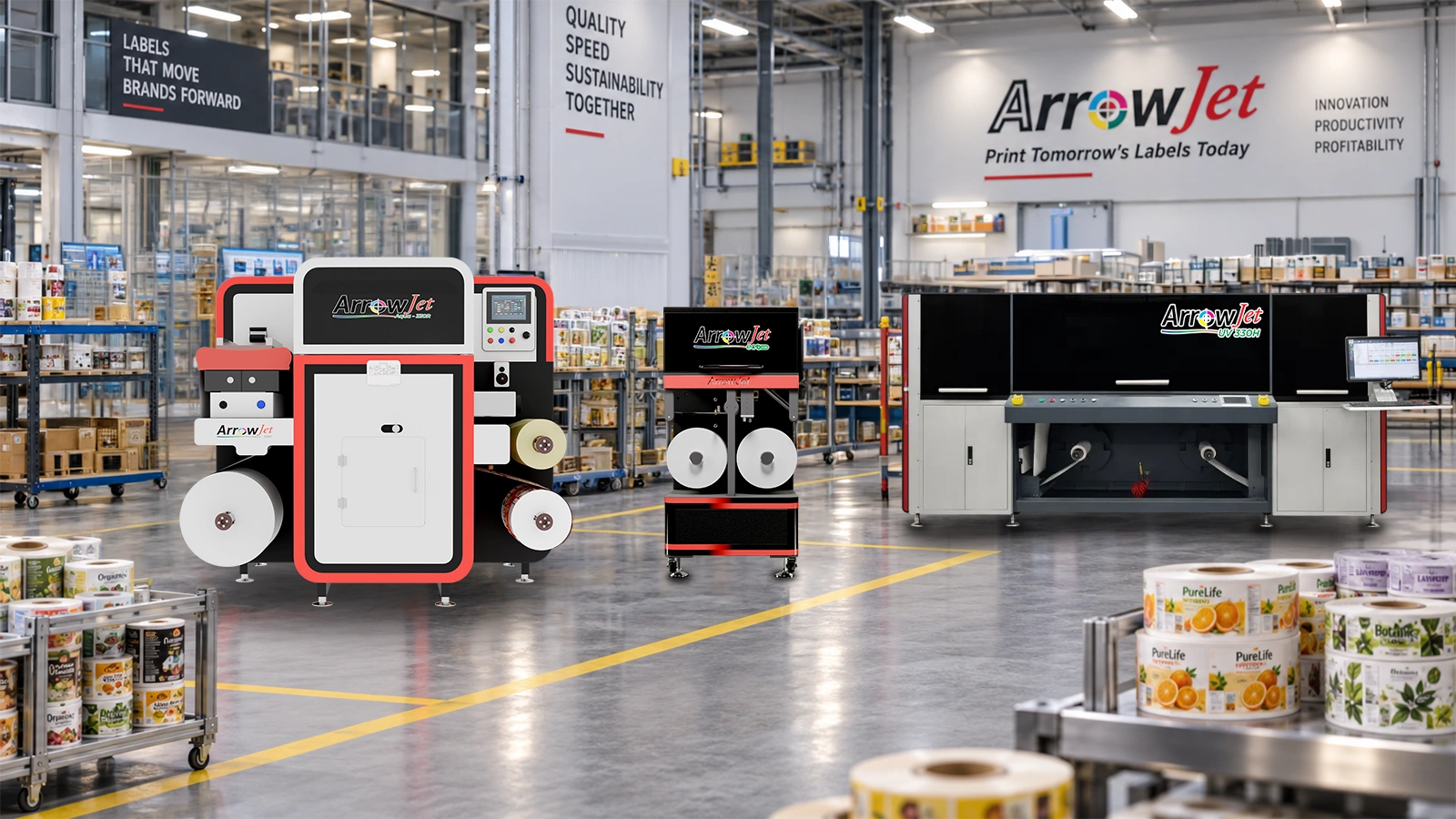
- Arrow Systems manufactures single-pass industrial inkjet label presses in aqueous (water-based pigment) and UV ink configurations, including the ArrowJet Aqua 330R, ArrowJet Eco 330R, and ArrowJet UV 330H.
What Is Industrial Inkjet Printing?
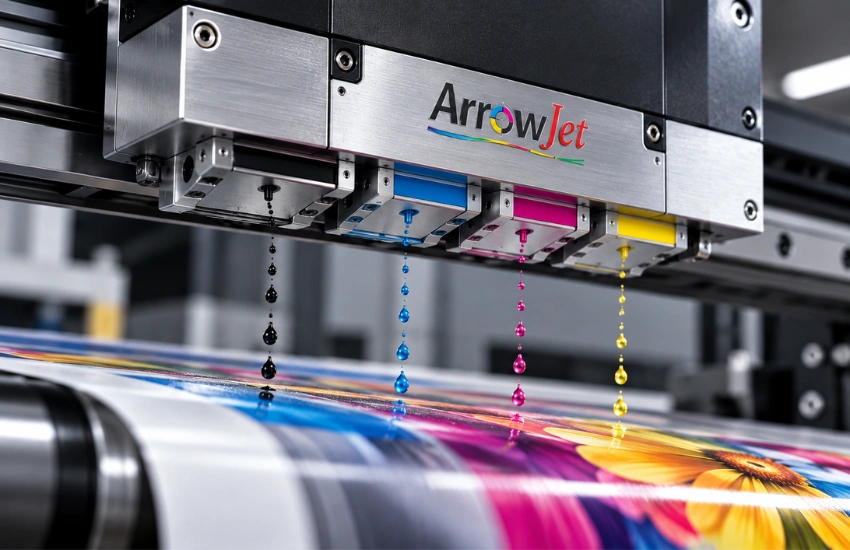
Inkjet printing is a digital, non-contact method of depositing ink onto a substrate by ejecting droplets through nozzles in a controlled pattern.
In an inkjet system, the printhead contains hundreds or thousands of tiny nozzles. Each nozzle is independently controlled by the printer’s software and fires at the moment the correct position on the substrate is beneath it. Because no printing plate, die, or physical stamp contacts the material, inkjet eliminates the setup costs and physical tooling associated with flexographic and offset processes.
Industrial inkjet differs from desktop inkjet in scale, throughput, and engineering. Production inkjet presses are built to handle continuous roll-to-roll media, maintain consistent droplet placement at speeds measured in feet or meters per minute, and operate reliably across long production runs. The substrates they handle — pressure-sensitive label stock, BOPP film, PET, paper, coated materials — require precise tension control, drying or curing systems, and ink formulations matched to the material’s surface energy.
Scan Printing vs. Single-Pass Printing
The two fundamental architectures for industrial inkjet differ in whether the printhead moves across the media or the media moves beneath a fixed printhead — a distinction that determines throughput, resolution trade-offs, and system cost.
For a deeper comparison of these two approaches including cost and volume considerations, see this scan vs. single-pass comparison guide.
Feature | Scan (Multi-Pass) | Single-Pass |
Printhead movement | Head moves laterally across fixed or advancing media | Head array is stationary; media moves beneath it |
Image formation | Multiple passes build up the complete image | Full image formed in a single pass of the media |
Throughput | Lower — passes per image slow production | High — media runs continuously at production speed |
Typical application | Wide-format signage, prototyping, shorter runs | Roll label production, flexible packaging, high-volume output |
Print width | Can span wide formats by carriage travel | Fixed by the width of the installed printhead array |
Capital cost | Generally lower for comparable print width | Higher — full-width printhead arrays are cost-intensive |
Why single-pass dominates production label printing
For commercial label converters and brand owners producing tens of thousands of labels per shift, the throughput of single-pass inkjet is the decisive factor. When the printhead array spans the full print width and the media moves at speed, there is no mechanical limit imposed by a reciprocating carriage. Modern single-pass production presses for labels run at speeds ranging from 20 meters per minute on entry-level systems to over 100 meters per minute on high-capacity platforms — throughput that scan architectures cannot match at equivalent quality levels.
How Inkjet Printheads Work: Thermal Bubble vs. Piezoelectric
Inside every inkjet printhead, each nozzle has an actuator that forces ink out when triggered. Two actuator technologies account for virtually all industrial inkjet systems: thermal bubble and piezoelectric.
Thermal bubble inkjet
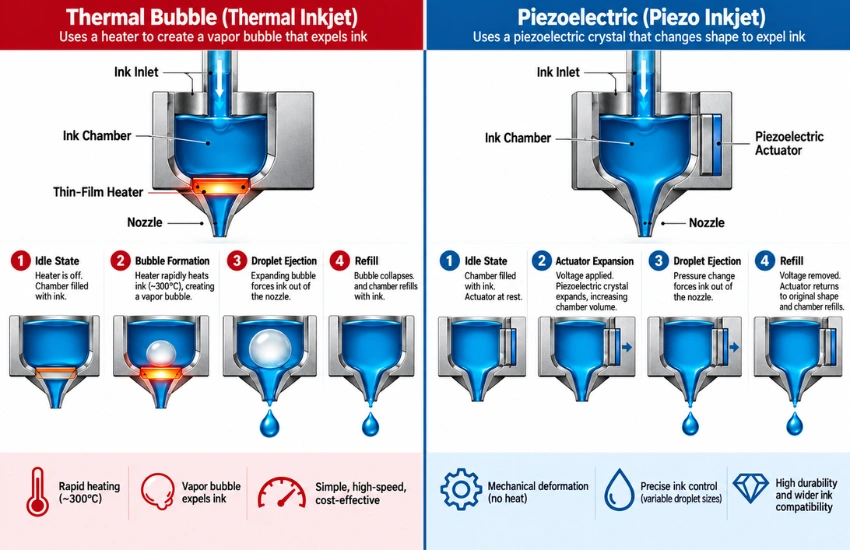
A thermal bubble printhead contains a resistive heating element behind each nozzle. When the nozzle fires, an electrical pulse heats the element to approximately 300°C in microseconds. The ink immediately adjacent to the heater vaporizes, forming a gas bubble. As the bubble expands rapidly, it forces a droplet of ink out through the nozzle opening. When the heating pulse ends, the bubble collapses, and the negative pressure created draws fresh ink from the reservoir back into the firing chamber to prepare for the next droplet cycle.
Thermal inkjet is inexpensive to manufacture and was the dominant desktop inkjet technology for decades. In industrial settings, its primary limitation is that the ink must be able to withstand the momentary heat spike without degrading — which restricts the range of compatible ink chemistries.
Piezoelectric inkjet
Piezoelectric printheads replace the heating element with a piezo crystal positioned behind or around the ink chamber. When an electrical charge is applied, the crystal physically deforms — flexing or compressing — and that mechanical movement creates pressure in the ink chamber that ejects a droplet through the nozzle. When the charge reverses, the crystal returns to its rest position, creating a slight negative pressure that draws ink back into the chamber.
Because no heat is involved, piezoelectric technology is compatible with a broader range of ink types: water-based pigment inks, UV-curable inks, solvent inks, and oil-based formulations can all be used with piezo printheads, provided the ink’s viscosity and surface tension are within the nozzle’s operating parameters. This makes piezoelectric architecture the standard choice for industrial label and packaging presses where the ink type must be matched to the substrate and end-use environment.
Feature | Thermal Bubble | Piezoelectric |
Actuation method | Heat — resistive element vaporizes ink | Mechanical — piezo crystal flexes under electrical charge |
Heat exposure to ink | Yes — brief but significant (~300°C) | None — ink is not exposed to heat |
Compatible ink types | Water-based dye and pigment inks that tolerate heat | Water-based pigment, UV-curable, solvent, oil-based |
Droplet size control | Fixed droplet size per nozzle | Variable droplet size via waveform shaping |
Head replacement cycle | Often consumable — replaced with ink cartridge | Long-life permanent heads; higher initial cost |
Primary industrial use | Memjet-engine single-pass presses (water-based pigment) | Ricoh Gen5/6, Kyocera, Konica Minolta heads in production presses |
Ink Types Used in Industrial Inkjet
The ink type determines how the printed image bonds to the substrate, how quickly it dries or cures, and how it performs in the product’s end-use environment — whether that is a refrigerated bottle, an outdoor label, or a flexible pouch.
Dye-based ink
Dye-based inks use colorants dissolved entirely in the carrier liquid. The colorant molecules absorb into the substrate rather than sitting on the surface. Dye inks are associated with vivid color gamut and smooth tonal gradients, but they offer lower resistance to UV light, water, and abrasion compared with pigment alternatives. Dye-based inkjet is more common in office and desktop printing than in industrial label production, where durability requirements are typically higher.
Pigment-based ink
Pigment inks suspend fine solid color particles in a liquid carrier. Rather than being absorbed by the substrate, the particles sit on and bond to the surface. The result is better resistance to UV fading, moisture, and abrasion — characteristics that make pigment ink the standard choice for pressure-sensitive label production across food, beverage, pharmaceutical, and personal care categories. For more on how water-based pigment chemistry works in practice, see our guide to water-based pigment inkjet technology.
UV-curable (UV) ink
UV inks are formulated from liquid monomers and photoinitiators. When exposed to a UV LED lamp, the photoinitiators trigger polymerization — the monomers cross-link and the ink solidifies almost instantaneously on the substrate surface. Because curing is driven by light rather than evaporation or absorption, UV ink works on a wide range of non-porous substrates including clear film, metallic materials, and certain plastics where aqueous inks would not adhere. UV inks also enable specialty effects: opaque white, spot gloss, varnish, and tactile texture. The ArrowJet UV 330H is Arrow’s hybrid UV inkjet press, supporting CMYK plus white and varnish configurations on both roll and flatbed media.
Solvent ink
Solvent inks carry the colorant in a volatile organic compound (VOC) carrier. As the ink is applied to the substrate, the solvent evaporates — either passively or with heat assist — leaving the colorant bonded to the surface. Solvent inks adhere to many uncoated flexible materials including vinyl, and are commonly used in wide-format applications such as outdoor signage, banners, and vehicle graphics. In commercial label production for food and consumer goods, aqueous and UV formulations have largely replaced solvent inks because of odor, VOC handling requirements, and the availability of higher-quality alternatives for coated label substrates.
How These Technologies Apply to Label and Packaging Production
For converters and brand owners evaluating in-house printing equipment, the technology choices above translate directly into real production trade-offs: substrate compatibility, throughput, ink cost, and finishing workflow.
Most commercial label presses for pressure-sensitive labels use single-pass piezoelectric architecture with water-based pigment ink. This combination delivers the throughput required for production volumes, the print quality (typically 1600 dpi or higher) needed for fine text, regulatory copy, and barcodes, and an ink chemistry that is compatible with the coated paper and film stocks used across food, beverage, pharmaceutical, and personal care labeling.
Arrow Systems manufactures the ArrowJet Aqua 330R for this segment — a single-pass digital label press using the Memjet DuraFlex® engine, printing up to 1600 × 1600 dpi in CMYK water-based pigment ink on roll-fed pressure-sensitive label stock. For operations entering in-house label production at a lower initial investment, the ArrowJet Eco 330R uses the same DuraFlex® engine in a compact single-phase configuration running up to 20 m/min — suitable for shorter runs and variable data work where the production pace of larger systems is not yet required.
Where the application requires specialty substrates — clear films, metallic materials, dark or non-coated surfaces — UV inkjet technology adds curing immediacy and substrate versatility that aqueous ink cannot match. The ArrowJet UV 330H combines roll-to-roll and flatbed capability in a single press, supporting opaque white, varnish, and multi-layer UV configurations for premium label production.
The ink type, printhead technology, and system architecture are not independent decisions. A converter choosing a press is choosing all three simultaneously — and the right combination depends on their substrate range, run length profile, finishing workflow, and end-market compliance requirements (food contact, indirect food contact, compliance certifications). Mapping those requirements to a specific system is the starting point for any in-house digital label printing evaluation.
Frequently Asked Questions
No. Industrial inkjet is a non-contact process. The printhead ejects droplets through nozzles, and those droplets land on the substrate without any physical contact between the printhead and the material. This is one reason inkjet works across a wide range of substrates — including delicate films and textured materials.
In single-pass inkjet printing, the printhead array spans the full print width and remains stationary while the substrate moves beneath it. The entire image is formed in a single pass of the media through the system. Single-pass architecture enables much higher throughput than scan (multi-pass) systems and is the standard approach in production-grade industrial inkjet presses for labels and flexible packaging.
Thermal bubble systems use a heating element to vaporize ink into a bubble; the expanding bubble forces a droplet through the nozzle. Piezoelectric systems use a piezo crystal that physically flexes when an electric charge is applied, pushing ink through the nozzle without heat. Piezoelectric technology is more common in industrial label and packaging presses because it supports a wider range of ink chemistries — including water-based pigment and UV — and produces consistent droplet volumes across a broader operating range.
The four main ink types are dye-based (colorants dissolved in carrier — lower durability), pigment-based (particles suspended in liquid — better UV resistance and adhesion), UV-curable (liquid monomers that polymerize under UV LED light, bonding directly to the substrate surface), and solvent-based (volatile organic compound carrier that evaporates during drying). For label production in food, pharmaceutical, and personal care categories, water-based pigment and UV-curable inks are the most common choices.
Key factors include: printhead architecture (single-pass for high throughput vs. scan for lower volumes or wider formats); ink chemistry matched to your substrate and end-use requirements; print resolution for the detail level your labels require; print width relative to your label dimensions; and infrastructure requirements such as power supply type and air source. Arrow Systems manufactures ArrowJet label presses in aqueous and UV configurations covering a range of production scales — from the entry-level Eco 330R to the high-speed Aqua 330R platform.
Evaluating in-house digital label printing?
Arrow Systems manufactures industrial inkjet label presses for converters, brand owners, and in-plant print operations. Explore the full Arrow digital label printers range, or speak with our team about print specs, substrate requirements, and the right system for your production volume.
Coffee Roaster Flexible Pouch Printing Workflow: Roll to Bag
Table of Contents Coffee Roaster Flexible Pouch Printing Workflow: Roll to Bag In-house coffee pouch printing runs five stages — substrate loading, queue setup, the
How Industrial Inkjet Printers Work: Technology, Ink Types, and Single-Pass Explained
Learn how industrial inkjet printers eject controlled droplets, how scanning and single-pass systems differ, and what ink, substrate, drying, and QA affect.
White Ink Label Printing: Substrates, File Setup & In-House Equipment
Learn how white ink or toner supports clear, dark, and metallic labels, how to build a white layer, and what to test for opacity, registration, and adhesion.
Benefits of Digital Label Printing for In-House Production
Explore the practical benefits of digital label printers: short runs, versioning, variable data, inventory control, faster response, and integrated finishing.

What Is Flexible Packaging? Formats, Materials, and Digital Printing
Learn how flexible packaging is used, how pouches and rollstock differ, which barrier and seal questions matter, and where digital printing fits.
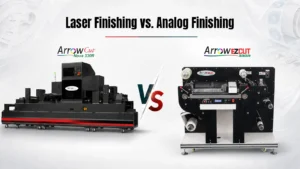
Laser Finishing vs. Analog Finishing for Labels: A Complete Comparison Guide
Compare laser and analog label finishing by tooling, changeovers, materials, run length, quality, workflow, and total cost before selecting equipment.