Benefits of Digital Label Printing for In-House Production
Explore the practical benefits of digital label printers: short runs, versioning, variable data, inventory control, faster response, and integrated finishing.
Digital label printers produce labels from digital files, eliminating the plate-based setup that makes traditional printing costly and slow for short runs. For manufacturers, consumer brands, and contract packagers managing frequent design changes or many SKUs, that operational flexibility can determine whether label production keeps pace with the business — or holds it back.
This post covers the core benefits of digital label printing, how it compares to traditional flexographic production, and which ArrowJet presses are built for in-house label operations.
Digital label printing supports short production runs — including single labels — without the plate setup that makes small quantities expensive in traditional printing.
Traditional flexographic label printing requires a set of plates — typically one per color — before a single label can be produced. Plate costs range from $200 to $800 or more per color per design, and minimum order quantities of 5,000 to 25,000 labels per SKU are common. For a brand with ten label variants, those setup costs multiply quickly.
Digital label presses have no plates. The print file is sent directly to the press, which means a run of 100 labels costs no more to set up than a run of 10,000. This removes the economic pressure to over-order in advance — a practice that creates excess inventory that can become obsolete when formulations, ingredients, or regulations change.
Short-run digital production is particularly useful for:
Digital label presses can change information from one label or batch to the next without any physical setup change — a capability plates cannot replicate.
Variable data printing (VDP) allows information to change across labels within a single production run, driven entirely by the print file. There is no plate reconfiguration, no press downtime, and no manual intervention to switch between label versions.
Common variable data applications in label production include:
For industries where traceability, compliance, or rapid SKU differentiation matters — food and beverage, nutraceuticals, pharmaceuticals, chemicals — variable data printing is a practical operational requirement rather than a nice-to-have.
Digital printing cuts label changeover time and reduces the inventory exposure created by bulk pre-printed label orders that may become outdated.
In a traditional label supply chain, a design revision — triggered by a formula change, a regulatory update, an ingredient swap, or a rebrand — can mean scrapping existing plate-based label inventory and waiting 2–4 weeks for new plates and a fresh production run. The label stock already in the warehouse may be unusable the moment the change takes effect.
Digital label production changes the risk profile. Because there are no plates to remake, a design file update translates directly into updated labels at the next print run. Operations printing labels in-house on demand — in the quantities needed, when needed — hold little or no label inventory, which means a compliance or branding change takes effect on the next print run rather than after a warehouse write-off.
The actual time and cost savings depend on label volume, substrate, ink consumption, labor, finishing, and how frequently designs change. Every operation should assess its own workflow. But for businesses managing many SKUs with regular revision cycles, the reduction in setup friction and inventory risk is often where digital label printing delivers its clearest financial return.
Digital label production often connects directly with finishing — die-cutting, lamination, slitting, and rewinding — either inline or in a closely linked downstream workflow.
Printing a label is only part of the process. Before labels are ready for application, they typically require finishing steps: cutting to shape, removing waste matrix, laminating for durability, slitting to roll width, and rewinding to the core size required by the applicator.
Digital finishing equipment handles these steps without the physical dies that traditional cutting systems require. This means no die tooling lead time, no die storage, and the ability to change cut shapes as quickly as the label design changes.
Some digital label presses support inline finishing modules that complete these steps within the press workflow itself. The ArrowJet Aqua 330R Hybrid Pro M, for example, supports inline primer and varnish stations, an inline IR dryer, and an optional rotary slitter — consolidating multiple finishing steps into a single pass.
Operations that prefer to keep printing and finishing as separate steps can pair a digital press with standalone label finishing equipment in a connected workflow.
For operations keeping print and finishing as separate connected steps, the Arrow EZCut 330R+ and ArrowCut Nova 330R pair directly with digital label presses in a downstream finishing workflow.
The EZCut 330R+ is a blade-based digital finisher with a cutting media width of up to 350 mm and a maximum cutting speed of 150 cuts per minute. It handles die-cutting, slitting, cold lamination, automatic matrix removal, and rewinding — suited for consistent label shapes running at medium-to-high volume. The ArrowCut Nova 330R is a roll-to-roll laser finisher that handles kiss-cutting, full cutting, perforation, engraving, slitting, lamination, and waste removal without physical dies. Removing the die from the workflow eliminates die tooling lead times and storage requirements — the cut shape is defined entirely in software and can change as quickly as the label design itself.
Modern digital inkjet label presses produce high-resolution output at production speeds, with consistent color across short and medium runs.
Label quality influences how a product is perceived on shelf. Digital inkjet printing has advanced to the point where output resolution, color consistency, and substrate range meet the requirements of consumer packaging, industrial labels, and regulated product categories.
ArrowJet label presses use water-based pigment inks and print at resolutions up to 1600 × 1600 dpi. The Memjet DuraFlex single-pass printhead architecture used in the Aqua 330R and Eco 330R allows high-resolution output at the speeds required for production environments — not just sampling or proofing.
Digital presses support a range of pressure-sensitive label substrates, including coated paper, polypropylene (PP), polyester (PET), PVC, BOPP, Mylar, and Tyvek — giving in-house print operations flexibility across product lines and packaging formats.
Digital label printing delivers the most value when short runs, design flexibility, or in-house production control are operational priorities.
Digital label printing is typically the right choice when one or more of the following conditions apply to your operation:
Digital printing becomes less cost-competitive when a single label design runs at very high volumes — typically above 25,000–50,000 labels per SKU — and changes infrequently. At those volumes, the per-label cost advantage shifts back toward traditional flexographic printing.
The table below compares digital inkjet label printing against traditional flexographic printing across the factors most relevant to in-house production decisions.
|
Factor |
Flexographic (Traditional) |
Digital Inkjet (In-House) |
|
Plate / setup cost |
$200–$800+ per color per design |
None |
|
Minimum order quantity |
Typically 5,000–25,000+ labels |
1 label minimum |
|
Lead time — new artwork |
2–4 weeks (plate production) |
Hours to same day |
|
Design revision turnaround |
New plates required; 2–4 additional weeks |
File update; print immediately |
|
Variable data support |
Not supported |
Supported |
|
Obsolete inventory risk |
High — any formula or compliance change strands stock |
Minimal — print to demand |
|
Per-label cost at low volumes |
High (plate cost amortized over small run) |
Lower at short runs |
|
Per-label cost at high volumes (50,000+) |
Lower than digital at scale |
Higher than flexographic at scale |
|
Color consistency across long runs |
Excellent |
Good; press and calibration dependent |
The right choice depends on your run lengths, SKU count, revision frequency, and total-cost calculation. Most operations with a diverse product range and regular design changes find that digital is more cost-effective on a total-cost basis, even when the per-label price at high volumes is lower for flexographic.
Arrow Systems manufactures a range of digital label presses designed for in-house production — from entry-level single-pass presses to high-throughput configurations with inline finishing.
Arrow Systems builds digital label printing hardware for manufacturers, brand owners, and converters that want to bring label production in-house. The ArrowJet line covers a range of throughput requirements and finishing configurations.
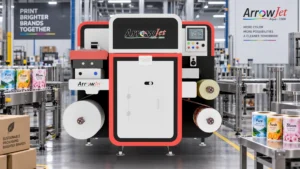
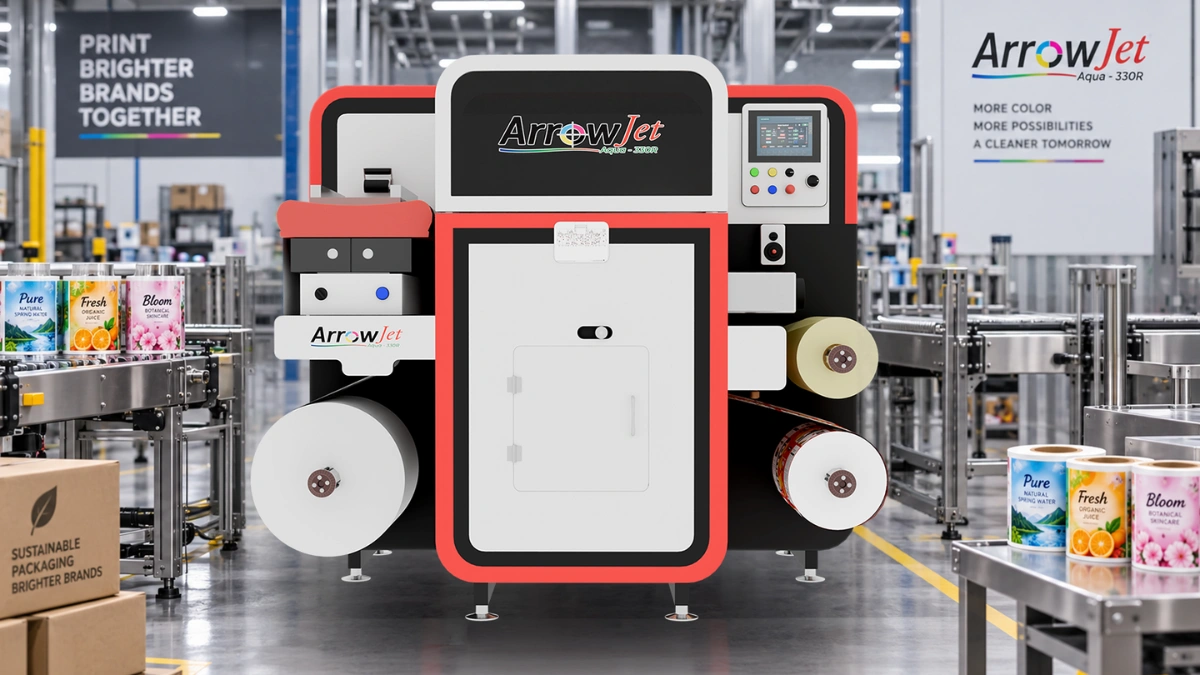
The ArrowJet Aqua 330R is a high-speed aqueous pigment inkjet label press using Memjet DuraFlex technology. It is designed for roll-to-roll label production at production speeds, with resolution and substrate range suited to consumer and industrial label applications.
The ArrowJet Eco 330R is a compact, entry-level digital label press designed as an accessible starting point for brands moving label production in-house. It uses single-pass digital inkjet technology with a small footprint and single-phase power — reducing installation requirements compared with larger-format presses.
The ArrowJet Aqua 330R Hybrid Pro M is a high-throughput label press with inline finishing capabilities. It adds inline primer and varnish stations, an inline IR dryer, and optional modules including a rotary slitter and lamination — enabling operators to complete multiple production steps in a single pass.
For a full overview of ArrowJet label presses, visit the ArrowJet digital label printer range.
Common questions about digital label printing and how it compares to traditional production methods.
Digital label printing is a plate-free process that produces labels directly from digital files using inkjet or laser technology. It supports short runs, variable data, and rapid design changes without the setup time or plate costs associated with traditional flexographic printing.
Flexibility. Digital printing eliminates plate costs, removes minimum order quantities, and makes design changes possible without setting up new tooling. This is particularly valuable for operations managing multiple SKUs, frequent formula or compliance updates, or short-run production schedules.
Flexographic printing has a lower per-label cost at very high volumes — typically above 25,000–50,000 labels per SKU — but requires plate production and 2–4 week lead times for new artwork. Digital printing has no plate costs, no minimum order requirement, and can produce labels the same day an approved file is received. For operations with many SKUs, short runs, or frequent revisions, digital is generally more cost-effective on a total-cost basis.
Yes. Digital label presses can change information from one label or batch to the next without any physical setup change. Variable data applications include serialized numbers, batch codes, expiry dates, product variation details, and QR codes — all driven by the print file.
Digital label finishing refers to the post-print steps that prepare labels for application — including die-cutting, laser cutting, lamination, waste removal, slitting, and rewinding. Standalone finishers such as the Arrow EZCut 330R+ (blade-based, up to 150 cuts per minute) and the ArrowCut Nova 330R (laser-based, die-free) handle these steps in a downstream workflow paired with any digital label press. Presses such as the ArrowJet Aqua 330R Hybrid Pro M also support inline finishing modules that integrate these steps directly into the print run.
Not automatically. Digital printing can eliminate plate setup costs and reduce obsolete inventory waste, but total cost depends on label volume, substrate, ink coverage, labor, and finishing. At very high volumes, traditional flexographic printing generally has a lower per-label cost. Businesses should evaluate their own run lengths, SKU count, and revision frequency before drawing conclusions.
ArrowJet digital label presses support a range of pressure-sensitive label substrates including coated paper, polypropylene (PP), polyester (PET), PVC, BOPP, Mylar, and Tyvek. Substrate compatibility varies by press model and configuration. Consult the product specifications for the specific press you are evaluating.
Arrow Systems manufactures digital label presses for short runs, variable data, and high-throughput production. Our team can help you match the right press configuration to your label volume, substrate requirements, and finishing workflow.
Contact the Arrow Systems team to discuss your requirements or request a sample.
Explore the practical benefits of digital label printers: short runs, versioning, variable data, inventory control, faster response, and integrated finishing.
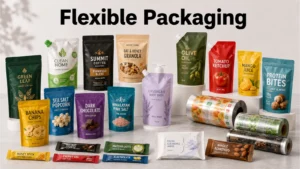
Learn how flexible packaging is used, how pouches and rollstock differ, which barrier and seal questions matter, and where digital printing fits.
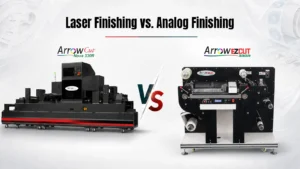
Compare laser and analog label finishing by tooling, changeovers, materials, run length, quality, workflow, and total cost before selecting equipment.
Table of Contents Arrow Systems to Exhibit at LOUPE Americas 2026 Chicago, IL — Arrow Systems Inc. will exhibit at LOUPE Americas 2026, taking place
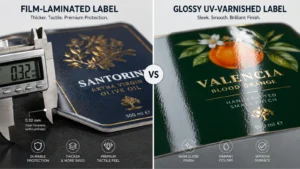
Table of Contents Overlaminate vs. Varnish Labels: How to Choose Protection Film overlaminate protects against immersion, wash-down, and solvents; UV and aqueous varnish suit retail
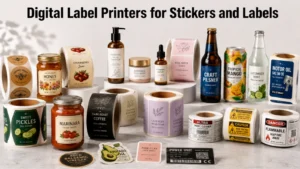
Table of Contents Digital Label Printers for Stickers and Labels: How to Choose the Right Press The right printer for stickers and labels depends on