Table of Contents
Cannabis Label Compliance in 2026: State Rules, Variable Data, and In-House Printing
U.S. cannabis label compliance has no federal baseline — each state writes its own rules, revises them frequently, and enforces them at the batch level.
Key Takeaways
- There is no federal cannabis labeling framework — every legal state writes its own rules, and most revise them on rolling timelines that do not align across jurisdictions.
- Batch-level variable data (potency, lab ID, COA reference, harvest and package dates) must appear on the consumer-facing label in most states, making pre-printed label inventory a structural compliance liability.
- The universal cannabis warning symbol is not standardized nationally — artwork, color, size, and placement differ by state, and symbol revisions can render in-stock label inventory non-compliant on short notice.
- In-house digital label printing with the ArrowJet Aqua 330R eliminates minimum order quantities, supports per-batch variable data printing, and turns regulatory updates into artwork file changes rather than inventory write-offs.
- Operators should model obsolescence cost — not just per-label material price — when evaluating the breakeven for in-house label production.
- Match press tier to operator scale: the ArrowJet Eco 330R suits entry-level and smaller cannabis producers; the ArrowJet Aqua 330R suits regional producers and operators managing higher SKU complexity.
Why Cannabis Label Compliance Is More Complex Than Other Industries
Cannabis labeling has no FDA-style federal baseline — each legal state builds its own program, revises it independently, and enforces it at the batch level with direct license consequences.
Unlike food, beverage, or pharmaceuticals — where federal frameworks establish a compliance floor across jurisdictions — cannabis sits outside federal regulation entirely. Every legal state has built its own licensing, testing, and labeling program, and most continue to revise rules annually as markets mature and consumer protection priorities evolve.
For operators managing in-house label production, this creates a category of compliance demand that standard pre-printed label workflows are not designed to handle. Several converging factors make cannabis the hardest consumer category for label consistency:
No federal baseline
Every state writes its own labeling statute, and most maintain separate rule sets for medical versus adult-use markets. What is compliant in Michigan may be a violation in Massachusetts. A single SKU sold across five states may require five distinct label versions — each subject to independent revision cycles.
Frequent rule updates
Warning statement language, universal symbol artwork, and potency disclosure formats are revised on rolling timelines that rarely align across states. Emergency rule changes can take effect with limited notice, creating a compliance window that pre-printed label inventory cannot absorb without scrapping stock.
Batch-level variable data
Every harvest and manufacturing lot produces unique potency results, lab test IDs, COA references, and production dates. Most states require this data to appear directly on the consumer-facing label — not on a secondary sticker or accessory tag — making every label effectively unique to its production run.
High SKU complexity
Flower, pre-rolls, vapes, edibles, tinctures, topicals, and concentrates each carry different category-specific requirements. A producer running multiple product categories across even a single state manages a label matrix that grows with every new SKU or regulatory update.
Direct enforcement risk
Mislabeled THC content, missing warning statements, or outdated symbols can trigger product holds, mandatory destruction, fines, or license action. The consequence of a label compliance failure in cannabis is not a warning letter — it is a potential production shutdown.
State-by-State Mandatory Label Elements
Most state cannabis programs converge on the same label element categories — but specific wording, format, and placement requirements differ enough that the gap between jurisdictions is where most compliance failures originate.
While every state program must be validated independently against current published rules, the following categories appear consistently across major cannabis markets. Operators should treat this table as a categorical reference — not a compliance checklist. The specific values in each cell are where state programs diverge.
Label Element | Typical Requirement | Where Variation Risk Is Highest |
THC and CBD content | Total per package; per serving for edibles and tinctures | Pre-activation versus post-activation values; tolerance thresholds differ by state |
Government warning statements | State-specific language, often category-specific | Wording revised on rolling timelines; medical versus adult-use versions differ |
Universal cannabis symbol | Designated symbol indicating cannabis or THC content | Artwork, color, minimum size, and placement vary by state; symbols subject to revision |
Batch or lot number | Links finished product to production and testing records | Format conventions differ; some states require specific traceability system integration |
License or facility identifier | Producer’s state license number | Placement conventions and label field labeling vary |
Harvest, package, or expiration date | At least one date field typically mandated | Which date is required and what format vary by state and product category |
Allergen and ingredient disclosures | Required for edibles and infused products | Alignment with food labeling rules differs; some states adopt FDA standards, others write independent requirements |
Child-resistance messaging | “Keep away from children” and related iconography | Icon usage, placement, and specific wording vary |
Font size and contrast | Minimum legibility standards across most programs | Point size minimums and contrast ratio specifics differ; failure here is a frequent low-visibility violation |
Cannabis labeling requirements change frequently. Validate all label elements against current state-published rules before each production run. This table is a categorical reference only — Arrow Systems does not provide regulatory or compliance advisory services. Confirm requirements with qualified regulatory counsel.
Universal Warning Symbol: Where and How to Print It
There is no single national cannabis warning symbol — artwork, color, size, and placement requirements differ by state, and symbols are revised on timelines that can render pre-printed inventory non-compliant without warning.
The universal cannabis symbol is one of the clearest examples of why pre-printed label inventory is a structural compliance risk in this industry. Several states have adopted their own artwork with distinct shapes and colors. Placement, minimum size, and contrast rules differ across jurisdictions, and symbols themselves are revised as regulators refine their programs.
Per-state artwork library management
For multi-state operators, a centralized, version-controlled artwork library is a non-negotiable operational requirement. Each state jurisdiction requires its own symbol file, and that file must be updated every time the state revises its artwork — which happens on cycles that do not align across programs. A single outdated symbol file can invalidate an entire label SKU for a given state.
Symbol revision as an inventory liability
When a state updates its warning symbol, every in-stock pre-printed label for that state carrying the old artwork becomes a compliance liability — not a future cost, but a current one. Operators must either absorb the scrap or accept the enforcement risk of using outdated labels. For operations running bulk pre-printed inventory across multiple states, a single symbol revision can represent a significant unplanned write-off.
Color, contrast, and size compliance at the press
Symbols printed too small, in incorrect colors, or against low-contrast backgrounds can trigger rejection even when the artwork file is current. Digital label printing allows color accuracy, symbol size, and contrast to be validated in proofing before a production run begins — catching print-side compliance failures before labels ship rather than after.
Variable Data Printing for Cannabis: Batch, Lot, and Test Results
Every cannabis batch produces unique data — potency, lab ID, COA reference, and dates — that must appear on the consumer-facing label, making variable data printing a core production requirement rather than an optional feature.
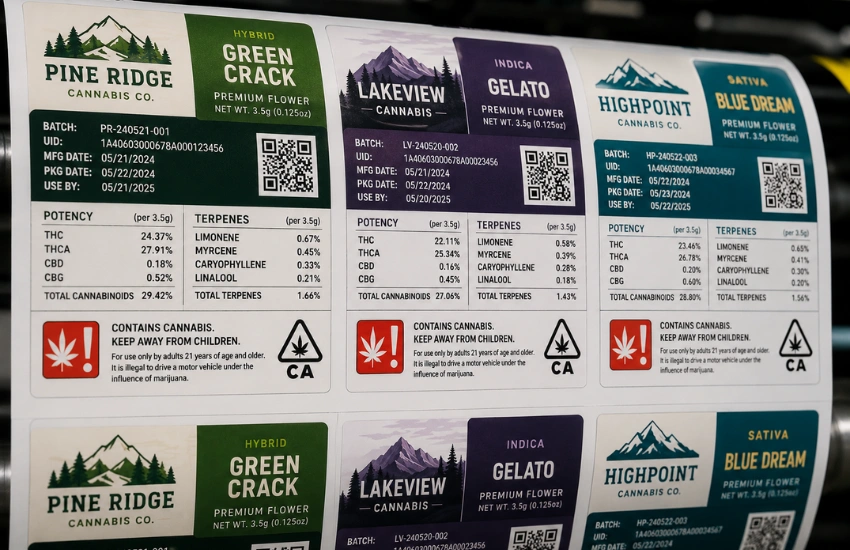
This is the operational reality that defines cannabis labeling more than any other compliance category: every batch carries unique data. Cannabinoid potency, terpene profiles, lab test results, COA references, batch IDs, harvest dates, and package dates change with every production run. In most states, this data must appear directly on the consumer-facing label — not on a secondary sticker or an accessory tag applied downstream.
Pre-printed labels cannot accommodate this reality without accepting one of two compromises that operators routinely make but should not:
Manual batch-specific sticker application
Applying secondary batch data stickers over pre-printed label blanks adds labor, slows production lines, creates a second failure point in the compliance chain, and produces an inconsistent consumer-facing label. Regulatory inspectors can treat overprinted or re-stickered labels as a traceability red flag — even when the underlying data is accurate.
Thermal overprinting on pre-printed blanks
Hand-stamping or thermal transfer overprinting on pre-printed blank labels is workable for simple date codes but error-prone and visually inconsistent when applied to full potency panels. It also introduces a second point of potential data entry error between the COA and the finished label.
Variable data printing as the primary solution
A digital label press that supports variable data printing receives batch-specific information — potency values, lab IDs, batch and package dates, COA references — directly from the production system or LIMS, and prints a fully compliant, batch-specific label on demand. Each label reflects the actual lab results for that specific lot, with no manual transcription, no secondary stickering, and no pre-printed blanks sitting at risk of regulatory obsolescence.
Traceability as a workflow byproduct
When label production pulls directly from batch records and lab data, traceability becomes a natural output of the production workflow rather than a manual reconciliation task after the fact. Audit trails are stronger, artwork version history is clearer, and the risk of a mismatch between what is printed and what is in the traceability system drops substantially.
In-House Cannabis Label Printing with the ArrowJet Aqua 330R
The ArrowJet Aqua 330R is a roll-to-roll water-based pigment inkjet label press designed for on-demand, short-run production — addressing the variable data and regulatory update demands that define cannabis label workflows.
For licensed producers and regional brands managing diverse SKUs across one or two states, the ArrowJet Aqua 330R handles the workflow realities of cannabis label production without the lead times, minimum order quantities, and obsolescence exposure that external converter relationships carry.
On-demand, short-run production
Print only the labels needed for the current batch — not a minimum order that may expire before it is consumed. When a state updates its warning language or universal symbol, the change is a file revision in the RIP rather than a scrapped converter order. This is the structural difference that in-house digital printing makes against pre-printed label inventory in a high-revision-frequency environment.
Variable data per label, per batch
The ArrowJet Aqua 330R supports full variable data printing — batch numbers, potency values, lab IDs, COA references, and harvest and package dates that change with every production run, without plate changes, die changes, or secondary overprint steps. Each label is produced as a unique, batch-specific compliance document.
Substrate range for cannabis packaging formats
Cannabis products ship in glass jars, mylar pouches, plastic containers, paperboard boxes, vape cartridges, and child-resistant flexible packaging. The ArrowJet Aqua 330R supports coated paper, BOPP, PET, PVC, synthetic stocks, and laminate papers — covering the primary label substrates across these packaging formats at a maximum printing width of 12.75 inches (324 mm).
Print speed for production-scale label runs
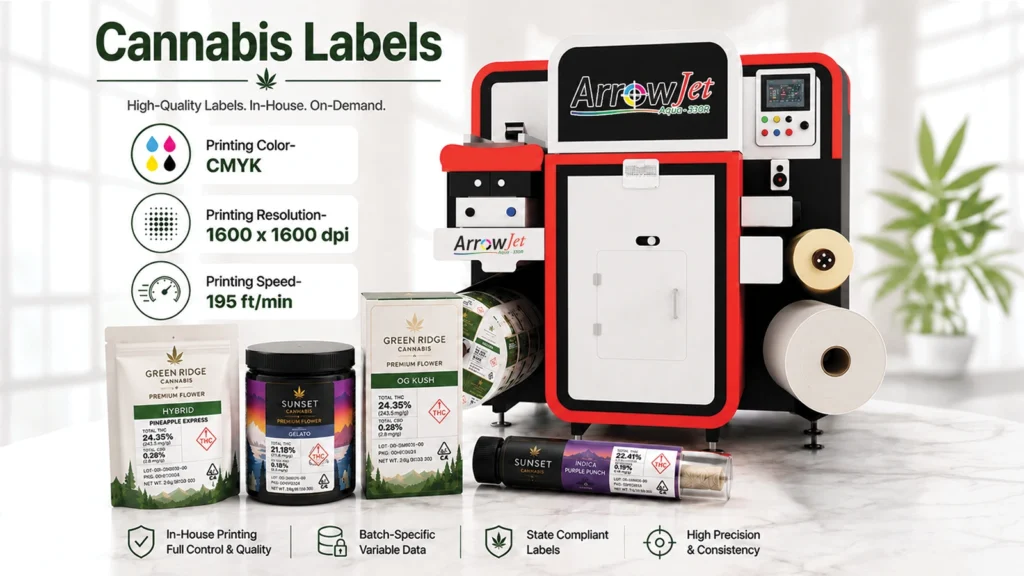
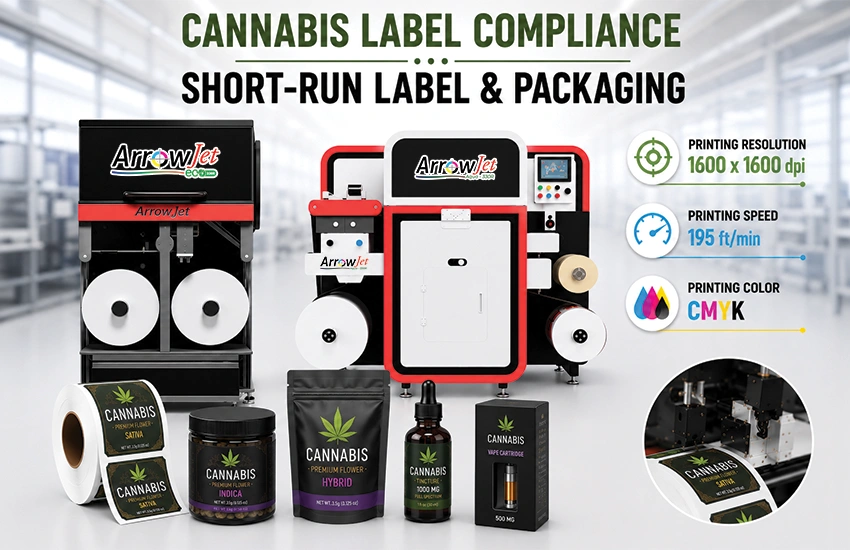
The ArrowJet Aqua 330R prints at up to 150 ft/min, with an optional NIR dryer upgrade extending that to 195 ft/min, at a resolution of up to 1600 × 1600 dpi. For cannabis operations running multiple batches per shift or managing dozens of active SKUs across a single state, this throughput supports compliant label production without external converter lead times.
Reduced converter dependency for routine production
Bringing core cannabis label production in-house reserves external converter relationships for specialized finishes, embellishment, or volume runs where they remain economically justified — rather than using them as the default path for every label SKU. For an operator managing 50 to 150 active SKUs across one or two states, this typically collapses the window between a compliance bulletin landing and a fully updated label reaching the production line. Arrow’s in-house cannabis label printing ROI guide walks through how to model that breakeven against your specific SKU mix and scrap rate.
Choosing the Right Press Tier: Eco 330R vs. Aqua 330R
Arrow Systems offers two aqueous inkjet label press tiers suited to different scales of cannabis label production — the entry-level Eco 330R for smaller producers and the Aqua 330R for regional operators managing higher SKU complexity.
Not every cannabis operator needs the same press configuration. The right match depends on active SKU count, batch frequency, substrate variety, and how much of the current label spend is tied to external converters. The two aqueous label press tiers suited to cannabis production differ primarily in throughput, footprint, and operational scale.
Consideration | ArrowJet Eco 330R | ArrowJet Aqua 330R |
Operator profile | Smaller or entry-level cannabis producers bringing label production in-house for the first time | Regional producers and operators managing higher SKU counts, faster batch cycles, or multiple product categories |
Print speed | Up to 20 m/min | Up to 150 ft/min (45.7 m/min); up to 195 ft/min with optional NIR dryer |
Max print width | 324 mm | 324 mm (12.75″) |
Resolution | 1600 × 1600 dpi | 1600 × 1600 dpi |
Power requirements | Single-phase 230V — no air compressor required | Three-phase 220V |
Variable data per label | Yes | Yes |
Substrate range | Self-adhesive label stocks, coated papers, BOPP, PET, PVC | Coated paper, BOPP, PET, PVC, Mylar, Tyvek, synthetic and laminate stocks |
Best fit for cannabis | Entry-level producers with lower batch frequency and simpler SKU mix; ideal starting point for in-house label production | Regional producers, operators with faster batch cycles, or those managing 50+ active SKUs across one or two states |
Both press tiers support full variable data printing, short-run on-demand production, and the substrate range required across cannabis packaging formats. The decision between them is primarily a throughput and operational scale question — not a compliance capability question. Either press eliminates the pre-printed label inventory exposure that defines the core cannabis compliance risk. For additional selection criteria including volume thresholds and substrate compatibility, see Arrow’s guide to choosing cannabis label printers.
Both presses are also compatible with Arrow’s label finishing systems — the EZCut 330R+, EZCut 350R, and ArrowCut Nova 330R — for lamination, die-cutting, and label shape finishing downstream of the print pass. See Arrow’s full range of label finishing systems for configuration options.
Product specifications are subject to change. Verify current specifications against Arrow Systems’ published product documentation before making a purchase decision. Arrow Systems sells label printing hardware and does not provide regulatory, compliance, or legal advisory services.
Frequently Asked Questions — Cannabis Label Compliance and In-House Printing
Common questions from cannabis operations, compliance, and packaging teams evaluating state labeling requirements and in-house digital label production for 2026.
No. There is no single national cannabis warning symbol. Symbol artwork, color, minimum size, and placement requirements differ by state — and several states have revised their symbols since their programs launched. Operators selling into multiple states need a per-jurisdiction, version-controlled artwork library and must confirm current requirements against each state’s published rules before every production run.
Frequently enough that operators should treat label requirements as a moving target, not a fixed reference. Many states revise warning language, potency disclosure formatting, or symbol artwork on annual or semi-annual cycles. Emergency rule changes can take effect with limited notice. The operational goal is a label production workflow that can absorb these updates without scrapping pre-printed label inventory — which is the core advantage in-house digital printing provides.
Yes — that is where variable data printing delivers its clearest advantage in cannabis operations. When the press receives potency values, lab IDs, batch and package dates, and COA references directly from production or LIMS data, every label reflects the actual test results for that specific lot. This removes manual entry, eliminates secondary stickering, and produces a cleaner, more traceable consumer-facing label.
For most small and mid-size producers, the financial case goes beyond per-label material cost — it is the cost of obsolescence. When a meaningful share of pre-printed label inventory is scrapped due to regulatory updates, formulation changes, or batch-data shifts, the breakeven for in-house printing moves significantly earlier than per-unit pricing alone suggests. Operators should model their own scrap rate and SKU change frequency, not benchmark against generic per-label cost comparisons. Arrow’s detailed analysis of real cost savings in short-run digital printing provides a structured methodology for building that model.
The combination of fixed inventory and shifting requirements. When a state updates its universal symbol, warning language, or potency disclosure format, every pre-printed label in stock for that state becomes a compliance liability. Operators must either absorb the scrap cost or — riskier — continue applying outdated labels and expose themselves to fines, product holds, or license action. In-house digital printing changes this calculus: a rule update becomes a file revision, not an inventory write-off.
Evaluate In-House Cannabis Label Printing with Arrow Systems
If your operation is managing fragmented state rules, frequent regulatory updates, or growing scrap exposure from pre-printed label inventory, an in-house digital label press is worth a structured evaluation.
Arrow Systems works with licensed cannabis producers, regional brands, and co-packers to assess current label workflows across four dimensions: state coverage, SKU complexity, batch-level data variability, and the total cost of label obsolescence. The conversation is about fit — not a product pitch.
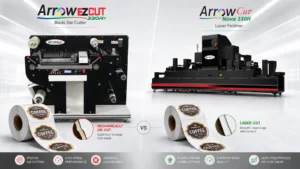
Blade vs. Laser Label Die Cutting: Accuracy, Speed, and Cost per Label
Table of Contents Blade vs. Laser Label Die Cutting: Accuracy, Speed, and Cost per Label Blade die-cutting suits simple shapes and long runs; CO2 laser
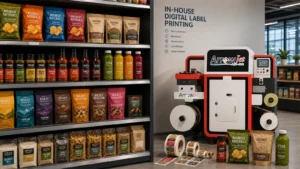
Custom Food Packaging: Key Questions Answered for Food Brands
Table of Contents Custom Food Packaging: Key Questions Answered for Food Brands Custom food packaging shapes how shoppers recognize, evaluate, and choose a product —
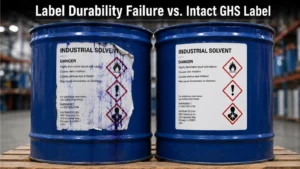
GHS Label Durability Failure: 4 Causes and Practical Fixes
Table of Contents GHS Label Durability Failure: 4 Causes and Practical Fixes GHS label durability failures trace to four causes: aqueous ink chemistry, paper face

White Ink Clear Label Printing: When You Need It and Why
Table of Contents White Ink Clear Label Printing: When You Need It and Why White ink under clear film keeps brand color, mandatory copy, and
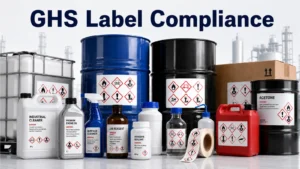
GHS Label Compliance: A Practical Guide for Chemical Label Printing
Table of Contents GHS Label Compliance: A Practical Guide for Chemical Label Printing GHS label compliance is a safety-critical requirement for any business that manufactures,
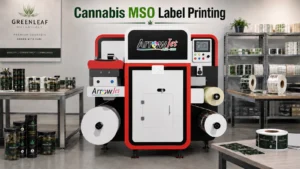
Cannabis MSO Label Printing: In-House or Outsource?
Table of Contents Cannabis MSO Label Printing: In-House or Outsource? Cannabis MSO label printing moves in-house when label versions outgrow converter minimums or batch data