
Personalized Label Printing

Table of Contents

Personalized Label Printing: How Custom Labels Influence Recycling and Reuse

Personalized labels increase consumer attention to packaging — attention that, when paired with clear end-of-life guidance, can improve recycling and reuse behavior.

Key Takeaways

  • Personalized labels command more attention than generic packaging because they feel directly relevant to the individual consumer — a well-documented effect in consumer behavior research.
  • Increased attention to a label raises the probability that consumers notice recycling instructions, material identifiers, and reuse suggestions they would otherwise overlook.
  • Personalization does not guarantee recycling or reuse behavior on its own; it creates the attentional conditions that make responsible end-of-life choices more likely.
  • Short-run label printing with digital inkjet technology is the production method that makes personalized label campaigns viable — it eliminates plate costs and minimum order quantities that make variable-run label production impractical on conventional presses.
  • The ArrowJet Aqua 330R Lite and ArrowJet Eco 330R both support variable data printing and short-run customized label jobs for brands bringing personalized label production in-house.

Why Personalized Labels Command Consumer Attention

A label that speaks to a specific person, occasion, or audience triggers a level of attention that generic packaging rarely achieves — and that attention is the starting point for every downstream behavior that follows.

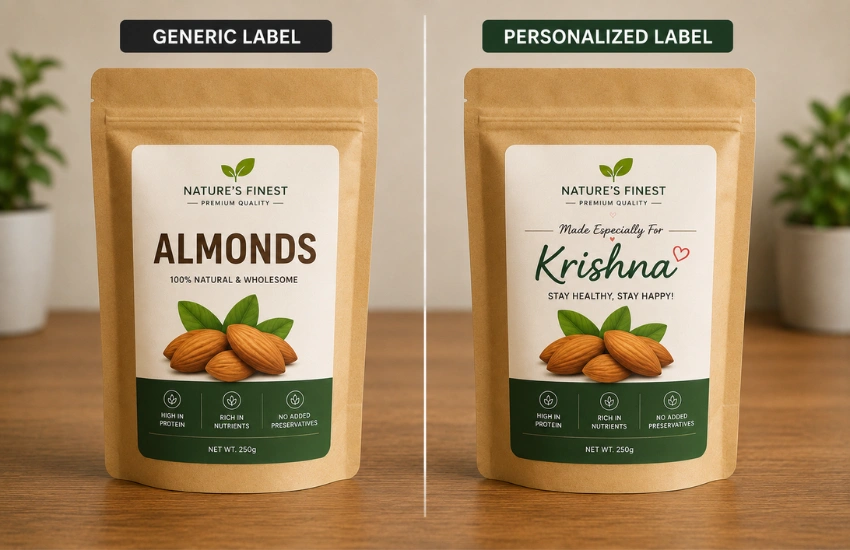
When a consumer sees their own name, the name of someone they know, or a message that references something personally relevant to them, the packaging stops functioning as background noise and becomes something to study. This is not a subtle effect. It has been observed consistently across product categories — from personalized beverage bottles to custom confectionery packaging — where consumers who identified with the label spent significantly more time reading it than those who received identical products with a non-personalized version.

That extra time with the label matters operationally. A consumer who looks at a label for three seconds processes fundamentally different information than one who glances for half a second. The three-second reader is more likely to register the product’s country of origin, ingredient list, storage instructions, and — critically — any recycling or disposal guidance the brand has placed on the label.

This is the core mechanism behind the argument that personalized labels can support better recycling and reuse behavior. The personalization itself does not produce the sustainable outcome. The attention it generates creates the conditions in which the consumer is more likely to notice and act on the information the brand provides.

Emotional Connection and Perceived Packaging Value

Personalization changes how consumers assign value to packaging — and perceived value is one of the strongest predictors of whether packaging gets kept, repurposed, or discarded.

Generic packaging carries an implicit signal: this product was made for the mass market. Personalized packaging carries a different signal: this was made for you, or for this moment, or for this specific person. That shift in framing has measurable consequences for how consumers treat the physical object after use.

Packaging that feels special — a bottle bearing a friend’s name, a seasonal edition label tied to a personal milestone — is more likely to be saved, displayed, gifted, or refilled. This is reuse behavior driven by emotional attachment rather than deliberate sustainability intent, but the end result is the same: the packaging cycle is extended, and fewer units go directly from first use to waste stream.

The effect is not guaranteed. A personalized label on packaging that is structurally inconvenient to reuse — sealed, contaminated, or made from a material that cannot be cleaned — will not overcome those physical constraints. But for formats where reuse is structurally possible, personalization can provide the emotional push that makes the consumer pause before discarding.

Side-by-side comparison

Personalization and Recycling Behavior

Personalized labels and recycling outcomes are connected through attention, not material properties — but they can improve the odds that a consumer reads and acts on the recycling guidance the brand provides.

When thinking about personalized labels recycling behavior, it helps to separate what labeling can and cannot influence. Recycling outcomes depend on a set of conditions that labeling alone cannot control: whether the packaging material is accepted in the consumer’s local recycling stream, whether the packaging is clean and uncontaminated at disposal, whether the consumer knows which bin to use. These factors sit outside what any label can address.

What a label can influence is whether the consumer reads the guidance at all. Most consumers do not read standard packaging labels in detail. The information is present, but the attention is not. Personalization changes that by making the label worth looking at — and a consumer who is already reading the label is far more likely to register the recycling symbol, the material identifier, or the specific disposal instruction than one who is not.

Behavior Factor

Generic Label

Personalized Label

Time spent reading label

Low — label read as background product information

Higher — personalized element draws deliberate attention

Probability of noticing recycling guidance

Lower — consumer unlikely to read full label text

Higher — consumer already engaged with label content

Perceived packaging value

Standard — packaging is a functional container

Elevated — packaging associated with a personal occasion or identity

Likelihood of reuse

Low for most formats without structural reuse affordance

Higher where format allows — emotional attachment supports keeping

Brand association with sustainability

Neutral — depends entirely on explicit sustainability claims

Stronger signal if personalization is paired with clear recycling guidance

For brands, the practical implication is that personalization is not a substitute for responsible label design — it is a multiplier for it. A personalized label that buries recycling instructions in six-point type has not improved on a generic label. A personalized label that uses the heightened attention to make disposal guidance prominent, clear, and actionable has made the most of what personalization delivers.

How Personalized Labels Encourage Reuse

Reuse behavior starts with perceived value — and personalization raises perceived value by transforming generic packaging into something that feels specific, limited, or meaningful.

A container that carries the name of a recipient, or that was produced as part of a limited regional campaign, or that references a personal occasion, occupies a different mental category than standard product packaging. It is less likely to be considered disposable on first encounter. That friction — the brief moment of hesitation before discarding — is where reuse decisions get made.

Brands that have used personalized label campaigns report secondary behaviors that extend packaging life: consumers who refill the container because the label still feels relevant, who give the product as a gift because the label makes it feel intentional, or who keep the packaging on display because the personalization makes it function as a memento rather than a container.

None of these outcomes is guaranteed by personalization alone. The underlying packaging must be physically suited to reuse — durable construction, a format that can be cleaned, and material compatibility with typical reuse applications. Personalization provides the emotional motivation; the product and packaging design must make reuse physically viable.

What to Keep in Mind When Designing Personalized Labels

Personalized labels work best when the heightened attention they generate is used to communicate clearly — including communicating clearly about end-of-life handling.

Keep personalization relevant, not decorative

Personalization that connects to the consumer’s identity, occasion, or community creates genuine attention. Personalization that adds a name without any connection to the product or the purchase context is less effective and can read as a gimmick. The signal value comes from specificity.

Place recycling guidance where attention lands

If a personalized element draws the consumer’s eye to a specific zone of the label — a name across the front panel, a personalized message along the neck — that zone is where recycling guidance is most likely to be seen. Placing disposal instructions in small print on the back panel negates the attention advantage that personalization creates.

Avoid environmental claims the packaging cannot support

Personalization is not, by itself, a sustainability claim. A personalized label on packaging made from non-recyclable mixed materials does not make that packaging more recyclable. Brands should not make environmental claims — explicit or implied — that are not substantiated by the actual material composition and end-of-life options for the specific packaging format.

Test before scaling

Personalized label campaigns benefit from small-batch testing before full rollout. A run of 200 to 500 personalized labels for a pilot audience costs very little on a digital inkjet press and generates real consumer data about engagement, reuse behavior, and messaging clarity before the brand commits to a larger campaign.

How Short-Run Digital Printing Makes Label Personalization Practical

Personalized label printing requires the ability to vary label content across a production run — a capability that digital inkjet presses support natively, without the plate changes or minimum order quantities that make personalization impractical on conventional presses.

Conventional label printing — flexographic or offset — produces labels from a fixed plate. Every label in a run is identical. To produce a version with a different name, message, or graphic, the press must stop, change the plate, and start again. At short run lengths, the cost of that setup outweighs the cost of the labels themselves. This makes large-scale personalized label campaigns commercially unviable on conventional equipment.

Digital inkjet printing works differently. Each label is produced from a digital file. Changing a name, a message, a regional market code, or a seasonal graphic requires a file update, not a physical plate change. A run of 5,000 labels can include 5,000 different names, or 50 different regional variants at 100 copies each, or any combination of content variations the brand needs — all produced in a single pass at the same per-label cost.

This is what makes personalized label campaigns accessible to brands that cannot commit to the minimum order quantities that conventional personalized printing requires. Short-run digital production matches the production run to the campaign size, not the other way around.

ArrowJet Aqua 330R for Short-Run Personalized Label Production

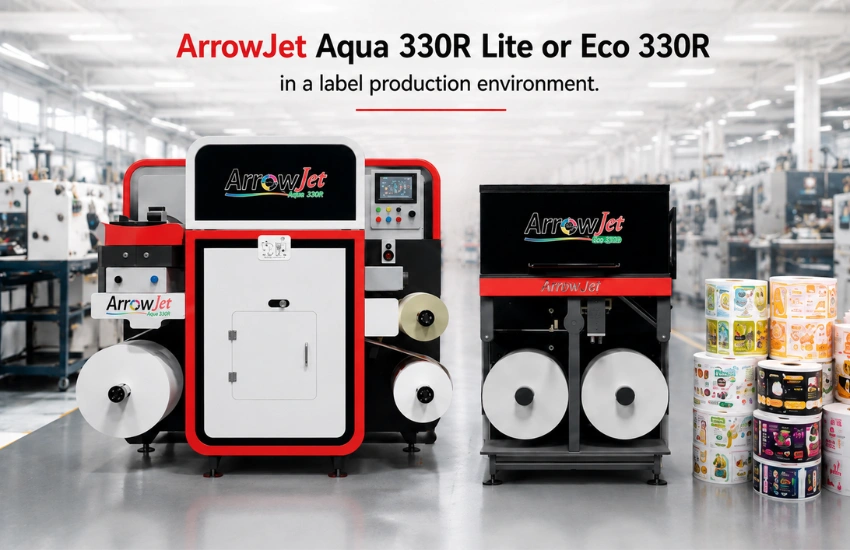
The ArrowJet Aqua 330R is a high-speed aqueous pigment inkjet label press designed for roll-to-roll label production at short to medium run lengths. It uses Memjet DuraFlex technology to produce labels at up to 1600 × 1600 dpi resolution and supports variable data printing — the core production requirement for personalized label campaigns.

Variable content production

Each label can carry unique content — names, messages, batch codes, or campaign-specific graphics — without stopping the press or changing tooling. This is the production architecture that makes personalized label runs economically viable.

No plate cost, no minimum order

Because the press produces from a digital file rather than a physical plate, there are no setup charges per label variant. Brands can produce a run of 300 personalized labels for a pilot event, then scale to 10,000 for a full campaign, without changing the unit economics at the short-run end.

Water-based pigment inks

The Aqua 330R Lite uses aqueous pigment inks — a water-based ink system that does not require solvent handling and is well suited to production environments where workplace safety compliance is a priority.

ArrowJet Eco 330R for Brands Entering In-House Personalized Label Production

The ArrowJet Eco 330R is a compact industrial single-pass digital press designed for brands that are moving label production in-house for the first time. Its brochure explicitly lists variable data printing and short-run customized jobs among its confirmed applications — the two production requirements at the core of any personalized label program.

Compact footprint, industrial performance

The Eco 330R runs on single-phase power and requires no air compressor, which significantly simplifies installation in a production environment that was not previously set up for label printing. The press can be operational faster and with lower infrastructure cost than larger-format press installations.

1600 × 1600 dpi resolution

At full resolution, the Eco 330R produces sharp text, fine detail, and clean gradients — the output quality requirements for personalized labels that are being used in gift, collectible, or limited-edition contexts where print quality is part of the perceived value.

Entry point for in-house label printing

For a brand currently outsourcing label production to a converter and paying lead times and minimum order quantities that make short-run personalized campaigns impractical, the Eco 330R represents the hardware entry point for bringing that capability in-house.

For limited-edition or gift-market personalized labels requiring spot varnish, white ink, or matte/gloss tactile effects, the ArrowJet UV 330H adds premium output capability within the same short-run, on-demand workflow.

Both presses are available to browse and compare on Arrow Systems’ digital label printers page, where specs, print widths, and configuration options are listed in full.

ArrowJet Aqua 330R Lite or Eco 330R

Frequently Asked Questions

Not automatically. Personalized labels can increase the attention a consumer pays to a product, which may improve the chance they notice recycling directions or reuse guidance on the label. Actual recycling outcomes depend on material type, local recycling infrastructure, contamination rules, and whether the brand includes clear end-of-life instructions. Personalization raises attention; it does not replace good label design or clear disposal guidance.

Variable data printing (VDP) is a digital printing method that changes specified elements — names, images, barcodes, batch codes, or messages — from one label to the next within the same production run, without stopping the press or changing plates. It is the production technique that makes large-scale personalized label campaigns practical. Short-run digital inkjet presses support VDP natively because every label is produced from a digital file rather than a fixed plate.

With digital inkjet printing, there is no enforced minimum. Brands can produce as few as 50 personalized labels for a test or pilot campaign and scale upward without paying plate setup fees. The per-label cost decreases as run length increases, but the absence of a minimum order quantity is what makes short-run personalized campaigns commercially viable — especially for regional campaigns, seasonal editions, or audience-specific SKU variants.

If a personalized label draws the consumer’s attention, that attention is an opportunity. The label design should use the heightened engagement to make recycling or reuse guidance visible, specific, and easy to act on. This means placing disposal instructions where the eye naturally lands — not buried in small print — and using language that matches the conversational, personal tone the rest of the label has already established.

The ArrowJet Aqua 330R Lite is a high-speed roll-to-roll aqueous inkjet press suited to personalized label production at short to medium run lengths, with no plate charges and support for variable data printing. The ArrowJet Eco 330R is a compact industrial inkjet press positioned for brands entering in-house label production, also supporting variable data printing and customized short-run jobs. Both are listed on the Arrow Systems digital label printers page.

Bring Personalized Label Production In-House

Arrow Systems manufactures digital inkjet label presses designed for short-run, variable data, and customized label production — the hardware foundation for any personalized label program.

Browse our digital label printers page, including the ArrowJet Aqua 330R Lite and ArrowJet Eco 330R.