Table of Contents

In-House Label Printing vs. Outsourcing: Costs, Control & When to Switch

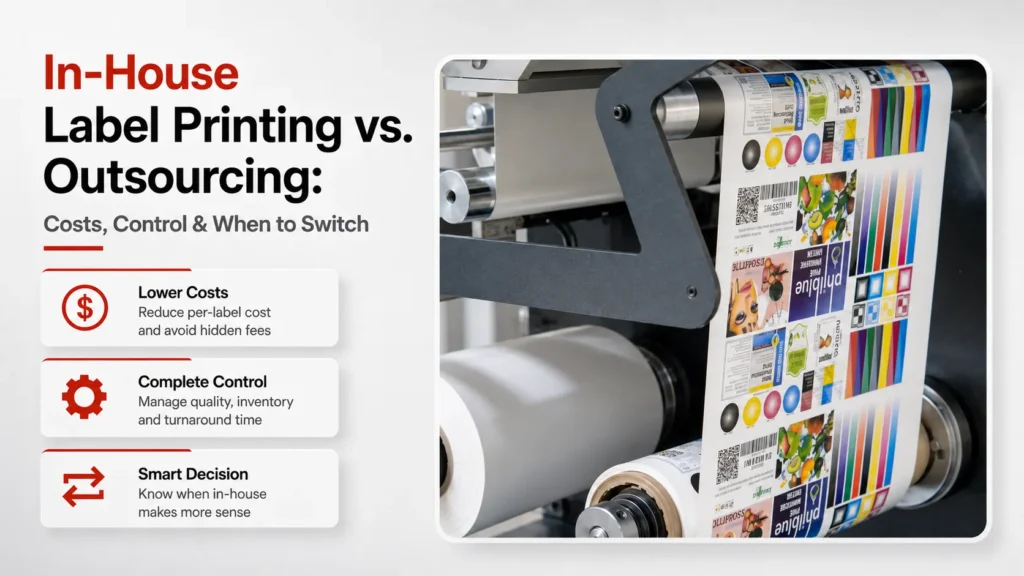
In-house label printing gives businesses faster turnaround, no minimum order quantities, and full version control — outsourcing works better for very large runs or specialty applications outside your current equipment range.

Key Takeaways

  • Outsourced label suppliers commonly require minimum order quantities, which leads to excess inventory that becomes obsolete when designs, ingredients, or regulations change.
  • External vendor lead times of eight to ten days can slow response to demand spikes, product updates, or packaging revisions.
  • In-house digital label printing removes minimum orders entirely — teams can produce exactly the quantity needed, when needed.
  • Sensitive label data — including formulations, batch codes, and proprietary product information — stays internal when printing is done in-house.
  • Outsourcing remains appropriate for very large production runs, specialty finishing, or applications outside the capability of current in-house equipment.
  • Arrow Systems manufactures digital label printing hardware under the ArrowJet brand for businesses bringing label production in-house.

Why Businesses Outsource Labels — and Where It Falls Short

Label outsourcing works well at high volumes with stable designs, but it creates cost and speed problems for businesses managing short runs, frequent revisions, or multiple SKUs.

Outsourced label production made sense when printing required expensive plates, long press setups, and large runs to recover fixed costs. Commercial label printers spread those costs across thousands of units, making bulk orders economical for buyers. That model still works — but only when demand is predictable and label designs are stable.

The problem for many businesses today is that neither condition holds. Product formulations change, regulatory language gets updated, seasonal promotions come and go, and retailers request packaging revisions on short notice. Every one of those events creates a problem when labels are pre-printed and sitting in inventory: the existing stock becomes unusable, and a new outside order restarts the wait. For a direct comparison of both approaches, see our guide on printing your own labels vs. professional label production.

Waste from Minimum Order Quantities

Supplier minimum order quantities often require purchasing thousands of labels when only hundreds are needed — generating inventory that becomes obsolete when product details, branding, or regulations change.

Most commercial label suppliers set minimums based on their production economics, not the buyer’s actual demand. For a business that needs 300 labels for a short-run product or a seasonal SKU, the requirement to purchase 2,000 or 5,000 creates two problems: unnecessary upfront spend and labels that may never be used.

Unused labels are not simply a sunk cost — for a breakdown of where those savings accumulate, see our analysis of the cost savings of in-house short-run digital printing. They consume warehouse space, require controlled storage conditions, and must be tracked, inventoried, and eventually disposed of when they go out of date. If a design error reaches the end of a print run, the entire batch is at risk — in-house digital production allows the team to catch and correct errors after the first few labels, before committing to a full quantity.

Minimum order quantity (MOQ)
The smallest quantity a supplier will produce in a single print run, set by the vendor’s production economics. MOQs for commercial label suppliers typically range from 1,000 to 10,000 units depending on substrate, label size, and complexity. In-house digital printing carries no MOQ — production quantity is set entirely by operational need.
Obsolete label inventory
Pre-printed labels that can no longer be applied to finished products because of a design change, regulatory update, formula revision, or expired promotional period. Obsolete label inventory is a direct cost of minimum-order purchasing; it is largely eliminated by on-demand in-house printing.
Label version control
The process of managing which artwork file and which printed label version corresponds to which product SKU and production run. In-house digital printing from controlled digital files simplifies version control by creating a direct link between the approved file and the printed output. Bulk pre-printed inventory introduces risk when multiple label versions exist in the same warehouse simultaneously.

Turnaround Speed and Response to Changing Demand

External label suppliers typically have lead times of eight to ten business days — a window in which demand, retailer requirements, or product specifications can change significantly.

Eight to ten business days is the standard lead time for a commercial label order. That covers file submission, pre-press checks, plate preparation where applicable, press scheduling, production, finishing, and shipping. The buyer has no control over any of those steps, and expedite fees to compress the timeline add cost without guaranteeing the outcome.

In-house digital label printing changes the equation. Once artwork is approved in digital format, production can begin immediately. Seasonal labels, limited-edition SKUs, demand spikes from a retailer, last-minute regulatory text updates, and variable data printing requirements can all be addressed the same day without contacting a supplier or paying a rush fee.

Industries where this matters most include food and beverage (where ingredient and allergen declarations require fast updates), nutraceuticals (where formula revisions are frequent), cosmetics (where promotional copy changes often), and any business running multiple SKUs with different label sets that vary by channel or region.

Control Over Sensitive Label Data

Outsourcing label production means sharing artwork files, formulation details, batch codes, and product specifications with an external supplier — in-house printing keeps that data entirely within the operation.

Label files often contain more than design graphics. Ingredient declarations, proprietary formulations, production batch codes, supplier names, and compliance certifications may all be embedded in label artwork or associated production files. When those files are submitted to an external printer, a third party gains access to information the business may prefer to keep internal.

Commercial label printers typically handle customer data professionally and may have confidentiality agreements in place. The point is not that outsourcing is inherently insecure — it is that in-house printing removes the need to share that information at all, which simplifies the data chain of custody and reduces the number of external parties who hold access to sensitive product documentation.

This consideration is particularly relevant for businesses with regulatory obligations around proprietary formulations, businesses operating under non-disclosure agreements with retail or manufacturing clients, and operations where batch traceability data must be tightly controlled.

In-House vs. Outsourced Label Printing: Side-by-Side Comparison

The two approaches differ fundamentally on turnaround speed, minimum quantities, version control, and data handling — with in-house printing offering advantages for short-run, revision-heavy, or multi-SKU operations.

Factor Outsourced Label Printing In-House Digital Label Printing
Turnaround time 8–10 business days (standard); rush available at additional cost Same-day from approved artwork — no supplier scheduling dependency
Minimum order quantity Typically 1,000–10,000+ units per run depending on supplier and substrate No minimum — produce exactly the quantity needed
Cost structure Per-label cost may be lower at very high volumes; plate or setup fees may apply; rush fees common Higher upfront equipment investment; lower per-label cost on repeat runs; no setup or rush fees
Design revision speed Full reorder required; 8–10 day lead time restarts Update artwork file and reprint immediately
Obsolete inventory risk High — pre-printed inventory becomes unusable after design changes Low — print on demand eliminates the need for label inventory
Data security Artwork and product data shared with external supplier All files remain internal; no external data transfer required
SKU flexibility Each SKU requires a separate order with its own lead time and potential MOQ Multiple SKUs can be printed in any sequence and quantity from the same press
Quality control Proofing and corrections add time; errors in bulk orders may not be caught until delivery Errors identified after the first labels can be corrected before the full quantity is produced
Best suited for Very large stable runs; specialty substrates; finishing outside in-house capability Short-to-medium runs; frequent revisions; multi-SKU operations; sensitive label content

When Outsourcing Still Makes Sense

Outsourcing remains the better option for very large, stable production runs, specialty finishing processes, or label requirements that exceed current in-house equipment capability.

In-house printing is not the right answer for every label job. Several scenarios still favor external production:

  • Very high-volume stable runs: When a single SKU requires hundreds of thousands of identical labels with no design changes anticipated, commercial printing at scale can deliver lower per-unit cost than in-house production.
  • Specialty finishing: Hot foil stamping, embossing, multi-layer lamination, or other finishing techniques that go beyond the capability of current in-house equipment require outside production.
  • Substrate requirements outside current press range: If a label application requires a material your in-house press does not support, outsourcing that specific job while keeping standard jobs in-house is a practical hybrid approach.
  • Overflow production: During periods when in-house capacity is fully committed, outsourcing overflow jobs prevents production delays without requiring additional capital investment.

For most operations, the optimal approach is a hybrid: bring short-run label printing, revision-heavy, sensitive, and time-critical jobs in-house, while reserving outsourced production for long stable runs or specialty applications the in-house press cannot handle.

Questions to Ask Before Bringing Label Printing In-House

Six operational questions help assess whether in-house label printing will reduce costs and improve workflow for a specific operation. For equipment-specific evaluation criteria, see our guide on questions to ask before investing in a label printer.

How often do label designs change?
If label revisions happen more than two or three times per year per SKU — due to formula changes, regulatory updates, seasonal promotions, or retailer requirements — the cost of reordering pre-printed labels accumulates quickly. Frequent revision cycles are a strong indicator that in-house production will pay back the equipment investment faster.
How much label inventory becomes obsolete each year?
Calculate the quantity of pre-printed labels discarded or quarantined because they could no longer be applied. If that number is measurable, it represents a direct cost that in-house on-demand printing eliminates.
What is the actual lead time impact on operations today?
Track how often 8–10 day supplier lead times have caused delays — in production scheduling, product launches, or responses to retailer demand. Assign a cost to those delays where possible. Lead time elimination is one of the clearest financial benefits of in-house printing.
How many SKUs does the operation manage?
Each SKU adds complexity to an outsourced label program — separate orders, separate inventory locations, separate reorder tracking. In-house digital printing handles multiple SKUs from the same press without separate minimum-order commitments for each one.
What label data is sensitive, and who currently has access to it?
List the external parties who currently receive label artwork or associated production files. If that list includes formulation details or proprietary product data, assess whether concentrating that access in-house is operationally preferable.
Which jobs should still be outsourced after the switch?
Identify label jobs that will always be better served externally — very large stable runs, specialty substrates, or applications requiring finishing the in-house press does not support. Plan to route those jobs externally while moving eligible jobs in-house.

ArrowJet Digital Label Printers for In-House Production

Arrow Systems manufactures the ArrowJet range of digital label presses — roll-fed inkjet systems designed for in-house label production across food, beverage, cosmetics, nutraceutical, and industrial applications.

Arrow Systems builds digital label printing hardware — not a service. ArrowJet presses are sold to businesses that want to own and operate their own label production capability. The equipment is designed around the demands of in-house label printing: roll-to-roll production, wide substrate compatibility, and print speeds suited to short-and-medium run volumes without the plate costs or minimum orders that define outsourced production. Read more about switching to in-house label printing with ArrowJet.

ArrowJet Aqua 330R — Production Label Printing for Established In-House Operations

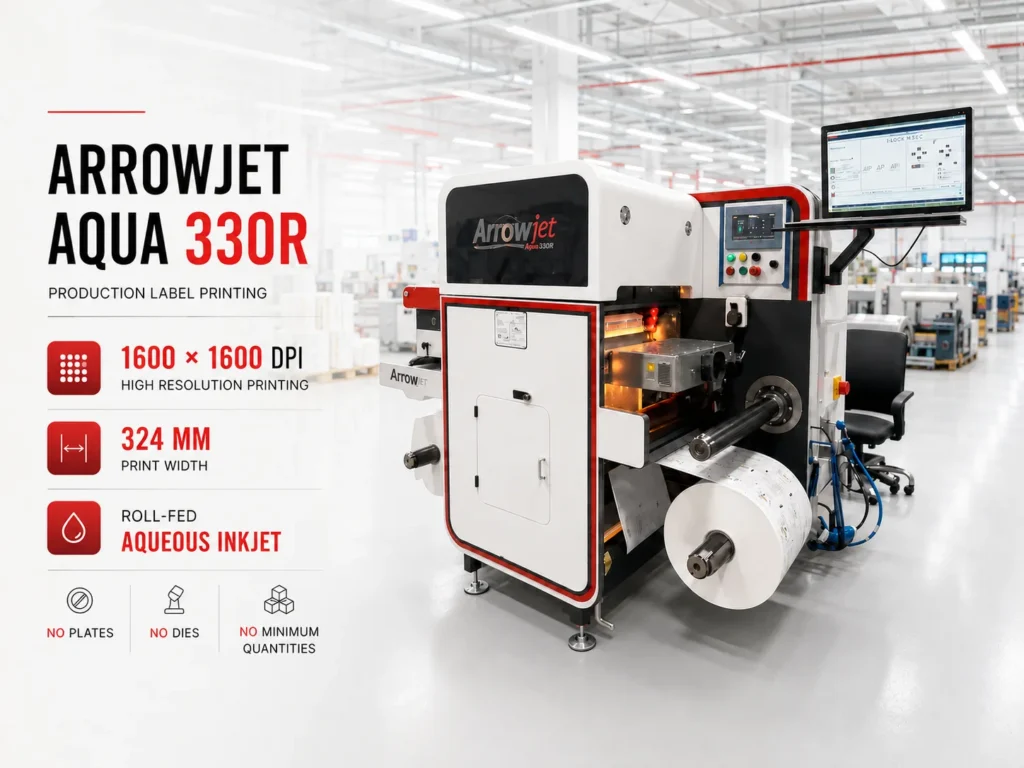
The ArrowJet Aqua 330R is a roll-fed aqueous inkjet label press built for production-volume in-house label printing. It prints on a wide range of pressure-sensitive substrates including coated paper, BOPP, PET, PVC, Mylar, and Tyvek — the materials used across food, beverage, cosmetics, nutraceutical, and industrial label applications.

The press prints at up to 1600 x 1600 dpi resolution at multiple speed modes across a 324 mm print width, making it suited for businesses that need both quality and throughput from a single in-house system. No plates, no dies, no minimum quantities — artwork changes take effect immediately on the next print job.

ArrowJet Eco 330R — Entry-Level In-House Label Production

The ArrowJet Eco 330R is designed for businesses entering in-house label production for the first time. It uses a single-pass digital inkjet engine powered by the Memjet DuraFlex® platform, printing at up to 20 meters per minute at 1600 x 1600 dpi on a 324 mm print width. Single-phase power and no air compressor requirement simplify installation and reduce infrastructure demands compared to production-tier presses.

For operations currently outsourcing all label production, the Eco 330R provides a practical starting point: a compact footprint, lower entry cost, and immediate elimination of supplier lead times and minimum order requirements on the jobs it handles.

ArrowJet UV 330H — In-House UV Label Printing for Specialty Applications

Businesses producing labels that require UV ink durability — including outdoor-rated labels, chemical-resistant industrial labels, or premium cosmetics and spirits labels with high-gloss or specialty varnish finishes — have different in-house requirements than standard aqueous label operations. The ArrowJet UV 330H is Arrow Systems’ UV inkjet label press, designed for operations where UV-cured ink performance is the specification — not an upgrade.

Bringing UV label capability in-house with the UV 330H eliminates the same outsourcing friction that applies to standard label jobs: supplier lead times, minimum order quantities, and the delay cost of waiting on revisions. For operations currently outsourcing UV labels specifically because they assume the capability requires a commercial supplier, the UV 330H makes that assumption worth revisiting.

Frequently Asked Questions — In-House Label Printing vs. Outsourcing

Not always. In-house printing requires an upfront equipment investment plus ongoing materials and maintenance costs. It typically becomes more cost-effective than outsourcing when it eliminates recurring setup fees, minimum order waste, obsolete label inventory, and rush charges for design revisions. For businesses managing frequent design changes or short-to-medium run volumes, the total cost of ownership often favors in-house production over time.
Yes. Modern digital inkjet label presses produce high-resolution output suited for demanding label applications including food, cosmetics, pharmaceuticals, and nutraceuticals. Print quality depends on the equipment, substrate, artwork preparation, and operator process. Presses such as the ArrowJet Aqua 330R print at up to 1600 x 1600 dpi on paper, BOPP, PET, PVC, and specialty film substrates — comparable to what many commercial label printers produce.

External label suppliers commonly have lead times of eight to ten business days for standard orders, and longer for custom die shapes, special substrates, or high volumes. Rush orders may be available at a premium but are subject to supplier capacity. In-house digital printing removes supplier lead time from the equation entirely — labels can be produced the same day artwork is approved.

There is no minimum order quantity for in-house digital label printing. A single roll or even a handful of labels can be produced as needed. This is one of the core advantages over outsourced production, where supplier minimums often require ordering thousands of labels regardless of the buyer’s actual demand.
Arrow Systems manufactures digital label printing hardware sold under the ArrowJet brand. The ArrowJet Aqua 330R is a high-speed aqueous inkjet roll label press suited for production-volume in-house label printing. The ArrowJet Eco 330R is a compact, entry-level option designed for businesses starting out with in-house label production. Both presses print on a wide range of pressure-sensitive label materials including paper, BOPP, PET, and film substrates. Product details are linked in the equipment section above.

Ready to evaluate in-house label printing for your operation?

Arrow Systems manufactures digital label presses designed for businesses that want to own their label production. View the ArrowJet Aqua 330R or ArrowJet Eco 330R above — or contact the Arrow team to request a sample and see the print quality for yourself.