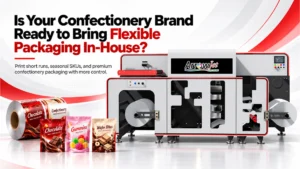
What Is Flexible Packaging? Formats, Materials, and Digital Printing
Learn how flexible packaging is used, how pouches and rollstock differ, which barrier and seal questions matter, and where digital printing fits.
Labels do more than identify a product. They carry branding, ingredients or usage details, regulatory information, barcodes, and the first visual impression a customer has on the shelf. That is why the decision between printing labels in-house and ordering professional labels deserves more than a simple cost comparison.
The original article notes that printing labels yourself can be profitable when a business has recently launched. It supports on-demand production, small product batches, and special edition testing without minimum order requirements.
DIY or in-house label printing can be a smart fit when you need to:
The source points out that in-house or home label printing can limit the available label sizes, shapes, and materials. It also notes that some traditional home-printed labels may not perform well when exposed to oils, temperature changes, or moisture.
Those limitations matter most when labels are used on food, cosmetics, refrigerated goods, wet environments, squeezable containers, or products that see abrasion during shipping and handling.
Professional label printing becomes more attractive as volume, material complexity, and durability requirements increase. The original article emphasizes that professional providers can offer broader material options and advice on materials, finishes, and design.
If your business is scaling, running out of labels often, or struggling with inconsistent quality, it may be time to compare professional production or a more capable in-house digital label workflow.
The source notes that some providers can deliver quickly while others may take weeks. That creates a planning tradeoff: outsourcing can provide professional materials and finishing, but it may require better forecasting. In-house production can offer speed and control, but only if the equipment, materials, and quality process are right for the job.
Do not evaluate an in-house or outsourced label program in isolation. Map order volume, SKU count, turnaround, material and adhesive needs, finishing, artwork control, operator time, maintenance, quality checks, and inventory. A constraint after printing can determine usable capacity just as easily as the print engine or cutter. Put the requirements in writing, separate must-haves from preferences, and ask vendors to identify assumptions behind every recommendation.
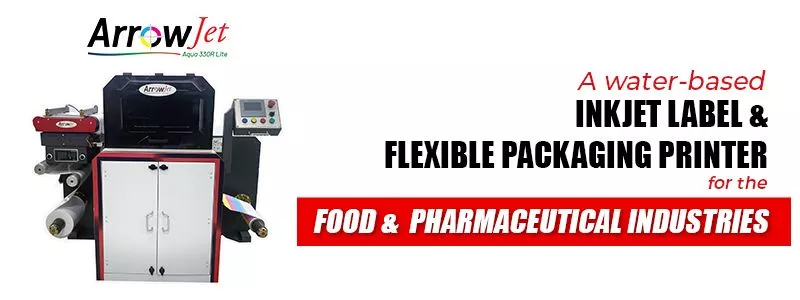
Use a simple job matrix rather than one average volume. Include the smallest and largest formats, normal and peak quantities, repeat work, rush work, seasonal changes, and the jobs that currently produce the most waste or delay. For related background, review Arrow’s guide to printing product labels and color label printing options.
| Decision area | What to document | Why it matters |
|---|---|---|
| Application | Format, material, dimensions, graphics, end use | Defines the physical and visual requirements |
| Demand | Run lengths, SKUs, peaks, reorder pattern | Reveals setup and capacity pressure |
| Workflow | Prepress, printing, converting, inspection, packing | Exposes handoffs and hidden labor |
| Support | Training, service response, parts, consumables | Shapes operating risk after installation |
Ask for a trial using a normal SKU and a difficult SKU with small type, heavy ink coverage, moisture or oil exposure, and the actual container; compare total labor, rejected labels, lead time, and consistency. Agree on test conditions before the demonstration and retain approved samples. A polished sample made on an unspecified stock is not enough. The trial should show how the process handles ordinary work, difficult work, and changeovers.
Record setup time, sellable output, waste, operator actions, defects, rework, consumables, and finishing performance. Check the sample after realistic handling rather than only when it leaves the machine. If barcodes, variable data, seals, adhesives, coatings, or regulated packaging are involved, validate those functions with the appropriate specialist.
In-house printing can improve control and response time, but it adds equipment, training, maintenance, materials, and quality responsibilities. Outsourcing adds lead time and minimums but may provide broader materials and finishing expertise.
Build a total-workflow estimate that includes equipment, tooling, software, materials, consumables, labor, training, maintenance, utilities, quality checks, waste, floor space, and outside services that remain necessary. Model a normal month and a peak month. Finally, document who owns artwork approval, material release, production sign-off, preventive maintenance, and escalation when a job fails. That operating plan is often more useful than a feature list.
Sometimes, especially for early-stage testing. For retail durability and consistency, professional materials and finishing may be needed.
When quality, volume, material limitations, or turnaround pressure begin to interfere with sales and fulfillment.
Yes, with the right equipment, materials, file preparation, and finishing workflow.
Use actual artwork and materials, include a demanding job and a changeover, define acceptance criteria in advance, and measure usable output rather than relying only on rated speed.
Give each supplier the same job matrix and request a written workflow, assumptions, exclusions, support plan, and sample results. Compare total process fit, not one headline specification.
Talk with Arrow Systems about your application, materials, production goals, and the equipment options that may fit.

Learn how flexible packaging is used, how pouches and rollstock differ, which barrier and seal questions matter, and where digital printing fits.

Compare laser and analog label finishing by tooling, changeovers, materials, run length, quality, workflow, and total cost before selecting equipment.

Table of Contents Arrow Systems to Exhibit at LOUPE Americas 2026 Chicago, IL — Arrow Systems Inc. will exhibit at LOUPE Americas 2026, taking place

Table of Contents Overlaminate vs. Varnish Labels: How to Choose Protection Film overlaminate protects against immersion, wash-down, and solvents; UV and aqueous varnish suit retail

Table of Contents Digital Label Printers for Stickers and Labels: How to Choose the Right Press The right printer for stickers and labels depends on

Table of Contents Blade vs. Laser Label Die Cutting: Accuracy, Speed, and Cost per Label Blade die-cutting suits simple shapes and long runs; CO2 laser