The Best Color Label Printers for 2021
With 2020 coming to a close, we wanted to take some time and update our list from earlier this year. While a number of these printers are the same as last years, we have seen a change in the trend of the industry in 2020, with more customers wanting to bring their label printing in house.
With that in mind, we have included a mix of both in-house label printers, as well as more industrial label printers for 2021. We hope you enjoy our list, and invite you to let us know any suggestions you might have!
5. Epson Colorworks C7500
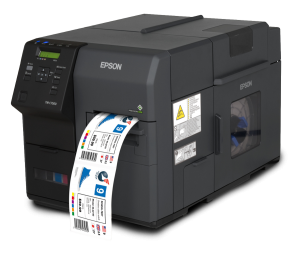
We will group all of the Epson C7500 models together here for the sake of brevity. There are 3 different models of Epson C7500, each with their own unique capabilities. We covered this in a previous post which you can find HERE.
The Epson C7500 allows customers to digitally print their labels, either on pre-cut materials or continuous to be cut out after. Perfect for any type of consumer based labels, such as food labels, cannabis labels, e-juice labels, and much more! These printers are a great solution for customers who want to get started in printing their own labels with a low investment cost.
The compact design can be used with or without a rewinding station. Its rugged design makes it the perfect solution for demanding jobs in tough environments.
4. Epson Colorworks C6500
Coming in at number 6 is the Epson C7500’s little brother; the C6500. This printer was just released from Epson in 2020 and has been a huge success for the short run label printing market! There are 2 models for this label printer: Epson C6500A and Epson C6500P.
Epson C6500A
The C6500A model is equipped with an automatic guillotine cutter that cuts the roll materials after the job is finished printing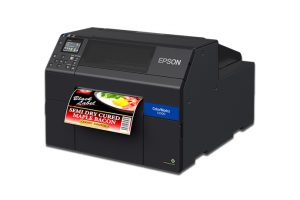 saving you time and material! It is the perfect solution for when you need a few labels or prints in a hurry and don’t want to have to web up a larger printing press.
Epson C6500P
The C6500P model from Epson is the same as the C6500A with the exception that it is designed for use on an automatic label applicator. The “P” in the name stands for peel-and-apply, meaning that after the label is printed the back liner is automatically peels and is ready to be applied to your package!
This allows customers to have digital printing capabilities inline with their existing label applicators. While there have been other ways to add printing inline in the past, the 6500P does not require a loose-loop for the web before being applied. It can be directly integrated into the system for a true print-and-apply solution!
3. Colordyne 1800-C
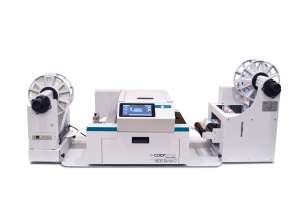
If you’re looking for absolute ease with primary and secondary labeling with integrated variable data and AIDC applications then this printer is the one for you. Eliminate pre-printed label inventory through this fast, high-quality, and completely scalable solutions for the utmost versatility and performance. Easy to set up and with the convenient touch screen display you can program your most frequently used function as well as monitoring printer status, ink level, and job status, to save you time.
The 1800-C was also on last years list, but as we discussed in our introduction inkjet printers has seen substantial growth. There is more interest in these table-top digital inkjet printers in more countries than ever before!
With explosive growth in Latin and South America, the 1800-C is poised to have another great year!
2. ArrowJet Nova 250R Inline Printer and Laser Finisher
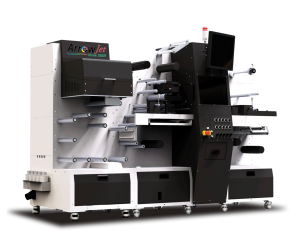
The ArrowJet Nova 250R is a newcomer to our list as it was released at the end of 2020. It is truly a shame that we did not have LabelEXPO or Drupa to introduce this press to the market.
The technology builds on that of the ArrowJet, with inline Memjet printing coupled with a laser die-cutter to laminate and cut out labels. Many customers want the ability to digitally print and cut in-line, and this is the perfect solution!
The biggest addition to the ArrowJet Nova 250R is the inline web guide, as well as slitter and dual rewinders. This allows customers to get the perfect sized roll with an inline print and cut solution.
In addition, the ArrowJet Nova 250R can be built with a variety of laser power systems, which allows customers to increase their throughput speeds, or keep their budget lower. This is by far the most cost effective way to get in to digital print and cut solutions.
1. Arrowjet Aqua 330R Industrial Label Printer
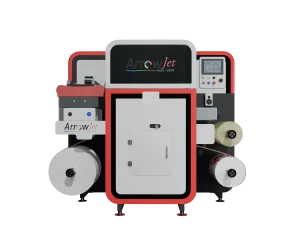 The ArrowJet Aqua 330R is the latest in digital printing technology. This machine boasts the ability to print high resolution labels, flexible packaging, and more at speeds up to 150’/min! Your designs will look better than ever when printed in 1600 x 1600dpi.
It utilizes an water based pigment ink which has a lower migration than the dye inkjet printers mentioned above. This will be the most industrial printer on the list. It is capable of producing millions of labels per month and can be paired with a wide variety of digital finishing equipment.
Complete with a built in edge and splicing station, setup has never been more efficient. Custom configuration will make sure that no matter what your company has in mind, this machine will be a perfect fit.
We hope this list was helpful in finding the right digital label printer for your company. If you have any questions on any of these printers, or would like to receive a free consultation on your label printing needs contact us today!
Our knowledgeable staff will be able to asses your requirements and provide a number of options to help you make the right choice for your business. We help with everything from printer selection, to material validation, through installation. Our goal here is not to just sell you a printer, but to develop a relationship to help your business succeed.