cbd-label-printing

Table of Contents

CBD Label Printing: State-Compliant In-House Guide

CBD label printing for hemp-derived products must satisfy federal FDA baselines and state-specific mandates — batch codes, COA links, and disclaimer text that changes when regulations shift.

Key Takeaways

  • CBD label compliance requires satisfying both federal FDA expectations and state-specific mandates that vary by market and update without a fixed schedule.
  • FTC scrutinizes efficacy and health claims on CBD products; avoid disease-treatment language and pair any structure/function claim with the standard disclaimer.
  • Variable data printing applies batch codes, COA links, and QR codes inline — eliminating the manual lot-sticker step and its associated traceability errors.
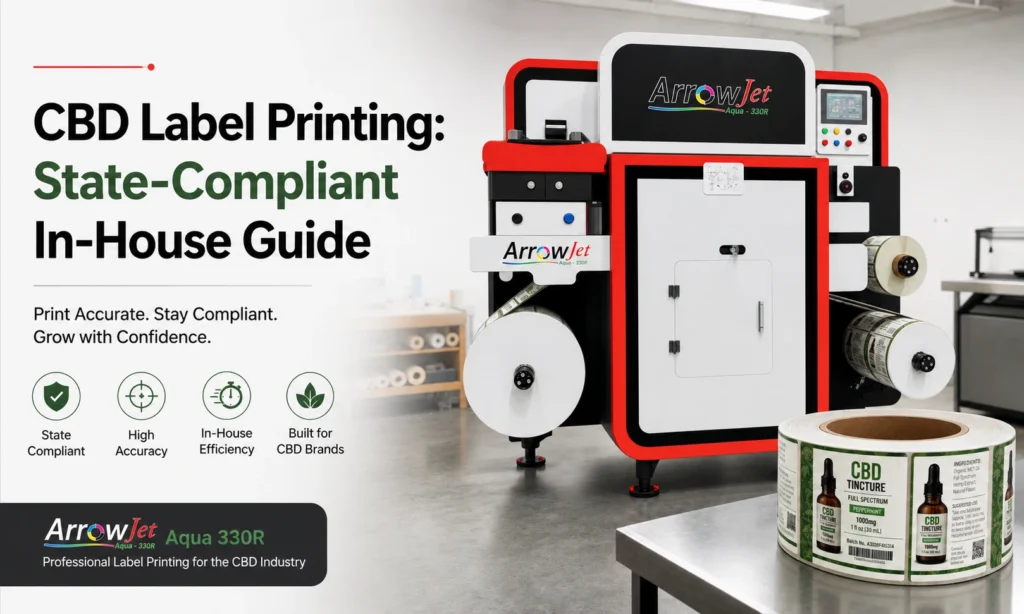
  • The ArrowJet Aqua 330R handles tincture, topical, and rigid-container label production; the ArrowJet Eco 330R is the entry-level option for smaller brands moving in-house for the first time.
  • Dedicated flexible-film formats — pouches, sachets — require a press engineered for film substrates; the ArrowJet Aqua 800M addresses that format category.
  • On-demand printing eliminates obsolete pre-printed inventory risk when disclaimer language or state rules change between production runs.

This guide is operational reference only — not legal advice. Federal and state CBD labeling requirements change frequently. Always confirm current FDA, FTC, and state rules with qualified regulatory counsel before finalizing label artwork or production workflows.

What Must Appear on Every CBD Label (FDA + State)

Hemp-derived CBD label requirements span two overlapping rule sets: federal FDA baselines and state-specific mandates that vary by market and update on no fixed schedule.

State rules differ significantly, so treat the fields below as a working baseline and verify against each state you ship into. For a detailed breakdown of required label language by jurisdiction, see our companion post on CBD label requirements.

Product identity
A clear statement of what the product is — for example, “Full-Spectrum CBD Tincture” or “Broad-Spectrum CBD Topical Balm.” This must appear prominently on the principal display panel.
Net quantity
The volume or weight of the contents, expressed in standard units. Tinctures typically declare in fluid ounces or milliliters; topicals and solids in weight.
CBD content
Total cannabinoid amount — most commonly expressed as mg per container and mg per serving. Many states require this to appear on the principal display panel, not buried in the supplement or drug facts area.
Suggested use or serving size
Required for ingestible products, and expected by most state programs. Must be consistent with the per-serving CBD content declared elsewhere on the label.
Full ingredient list
All ingredients in descending order of predominance, including carrier oils, flavoring agents, and any botanical additions. Allergen declarations follow where applicable.
Manufacturer or distributor name and address
The name and principal place of business of the domestic responsible party. Required under federal baseline labeling rules and expected by virtually all state programs.
Batch or lot code
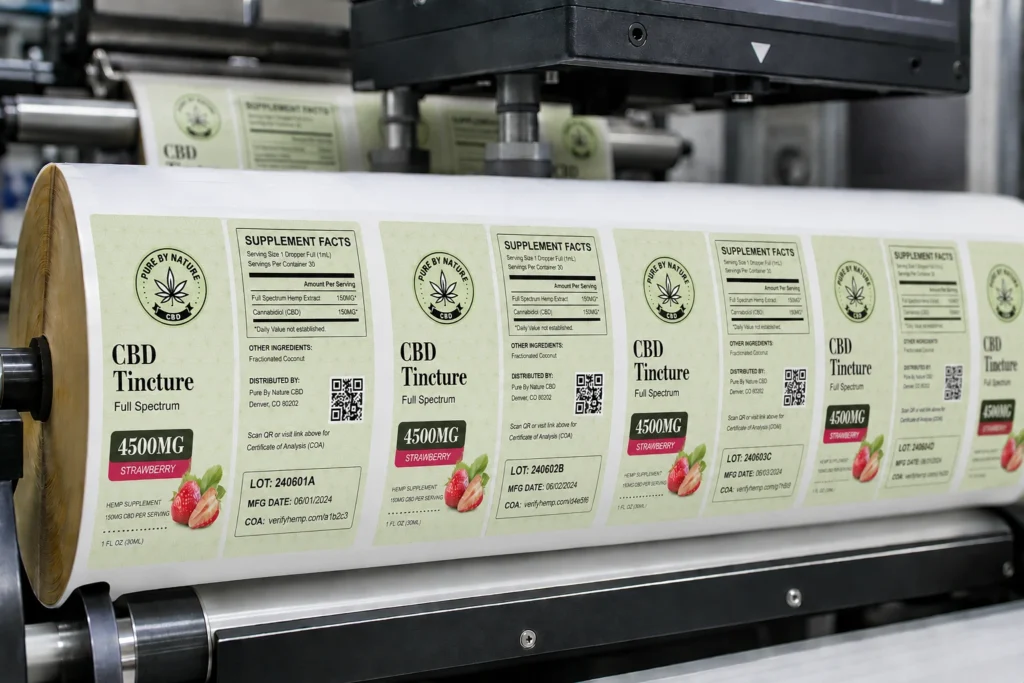
A unique identifier tying every unit to production records and the corresponding certificate of analysis (COA). Variable data printing applies this inline — eliminating the manual lot-sticker step that introduces traceability errors.
Hemp source statement
Many states require language confirming the product is derived from hemp and contains THC at or below the applicable legal threshold. Exact wording requirements vary by jurisdiction.
THC content statement
A declaration confirming THC compliance with applicable thresholds — typically ≤0.3% total THC for hemp-derived products. Some state markets require this to appear with specific formatting or font-size minimums.

State requirements frequently add their own mandates: specific warning statements, QR codes linking to batch lab results, child-resistant cannabis packaging requirements, or symbols for particular product categories. Because these rules update without notice, build artwork so individual fields can be revised and reprinted without rebuilding the full label layout.

FTC and FDA Disclaimer Requirements for CBD Products

Disclaimer language is where many CBD brands accumulate compliance risk — and where pre-printed inventory becomes a liability fastest when regulatory expectations shift.

The following reflects commonly applied industry practices as of this writing. Regulatory positions on CBD products evolve. Confirm current FTC and FDA guidance with your legal and regulatory team before finalizing label text.

Avoid disease or treatment claims
Statements implying a product diagnoses, cures, treats, or prevents disease are subject to enforcement attention from both the FDA and FTC. This applies to implied claims as well as explicit ones — language like “supports recovery” or “reduces inflammation” can draw scrutiny depending on context and product type.
Include the standard structure/function disclaimer where applicable
Where a structure/function claim is made, pair it with the standard disclaimer language: the product is not intended to diagnose, treat, cure, or prevent any disease, and the statement has not been evaluated by the FDA. This disclaimer must appear with each claim — it cannot be placed only in fine print at the bottom of the label.
Keep benefit claims substantiated
The FTC expects competent and reliable scientific evidence behind any benefit claim, including implied ones. The evidentiary standard applies regardless of whether the claim is on the label itself or in associated marketing materials.
Match disclaimers to product type
Tinctures, topicals, and edibles operate under different expectations and, increasingly, different state regulatory frameworks. A disclaimer appropriate for a topical balm may not satisfy requirements for an ingestible tincture in the same market.

Because disclaimer language is exactly what regulators revise expectations around, in-house printing lets you update the next run rather than scrapping pallets of pre-printed inventory. The ability to revise a single variable field — disclaimer text, THC statement, state-specific warning — without rebuilding or reordering an entire label is the single strongest operational argument for on-demand digital printing. For teams weighing the economics, our guide on printing labels in-house over outsourcing covers the full cost comparison.

Variable Data Printing for CBD: Batch Codes, COA Links, and QR Codes

Variable data printing for CBD labels turns a static label into a traceable one — each unit carries its own batch-specific information printed inline, without a separate lot-sticker step.

CBD batch code printing
Every batch code CBD label production runs generate must tie back to a specific production record and certificate of analysis. Applied inline during the print run, the batch code eliminates the need for a manual lot-sticker step — a common source of pairing errors and rework.
A URL or short link pointing to the certificate of analysis for that specific batch. When the print job pulls this data from your production system, the correct COA link is generated automatically for each run — not applied from a manual lookup.
QR code on CBD label
A COA QR code label implementation means each unit carries a scannable code that resolves directly to the certificate of analysis for that specific batch — not a generic brand page or outdated lab result. For CBD products operating under state traceability mandates, this is the most defensible implementation.
Date codes
Manufacture date, best-by date, or expiration — as required by product type and applicable state or retailer mandates. Applied as a variable field so each run carries the correct date automatically.

The variable data printing CBD brands rely on for compliance traceability works best when batch codes, COA links, and QR codes are all connected to your production system and applied inline during the print run. When that connection is in place, a customer scanning a QR code on a tincture box lands on the COA for the exact batch they received — not a generic or outdated lab result.

ArrowJet Aqua 330R for Tincture and Topical Label Production

The ArrowJet Aqua 330R is the core in-house label press for CBD brands producing tincture bottles, topical jars, and rigid-container SKUs at production volume with full variable-data capability.

Tincture bottles and topical jars are the workhorse SKUs for most CBD operations. CBD topical label printing demands durable films and moisture-resistant adhesives; tinctures require oil-resistant facestock and crisp text for small-format compliance fields. For both formats, the ArrowJet Aqua 330R functions as the core CBD tincture label printer and topical label press — handling accurate color, dependable adhesion, and variable-data output in the same roll-to-roll production run. The following workflow applies to both format types.

  1. Finalize and version-lock your artwork. Confirm all mandatory fields, disclaimer language, and state-specific elements for the markets you ship to. Lock the approved version in your artwork management system so operators cannot run a previous file.
  2. Set up variable data fields. Map the batch code, COA link, and QR code to your production or batch records system. When the connection is active, each run prints the correct current information automatically.
  3. Select and load the right substrate. Choose facestock and adhesive matched to your container: oil-resistant films for tinctures, durable laminates for topicals exposed to handling and moisture. See our label adhesive selection guide for a full breakdown by application type. Load the roll and verify web alignment before printing.
  4. Run a first article and verify. Print a sample and check text legibility, color accuracy, barcode and QR scannability, and correct batch/COA data. Scan the QR code to confirm it resolves to the right COA before committing the full run.
  5. Print on demand for the run quantity. Produce exactly what the current production schedule requires. On-demand printing avoids minimum order quantities and prevents obsolete pre-printed inventory from accumulating when rules change.
  6. Move verified rolls to application. Because batch and COA data printed inline during the run, there is no separate lot-sticker application step to introduce pairing errors.

This sequence gives packaging leads a repeatable path from approved artwork to production-ready, state-compliant labels — without waiting on a converter for routine SKUs. Browse the full range of Arrow digital label presses to see where the Aqua 330R sits in the ArrowJet product line.

ArrowJet Eco 330R for Smaller CBD Brands Entering In-House Printing

The ArrowJet Eco 330R is designed for smaller CBD operations bringing label production in-house for the first time — compact footprint, single-phase power, no air compressor, and no minimum order quantities.

Entry point for growing CBD brands
For operations managing a developing SKU set at lower label volumes, the Eco 330R provides the core capability of on-demand digital label production — without the capital commitment or operational complexity of a high-throughput commercial press. It runs on single-phase 230V power and requires no air compressor, simplifying installation in production environments that were not originally designed for label printing equipment.
Rapid response to disclaimer and regulatory changes
Smaller CBD brands are often most exposed to the cost of pre-printed label obsolescence — they typically lack the volume to negotiate flexible revision terms with converters. The Eco 330R removes this exposure: updated disclaimer text, a revised THC statement, or a new state-specific warning is in production the same day the change is approved, not two to four weeks later.
Right-sized for a concentrated SKU portfolio
CBD brands entering in-house printing typically manage a manageable number of active SKUs — tinctures, a topical or two, and perhaps a few format variants. The Eco 330R produces the exact label quantities needed per run, matching output to actual production schedules rather than minimum order thresholds.
Supports variable data from day one
Batch code printing, COA QR links, and date codes are available as variable fields on the Eco 330R — so the traceability infrastructure that compliance programs require is in place from the first production run, regardless of volume.

For CBD operations managing under 20 active label SKUs or producing at lower weekly volumes, the Eco 330R is the practical starting point for in-house digital label production — delivering immediate control over revision cycles without over-investing in press capacity ahead of growth.

Choosing the Right Press for Your CBD Label Formats

Format mix and production volume are the two primary variables that determine which ArrowJet system fits a CBD operation’s label requirements. For a broader evaluation framework, see our guide to choosing a cannabis label printer.

ConsiderationArrowJet Aqua 330RArrowJet Eco 330R
Best-fit formatsTincture bottles, topical jars, rigid containersSame label formats at lower volume or smaller SKU count
Substrate focusPressure-sensitive label stock — BOPP, polyester, paperPressure-sensitive label stock; some flexible packaging substrates
Typical run profileEstablished core-line SKUs at production volumeSmaller brands entering in-house production; lower weekly volumes
Variable dataBatch codes, COA links, QR codes, date codes — inlineBatch codes, COA links, QR codes — inline
Installation requirementsProduction-floor installationSingle-phase power; no air compressor; compact footprint
Common use caseHigh-frequency tincture and topical label runsFirst in-house press for a growing CBD brand

Note on flexible pouch and sachet formats: Neither the Aqua 330R nor the Eco 330R is purpose-built for wide-web flexible packaging. CBD brands printing on flexible film substrates — stand-up pouches, sachets, sample packets — should evaluate the ArrowJet Aqua 800M, which is engineered for flexible packaging production. See the full flexible packaging printer range for an overview of that equipment category.

Building a Compliant In-House CBD Labeling Workflow

Equipment is only part of the solution — a repeatable workflow that connects artwork control, variable data, and first-article verification is what keeps compliance consistent across shifts and SKU changes.

Govern artwork and versions centrally
Maintain a single approved source file for each SKU and lock it so operators cannot run a previous version. In highly regulated categories like CBD, an operator accidentally printing from a superseded disclaimer file carries the same regulatory risk as not updating the label at all.
Connect print jobs to batch and COA data
Operations automation that links the press directly to your production records keeps batch codes and COA QR links accurate without manual data entry. Each run generates the correct lot code and the correct COA URL automatically — removing the human step where errors most commonly occur.
Verify a first article before every run
Print a sample from each new run setup and check: text legibility, disclaimer accuracy, barcode and QR scannability, and correct batch data. Scan the QR code yourself to confirm it resolves to the right COA before committing full production.
Print to the production schedule, not a forecast
On-demand runs sized to actual production schedules eliminate the obsolete inventory that accumulates when CBD disclaimer language or state requirements change after pre-printed stock has been ordered. No minimum order quantity means no stranded inventory.
Document the standard operating procedure
A written procedure for label production — covering file approval, substrate selection, variable data setup, first-article check, and run sign-off — maintains consistency across operator shifts and protects the operation when staffing changes.

Teams often see faster revision cycles and less label scrap when these controls are in place, though actual results depend on SKU mix, run frequency, and how frequently applicable rules change in the markets they serve. For a detailed look at cost savings and production metrics, see our in-house cannabis label printing ROI guide.

compliant-labelling-workflow

Frequently Asked Questions — CBD Label Printing

Common questions from CBD operations, packaging, and compliance leads on mandatory label fields, variable data, in-house printing economics, and equipment selection.

Requirements vary by state, but a working baseline includes product identity, net quantity, CBD content in mg per container and per serving, a full ingredient list, manufacturer name and address, a batch or lot code, a hemp source statement, and applicable FDA and state disclaimers. Many states add their own mandates — specific warning language, font-size minimums, or QR codes linking to lab results. Always confirm current FDA and state-specific requirements for every market you ship into.
Use variable data printing to generate a QR code linked to the certificate of analysis for that specific batch. When the print job pulls batch and COA data from your production system, each run’s QR code resolves to the correct lab result automatically — removing the risk of pairing the wrong COA with a production run. The ArrowJet Aqua 330R and Eco 330R both support variable QR code generation inline.

In-house printing lets you revise disclaimer text and state-specific fields quickly, print on demand to avoid minimum order quantities, and apply batch codes and COA QR links consistently run to run. When FDA expectations or state requirements change, you update the file and print the next run — rather than scrapping pre-printed inventory that carries outdated language or noncompliant disclaimers.

The ArrowJet Aqua 330R is suited for established CBD operations running frequent core-line production at higher volumes. The ArrowJet Eco 330R is a compact, single-phase press designed as a lower-investment entry point for smaller brands moving label production in-house for the first time. Both support on-demand printing and variable data. Brands needing dedicated flexible pouch or sachet printing should evaluate the ArrowJet Aqua 800M, which is engineered specifically for wide-web flexible packaging formats.
Pressure-sensitive labels for tincture bottles and topical jars suit roll-label presses like the ArrowJet Aqua 330R or the entry-level Eco 330R. Flexible-film formats — pouches, sachets, and sample packets — typically require a press engineered for film substrate handling. The ArrowJet Aqua 800M addresses the flexible packaging format category. Matching the press to the substrate and format is part of any label printing system evaluation.

Get a Label Printing Assessment for Your CBD Operation

If shifting state rules, slow outsourced revision cycles, or pre-printed inventory carrying outdated disclaimer language are slowing your launches, a structured evaluation can clarify your best path forward.

Arrow Systems works with CBD and hemp brands to match the right ArrowJet label press to their packaging formats, SKU count, production volume, and compliance workflow — including variable data setup for batch codes and COA QR links.

Request Your CBD Label Printing Assessment →