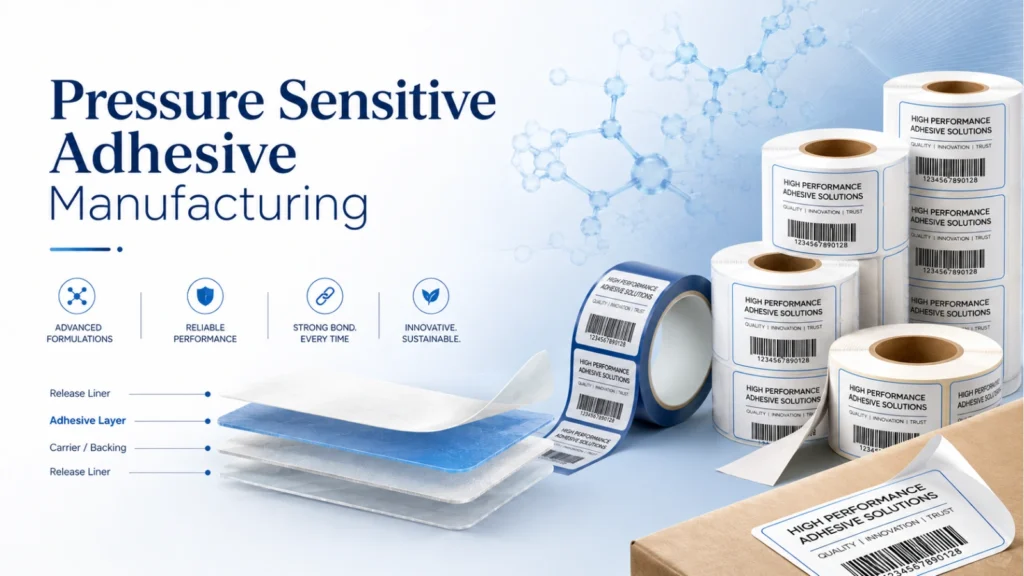

Pressure Sensitive Adhesive Manufacturing banner with premium label rolls, molecular graphics, and layered adhesive structure illustration.

Table of Contents

Pressure Sensitive Adhesive Manufacturing: Construction & Coating Methods

Key Takeaways

  • A PSA bonds under light pressure at room temperature — no heat, water, or solvent activation required.
  • Every PSA label has three core layers: facestock, adhesive, and liner. A primer layer is added in some constructions to improve adhesive anchorage on low-energy film or foil surfaces.
  • Direct coating applies adhesive to the facestock. Transfer coating applies it to the liner first — used when the facestock cannot tolerate direct coating conditions.
  • Pre-metered methods (gravure, slot die, extrusion slot die, reverse roll, curtain) control coat weight before substrate contact. Post-metered methods (knife over roll, Mayer rod) apply excess adhesive and remove the surplus.
  • Extrusion slot die has largely replaced reverse roll coating in high-volume production — lower cost, smaller footprint, broader applicability.
  • Mayer rod coating is the most economical option and is used primarily for lower-viscosity adhesives such as solution and emulsion PSAs.
  • Coating method choice affects coat weight uniformity, surface appearance, and in-service label performance — methods are not interchangeable across all adhesive and substrate combinations.

What Is a Pressure-Sensitive Adhesive?

A pressure-sensitive adhesive bonds to surfaces under light finger or hand pressure — no heat, water, or solvent activation required.

PSAs are found on an enormous range of products: packaging labels, price stickers, product identification tags, tapes, and many everyday materials. Their usefulness comes from a single defining property — the adhesive remains permanently tacky at room temperature and forms an immediate bond when pressed against a surface.

A pressure-sensitive adhesive, often shortened to PSA, combines stickiness with enough elasticity to remain useful across different surfaces and applications. The right construction depends on the surface the label will bond to, the environment the label will encounter, the facestock material selected, and the performance expected from the finished label. Because labels are used on so many products and in so many conditions, PSA manufacturing includes a wide range of adhesive chemistries, facestock combinations, and coating methods.

PSA Label Construction: The Three Layers

Every pressure-sensitive label is a layered construction: facestock on top, adhesive in the middle, and a removable liner on the back.

Understanding these layers matters because each one is a performance variable. The choice of facestock and finishing materials affects printability, conformability, and durability. Changing the adhesive type or liner material changes how the finished label applies, adheres, and performs in service.

Cross-section diagram of a pressure-sensitive adhesive label showing facestock, adhesive layer, and removable silicone-coated liner.

Facestock

The visible top layer of the label — the surface that carries the printed image or text. Facestock materials include paper (gloss, matte, semi-gloss), film (polypropylene, polyester, polyethylene), foil, and fabric. The facestock choice affects printability, conformability to curved surfaces, durability in service, and the range of adhesives that can be anchored to it.

Adhesive

The bonding layer positioned between the facestock and the liner. Adhesive selection is driven by the intended application surface, the required peel strength, the expected service environment — including temperature, moisture, and chemical exposure — and whether the label needs to be removable or permanent.

Liner

The backing layer — usually silicone-coated paper or film — that protects the adhesive surface during storage and handling. The liner is removed immediately before the label is applied to its final surface. Liner material and silicone release coating weight affect both the release force required and compatibility with high-speed label application equipment.

Primer (when used)

A thin treatment layer applied to the facestock surface before adhesive coating. Primers improve adhesion between the facestock and the adhesive layer, particularly on films or foils where low surface energy would otherwise limit adhesive anchorage. Not all constructions require a primer layer.

Direct Coating vs. Transfer Coating

Direct coating applies adhesive straight to the facestock; transfer coating applies it to the liner first, then laminates facestock to liner to complete the construction.

The two approaches serve different manufacturing situations. In direct coating, the adhesive is applied onto the facestock surface and then dried or cured in place. This is the more straightforward path when the facestock material is fully compatible with the coating process conditions.

Transfer coating is used when the facestock cannot tolerate direct exposure to adhesive solvents, high drying temperatures, or other process conditions. Adhesive is applied to the silicone-coated liner, dried or cured on the liner surface, and then laminated to the facestock under pressure. The adhesive transfers from the liner to the facestock during lamination — remaining bonded to the facestock when the liner is peeled away at end use.

The best method depends on the adhesive chemistry, the facestock material’s process tolerance, the required coat weight, and the overall performance specification of the finished label construction.

Pre-Metered Coating Methods

Pre-metered coating controls adhesive volume before it contacts the substrate — delivering a precise, consistent coat weight from the point of application.

The five main pre-metered methods used in PSA manufacturing are gravure roll coating, reverse roll coating, slot die coating, extrusion slot die coating, and curtain coating. Each suits different adhesive viscosities, required coat weights, and substrate types.

Gravure Roll Coating

An engraved applicator roll picks up adhesive and transfers it to the substrate. The cell depth and pattern on the roll determine the coat weight delivered. Gravure coating produces smooth, uniform adhesive layers with accurate coat weights at a wide range of line speeds, making it one of the most versatile pre-metered methods. It is used across a broad viscosity range and is well suited to both solvent-based and water-based adhesive systems.

Reverse Roll Coating

Uses a metering roll and an applicator roll running in counter-rotation. The two rolls work in tandem: the metering nip controls how much adhesive passes, and the applicator nip delivers it to the substrate while both rolls run in opposite directions. Highly polished, uniform coatings are achievable with this method. Magnetic tapes, coated papers, and pressure-sensitive tapes are among the products manufactured using reverse roll coating.

Slot Die Coating

Adhesive is pumped through a precision slot or narrow channel positioned close to the substrate surface and applied under controlled pressure. Slot die coating produces uniform coat weights across wide substrates and handles a variety of adhesive viscosities and solution types. It can be scaled to roll-to-roll coating systems and sheet-to-sheet deposition configurations.

Extrusion Slot Die Coating

Similar to slot die coating but fed directly from an extruder, which delivers polymer melt rather than a dissolved adhesive solution. This method has largely replaced reverse roll coating in high-volume operations because it is more economical, requires less floor space, and is scalable from small to large industrial production. It can handle fluids at both high and low viscosity and is widely used for hot melt and solvent-free adhesive systems.

Curtain Coating

A continuous free-falling sheet — or “curtain” — of adhesive falls from a slot die positioned above the moving substrate. The curtain lands across the full web width simultaneously. Curtain coating requires high-speed application and precise control of fluid temperature and viscosity to maintain a stable curtain from slot to substrate. It has been more prevalent in European manufacturing but is gaining acceptance in North American PSA production. The method is well suited for irregular surfaces and certain coat weight profiles.

Post-Metered Coating Methods

Post-metered coating applies adhesive in excess first, then removes the surplus to reach the target coat weight.

The two most common post-metered methods in PSA manufacturing are knife over roll coating and Mayer rod coating. Both are used where the required coat weight is higher, the substrate surface is less uniform, or the adhesive system is better suited to a flood-and-meter approach than to precision pre-metering.

Knife Over Roll Coating (KOR)

A large volume of adhesive is applied to the substrate using a backer roller, then a stationary blade or “knife” spreads and removes the excess to reach the desired coat thickness. Knife over roll coating is particularly useful when a heavy coat weight is needed or when the substrate surface is uneven — such as textiles, fibrous materials, fiberglass, or other irregular surfaces that pre-metered methods cannot coat consistently.

Mayer Rod Coating (Wire-Wound Rod)

A wire-wound rod — where the wire diameter determines the metering gap — removes excess adhesive after the substrate passes through a coating bath or flood applicator. Mayer rod is the most economical PSA coating method to implement and is typically used for lower-viscosity adhesive systems such as solution or emulsion PSAs. It is adaptable to a wide range of substrates. The characteristic ribbing sometimes visible on Mayer-coated adhesive surfaces results from the wire impression on the substrate during metering.

Coating Method Comparison

The table below shows how the main PSA coating methods compare on metering type, viscosity range, typical application, and primary advantage.

Coating Method

Metering Type

Adhesive Viscosity Range

Typical Application

Key Advantage

Gravure Roll

Pre-metered

Wide range

General PSA label stock, tapes

Accurate coat weight; high-speed capable

Reverse Roll

Pre-metered

Medium to high

Magnetic tape, coated paper, pressure-sensitive tape

Highly polished coatings; precise film build

Slot Die

Pre-metered

Wide range

General PSA, film substrates, roll-to-roll

Excellent uniformity across wide webs

Extrusion Slot Die

Pre-metered

High (polymer melt)

High-volume PSA, hot melt adhesive systems

Economical; scalable; compact footprint

Curtain Coating

Pre-metered

Low to medium

Wide-web PSA, irregular surfaces

Full-width simultaneous application

Knife Over Roll

Post-metered

Medium to high

Heavy coat weights, uneven substrates

Handles fibrous and irregular surfaces

Mayer Rod

Post-metered

Low (solution / emulsion)

Cost-sensitive operations, flexible substrates

Lowest equipment cost; adaptable substrate range

Why Coating Method Matters for Label Performance

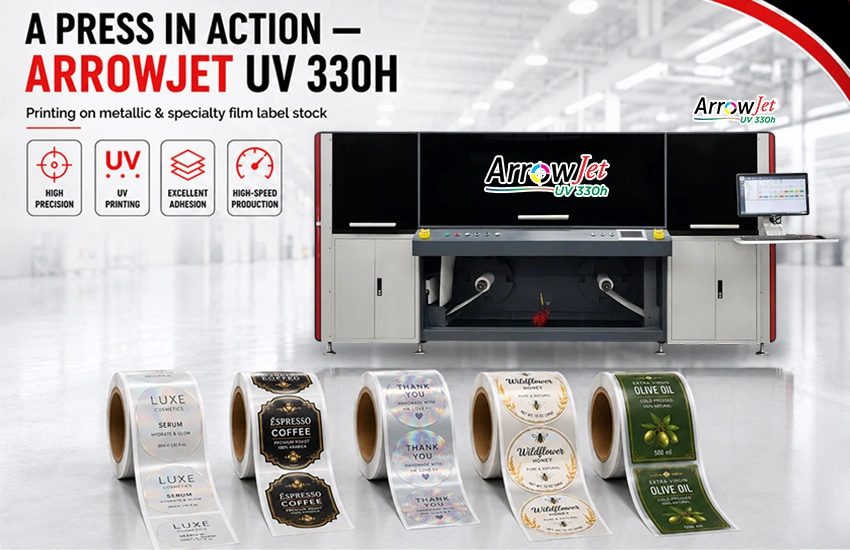
"ArrowJet UV 330H label press printing on specialty film PSA label stock.

Coating method directly determines adhesive uniformity, coat weight accuracy, surface appearance, and how the finished label performs throughout its service life.

Two labels made from identical facestock and adhesive can perform differently if the coating method produced different coat weights, introduced surface variation, or created adhesive voids. A higher coat weight generally increases initial tack and peel strength, but can reduce shear resistance. A non-uniform coat creates zones of strong and weak adhesion on the same label — producing uneven application, edge lift, or early failure in service.

Selecting a coating method is not only a manufacturing decision. It determines how the adhesive layer is built, which shapes label performance from application through end of life. For label printers and converters, understanding the upstream coating process provides useful context when specifying a PSA construction or troubleshooting adhesion performance on press. A label’s behaviour under the different label printing techniques used in production is influenced in part by how the adhesive layer beneath it was applied.

Frequently Asked Questions — PSA Manufacturing

A pressure-sensitive adhesive bonds to a surface when pressure is applied, without requiring a separate drying, curing, or activation step. It remains permanently tacky at room temperature and forms an immediate bond to most surfaces under light fingertip or hand pressure. This distinguishes PSAs from hot melt adhesives (which require heat to activate) and liquid adhesives (which require a drying period after application).

A pressure-sensitive label has three core layers: facestock (the visible surface, which may be paper, film, foil, or fabric), adhesive (the bonding layer selected for the intended surface and conditions), and liner (the silicone-coated backing removed before application). Some constructions also include a primer layer applied to the facestock to improve adhesive anchorage on low-energy film or foil surfaces.

In direct coating, adhesive is applied directly onto the facestock. In transfer coating, adhesive is applied to the liner first and transferred to the facestock during lamination. Transfer coating is used when the facestock cannot withstand the solvents, temperatures, or process conditions involved in direct application — for example, very thin films or heat-sensitive facestocks.

Pre-metered methods measure and control adhesive volume before it contacts the substrate, delivering a precise coat weight from the point of application. Examples include gravure, slot die, and curtain coating. Post-metered methods apply adhesive in excess first, then remove the surplus using a blade or rod. Examples include knife over roll and Mayer rod coating.

Slot die and gravure coating are both known for producing highly uniform adhesive layers. Slot die coating applies adhesive through a precision opening under controlled pressure, making it well suited for consistent coat weight across wide substrates. Gravure coating achieves uniformity through engraved cell patterns on the applicator roll and operates across a wide viscosity range.

Mayer rod, or wire-wound rod coating, is most commonly used with lower-viscosity adhesives such as solution or emulsion PSAs. It is a post-metered method where a wire-wound rod removes excess adhesive after application. It is less expensive than most pre-metered methods and can be used with a wide range of substrates, making it practical for smaller-scale or cost-sensitive PSA manufacturing operations.

Printing on pressure-sensitive label stock? Arrow Systems manufactures digital label presses for in-house label production — from short-run specialty work to full production volumes. Contact our team to discuss your label printing requirements, or browse label materials available from Arrow.