Natural Wine Label Printing: Design, Materials & In-House Options

Natural Wine Label Printing: Design, Materials & In-House Options

Natural Wine Label Printing: Design, Materials & In-House Options

Natural wine labels stand apart through bold illustration, farming values, and artistic identity — and small producers can now print custom runs in-house with no plates or minimums.

Key Takeaways

  • Natural wine labels use illustration, collage, photography, and unconventional color — reflecting the independent character of the producers behind them.
  • Wine bottle labels must survive condensation, refrigeration, and ice-bucket conditions — substrate selection and ink technology matter as much as design.
  • UV-cured inkjet printing delivers moisture-resistant output with premium effects (spot varnish, opaque white, multi-layer finishes) that match natural wine label ambitions.
  • Sustainability claims on labels must be accurate and traceable to verified certifications — not used as general marketing language.

Why Natural Wine Labels Stand Out

Natural wine labels are visually distinctive because independent producers use them to communicate who they are, not just what is in the bottle.

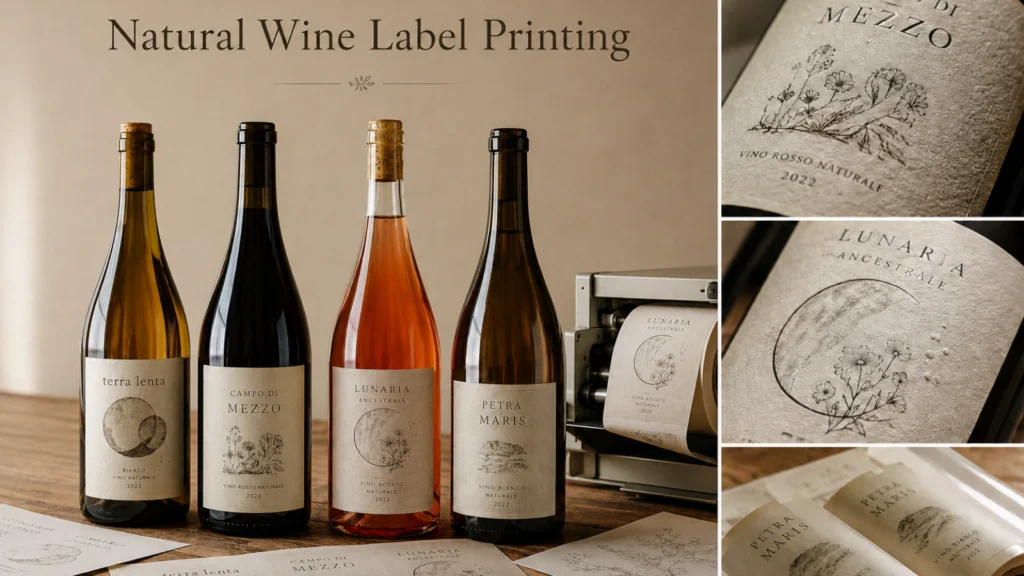
Natural wine labels have become almost as recognizable as the bottles themselves. They look different from conventional wine packaging — more playful, more experimental, more personal. That difference is not accidental. It reflects the natural wine movement’s origins as a community built around small growers, unconventional winemaking, and a deliberate departure from mainstream wine aesthetics. Where established wine brands lean on heritage cues — crests, estates, formal typography — natural wine producers reach for illustration, photography, collage, and unexpected color palettes.

The artists behind these labels are as eclectic as the wines: children’s book illustrators, tattoo artists, photographers, and printmakers all work in this space. The result is a category where label art is genuinely unpredictable, and where visual identity has become one of the primary ways producers differentiate on a crowded shelf.

Design Elements That Define the Category

Natural wine label design draws from illustration, collage, and fine art — techniques that signal independence and personality over category convention.

Hand-drawn illustration

Original artwork — whimsical animals, botanical drawings, imagined landscapes, abstract figures — signals a specific human made this wine, not a marketing template. Illustrators in this space frequently bring backgrounds in printmaking, tattooing, or street art.

Collage and mixed media

Cut-paper and photo collage techniques give labels a handmade, layered quality that reads as intentional rather than unfinished — and is difficult to replicate with purely digital design tools.

Creative photography

Documentary portraits, vineyard imagery, and close-up soil or vine photography connect the label directly to a person, a place, or a moment in the growing season.

Unconventional typography

Natural wine labels often break conventional hierarchy — hand-lettered scripts, oversized producer names, or type borrowed from vintage posters and zine culture rather than classical wine fonts.

Unexpected color palettes

Electric blues, deep terracottas, pastels, and combinations that would read as too bold in traditional wine branding. Color is used to signal category departure as much as aesthetic preference.

Farming Values and Label Storytelling

Natural wine labels often carry a farming philosophy directly — sustainability, terroir, and handmade character are all legitimate elements of label storytelling.

Natural wines are associated with organic growing, biodynamic practices, cover cropping, and a focus on soil health through beneficial microbe populations. The movement traces its origins to 1990s Paris and developed in reaction against industrial vineyard management and winemaking additives. Many producers in this space have been farming this way for decades, and their labels reflect it — a hand-drawn vineyard map, soil cross-sections, insect and bird imagery, or simply the personality of the producer in a way that signals authenticity over polish.

Any farming or sustainability claim on a label must be accurate and specific to be credible. Here are the key designations natural wine producers typically reference:

Organic certification (USDA)

Wines must be produced from organically grown grapes, made in a USDA-certified facility, and contain added sulfites below 100 ppm. Active certification must be maintained annually.

Biodynamic farming

A holistic approach treating the vineyard as a self-sustaining ecosystem. Demeter certification is separate from organic certification and involves additional auditing requirements.

Natural wine (working definition)

No universally accepted legal definition exists. Producers generally use native yeast fermentation, minimal or no added sulfur, and avoid the 300-plus additives permissible in conventional wine production.

Label Materials and Ink Technology for Wine Bottles

Wine bottle labels must survive condensation, refrigeration, and ice-bucket conditions — substrate and ink choices are as important as the design itself.

Labels that look compelling in a design file must perform in a very different environment on a retail shelf or restaurant table. Glass bottles accumulate condensation in refrigerated displays and sweat heavily when removed from ice baths. Polypropylene (PP) and BOPP films offer substantially better moisture resistance than paper and maintain adhesion in wet conditions — the standard substrate choice for most wine bottle label applications. UV-cured inkjet printing adds another layer of durability: UV inks deliver vibrant, moisture-resistant color that also supports premium effects including spot varnish, opaque white on metallic stocks, and multi-layer tactile finishes.

The ArrowJet UV 330H is a hybrid UV label press that combines roll-to-roll and flatbed printing in one system, supporting CMYK plus White and CMYK plus Varnish configurations. Food and beverage labels are a confirmed application. These capabilities map directly to the premium visual effects natural wine producers pursue — varnish overlays that make illustration details pop, opaque white under-printing on metallized stocks, and consistent high-resolution output across short runs. Producers evaluating UV label printing can review the full range at ArrowJet UV label printers.

Substrate Options for Wine Bottle Labels

Substrate

Moisture Resistance

Best Application

Pressure-sensitive paper

Low — not suitable for ice-bucket or refrigerated-display exposure

Cellar-direct sales, ambient-temperature tasting room

Polypropylene (PP) film

High — resists condensation and brief water exposure

Refrigerated retail, on-premise/restaurant, general distribution

BOPP film

High — dimensional stability maintained under moisture

Premium wine, export, long-cellaring, ice-bucket service

Coated paper + UV overlaminate

Medium — improved over bare paper, not equivalent to PP

Boutique retail where limited moisture exposure is expected

In-House Label Printing for Natural Wine Producers

Digital label presses let natural wine producers print short runs with no plates, no minimums, and full artwork flexibility — ideal for vintage rotations, limited releases, and artist collaborations.

Many natural wine producers release small batches, rotate artwork by vintage, or collaborate with different artists across individual bottlings. This creative flexibility is extremely difficult to manage through a commercial label printer, where plate costs, minimum order quantities, and lead times make short-run or variable-artwork production expensive and slow. In-house digital label printing removes these friction points. A digital inkjet label press prints from a file — no plates, no makeready — and a single-label proof costs the same in setup time as a full production run.

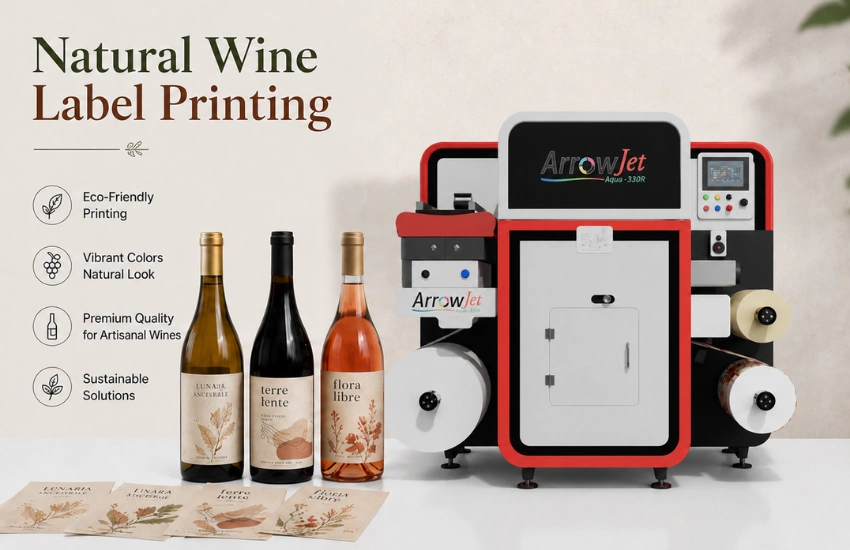
The ArrowJet Aqua 330R is an aqueous inkjet digital label press built on the Memjet DuraFlex® platform, producing high-resolution output on coated paper, PP, BOPP, PET, Mylar, and other pressure-sensitive substrates across a 330mm web width. Producers printing bottle labels, back labels, and neck labels from the same machine cover their full label format range from a single in-house system. Arrow’s full range of digital label printers covers configurations for wineries from boutique scale to higher-volume operations.

Interested in in-house wine label printing? Arrow Systems offers digital label presses for wineries of all sizes. Request a sample print or contact the team to discuss your production requirements.

Factor

Commercial Label Printer

In-House Digital Label Press

Setup cost per new artwork

Plate charges — typically $200–$800+ per color per SKU

None — print from file

Minimum order quantity

Typically 500–5,000+ labels per SKU

1 label minimum

Lead time — new artwork

1–3 weeks for plates and first run

Hours to same day

Artwork revision cost

New plates required per revision

File change only — print immediately

Obsolete label inventory risk

High — any revision or vintage change strands stock

None — print only what is needed per run

Balancing Creativity and Compliance

Natural wine labels can be bold and artistic, but they must still carry required regulatory information — and sustainability claims must be verifiable.

In the United States, wine labels are regulated by the Alcohol and Tobacco Tax and Trade Bureau (TTB). Required elements include brand name, class and type designation, appellation of origin where applicable, alcohol content by volume, net contents, bottler name and address, government health warning, and a sulfite declaration where applicable. Design-forward natural wine labels handle these requirements by treating compliance elements as part of the visual system, not afterthoughts — typography, placement hierarchy, and the front-to-back label relationship all affect how required information integrates with overall identity.

Sustainability claims require particular care. Organic, biodynamic, or certified sustainable designations must reflect actual certifications and production methods — a label should not carry the term “organic” without active USDA certification status. Broader claims like “natural” or “eco-friendly” without substantiation may create exposure under the FTC’s Green Guides on environmental marketing. The most credible natural wine labels are specific: they name a certification or a practice rather than reaching for generic environmental language.

Frequently Asked Questions — Natural Wine Labels

Natural wine producers use labels to express the individuality of the wine, the grower, and the farming philosophy behind the bottle. Because the category is driven by small, independent producers, artistic freedom is a core part of brand identity — not just the packaging.

Polypropylene (PP) and BOPP films offer the best moisture resistance for wine bottle applications, maintaining adhesion through refrigeration, condensation, and ice-bucket conditions. Paper labels are suitable for ambient-temperature retail or cellar-direct settings where moisture exposure is limited.

Yes. Digital label presses allow small wineries to produce runs as low as a single label with no plate costs or minimum order quantities — practical for boutique producers who rotate artwork by vintage or produce small-batch SKUs.

UV-cured inkjet inks deliver vibrant, moisture-resistant output suited for wine bottle labels, and support premium effects including spot varnish, opaque white on metallic substrates, and multi-layer tactile finishes. The ArrowJet UV 330H is a hybrid UV label press built for food and beverage label applications.

Only when accurate and supportable. Claims about organic, biodynamic, or sustainable practices must match actual certifications — USDA organic wines must meet specific production and sulfite standards. Vague terms like “eco-friendly” without substantiation may create exposure under FTC environmental marketing guidelines.

Natural Wine Label Printing: Design, Materials & In-House Options