In-House Label Printing vs. Print on Demand: Cost by Volume
Table of Contents In-House Label Printing vs. Print on Demand: Cost by Volume In-house label printing vs. print on demand comes down to a cost-per-label
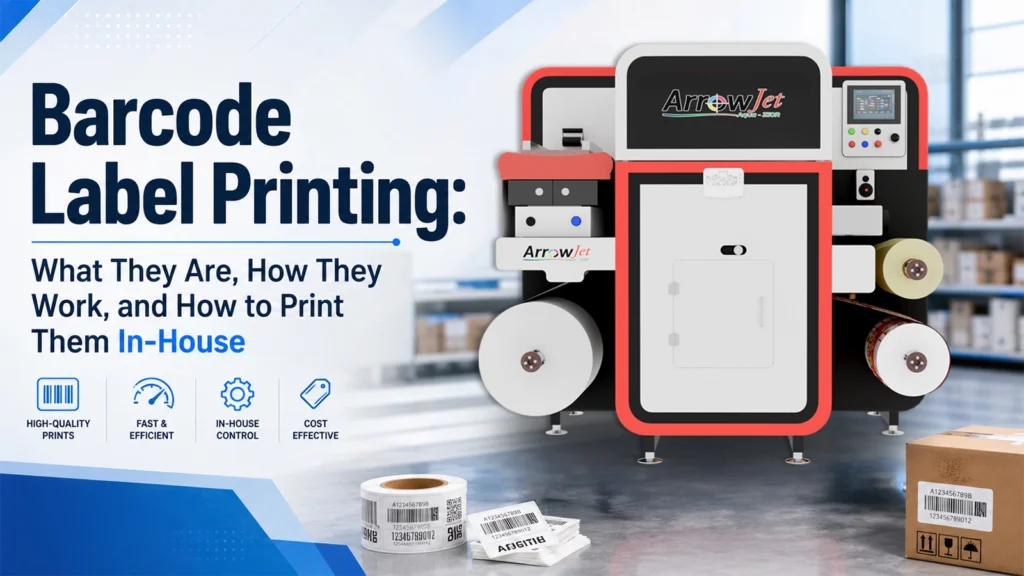
A barcode label encodes product or tracking information as machine-readable lines or patterns — connecting physical objects to digital systems across retail, logistics, healthcare, and manufacturing.
Barcode labels are so common today that most people barely notice them. They appear on retail products, shipping cartons, hospital wristbands, library books, airline boarding passes, and thousands of other objects that need to be identified, tracked, or priced. Yet the idea behind them changed the way modern commerce and logistics work.
In the late 1940s, Joe Woodland — an inventor from Ohio vacationing in Miami Beach — began searching for a way to encode product information as a visual pattern that a machine could read. His early work drew on Morse code principles, extending dots and dashes into lines of varying widths. Woodland filed one of the earliest barcode patents in 1949, though the scanning and computing technology required to make the system commercially practical took decades to follow.
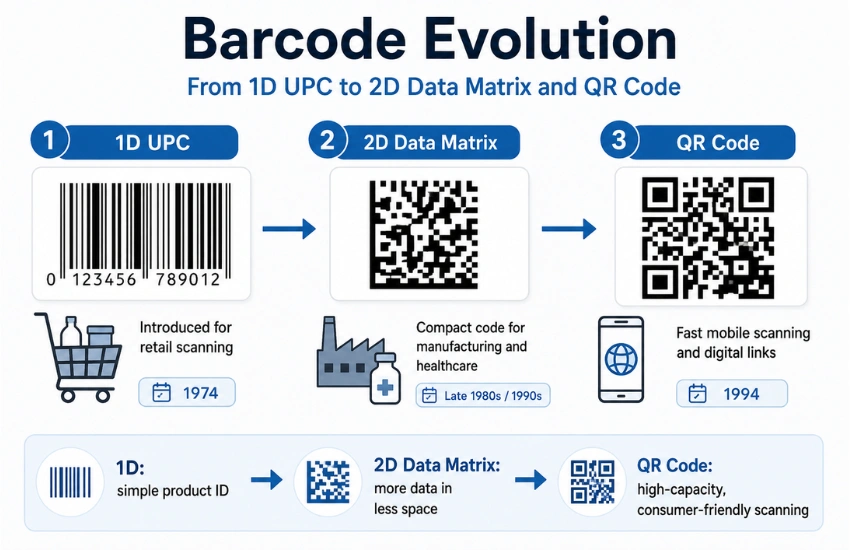
The first commercial barcode scanner was deployed at retail checkout in 1974. From that point, standardized label formats and falling scanner costs drove rapid adoption — from grocery stores into manufacturing plants, warehouses, hospitals, airports, and distribution centres worldwide. What began as a checkout solution became foundational infrastructure for the entire modern supply chain.
Before barcodes, tracking a product through a warehouse, store, or supply chain relied on manual data entry — slow, error-prone, and expensive to scale. A barcode label removes that manual step entirely. The scanner reads the label; the connected system updates automatically.
In retail, price lookups happen instantly at checkout. In logistics, every package movement is logged without a human typing a tracking number. In healthcare, patient wristbands and medication containers are matched by scan rather than visual inspection. In food manufacturing, a single barcode scan connects a product to its batch record, supplier, and distribution path. The value is consistency at scale: the same information, read the same way, every time — regardless of who is operating the scanner or where in the world the product is moving.
Industry | Barcode Label Application | Common Barcode Format |
Retail | Product pricing, point-of-sale scanning, inventory management | UPC-A, EAN-13 |
Logistics & Shipping | Package tracking, carrier scanning, route sorting | Code 128, GS1-128 |
Healthcare | Patient identification, medication verification, specimen tracking | Data Matrix, Code 128 |
Manufacturing | Batch tracking, work-in-progress routing, component identification | Code 39, Data Matrix |
Food & Beverage | Lot traceability, expiry date encoding, retailer compliance labelling | GS1 DataBar, GS1-128 |
Publishing | ISBN encoding on book covers, library cataloguing systems | EAN-13, ITF-14 |
Pharmaceuticals | Unit-level serialisation, anti-counterfeiting, dispensing verification | Data Matrix, GS1-128 |
Events & Travel | Ticket validation, boarding passes, access control | QR Code, PDF417 |
Format selection should be driven by data requirements and scanning infrastructure — not by familiarity with a particular symbology. Validate your format choice against your scanner hardware and any retail or regulatory partner requirements before committing to a label design.
Encode data as a series of vertical bars and spaces of varying widths. Read by a single horizontal scan. Common formats include UPC-A (retail consumer products in North America), Code 128 (shipping and logistics), EAN-13 (retail globally), and Code 39 (manufacturing and industrial). Best for product identification, shipping labels, and retail applications where data storage needs are limited.
Encode data in a two-dimensional grid of squares, dots, or hexagons. Store significantly more information than 1D codes — including URLs, lot numbers, expiry dates, and serialised identifiers — in a smaller printed area. Common formats include QR Code, Data Matrix, and PDF417. Best for healthcare, pharmaceutical serialisation, food traceability, and variable-data applications requiring compact, high-density encoding.
The standardised 1D barcode used on retail consumer products in North America. Encodes 12 numeric digits identifying the product and its manufacturer. The UPC-A is the format most consumers encounter at a retail checkout — it was first deployed commercially in 1974.
A linear barcode standard used in supply chain and logistics. Encodes batch numbers, expiry dates, GTINs, and shipping unit identifiers within a single label using Application Identifiers. Required by many major retailers, distributors, and food manufacturers for case-level and pallet-level labelling compliance.
A compact 2D barcode format widely used in healthcare, electronics, and aerospace. Encodes large amounts of data in a very small print area — making it suited to small parts, medical devices, pharmaceutical unit-dose packaging, and components where available label real estate is minimal.
A 2D barcode capable of storing URLs, text, contact information, or structured data. Originally developed for automotive parts tracking, QR codes are now used across consumer marketing, product authentication, and supply chain traceability applications.
Barcode bars must be sharp and dimensionally consistent to scan reliably. A minimum of 300 dpi is generally accepted for 1D barcodes. 2D codes such as Data Matrix typically require 600 dpi or higher to resolve the fine grid structure accurately — particularly at small print sizes where bar width tolerances are tightest.
Scanners read the contrast ratio between dark bars and light spaces. Low-contrast combinations — dark ink on a dark substrate, or light ink without sufficient opacity — cause scan failures. Dark ink on a white or light-coloured background is the accepted standard for maximum scan reliability across 1D and 2D formats.
The substrate affects ink adhesion, surface smoothness, and the sharpness of printed barcode edges. Coated papers, BOPP film, and polyester label stocks produce cleaner bar edges than uncoated or textured materials. Substrate choice also determines whether the label survives the storage, transport, and end-use conditions the product will encounter — moisture, heat, chemicals, or abrasion.
Every barcode format specification requires clear margins — called quiet zones — on each side of the barcode symbol. These blank areas allow the scanner to locate the start and end of the code. Cropping quiet zones at the print, die-cut, or application stage is one of the most common preventable causes of scan failure in production environments.
A correctly printed barcode on the wrong surface or in the wrong position still fails at the scanner. Labels applied to highly curved surfaces, recessed areas, or locations near package seams or folds can distort barcode geometry and reduce scan reliability — regardless of print quality.
Labels in cold-chain, outdoor, chemical, or high-traffic environments need materials and inks rated for those conditions. A label that scans correctly off the press but degrades through moisture, abrasion, UV exposure, or chemical contact creates downstream failures in inventory and traceability systems that are difficult to trace back to the label as the root cause.
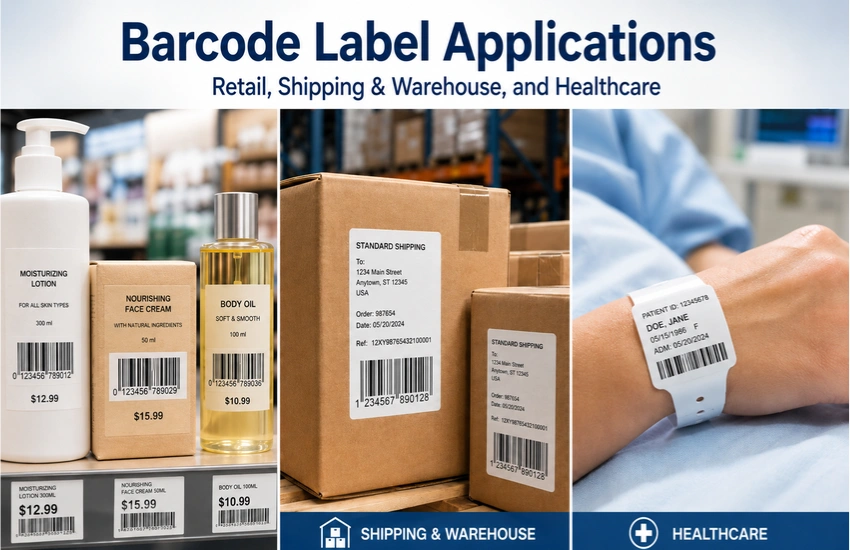
Outsourcing barcode label production introduces lead times, minimum order quantities, and version control risk on pre-printed stock. When lot information, regulatory content, or SKU details change, pre-printed inventory becomes obsolete. In-house digital label printing eliminates that constraint — each run is printed on demand, exactly to specification, with no minimum volume.
Arrow Systems manufactures digital label printing equipment for in-house label production. Two presses are directly relevant for barcode label production at industrial volumes:
ArrowJet Aqua 330R — high-speed digital pigment inkjet label press
The ArrowJet Aqua 330R uses Memjet’s DuraFlex technology to print at up to 150 ft/min at 1600 × 1600 dpi — producing barcode labels with the resolution and bar-edge sharpness required for reliable scanning across 1D and 2D symbologies. Handles coated papers, BOPP, PET, and other label substrates up to 15″ media width. Available with a 10L bulk ink system for high-volume continuous production runs. Compatible with fully integrated digital finishing for offline or inline configurations.
ArrowJet Eco 330R — compact industrial digital label press
A compact industrial single-pass digital press designed for operations stepping up from desktop printers. Runs on single-phase power and requires no air compressor — reducing installation complexity and operating costs. Prints at up to 20 m/min at 1600 × 1600 dpi on label and flexible packaging substrates up to 324 mm print width. A practical entry point for in-house barcode label production without the footprint or infrastructure requirements of a large press.
Print speed, resolution, and substrate compatibility specifications are sourced from Arrow Systems product documentation. Validate against your specific substrate and barcode symbology requirements before press selection. Arrow Systems sells label printing hardware — Arrow does not provide label design, barcode verification, or compliance advisory services.
They are how supply chains maintain real-time inventory visibility. How retailers reconcile physical stock against digital records. How hospitals verify patient identity and medication matches at the point of care. How food manufacturers trace products from a production batch to a specific retail location when a recall is initiated. The value of any single barcode label is modest. The value of a consistent, system-wide barcode identification standard is enormous.
As regulatory requirements for lot traceability, unit-level serialisation, and supply chain documentation continue to expand — across food and beverage, pharmaceutical, medical device, and consumer product sectors — the demand for accurate, high-resolution barcode labels at scale continues to grow. For businesses in regulated industries, the ability to print correct, compliant barcode labels in-house is becoming an operational requirement, not just a cost optimisation.
Barcode labels are used to identify, track, price, and connect physical items to digital records across retail, logistics, healthcare, manufacturing, food and beverage, publishing, and pharmaceutical applications. They are the primary mechanism for connecting a physical product to the inventory, pricing, or traceability system that manages it — at the speed and consistency that manual data entry cannot match.
A 1D barcode (such as a UPC-A or Code 128) encodes data as a series of vertical bars and is read with a single horizontal scan. A 2D barcode (such as a QR Code or Data Matrix) encodes data in a two-dimensional grid and stores significantly more information — including expiry dates, lot numbers, URLs, and serialised identifiers — in a smaller printed area. The choice between 1D and 2D depends on how much data needs to be encoded and the scanning equipment in use at the destination.
Print resolution, ink contrast between bars and background, label substrate surface, quiet zone margins, label placement, and field handling conditions all affect whether a barcode scans reliably. The most common preventable causes of scan failure are insufficient print resolution, low contrast between ink and substrate, and quiet zones cropped during the die-cutting or application process.
Yes. Digital label printing equipment lets businesses produce barcode labels in-house at industrial volumes. Arrow Systems manufactures digital label presses — including the ArrowJet Aqua 330R and ArrowJet Eco 330R — designed for in-house label production. Printing in-house eliminates minimum order requirements, reduces lead times, and allows label artwork to be updated immediately when lot information, regulatory content, or SKU details change.
Barcode labels became widely adopted because they provided a reliable, low-cost method to eliminate manual data entry at checkout, in warehouses, and throughout supply chains. A scanner reading a barcode is faster, more consistent, and less prone to error than manual data recording — and the same label format can be read by any compatible scanner anywhere in the world, making global standardisation viable at scale.
If your operation needs to produce barcode labels at production volumes — with the resolution, consistency, and substrate flexibility that scan reliability demands — Arrow Systems manufactures the digital label presses to do it in-house.
The ArrowJet Aqua 330R handles high-speed production at 150 ft/min and 1600 × 1600 dpi across a wide range of label substrates. The ArrowJet Eco 330R is the compact industrial entry point for operations stepping up from desktop equipment.
Table of Contents In-House Label Printing vs. Print on Demand: Cost by Volume In-house label printing vs. print on demand comes down to a cost-per-label
Table of Contents Pharmaceutical Label Version Control Workflow for FDA Changes A GMP label version control workflow moves an approved revision to the line: change
Table of Contents Mylar vs BOPP Flexible Packaging: Substrate Selection Guide PET (Mylar) leads on oxygen and aroma barrier and heat tolerance; BOPP leads on
Table of Contents When to Add a Second Label Printer: Capacity Decision Guide Three measurable signals decide it — sustained utilization above your scheduling ceiling,
Table of Contents Diagnosing Supplement Label Peeling HDPE Bottle Failures HDPE label peeling traces to low surface energy, an adhesive mismatch, or moisture exposure —
Table of Contents Roll-to-Roll vs. Sheet-Fed Label Printing: Throughput & Cost Rolls win on cost per applied label with an automatic applicator; sheets win on