Craft Beer Label Printing: TTB Approval, Design, and In-House Guide

Craft Beer Label Printing

Table of Contents

Craft Beer Label Printing: TTB Approval, Design, and In-House Guide

Craft beer labels must clear federal TTB COLA review before any product ships — and be ready when your packaging line runs.

Key Takeaways

  • Beer sold in interstate commerce generally requires TTB COLA approval before it enters the market — treat COLA review as a production planning input, not a final-step checkbox.
  • The five core mandatory statements are: Government Warning (exact wording), brand name and class/type designation, brewer name and address, net contents, and alcohol content where applicable.
  • Most label rejections trace back to a small set of recurring problems: missing or illegible mandatory statements, incorrect Government Warning text, inaccurate class/type designation, or prohibited claims.
  • Design for compliance first — reserve space for required statements before creative work is finalized, and prioritize legibility and contrast throughout.
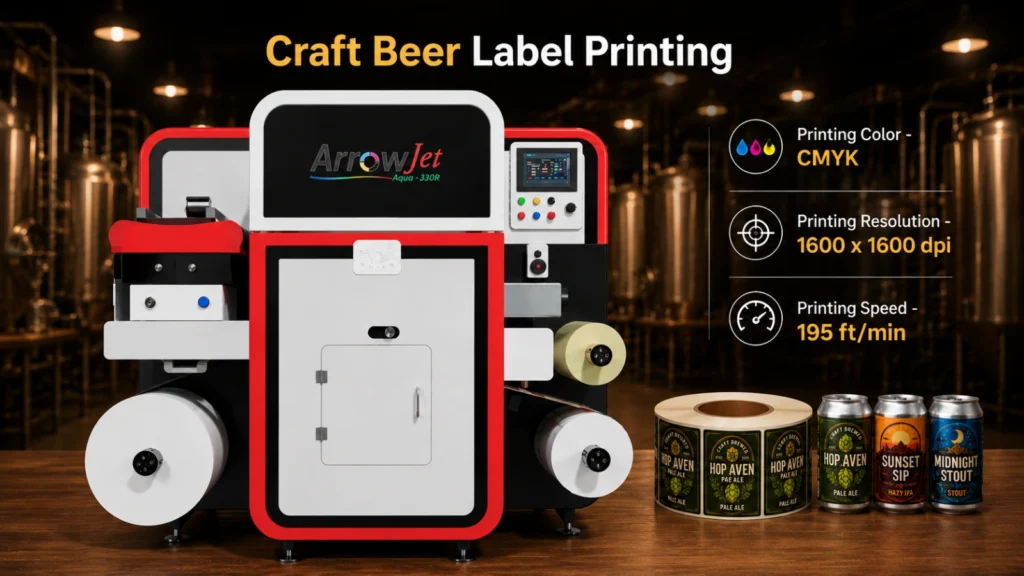
  • In-house digital printing (ArrowJet Aqua 330R for smaller craft operations; ArrowJet 800 for regional volume) enables on-demand production that responds to seasonal releases, reformulations, and compliance updates without bulk-order waste.
  • Arrow’s EZCut and ArrowCut Nova finishing systems handle custom die-cut and shaped labels in-house, giving breweries full control from print to retail-ready roll.

TTB COLA Approval: What Every Craft Brewer Needs to Know

A Certificate of Label Approval (COLA) is the federal sign-off required for TTB label approval — confirming a beer label meets applicable labeling regulations before interstate commerce, submitted online through the TTB’s application system.

Brewers selling beer in interstate commerce are generally required to obtain COLA approval — making the COLA beer label process a non-negotiable step before those products enter the market. Whether a product requires approval, and which pathway applies, can depend on the beverage type, distribution channel, and where it’s sold. Confirm current TTB guidance for your specific situation before assuming a previous approval covers a new SKU or formulation.

The brewery — or an authorized agent — submits label images and product details through the TTB’s online system. If the label conforms to labeling requirements, the brewery receives an approved COLA. If it doesn’t, the application is returned with the issues requiring correction.

Common reasons beer labels are returned for correction

Most rejections cluster around a handful of recurring problems: a mandatory statement is missing, incomplete, or illegible; Government Warning text does not match the required exact wording or formatting expectations; the class or type designation does not accurately reflect the product; net contents or alcohol content is inconsistent or improperly placed; or artwork includes claims considered misleading or prohibited.

How to treat the TTB COLA process as a production input

Review timelines can vary. Build the TTB COLA process into your release calendar before artwork is finalized — not after. Verify current processing expectations directly with the TTB rather than relying on turnaround assumptions from a previous submission. A delayed approval is a packaging-line constraint, not just a paperwork problem.

Mandatory Statements on Beer Labels (Government Warning, Net Contents, and More)

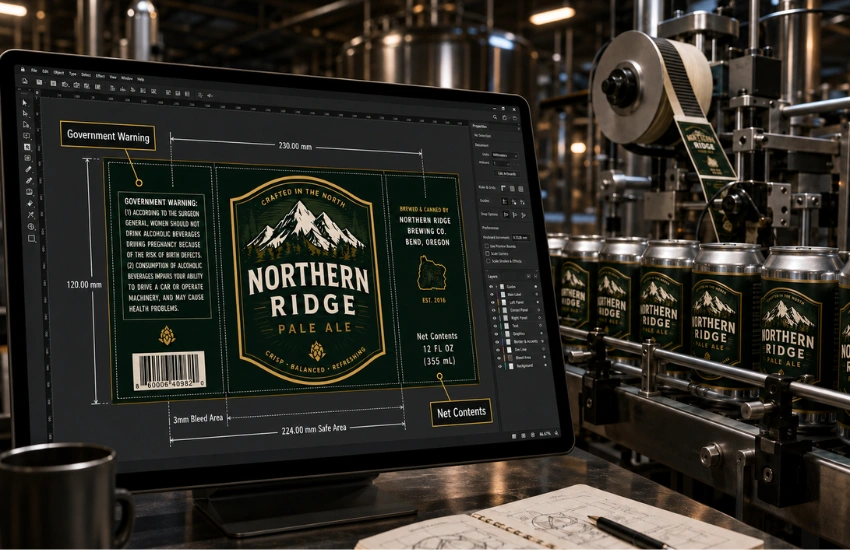
Federal beer label requirements generally mandate five categories of information on every label — exact wording, type size, and placement details must be confirmed against current TTB guidance.

Government Warning beer label requirement

The Government Warning beer label statement — the health warning regarding alcohol consumption — is generally required on every label, with prescribed wording that must be reproduced exactly. The Government Warning is one of the most common sources of returned applications — slight wording changes, incorrect abbreviations, or insufficient type size all trigger corrections. Confirm the current required text against official TTB guidance before locking artwork.

Brand name and class/type designation

The label must identify the brand and accurately designate what the product is. The designation should reflect the actual beverage — ale, lager, stout, and similar descriptions must match the product, not just marketing language. Inaccurate class or type designation is among the most common causes of COLA rejection for craft brewers introducing new styles or reformulated products.

Name and address of the brewer or bottler

The label must identify the responsible party and physical location in a form consistent with TTB expectations. Contract brewing arrangements may affect which party and address is required — confirm for your specific production and distribution structure.

Net contents — one of the beer label mandatory statements

The net contents statement is among the key beer label mandatory statements, declaring the liquid volume in the container. Format and placement follow specific rules, and consistency across SKUs reduces review friction when managing a growing can, bottle, and growler portfolio simultaneously.

Alcohol content where applicable

An alcohol content statement may be required or optional depending on the product type and distribution market. Some states layer requirements on top of federal rules, so confirm the alcohol content treatment for every market you sell into — not just for the initial launch state.

Allergen and other declarations

Depending on ingredients and product type, additional declarations may apply — particularly for beers with added flavors, adjuncts, lactose, wheat, or other non-traditional ingredients. Confirm current allergen and ingredient-related guidance before finalizing artwork for specialty releases.

Federal labeling requirements change. This article is not legal advice, and specific wording, placement, and type-size rules should be confirmed against current official TTB guidance before finalizing any label. Arrow Systems sells label printing hardware; Arrow does not provide regulatory or compliance advisory services.

Craft Beer Label Printing

Designing Labels That Pass TTB Review

Breweries that manage craft brewery label compliance cleanly treat it as a design constraint built into artwork from day one — not a final checkbox applied after creative work is complete.

Build compliance fields into artwork before creative work is finalized

Reserve space for the Government Warning, net contents, alcohol content, and brewer information while the label is still in layout. Squeezing mandatory text into finished artwork at submission is the primary cause of legibility failures. Establishing minimum type sizes and contrast requirements at the design brief stage eliminates most avoidable rejections.

Prioritize legibility and contrast on mandatory statements

Mandatory statements that are technically present but hard to read can still trigger a correction. Decorative typefaces, low-contrast color pairings, and crowded layouts around the Government Warning are among the most common culprits in returned applications. Verify legibility at the actual print size — not just on screen at 100% zoom.

Maintain disciplined version control across the SKU portfolio

Craft brewery label requirements multiply quickly across core brands, seasonals, limited releases, and collaborations. A clear file-naming and approval workflow keeps the wrong revision off the packaging line — a risk that compounds as SKU count grows. Mark every artwork file with the COLA approval date and the specific TTB guidance version it was designed against.

Avoid prohibited or misleading claims in artwork

Statements implying health benefits, misrepresenting the product, or otherwise running afoul of labeling rules can stall or block COLA approval. When in doubt about a specific claim or descriptor, confirm against current TTB guidance before committing it to artwork — not after the label is submitted.

Design with your print method in mind from the start

Label artwork that looks correct on screen still has to reproduce accurately on your chosen substrate and printing equipment. Knowing whether you will print in-house or outsource — and on which hardware — should inform color gamut, fine-detail feasibility, and bleed specifications before artwork is finalized. In-house digital label presses like the ArrowJet Aqua 330R and ArrowJet Aqua 330R Hybrid Pro M support CMYK label production with the color accuracy and consistency required for compliance-bearing text at small type sizes.

The ArrowJet Aqua 330R for Craft Brewery In-House Label Printing

The ArrowJet Aqua 330R is an in-house brewery label printer — a water-based inkjet press built for the on-demand, short-run production that craft operations need without committing to bulk converter orders for every seasonal or compliance update.

Water-based ink chemistry in a beverage packaging environment

The ArrowJet Aqua 330R uses a water-based ink approach with a food-safe-oriented design. In beverage packaging environments where ink chemistry near food-contact packaging is a consideration, water-based chemistry is a meaningful starting point. Breweries should confirm ink and label material suitability for their specific packaging configuration with qualified regulatory guidance.

On-demand beer labels for seasonal releases and compliance updates

Producing on-demand beer labels through in-house label production lets a brewery produce exactly the quantity a specific release needs, rather than committing to a large minimum order from an outside converter. When artwork changes for a new seasonal, a reformulation, or a compliance update prompted by revised TTB guidance, the updated file is printed immediately — reducing the obsolete label inventory that accumulates when labels are pre-ordered in bulk.

Version control across a growing SKU portfolio

For breweries releasing frequently or managing many concurrent SKUs — core brands, limited seasonals, collaboration releases, and taproom-only labels — in-house printing shortens the gap between an approved COLA and a packaged product. Each run reflects the current, approved artwork rather than whatever was approved months earlier when the bulk order was placed.

The ArrowJet Aqua 330R Hybrid Pro M for Regional Brewery and High-Volume Label Runs

The ArrowJet 800 is engineered for higher-volume regional production — supporting large runs on flagship SKUs while retaining the on-demand flexibility and version-control advantages of digital printing.

Scaling core-brand output for regional distribution

As breweries grow into regional distribution, label volume on core brands climbs significantly. The ArrowJet Aqua 330R Hybrid Pro M supports larger production runs on flagship products — the volumes that regional distributors and retail chains require — without sacrificing the ability to update and switch between designs between runs.

Retaining digital flexibility at volume

Operations that have outgrown a smaller press but still need to manage multiple active label versions — including seasonals, limited editions, and any compliance-driven artwork updates — benefit from the ArrowJet Aqua 330R Hybrid Pro M’s combination of throughput and per-run flexibility. Higher volume does not require returning to pre-printed inventory and the version-control exposure that comes with it.

EZCut / ArrowCut Nova for Custom Die-Cut and Shaped Label Finishing

Arrow’s label finishing systems — EZCut blade die cutters and ArrowCut Nova laser finishers — convert printed label rolls into retail-ready, custom-shaped output — handling die-cutting, lamination, and finishing for both standard and custom brewery label formats.

Why finishing is the second half of retail-ready label production

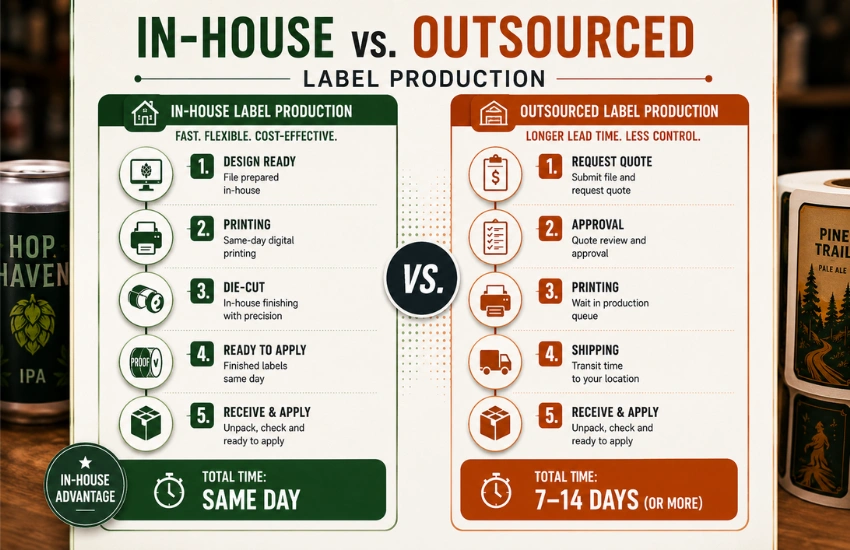
Printing is only half of a production-ready label. Finishing turns printed stock into the cut, shaped, rewound rolls a brewery packaging line actually uses. Handling finishing in-house — paired directly with in-house printing — removes the outside converter from routine production and eliminates the lead time, minimum order, and coordination friction that converter dependency creates.

Arrow EZCut — blade die cutting for standard and custom label shapes

The Arrow EZCut 330R+ handles roll-to-roll blade die cutting for custom label shapes, contours, and formats beyond a standard rectangle. For breweries that want distinctive on-shelf presence — shaped bottle labels, custom-contour neck wraps, or non-standard growler labels — The Arrow EZCut 350R extends that with up to six cutting heads for higher-throughput consistent label runs at volume.

ArrowCut Nova — laser finishing for die-free custom shapes

The ArrowCut Nova 330R and ArrowCut Nova 250R use CO₂ laser finishing to cut, perforate, and kiss-cut labels without physical dies — making it well-suited for short-run seasonal brewery labels and collaboration releases where the tooling cost of a blade die cannot be amortized across the print run. Custom shapes, perforations, and unique contours are feasible at short-run quantities that would not justify die tooling investment.

Connecting print and finish into a unified in-house workflow

Pairing print and finishing in one in-house workflow — ArrowJet press to EZCut or ArrowCut Nova — produces retail-ready rolls without manual handoffs to outside converters. For breweries managing tight release windows and frequent artwork changes, fewer production touchpoints between COLA approval and finished label directly shorten time-to-market.

In-House vs. Outsourced Label Production: How to Decide

The right answer depends on your SKU mix, revision frequency, lead-time sensitivity, and obsolescence exposure — not a single volume threshold or generic ROI benchmark.

Decision factor

Leans in-house when…

Leans outsourced when…

Volume and SKU count

Many SKUs, frequent seasonals, short runs per release

Few stable core brands, long predictable production runs

Revision frequency

Artwork or formulas change often; TTB compliance updates force label changes

Artwork rarely changes once a COLA is approved

Lead-time sensitivity

Tight release windows, distributor launch commitments, or taproom scheduling

Flexible timelines with ample planning runway before each release

Waste and version control

Obsolete inventory and outdated label revisions are growing production exposures

Scrap and revision risk are minimal across the current portfolio

Custom label formats

Shaped labels, custom contours, or multiple formats across bottle, can, and growler

Standard rectangle labels on a consistent single-format packaging line

Rather than applying a generic ROI benchmark, evaluate your own operational data: how much label inventory you currently scrap, how often artwork changes in a twelve-month period, how frequently lead times constrain release dates, and how complex your version-control workflow has become across all active SKUs. Those figures are more predictive of in-house printing fit than any industry average.

Frequently Asked Questions — Craft Beer Label Printing and TTB Compliance

Common questions from brewery operations, production, and packaging leads on TTB COLA requirements, mandatory label statements, and in-house printing feasibility.

Simple design, clear color systems, and story-driven packaging are practical starting points because they improve shelf recognition without requiring unnecessary production complexity. For small brands, the ability to print short runs in-house — rather than ordering large pre-printed quantities — is what makes testing these trends financially viable. The ArrowJet Eco 330R is built specifically for this use case, handling the scale of a growing in-house operation without the overhead of a larger press.

Federal labeling rules generally require: the Government Warning statement (with exact prescribed wording), brand name and class/type designation, the name and address of the brewer or bottler, net contents, and alcohol content where applicable. Allergen or ingredient declarations may also apply depending on product type. Verify exact wording, placement, and type-size rules against current TTB guidance before submitting artwork.

Yes. In-house digital printing can produce labels carrying all required compliance content, provided the artwork is designed to meet current TTB requirements and version control is disciplined. The printing equipment reproduces the artwork you supply — compliance depends on correct, approved artwork and consistent version management, not the printer.

The decision depends more on SKU count, revision frequency, and lead-time sensitivity than on a single volume threshold. Breweries with many SKUs, frequent seasonals, and regular artwork changes — including compliance updates triggered by revised TTB guidance — often find in-house printing worth evaluating earlier than those running a few stable core brands at long-run, predictable production volumes.

Yes. Arrow’s EZCut blade die cutters and ArrowCut Nova laser finishers are designed for custom-shape and die-cut label work. Pairing in-house printing with in-house finishing lets breweries produce retail-ready label rolls without dependence on outside converters for either standard or custom-format labels, including shaped bottle labels, contoured neck wraps, and non-standard growler formats.

Federal TTB labeling requirements change. This article provides general educational context only and is not legal advice. Confirm all mandatory statement wording, type-size rules, placement requirements, and COLA submission specifics against current official TTB guidance before finalizing any label. Arrow Systems sells label printing hardware; Arrow does not provide regulatory, compliance, or legal advisory services.

Get a Brewery Label Printing Assessment from Arrow Systems

If your brewery is evaluating in-house label production — for a single facility, a taproom operation, or a regional distribution line — Arrow Systems offers a structured assessment for operations, production, and packaging leads.

The assessment reviews your SKU mix, release cadence, revision frequency, format requirements, and label waste exposure to recommend a press configuration — ArrowJet Aqua 330R, ArrowJet 800, or combined with EZCut or ArrowCut Nova finishing — that fits your production environment and growth stage.

Leave a Comment

Your email address will not be published. Required fields are marked *