Table of Contents
Pressure-Sensitive vs. Heat-Shrink Labels: A Format Decision Guide
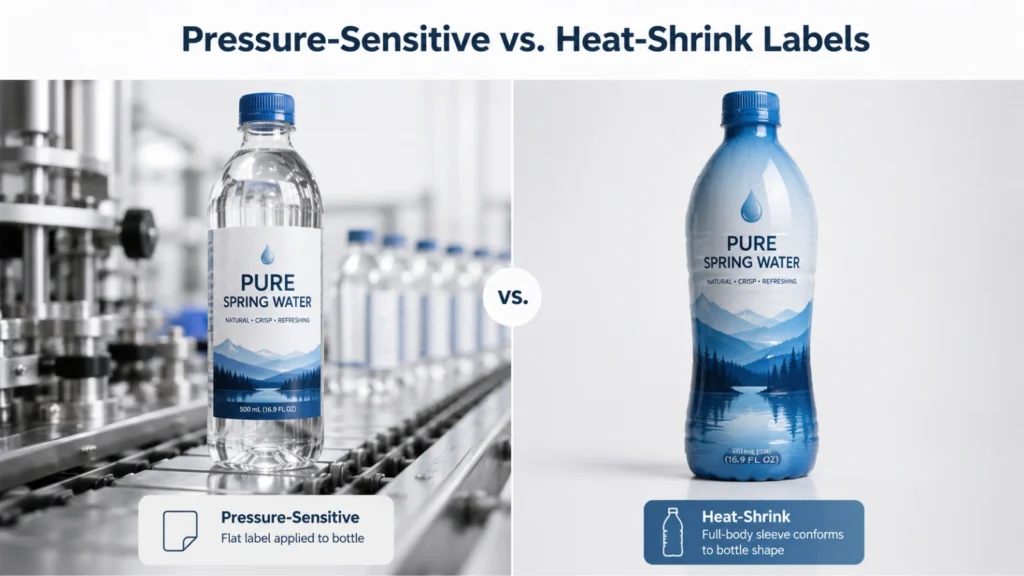
Container geometry decides the format first: pressure-sensitive for flat and cylindrical containers, shrink sleeves for contoured, full-body forms.
Packaging teams often search this as a pressure sensitive vs heat shrink labels question, or narrow it to a single SKU decision: pressure sensitive label vs shrink sleeve. Either framing leads to the same starting point — the container decides the answer before cost does.
Key Takeaways
- Decide by container geometry first — pressure-sensitive labels suit flat and cylindrical surfaces; heat-shrink sleeves suit tapered, contoured, and full-body forms that a die-cut label cannot lie flat against.
- Pressure-sensitive labels apply through contact pressure alone and finish through lamination, die-cutting, and slitting — no seaming or heat-application infrastructure required.
- Heat-shrink sleeves require prepress artwork distortion, reverse printing, seaming into a tube, and a steam or radiant shrink tunnel on the application line.
- On simple cylinders, pressure-sensitive labels usually carry lower total cost per finished unit because they skip seaming and heat application entirely.
- Digital pressure-sensitive printing on systems like the ArrowJet Aqua 330R favors short runs and frequent versioning, since there are no plates or dies to reset between SKUs.
- Validate any format decision on real containers under real line conditions — geometry, substrate, and cold-chain behavior rarely show up fully in a sample review.
What Is a Pressure-Sensitive Label and When Is It the Right Format?
A pressure-sensitive label is face stock backed by adhesive on a release liner, applied by contact pressure alone — no heat or solvent activation.
Pressure-sensitive label construction
A PS label is built from three layers: a printed face stock, an adhesive layer, and a release liner. The label is peeled from the liner and pressed onto the container, and the bond forms through contact pressure alone. This adhesive-backed construction is also referred to as a pressure sensitive adhesive label.
Pressure sensitive label adhesive options
PS adhesive comes in permanent, removable, and specialty formulations. This range lets PS labels adapt to glass, HDPE, PET, and coated board across food, beverage, personal care, and nutraceutical lines.
PS labels are typically the right choice when:
- Your containers have flat or gently curved surfaces where a die-cut label lies flat
- You need fast, simple label application with minimal added equipment
- SKUs change often and you want short-run, on-demand production
- You want tight control over label placement and a clean, defined label edge
What Is a Heat-Shrink Sleeve Label and When Is It the Right Format?
A heat-shrink sleeve is a printed film tube that shrinks tightly around a container under heat, conforming to contours a flat label cannot follow.
Heat-shrink sleeve application process
A seamed film tube is positioned on the container, then passed through a steam or radiant shrink tunnel so it hugs the contours a flat label would otherwise bridge or wrinkle across.
Reverse (inside) printing on shrink film
Shrink film printing is usually done as reverse printing on the inside surface, so the ink sits between the film and the container and is protected from abrasion and handling. Printed heat shrink sleeve labels produced this way resist scuffing through normal handling and shipping.
Digital printing has also brought short-run shrink sleeve production within reach for smaller batches, narrowing the versioning gap that once separated the two formats.
Shrink sleeves are typically the right choice when:
- Containers are tapered, contoured, waisted, or otherwise non-cylindrical
- You want 360-degree graphics with no visible label edge or seam gap
- You need full-body coverage, neck bands, or built-in tamper evidence
- Shelf differentiation from a wraparound, high-impact look is a priority
Container Compatibility: Which Shapes and Materials Favor Each Format?
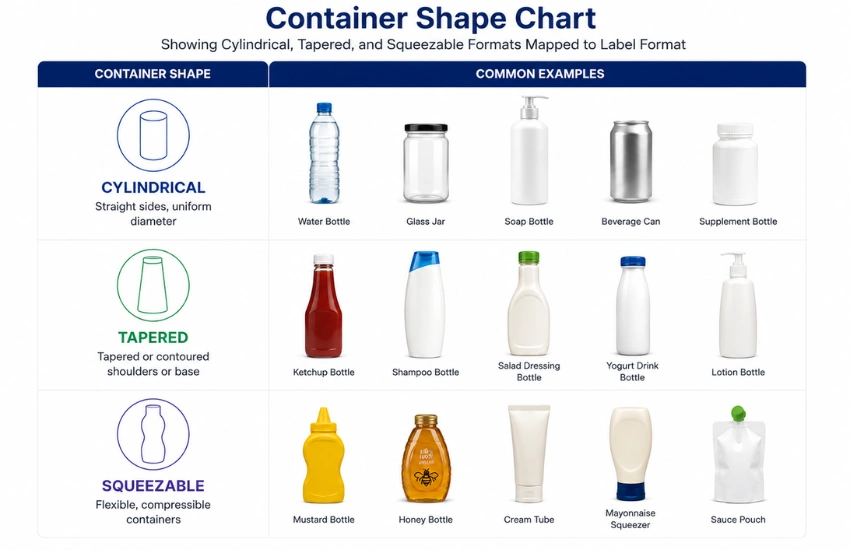
ontainer geometry is the most decisive factor in the format question — match the format to the surface first, then optimize print and cost.
Container Shape Guide
Cylindrical bottles and straight-walled jars
Both formats apply well here. PS labels are usually faster and cheaper on true cylinders, so shrink sleeves are worth the added complexity only when full-body coverage or continuous graphics are required. Brands evaluating shrink sleeves for bottles typically do so specifically for that uninterrupted 360-degree branding.
Contoured, tapered, or waisted containers
This is shrink sleeve territory. A die-cut PS label will tent, wrinkle, or lift across tight curves and shoulders, while shrink film conforms to compound curves that PS face stock cannot follow cleanly.
Squeezable containers (LDPE/HDPE tubes and bottles)
Flexible-film PS labels can work on squeezable containers, but shrink sleeves handle repeated squeezing without edge lift when the film’s recovery is specified correctly.
Flat panels and rigid boxes
PS labels are the clear default. Sleeving flat or boxy forms is impractical and offers no functional advantage.
Substrate Compatibility by Material
Glass
Accepts both formats. Verify PS label adhesive performance against condensation and cold-chain conditions, and verify sleeve fit and shrink behavior on heavy glass mass.
HDPE
Can challenge adhesion — low surface energy sometimes requires a specific pressure sensitive label adhesive or surface treatment. Sleeves sidestep adhesion entirely since they mechanically grip the container form.
PET
Works well with both formats. For sleeves, confirm the shrink film’s thermal profile is compatible with a thin-wall PET container so the bottle doesn’t distort in the tunnel.
Substrate selection extends beyond the three materials above — for a fuller breakdown of facestock and film options, see this guide to roll label materials.
Always confirm label substrate compatibility on your actual containers under real line conditions before committing to a format.
Print Compatibility: What Each Format Requires from Your Digital Press
PS labels finish through die-cutting and lamination; shrink sleeves add prepress distortion, seaming, and heat-application infrastructure.
Pressure-Sensitive Label Printing Process
PS production workflow
The face-stock/adhesive/liner construction runs through the press, prints the graphic, then finishes with lamination or varnish, die-cutting to shape, matrix stripping, slitting, and rewinding.
Why digital label printing suits PS production
There are no plates or dies to set for artwork changes, so versioning is a file update rather than a tooling change. Verification steps — barcode grade, color, registration — fit naturally into the digital workflow, and label runs can be triggered directly from production schedules. For teams currently running flexo plates, see this guide on making the switch from flexographic to digital printing.
Heat-Shrink Label Printing Process
PS production workflow
The face-stock/adhesive/liner construction runs through the press, prints the graphic, then finishes with lamination or varnish, die-cutting to shape, matrix stripping, slitting, and rewinding.
Why digital label printing suits PS production
There are no plates or dies to set for artwork changes, so versioning is a file update rather than a tooling change. Verification steps — barcode grade, color, registration — fit naturally into the digital workflow, and label runs can be triggered directly from production schedules. For teams currently running flexo plates, see this guide on making the switch from flexographic to digital printing.
Cost, Run Length, and Application Speed: A Direct Comparison
These figures are illustrative estimates for framing, not benchmarks — actual results depend on container, substrate, and line conditions.
Factor | Pressure-Sensitive Labels | Heat-Shrink Sleeves |
Container fit | Best on flat, cylindrical, rigid surfaces | Best on contoured, tapered, full-body forms |
Print method | Face stock, often surface-printed | Shrink film, often reverse-printed with distortion |
Finishing | Lamination, die-cutting, slitting | Seaming, then heat application |
Added line equipment | Applicator (relatively simple) | Sleeve applicator + shrink tunnel |
Short runs / versioning | Very well suited via digital printing | Feasible but more prepress-intensive |
Shelf appearance | Defined label with edge | Seamless 360° coverage |
Cost per finished unit
On simple cylinders, PS labels often carry lower total cost because they skip seaming and heat application. Sleeves are easier to justify when full-body graphics or complex geometry are essential to the product. Consider total cost per finished unit — material, waste, energy, and line labor — not just label price.
Run length economics
Digital PS printing tends to favor shorter runs and frequent changeovers, since setup waste drops without plates or dies. Shrink sleeves can also run digitally, but added prepress distortion and seaming steps typically make ultra-short runs less efficient than for PS. A short run shrink sleeve is achievable, but rarely matches PS economics at the same volume.
Application speed considerations
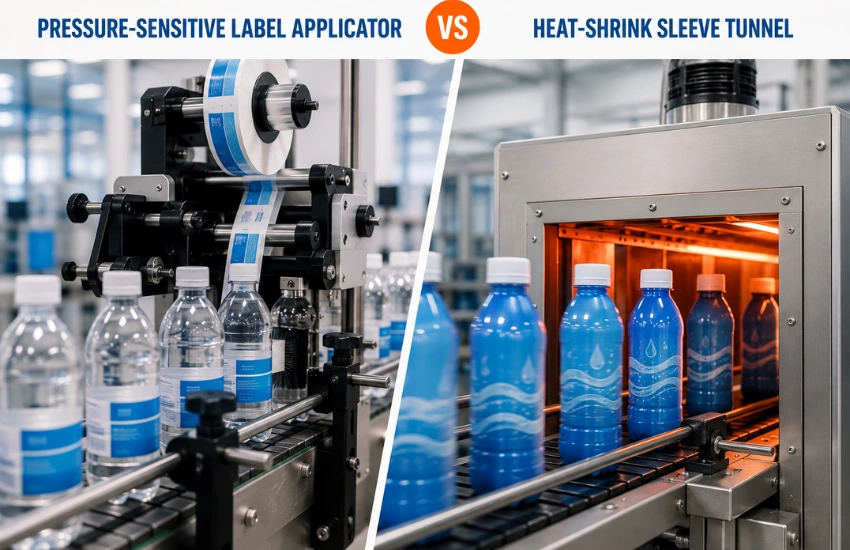
High-speed PS application is well established across many line types. Shrink sleeve application adds a shrink tunnel and dwell time — teams often see the shrink step become the pacing constraint that must be balanced against upstream filling speed.
ArrowJet Systems for Pressure-Sensitive Label Production
Arrow Systems builds digital press hardware for on-demand pressure-sensitive production — no plates, no minimum order quantities.
ArrowJet Aqua 330R for high-speed pressure-sensitive roll production
The ArrowJet Aqua 330R is a water-based digital inkjet press for pressure-sensitive roll label production, running three speed tiers — 90, 150, and 195 feet per minute — with a maximum media width of 380mm and three-phase 220V/400V power. It fits operations standardizing on PS labels for cylindrical containers alongside a sleeve line, or producing PS labels exclusively across a mixed, cross-vertical SKU portfolio.
ArrowJet Eco 330R for smaller-volume PS operations
The ArrowJet Eco 330R is a single-phase entry point into digital pressure-sensitive label production, built for teams with a smaller SKU count or lower weekly label volume who still need on-demand production without a converter’s lead time or minimum order quantity. It’s a natural fit for short run label printing where volume doesn’t justify a high-throughput press.
File-driven versioning for mixed SKU portfolios
Digital pressure sensitive labels succeed here because artwork and variable data are file-driven, so both presses fit naturally into an operations-automation workflow where label runs are triggered by production schedules and versioning happens without new tooling — the core advantage PS labels hold over shrink sleeves in high-SKU, high-revision environments.
For teams standardizing on digital label printers for pressure-sensitive production, ArrowJet systems produce exactly the quantity a run needs, reducing obsolete-inventory waste and shortening changeovers between versions across food, beverage, personal care, and nutraceutical lines.
For teams that would rather not run a separate finishing machine, the ArrowJet Aqua 330R Hybrid Pro M and ArrowJet Bolt 330R Hybrid Pro M print and finish pressure-sensitive labels on a single press — inline primer and varnish stations with an integrated dryer apply the finishing steps described below without a second machine. The Bolt 330R Hybrid Pro M adds a faster DuraBolt™ engine for higher-volume runs. Either is worth evaluating for operations consolidating press and finish into one line rather than two.
Arrow Label Finishers: Completing the Pressure-Sensitive Workflow
Arrow’s EZCut die cutters and ArrowCut Nova laser finishers handle the lamination, die-cutting, and slitting a PS label roll needs before shipping.
Arrow EZCut 330R+ — flatbed and roll-to-roll blade die cutting
The EZCut 330R+ is a flatbed and roll-to-roll hybrid blade die cutter with a maximum cutting width of 350mm, cutting accuracy of ±0.1mm, and a maximum speed of 150 cuts per minute. It supports self-adhesive, PP synthetic, PET, PVC, aluminum plastic film, and flexible materials, with cold lamination available inline — suited to operations needing the versatility to switch between roll-fed and flatbed specialty jobs.
Arrow EZCut 350R — higher-throughput multi-blade roll-to-roll cutting
The EZCut 350R is a dedicated roll-to-roll multi-blade cutter with up to 6 cutting heads, a cutting speed of 9 m/min, slitting speed up to 100 m/min, and die-cutting precision of ±0.1mm across a maximum label width of 330mm. Where the 330R+ suits mixed roll and flatbed jobs, the 350R is built for higher-throughput consistent label shapes at volume — the right choice for PS operations running core SKUs at scale.
ArrowCut Nova — CO₂ laser finishing without dies
The ArrowCut Nova 330R and ArrowCut Nova 250R are laser label finishers that cut without physical dies — enabling custom shapes, perforations, kiss cuts, and etching on PS label rolls. Laser finishing suits short-run PS jobs with unique label shapes, where the tooling cost of a blade die cannot be amortized across the print run.
Why finishing determines the shipped label
The press is only half the production system. Arrow’s full range of label finishing systems handles the die-cutting, lamination, and slitting that turn a printed PS roll into a finished, applied label — preventing the press decision from constraining downstream production.
How to Decide: A Practical Four-Step Framework
Map your container mix, cost the finished unit, account for the equipment gap, and validate on real containers before you standardize.
Step 1: Decide by container geometry first
Sort every active and planned container by shape. Flat panels and true cylinders point toward pressure-sensitive; tapered, waisted, or contoured shapes point toward shrink sleeves. This single pass resolves most of the shrink sleeve vs pressure sensitive label packaging question before cost enters the discussion.
Step 2: Cost the finished unit, not the label
Factor material, waste, energy, and line labor across the whole run — not just per-label price. Seaming and heat-tunnel dwell time on shrink sleeves add cost that a simple label-price comparison misses entirely.
Step 3: Account for the equipment gap
Shrink sleeves add seaming, prepress distortion, and a shrink tunnel that PS labeling does not need. Confirm your press and finishing configuration matches the format before committing capital to either path.
Step 4: Validate on real containers under real line conditions
Favor digital PS production for short runs and heavy versioning to cut setup waste and speed changeovers — then confirm the decision with a physical trial on your actual containers, substrates, and cold-chain conditions before standardizing across the SKU portfolio.
Frequently Asked Questions — Pressure-Sensitive vs. Heat-Shrink Labels
Common questions from ops, engineering, and packaging buyers deciding between pressure-sensitive labels and heat-shrink sleeves.
Often yes — but confirm container fit first. If the bottle is truly cylindrical or has flat panels, a pressure-sensitive label can usually replace a sleeve and eliminate the shrink tunnel from that line. If the container is contoured or relies on full-body coverage, a pressure-sensitive label may not lie flat, and the switch could introduce wrinkling or edge lift. Run a physical trial on your actual containers, validate adhesive against your storage and cold-chain conditions, and verify shelf appearance before committing.
Yes, and many cross-vertical operations do exactly this. The practical approach is to assign each container to the format that fits its geometry — pressure-sensitive for flat and cylindrical, shrink sleeves for contoured and full-body — rather than forcing one format everywhere. Standardize where possible to simplify sourcing and changeovers, but accept a split when it prevents application defects. Digital pressure-sensitive production makes it easier to handle the many short-run, high-versioning SKUs that a mixed-format line accumulates.
Pressure-sensitive labels need a digital press plus a finishing path for lamination or varnish, die-cutting, matrix stripping, and slitting, then a relatively simple applicator on the line. Heat-shrink sleeves need shrink-film handling and prepress distortion, reverse printing, seaming into tubes, and application equipment paired with a steam or radiant shrink tunnel. Match your press, ink, and finishing configuration to your chosen substrate and validate on real product before purchasing.
Get a Labeling Assessment for Your Mixed Container Portfolio
If you’re weighing pressure-sensitive labels against shrink sleeves across a mixed container lineup, Arrow Systems can help you evaluate the right format and print workflow for your specific SKUs — whether you standardize on digital labels for every SKU or split the line by container type.
A structured assessment looks at your container mix, substrates, and line conditions, then maps how ArrowJet digital label systems can produce pressure-sensitive labels on demand with less waste and faster changeovers.
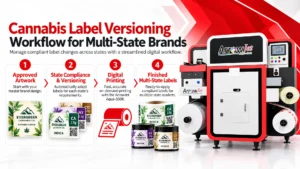
Cannabis Label Versioning Workflow for Multi-State Brands
Table of Contents Cannabis Label Versioning Workflow for Multi-State Brands A cannabis label versioning workflow produces state-specific labels from one master template by moving state-variable
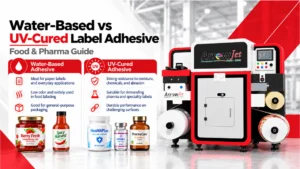
Water-Based vs UV-Cured Label Adhesive: Food & Pharma Guide
Table of Contents Water-Based vs UV-Cured Label Adhesive: Food & Pharma Guide Water-based adhesives suit dry, ambient containers; UV-cured hot melts suit cold, wet, curved
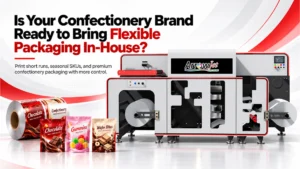
Is Your Confectionery Brand Ready to Bring Flexible Packaging In-House?
Table of Contents Is Your Confectionery Brand Ready to Bring Flexible Packaging In-House? In-house flexible packaging pays off for confectionery brands with many SKUs, short
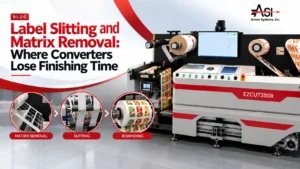
Label Slitting and Matrix Removal: Where Converters Lose Finishing Time
Table of Contents Label Slitting and Matrix Removal: Where Converters Lose Finishing Time Label slitting and matrix removal, plus rewinding, cost converters more finishing time
Limited Edition Spirits Label Printing: 4 Holiday Delay Fixes
Table of Contents Limited Edition Spirits Label Printing: 4 Holiday Delay Fixes Limited edition spirits label printing runs late because of the calendar, not the
Section 179 Label Printer Timing: Install Before December 31
Table of Contents Section 179 Label Printer Timing: Install Before December 31 A section 179 label printer purchase counts for 2026 only if the press