Future Trends Of Flexible Packaging And How You Can Dominate It
Do you know that the global market for flexible packaging is expected to reach $325.6 billion by the end of 2030?
Today’s market of the packaging industry is rapidly moving toward flexible packaging due to its durability and eco-friendly quality.
Flexible packaging was growing at a rate of 6.2% and is expected to grow at this rate till 2030. This growth is mainly due to increased demand for packaged food items and pharmaceutical/ nutraceutical products.
The data shows that the market for flexible packaging is strong and our product lines can help you capture a share of that market.
Flexible packaging can differ in quality according to the various materials like plastic paper and aluminum foil. There are many advantages to it.
It reduces the cost of production, retains the freshness of food products, barrier protection, customized printing and many more.
There are many types of flexible packaging as well. But it can be broadly classified into four categories like stand-up pouch, films, bag-in-box, and others.
Industries like food & beverages, personal care, pharmaceutical, household care & industrial are extensively relying on flexible packaging solutions.
This high demand requires the latest, high-speed tech printer. In this article, We will discover such technologies in flexible packing that will help you expand your printing business.
In order to dominate this printing segment, it is crucial to understand its market.
According to the statistics, Asia-Pacific holds the maximum market share, followed by North America and Europe. To dominate this sector, you must have a Next-gen, eco-friendly solution.
Reduce Carbon Footprints with Flexible packaging
Environmental awareness is increasing both among brands and consumers. Flexible packaging manufacturers are trying to keep up with the trend by relying on eco-friendly materials.
The Nielson IQ found that 81% of people believe companies should help fight climate change and reduce CO2 emissions.
The packaging manufacturers are taking measures to reduce carbon footprints, but still, we are unable to match the desired results.
The quality of the material plays a vital role in saving the environment. So, flexible packaging should target recyclable and renewable plastics, paper and bio-materials to produce end products.
One must understand that materials that require fewer resources and consume less energy in manufacturing are more environmentally friendly.
But materials like recyclable linear plastic, paper and bio-materials are considered environmental materials. Industry should focus more on environmental materials.
For example, plastic made up of petroleum is not renewable and non-degradable but can be recycled innumerable times.
That is why it is essential to use the correct type & combination of plastics on the packaging labels.
Upcoming trends With in Sustainable, flexible packaging and Labels
Climate change is the biggest concern, leading to both MICRO and MACRO shifts in trends in general.
First, increase in the use of MONO-Materials. Mano- materials means packaging and labels are made of the same materials, which will help with sorting and recycling materials.
Secondly, textured paper labels attract more consumers. Many brands are adopting this trend as papers can be recycled 6-8 times before they are worn out.
Every tone of recycled paper saves approximately 14 trees. Moreover, Paper can be recycled into new paper products such as writing paper, newspapers, envelopes, corrugated cardboard and egg cartons.
Third, linerless labels significantly reduce manufacturing waste. Brands are opting for linerless labels as it is directly linked to the UN” s sustainable development goals towards climate change.
Similarly, wide use of sustainable, long-lasting, solid color inks has become a priority among many brands. It helps products stand out on the store shelf. This trend can be seen in cosmetic, food and beverage products, and will eventually spread to other industries and household products.
Lastly, extensive use of Bio-Materials in flexible packaging!
Bio-materials are manufactured from renewable biological resources, but their properties are similar to conventional plastics and can be recycled.
For example, sugarcane can be processed into ethylene, which can be used to make polythene. This process includes processing starch to produce lactic acid, which can become polylactic acid.
ArrowJet Product line – The best solution for the Flexible Packaging Industry
The flexible packaging industry is on the rise, and to dominate this, you need world-class, high-speed packaging and finishing tools. Arrow System Inc. has introduced various dedicated, world class product lines that will bring a competitive edge to your business.
ArrowJet Aqua 330R lite
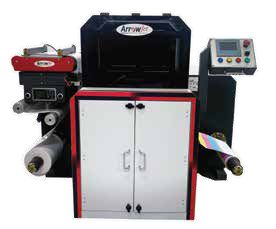
ArrowJet is a next-gen printing solution for flexible and label packaging. The latest high-speed digital printing technology uses water-based pigment ink and CMYK printing to produce 1600 x 1600 dpi prints.
This printer gives you high-resolution labels and flexible packaging for the food and pharmaceutical industries.
You can utilize our wide variety of digital finishers with it for a fully integrated workflow. Perfect for short and medium runs and registration printing on the pre-die cut or pre-printed and die-cut labels.
This Aqua Lite is perfect for businesses that want to increase short-run label and packaging production at a lower cost.
ArrowCut Nova250R
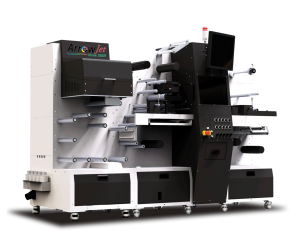
It is the latest in laser finishing solutions designed for a compact footprint with all the functionality of much larger finishing equipment. You can pair it with any digital label printer.
Laminate, die-cut, remove waste and slit your rolls labels to size in one pass. It comes with an 80W laser but can be upgraded to 150W for faster through speeds.
The ArrowCut Nova250R also allows users to perforate and do full cuts with ease!
Arrow Ezcut 330R
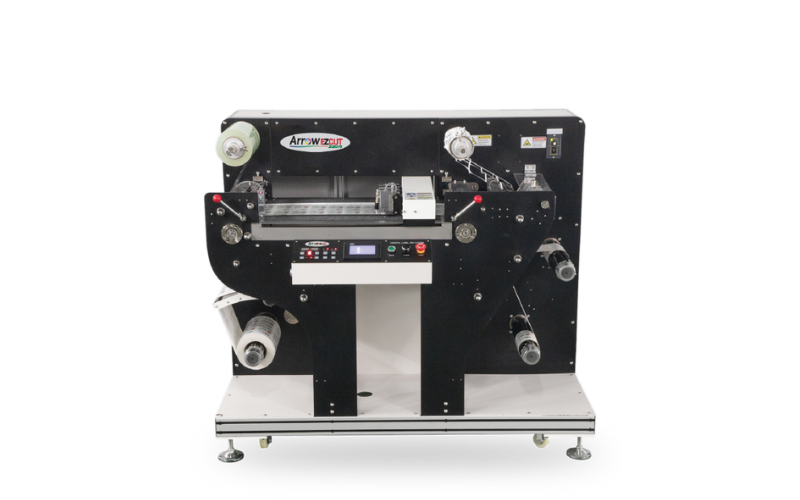
Arrow EZcut 330R is the perfect blade finishing option for printers up to 13″ wide. It has an automated web guide system that allows precision cutting never seen on any blade finisher.
Its dual cutting heads allow for high-quality cuts. It also comes with an option to add two additional heads for even higher through speeds.
Its high-quality lamination, slitting, and matrix removal allow high-quality finished labels to be produced on demand.
Conclusion
ArrowJet’s product line provides an entirely dedicated solution for labels and flexible packaging. It is built to fit the needs of today’s and tomorrow’s world. Along with these, you can get world-class support.
We curate our product by keeping an eye on manufacturer needs and upcoming consumer demands.
We are genuinely passionate about bringing the latest, eco-friendly printing solutions that will help you grow in the flexible packaging industry.
You can explore our complete product range(here) and feel free to connect with us.