How to Grow your Business with Eco-Friendly Packaging
With an increased awareness about climate change in recent years, eco-friendly packaging is becoming a more important aspect in the retail industry. How can organizations adjust to these standards while guaranteeing that it’s best for their business?
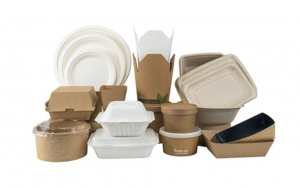
New data suggests that shopper interest for sustainability continues to grow. This has been seen in a younger generation, who are more than eager to pay for eco-friendly products and just as equally, their green packaging methods.
A 2021 study by Trivium Packaging, a billion global metal company, recently released its findings with the Boston Consulting Group. They asked more than 15,000 participants across Europe, North America, and South America about their attitudes and behaviors related to sustainable packaging. They also included consumers’ willingness to pay more for sustainable packaging.
The study reveals a steady climb in younger consumers’ dedication to sustainable living. 83% of those 44 and under were willing to pay more for sustainable packaging. The study also showed that younger consumers were 23% more willing to pay for sustainable packaging than older generations, with no significant difference in income bracket between the younger generations.
This is great news for businesses that wish to use eco-friendly materials in their packaging to increase brand awareness, and help the environment. As an extra bonus, transitioning to sustainable packaging isn’t as expensive as one might think.
Cut Costs
As eco-friendly products have grown in popularity in recent years, merchants are now providing them at competitive prices, allowing consumers to score some pretty great offers. Even though the initial cost is higher, the economic benefits of employing sustainable packaging surpass the immediate costs. For the consumer, there isn’t a downside to purchasing sustainable products. This can be a great opportunity for businesses to increase their brand awareness with the potential to help save the planet along the way – a win for everybody involved.
Another strategy to promote saving the planet while saving money is to reduce the amount of packages your organization utilizes. This not only helps to prevent waste, but it also lowers transportation expenses and the cost of replacing package inventory.
Lower Your Carbon Footprint
The most evident benefit of switching to sustainable and eco-friendly packaging is the total environmental effect. Improving your CSR (Corporate Social Responsibility) and lowering typical carbon consumption while gaining reputation as a firm that cares about the environment, is an excellent approach to promote your company for you and your customers.
Adapt to New Ideas
The word ‘sustainability’ seems to have some misconceptions. With many businesses and individuals alike concerned about its effectiveness and execution, it’s easy to see why many would be apprehensive. Many companies are looking at the problem at a different angle, looking to dissolvable and biodegradable plastics as a possible avenue in order to reduce their use of non-biodegradable materials.
Biodegradable, Compostable Plastics and More?
The main component in water-based material is polyvinyl alcohol, or PVOH for short, which is a synthetic polymer created without the heavy toxic metals that are often damaging to the planet. It’s also odorless, biodegradable, and water-soluble.
This means that the product can dissolve in warm water. This does not mean that all water-soluble products are biodegradable, on the contrary, compostable plastics are not intended for recycling. They will disrupt the recycling stream if intermixed with petroleum-based plastics that are non-compostable.
Bioplastics are either:
1) made from a renewable resource such as corn or sugar cane (bio based),
2) break down completely via a natural process (biodegradable or compostable)
3) are both bio based (renewable-resourced) and biodegradable.
They are used in the same ways as other plastics: packaging, agriculture, medical, automotive parts, 3D printing and more. Biodegradable plastics also reduce the amount of trash that is sent to landfills.
Cardboard is Still a Great Option
Cardboard comes in a variety of sizes, and it can withstand a tremendous amount of weight. It also has a great resistance to penetrating pressures, so cardboard is an effective way to keep your product secure throughout the shipping process. Corrugated cardboard is one of the top solutions for packaging sustainability because it’s as sturdy as it is organic.
A typical cardboard box is over 80% biodegradable and easily breaks down in a landfill.
Here Are Some Companies that are Already Taking on Eco-friendly Packaging:
Mondi
Mondi is supplying a range of recyclable pet food for Hau-Hau Champion, one of Finland’s most recognized brands in the premium dog food industry. They offer re-closable, recyclable packaging and the new material fully supports completely neutral carbon emissions.
Sheyn
Sheyn is a jewelry studio based in Vienna that specializes in simple yet excellent design. The company’s founders were eager to examine the possibilities of 3D printing, which led to the creation of their jewelry line. Their material is also entirely sustainable.

Sheyn has used a kraft mailer box consisting of 80% recycled material. This gives them the ability to incorporate their particular aesthetic into their packaging. As a result, their customers obtain a one-of-a-kind experience centered around them.
Ecoplasteam
The business has developed a technology that allows aluminum containers and their components to be recycled completely. Instead of separating layers of aluminum and plastic, their method mixes them to form a new material.
EcoAllene, their novel material, has chemical and mechanical qualities equivalent to fresh polyethylene. Its properties stay consistent over several batches of manufacturing, it may be colored, has an aesthetically attractive surface, is 100% recyclable, and it can be manufactured at affordable pricing.
The Takeaway
The bottom line here is to do your research. Creating biodegradable products and environmentally friendly packaging It is more important to understand what the material can do, rather than what the material is. Not every sustainable material is right for your business, but that does not mean they cannot be tailored and adapted to your specific packaging needs.
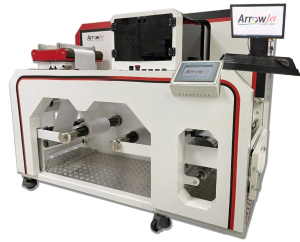
With new technology like the Arrow System’s ArrowJet Aqua 330R, flexible packaging has been made possible for your business. They utilize food-safe, aqueous pigmented inks that bring both durability and color to your packaging designs. As the world moves towards sustainability and health consciousness, these pigmented inks and recyclable flexible packages are the newest innovation for your brand’s packaging needs.
Find out more about Flexible Packaging and ArrowJet Aqua today on our website!