Biodegradable Custom Packaging Boxes And Bags
Did you know that the US custom box printing and packaging industry is predicted to reach $218.36 billion in 2025! In 2019 it was estimated at $183.92 million. Let’s discover the reason behind this growth and how you can dominate this segment.
Customers are looking for a more personalized touch in the products they purchase. The brands focus more on the solutions like customized printed bags and boxes to increase customer retention and ROI.
This has led to an increase in the demand for customizable printing bags and boxes. In a recent report, the global box printing and packaging market is expected to grow at a CAGR of 9%.
This staggering number is due to the shift in consumer behavior. According to a study, consumers tend to make subconscious decisions within the first 90 seconds of seeing a product on the shelf.
Another study has revealed that 80% of the awareness that people experience is from sight. These are fundamental reasons that brands explicitly focus on grabbing customers’ attention through customized eco-friendly bags and boxes for their products.
Currently, the usage of custom printed bags is growing in popularity, and customers around the globe love it. It makes the product look more appealing.
Many brands use social media as an advertising tool to improve their visibility in a highly competitive market and some use it to improve customer experience. However, it is an economical way to represent a product.
Current Market Segmentation
The demand for the customized solution was mainly from food packaging and the cosmetic industry. The food packaging and cosmetics sector used tailored packaging solutions like printed boxes and bags to boost their business even in a global pandemic like covid-19.
We can separate digital printing bags based on material, applications, and end-users. Bags can be made of various materials such as plastics (LDPE & HDPE), cotton, jute, paper, etc.
The printed, customized boxes and bags can be used for many applications. Based on the application, you get retail goods bags and boxes, grocery bags, merchandise designer boxes and bags, beauty products containers, stationary, gifts, etc.
Many industries like food, textile, apparel, pharmaceuticals, agriculture, cosmetics, and personal care.
Many industrial sectors also depend on personalized packaging boxes and bags, but the food industry predominantly uses them to retain customer attention.
However, the popularity and demand for this packaging solution will keep increasing in the coming years. Industries like health and wellness, skincare, and beauty products rely more on printed boxes and bags as they are eying to give customers a delightful experience.
As a digital printing business, you can plan to serve specific segments, and the Arrow product line can help you scale your business instantly.
Why Are Brands Looking For Printed Bags And Boxes?
The biggest reasons behind printed bags are flexibility in customizations and economical to increase brand value. It increases brand awareness and builds a trust factor among consumers. Many brands also use it as it gives an aesthetic look and feel.
Using digitally printed materials gives repeated brand exposure and subconsciously imprints the name of the brand in consumers’ minds. This is a major advantage over other methods.
Printed bags and boxes might be small, but they create a long-lasting impact on your customer. Brands do not have to empty their pocket in personalizing goods for various people segments; it is pretty reliable and gives them the best ROI.
The Arrow Product Line – Helps You Scale Printing Bags And Boxes
Arrow OverJet and Arrow OverJet Pro provide a super digital printing solution for bags and boxes.
These are high-tech, super efficient digital inkjet printers that help in continuous printing without the need to adjust the media height as you move between jobs.
These seamless transitions between jobs and ease of use allow Arrow OverJet and Arrow Over Jet Pro to increase efficiency. You can quickly reduce machine downtime between runs saving your business time and money to meet customer demands.
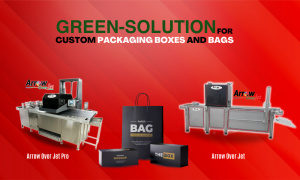
Moreover, its Water-based Pigmented Aqueous Inkjet printing gives long-lasting and high-resolution results up to 1600 dpi without using hazardous chemicals.
It is a green solution that offers you endless opportunities to print on numerous ink-receptive surfaces like boxes, envelopes, folding cartons, and more. You can print the smallest orders (no more minimum printing quantity).
Digital printing with Arrow OverJet pro is flexible and allows you to change graphics in real-time, making it ideal for customized seasonal or promotional products.
Conclusion
The technological advancements demand more creative boxes and bags for product packaging around the globe. North America, Europe, and Asia pacific are expected to grow at an above CAGR rate in the coming years. With our superior digital printing solutions for bags and boxes, you can easily dominate this segment. Visit this link to learn more about the product.