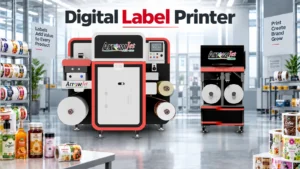
Digital Label Printer Buyer’s Guide: In-House vs. Industrial Systems Compared
Use Arrow’s original 2021 printer list as historical context while learning the durable criteria for comparing current desktop and industrial label systems.

Choosing a digital label printer comes down to five factors: application type, monthly volume, substrate format, finishing requirements, and installation constraints.
Digital label printers fall into two broad categories — compact in-house systems for lower-volume or office environments, and industrial inkjet presses for production-grade label and packaging output. Industrial systems such as the ArrowJet Aqua 330R and ArrowJet Eco 330R offer higher print speeds, wider web widths, and broader substrate compatibility than desktop alternatives — making them suitable for label converters, contract packagers, and in-house operations with growing print volumes.
Digital label printing removes the plate setup step that makes short runs expensive in traditional production.
More operations began evaluating in-house label printing as lead times from trade printers lengthened and SKU counts grew. Managing dozens of label variations — each with different copy, compliance information, or regional requirements — is significantly more difficult when every revision triggers a plate change and a minimum order quantity.
Digital inkjet presses print directly from digital files, meaning a label update takes hours rather than weeks and short runs carry no per-job plate cost. Operations that print labels on demand also carry less pre-printed inventory, which reduces the financial exposure when labels become obsolete due to formula, regulatory, or branding changes.
For a deeper look at the operational case for digital, see our overview of the benefits of digital inkjet label printing.
In-house and industrial label printers solve different production problems — volume, substrate range, and finishing integration are the key differentiators.
The label printer market spans a wide range of system types, from compact office printers handling a few hundred labels per day to full-width industrial presses running millions of labels per month. Buyers often compare systems across this spectrum without a clear framework for which category their operation actually needs.
Factor | In-House / Desktop Systems | Industrial Digital Label Presses |
Typical volume | Hundreds to low thousands of labels per day | Tens of thousands to millions per month |
Print speed | Low to moderate | Up to 150+ ft/min (varies by resolution) |
Web/print width | Narrow (often under 8″) | Up to 12.75″ or wider |
Substrate compatibility | Paper, some films | Coated paper, BOPP, PET, PVC, Mylar, Tyvek, flexible films |
Finishing integration | Separate or minimal | Inline or closely paired with finishing equipment |
Power requirement | Standard single-phase outlet | Single-phase or three-phase (model-dependent) |
Duty cycle | Light to intermittent | Continuous production |
See the ArrowJet digital label printer range for the current equipment lineup, or read our comparison of ArrowJet vs. traditional label presses for more on what changes when you move to digital.
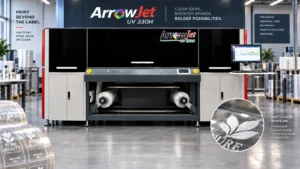
The ArrowJet Aqua 330R is an industrial-grade, single-pass digital label press powered by Memjet DuraFlex® technology, printing water-based pigment CMYK ink at up to 1600×1600 dpi.
The ArrowJet Aqua 330R is designed for label converters and in-house operations that need production-grade throughput on a range of label and flexible packaging substrates. Powered by Memjet’s DuraFlex® engine, it delivers single-pass inkjet printing with high redundancy — meaning that printhead anomalies don’t require stopping the press to address.
Specification | Details |
Print technology | Single-pass inkjet — Memjet DuraFlex® |
Ink type | Water-based pigment CMYK |
Maximum print width | 12.75″ (324 mm) |
Print speed | Up to 90 ft/min at 1600×1600 dpi; up to 150 ft/min at 1600×954 dpi |
Resolution | Up to 1600×1600 dpi |
Compatible substrates | Coated paper, BOPP, PP, PET, PVC, Mylar, Tyvek, and other inkjet-treated films |
Compliance | Nestlé Guidance compliant; inks meet REACh, RoHS 3, EUPIA, and China RoHS 2 standards |
Configuration options | NIR drying module for higher speeds; 2L or 10L bulk ink system; inline or offline finishing integration |
The Aqua 330R can be configured for offline operation or paired with Arrow’s digital label finishing equipment for inline lamination, die-cutting, slitting, and rewinding. Custom configurations are available depending on production workflow requirements.
The ArrowJet Nova 250R integrates a Memjet inkjet engine and a 125W laser die-cutter in a single platform — printing, cutting, slitting, and rewinding labels in one pass.
The ArrowJet Nova 250R was designed to eliminate the separate finishing step from the label production workflow. By combining a Memjet inkjet printer with an inline laser die-cutter, the system allows operators to print, cut, slit, and rewind labels in a single automated pass — with no physical dies required.
The Nova 250R is well-suited to operations that frequently change label shapes, run short-to-medium jobs across multiple SKUs, or need to bring print-and-cut capability in-house without investing in separate finishing equipment.
Specification | Details |
Print engine | Single-pass Memjet inkjet (dye-based CMYK) |
Resolution | 1600×1600 dpi |
Print speed | 10–60 ft/min (3–18 m/min) |
Maximum media width | 9.84″ (250 mm) |
Laser power | 125W CO₂ |
Cutting area | 8.8″ (225 mm) × unlimited length |
Cutting modes | Full cut, half cut, perforation, marking, scribing — all in one pass |
Finishing | Inline slitting and dual rewinders; cut-to-part function for sticker production |
Power | 100–220V |
Important note on ink type: The ArrowJet Nova 250R uses Memjet dye-based inkjet technology. This is distinct from the water-based pigment ink used in the Aqua 330R and Eco 330R. Dye-based inks offer excellent color vibrancy; for applications requiring maximum outdoor durability or chemical resistance, confirm substrate and lamination requirements against your specific end-use conditions.
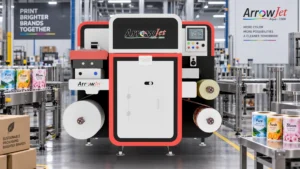
The ArrowJet Eco 330R is a compact industrial digital press running on single-phase power with no air compressor required — designed for operations stepping up from desktop printers.
The ArrowJet Eco 330R addresses a common entry point problem: operations that have outgrown desktop label printers but don’t yet need — or can’t yet install — a full three-phase industrial press. The Eco 330R runs on single-phase 230V power, requires no air compressor, and installs with a compact footprint — significantly lowering the infrastructure bar for in-house digital label production.
Specification | Details |
Print technology | Single-pass digital inkjet — Memjet DuraFlex® |
Ink type | CMYK water-based pigment |
Maximum print width | 324 mm (12.75″) |
Print speed | Up to 20 m/min (~66 ft/min) at 1600×1600 dpi |
Resolution | 1600×1600 dpi |
Power requirement | Single-phase 230V — no three-phase installation required |
Air compressor | Not required |
Machine footprint | 78 cm (L) × 106 cm (W) × 168 cm (H) |
RIP software | Xitron / Arrow RIP |
Applications | Food and beverage labels, nutraceutical labels, cosmetic labels, pharmaceutical labels, short-run and variable data jobs, in-house label production |
Despite its compact size and simplified power requirements, the Eco 330R delivers true industrial print quality — the same Memjet DuraFlex® engine used in the Aqua 330R, at 1600×1600 dpi, on the same range of label substrates. The 20 m/min speed ceiling reflects a configuration difference (single-phase power, optional IR dryer rather than NIR) rather than a difference in print engine or output quality.
Five questions drive the decision between in-house desktop systems, entry-level industrial presses, and full industrial production platforms.
Before comparing individual systems, confirm your answers to the five criteria below. A printer that performs well on one dimension but misses on another will create operational problems that are difficult to fix post-purchase. For a full pre-purchase checklist, see our guide on 7 questions to ask before investing in a new label printer.
1. Application type
Product labels, compliance labels, variable data printing, flexible packaging, and inline print-and-cut all have different system requirements. Confirm your primary use case before evaluating equipment.
2. Monthly volume
Desktop systems suit low-to-moderate volumes; industrial presses are designed for continuous production. Estimate your required monthly label output and map it against each system’s duty cycle and speed specifications.
3. Substrate format and type
Determine whether you need pre-cut labels, continuous roll, or inline-finished rolls. Confirm that your required substrates — paper, BOPP, PET, flexible film — are supported by the systems you’re evaluating.
4. Finishing integration
Die-cutting, lamination, slitting, and rewinding may be inline (as with the ArrowJet Nova 250R) or separate. Decide whether you need finishing capability from day one and whether it should be integrated or standalone. Explore Arrow’s label finishing equipment options for standalone configurations.
5. Installation constraints
Confirm available floor space, ceiling height, and power supply. The ArrowJet Eco 330R runs on single-phase 230V with no air compressor — suitable for facilities without three-phase power. The Aqua 330R requires three-phase 220V and a 6 bar air source. Match power and space requirements to your facility before finalizing.
In-house label printers are typically compact or desktop systems designed for lower volumes, often with simplified installation. Industrial digital label presses — such as the ArrowJet Aqua 330R or ArrowJet Eco 330R — are production-grade machines with higher print speeds, wider web widths, larger roll capacities, and industrial duty cycles suited for continuous or high-volume label production.
Speed varies by resolution setting and model. The ArrowJet Aqua 330R reaches up to 150 ft/min at 1600×954 dpi, or up to 90 ft/min at maximum 1600×1600 dpi. The ArrowJet Eco 330R reaches up to 20 m/min (~66 ft/min) at 1600×1600 dpi.
An inline print-and-cut system combines a digital inkjet printer with a finishing module — typically a laser or blade die-cutter — in a single connected platform. The ArrowJet Nova 250R integrates a Memjet inkjet engine with a 125W laser die-cutter, inline slitter, and dual rewinder, allowing print, cut, and rewind in one automated pass without a separate finishing step.
Many industrial digital label presses support both paper and film substrates. The ArrowJet Aqua 330R prints on coated paper, BOPP, PET, PVC, Mylar, Tyvek, and similar films — covering both label and flexible packaging applications. Confirm the substrate compatibility list for any system you evaluate, as support for specific films varies between models.
Confirm five criteria: (1) application type — labels, flexible packaging, or variable data; (2) monthly volume — desktop versus industrial; (3) substrate format — pre-cut, roll, or inline-finished; (4) finishing needs — inline versus standalone; and (5) installation constraints — floor space, power supply, and compressor requirements.
Arrow Systems manufactures the ArrowJet range of digital label and flexible packaging printing equipment. Talk to our team about application requirements, substrate compatibility, and system configurations.
Use Arrow’s original 2021 printer list as historical context while learning the durable criteria for comparing current desktop and industrial label systems.
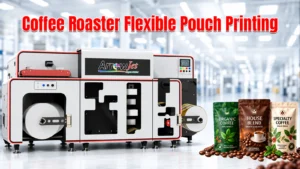
Table of Contents Coffee Roaster Flexible Pouch Printing Workflow: Roll to Bag In-house coffee pouch printing runs five stages — substrate loading, queue setup, the
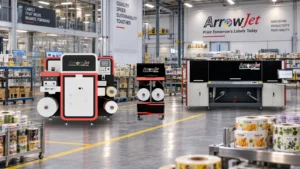
Learn how industrial inkjet printers eject controlled droplets, how scanning and single-pass systems differ, and what ink, substrate, drying, and QA affect.
Learn how white ink or toner supports clear, dark, and metallic labels, how to build a white layer, and what to test for opacity, registration, and adhesion.
Explore the practical benefits of digital label printers: short runs, versioning, variable data, inventory control, faster response, and integrated finishing.

Learn how flexible packaging is used, how pouches and rollstock differ, which barrier and seal questions matter, and where digital printing fits.