Cosmetic Label Printing: FDA Requirements for Beauty Brands
Table of Contents Cosmetic Label Printing: FDA Requirements for Beauty Brands U.S. cosmetic labels must satisfy 21 CFR Part 701, the FPLA, and MoCRA 2022

U.S. cosmetic labels must satisfy 21 CFR Part 701, the FPLA, and MoCRA 2022 — and be producible on the press you actually own.
A cosmetic label is the legal document that tells consumers what is in the product, how much they are buying, and who is responsible — it is not finished when the designer signs off.
A cosmetic label is both the most visible piece of packaging and the legal document that tells consumers what is in the product, how much they are buying, and who is responsible for it. That dual role means a label is not finished when the designer approves the artwork — it is finished when it clears FDA requirements under 21 CFR Part 701, the Fair Packaging and Labeling Act, and the obligations introduced by the Modernization of Cosmetics Regulation Act of 2022 (MoCRA).
Operationally, the implication is direct: labels change more often than they used to, and brands that pre-print large single-design inventories carry growing obsolescence risk. The printing technology decision — aqueous inkjet, UV inkjet, or digital die-cutting — determines whether cosmetic label printing can keep pace when a reformulation or regulatory update demands revised artwork.
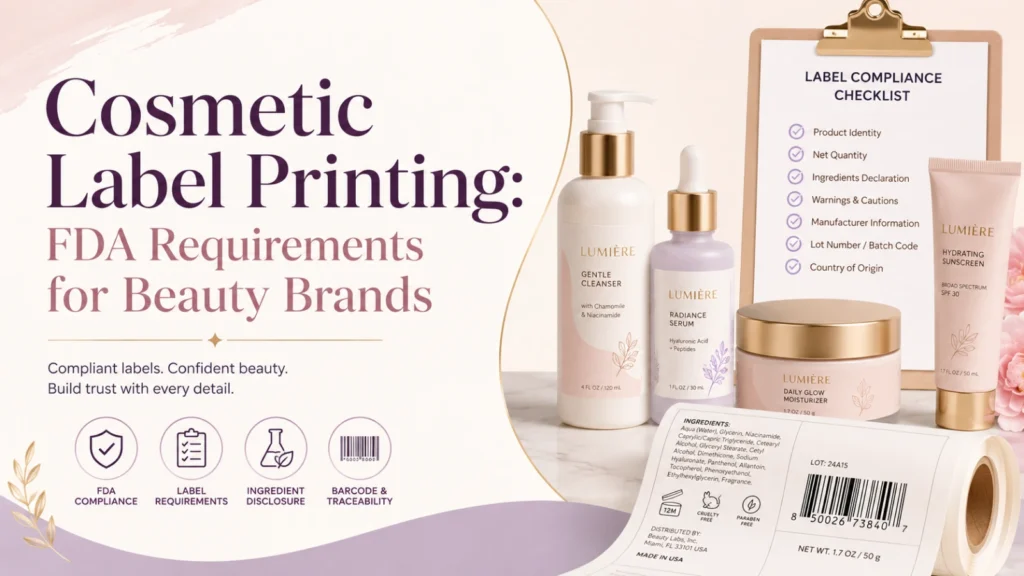
Six mandatory elements are required on every U.S. cosmetic label under 21 CFR Part 701 and the FPLA, distributed across the principal display panel and the information panel.
The following is a practical reference — not legal advice. Confirm current requirements with qualified regulatory counsel for your specific products and markets.
The common or usual name of the product (e.g. “moisturizing cream,” “lip balm”) appears on the principal display panel (PDP) in bold type, reasonably related in size to the most prominent other text on the panel.
Required on the lower 30% of the PDP, declared in both U.S. customary units (fl oz, oz) and metric equivalents (mL, g). Type size requirements scale with PDP area.
Manufacturer, packer, or distributor identified with a full street address or recognized directory equivalent. If the firm is not the manufacturer, qualify: “Distributed by” or “Manufactured for.”
Required on any cosmetic sold at retail, using INCI nomenclature in descending order of predominance by weight. Specific formatting rules apply at the 1% threshold — see the INCI section below.
Required where applicable — self-pressurized containers, flammable products, or products where safety has not been substantiated (“Warning — The safety of this product has not been determined”).
Required under U.S. Customs rules for imported products and frequently expected by retailers for domestic goods as part of supplier compliance requirements.
Cosmetic label printing requirements are enforced at the receiving dock — missing or misformatted elements are among the most common reasons distributors and retailers reject cosmetic shipments.
Knowing how to format INCI ingredient list entries correctly — descending order of predominance by weight to 1%, with color additives and fragrance following in any order — is a core requirement on every U.S. cosmetic label sold at retail.
The ingredient declaration is where compliance and print production collide most directly. INCI (International Nomenclature of Cosmetic Ingredients) names are long, technical, and unforgiving of typographic compromise — consult the FDA cosmetic labeling compliance guide for full regulatory context.
List all ingredients in descending order by weight down to and including ingredients present at 1% concentration.
Ingredients present at 1% or less may be listed in any order after all ingredients above the 1% threshold have been declared in weight order.
May be listed in any order after all other ingredients, regardless of their concentration in the formula.
May generally be declared as the single terms “Fragrance” or “Flavor.” MoCRA introduces evolving allergen-level disclosure expectations — confirm current FDA guidance for your products.
Use standardized INCI names — not trade names, supplier brand names, or marketing descriptors — in the required declaration.
FDA regulations require that required label information be conspicuous and in letters of a size reasonably related to the most prominent printed matter on the panel. A practical minimum for small cosmetic packages is approximately 1/16 inch (about 6-point type) — but that minimum does not automatically satisfy the legibility standard on larger panels.
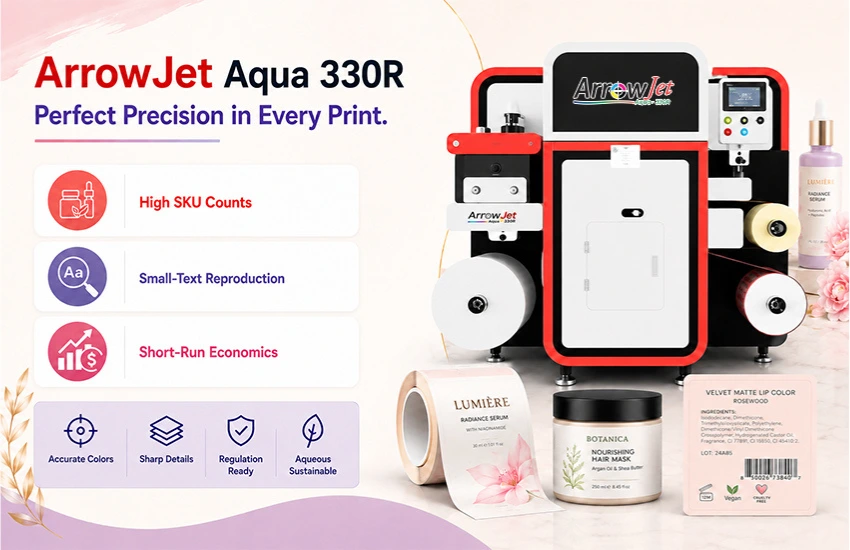
This is where print technology matters directly. Long INCI strings at 6-point type require a press capable of crisp, consistent small-text reproduction. Aqueous inkjet systems such as the ArrowJet Aqua 330R are suited for this work because they deliver high-resolution text on paper and film substrates without the dot gain that can blur narrow INCI panels on small-format cosmetic packaging.
MoCRA 2022 cosmetics regulations represent the most significant update to U.S. labeling law in decades — introducing facility registration, product listing, responsible-person labeling, and fragrance allergen disclosure obligations.
MoCRA provisions are still being phased in. The following is a practical reference, not legal advice. Confirm current requirements with qualified regulatory counsel.
Labels must identify a U.S.-based responsible person — the manufacturer, packer, or distributor — with contact information that allows consumers to report adverse events.
Manufacturers and processors must register facilities with the FDA on a defined cadence. Registrations must be renewed biennially and updated when information changes.
Each cosmetic product must be listed with the FDA, including ingredient information, with updates required when formulations change. Separate from facility registration.
Responsible persons must maintain records of serious adverse events and report them to the FDA within specified timeframes.
Certain fragrance allergens are expected to require individual disclosure on labels rather than being grouped under “Fragrance.” Monitor FDA guidance for finalized requirements.
The MoCRA labeling changes beauty brands face have one direct operational consequence: cosmetic labels change more often, and pre-printing large inventories carries rising obsolescence risk with every regulatory update or product change.
Aqueous inkjet suits standard shelf cosmetics; UV inkjet handles oil, water, and luxury substrate demands; digital die-cutting removes tooling costs from custom label shapes.
Product Type | Primary Label Stress | Recommended Print Technology | Finishing |
Skincare creams, color cosmetics (dry shelf) | Small-text legibility, frequent reformulation | Aqueous inkjet — ArrowJet Aqua 330R | Digital die-cut |
Facial oils, serums, dropper bottles | Oil contact, abrasion | UV inkjet — ArrowJet UV 330H | Digital die-cut |
Shampoos, body washes, shower products | Water, humidity, friction | UV inkjet — ArrowJet UV 330H | Digital die-cut |
Prestige / clean-beauty, metallic or clear films | Tactile and visual finish | UV inkjet on specialty substrates | Digital die-cut, custom silhouette |
Limited editions, influencer collabs | Low volume, shape iteration | Aqueous or UV inkjet | EZCut / Cut Nova digital die-cut |
For most cosmetic SKUs — skincare, haircare, and color cosmetics on standard paper or film facestock — aqueous inkjet is a practical production fit. The ArrowJet Aqua 330R is built for short-to-medium digital runs with the color accuracy and small-text fidelity cosmetic label work demands.
Print only what the next production run requires, avoiding pre-printed scrap when an INCI list or MoCRA-mandated responsible-person block changes mid-cycle.
High-resolution inkjet output keeps INCI panels and net quantity declarations legible at regulated minimum type sizes without dot gain compromising narrow label panels.
No plate costs and minimal job setup make short-run label printing viable for 500- or 1,000-unit seasonal or limited-edition SKUs — work that is cost-prohibitive through conventional flexographic converters.

Shower products, body oils, serums in dropper bottles, and travel-size formats face moisture, oil contact, and abrasion that degrade aqueous-printed labels without lamination. The ArrowJet UV 330H is a true hybrid press — roll-to-roll and flatbed modes, white ink and varnish capability — using UV-curable inks that cure instantly on the substrate surface.
Facial oils, cleansing balms, shampoos, and body washes where the label surface contacts or is regularly exposed to product residue, condensation, or shower humidity.
Clear “no-label look” films, metallized polyester stocks, and textured specialty papers that deliver the tactile and visual cues clean-beauty and luxury segments expect — without laminating every roll. For a side-by-side breakdown, see UV vs. water-based varnish for label durability.
Labels on travel-size formats and shipping-exposed SKUs that must survive abrasion from purse contents, mailer fill, and shelf friction without scuffing brand names off the principal display panel.
Cosmetic packaging is rarely a plain rectangle. Dropper bottles, jars, unusual tube shoulders, and asymmetric compacts benefit from die-cut shapes that conform to the container. Traditional rotary dies lock production into one shape per tool — expensive to change and slow to iterate. Digital die-cutting systems — EZCut 330R+/350R (blade) and ArrowCut Nova 330R/250R (CO₂ laser) — cut shapes from a digital file.
Iterate on a dropper bottle outline or jar wrap silhouette in the morning and produce the revised shape in the afternoon — no new die, no tooling lead time, no minimum order tied to amortizing a rotary die. See how laser vs. rotary die-cutting compares on cost and flexibility.
Unique label shapes earn shelf presence at retail without requiring custom packaging tooling or converter minimums. A distinctive silhouette becomes part of the brand’s visual identity.
Limited editions, influencer collaborations, and seasonal formats become producible at low quantities. The economics of a 500-unit special edition shift fundamentally when there is no die cost to amortize.
Paired with digital printing, on-demand die-cutting creates a complete in-house workflow: one approved file drives print, cut, and finished roll output with no converter handoff required.
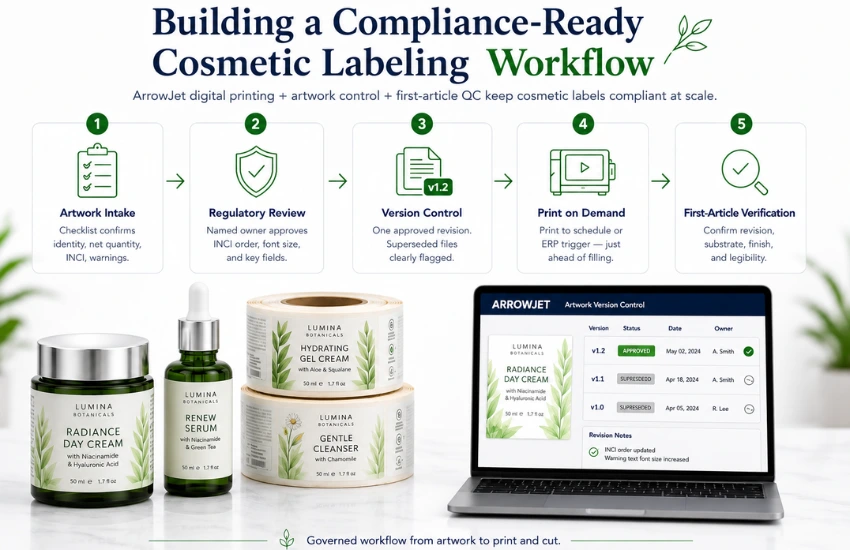
An in-house cosmetic label press makes on-demand production possible; the repeatable compliance workflow wrapped around it — intake checklists, named review gates, and version control — is what keeps beauty brands compliant at scale.

The press and die-cutter handle production. The workflow wrapped around them determines whether in-house cosmetic label production delivers consistent compliance or accumulates version errors as SKU counts grow.
Connecting artwork management, print queues, and cutting jobs into one governed flow is what eliminates the manual reconciliation that typically causes version mistakes in multi-SKU beauty brand operations.
Common questions from beauty brand operators, packaging leads, and regulatory owners on FDA compliance, INCI formatting, MoCRA obligations, and in-house digital printing.
U.S. cosmetic labels are governed primarily by the Federal Food, Drug, and Cosmetic Act, the Fair Packaging and Labeling Act, and 21 CFR Part 701, with additional obligations from MoCRA 2022. Together these establish required label elements, formatting rules, and the responsible-party and registration framework. Always confirm current specifics with qualified regulatory counsel.
Use INCI names in descending order of predominance by weight down to 1%. Ingredients at 1% or less, and color additives, may be listed in any order after that threshold. Fragrance and flavor may generally appear as single terms, though MoCRA-driven allergen disclosure rules are evolving.
MoCRA introduces mandatory facility registration, product listing, responsible-person identification on labels, adverse event reporting obligations, and expected fragrance allergen disclosures. The practical effect is more frequent label revisions and a strong case for on-demand digital printing over bulk pre-printed inventory.
The FDA requires required information be conspicuous and reasonably related in size to the most prominent text on the panel. A practical minimum for small packages is roughly 1/16 inch (about 6-point), but larger panels require proportionally larger type. Legibility — not just point size — is the enforced standard under 21 CFR Part 701.
Yes. Short-run digital printing — aqueous inkjet for standard work, UV inkjet for durable or premium finishes — combined with digital die-cutting makes in-house label production viable at low SKU volumes, provided the brand has disciplined artwork intake, a named regulatory review step, and version control.
If you are evaluating how on-demand digital printing and digital die-cutting could support your current SKU count and regulatory workload, book an assessment with Arrow Systems. The goal is practical: identify where your current process carries compliance risk or pre-print waste, and map how the ArrowJet Aqua 330R, ArrowJet UV 330H, and EZCut / Cut Nova fit your production volume.

Table of Contents Cosmetic Label Printing: FDA Requirements for Beauty Brands U.S. cosmetic labels must satisfy 21 CFR Part 701, the FPLA, and MoCRA 2022

Table of Contents Flexible Pet Packaging: Digital Printing for Pouches and Bags Flexible pet packaging — stand-up pouches and flat-bottom bags — is now the

Table of Contents GMP Label Printing for Supplements: A Manufacturer’s Guide to 21 CFR Part 111 GMP label printing for supplements means producing every bottle

Table of Contents Cannabis Gummy Packaging: Labels, Flexible Pouches, and State Compliance — A 2026 Brand Guide Cannabis gummy packaging must meet child-resistant standards, opaque-material

Table of Contents AAFCO Pet Food Label Requirements: 2026 Brand Guide AAFCO pet food label requirements define eight mandatory elements every dog and cat food

Table of Contents Vitamin Bottle Labels: Materials, Inks, and Compliance Guide HDPE supplement bottles require substrate, adhesive, ink, and workflow decisions that are compliance decisions