Table of Contents

Cannabis Gummy Packaging: Labels, Flexible Pouches, and State Compliance — A 2026 Brand Guide

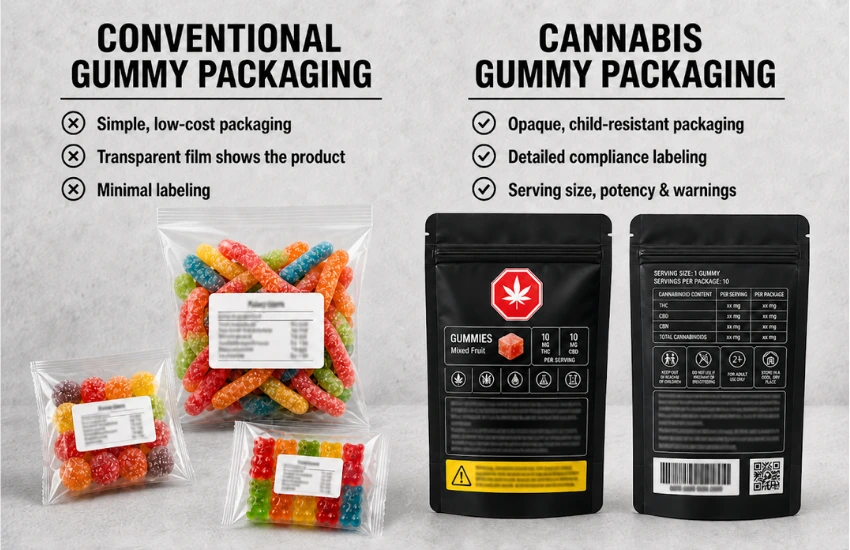
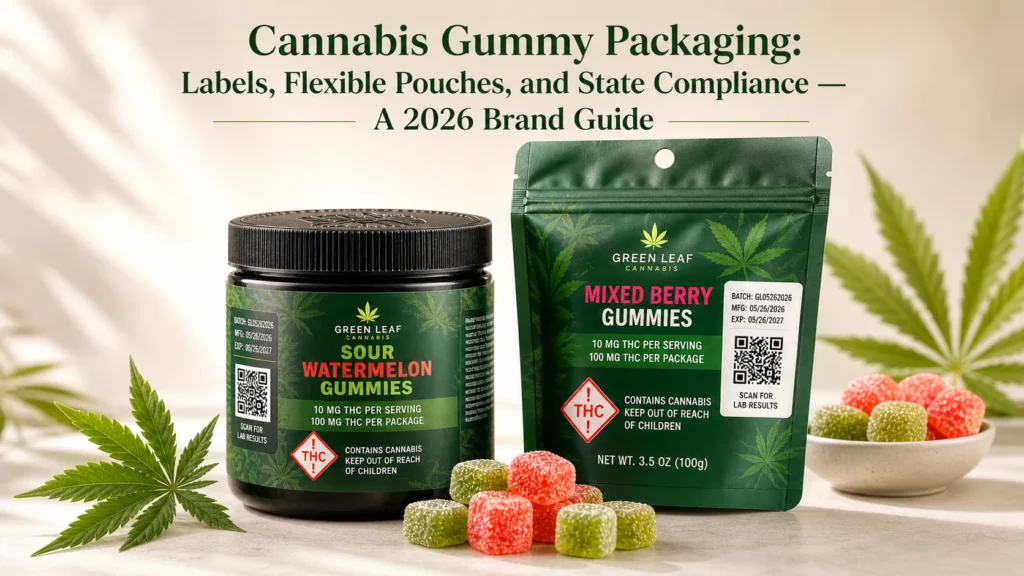
Cannabis gummy packaging must meet child-resistant standards, opaque-material mandates, and state-specific labeling rules — none of which apply to conventional confectionery. Whether you’re launching in a single state or managing multi-state SKUs, choosing the wrong packaging format or missing a compliance element can result in product seizures, regulatory fines, and lost retail placement.

This guide compares the two primary cannabis gummy packaging formats — pressure-sensitive roll labels on rigid containers and flexible stand-up pouches — against compliance requirements across the major adult-use states. It also covers how in-house digital inkjet printing with the ArrowJet Aqua 800M and ArrowJet Aqua 330R enables brands to version packaging by state affordably, without minimum order constraints.

Why Cannabis Gummy Packaging Is More Complex Than Standard Confectionery

Gummies are among the most popular cannabis edible formats across adult-use markets — and one of the most tightly regulated. Unlike standard candy, cannabis gummies must carry packaging that actively prevents access by children, conceals the product from view, and discloses precise chemical information in state-mandated formats.

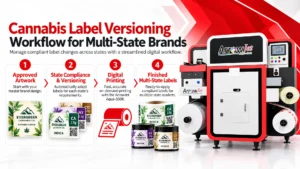
The deeper operational challenge is that cannabis packaging law is administered state by state, with no unified federal standard. A label version that fully complies in Colorado may fail inspection in New York. For multi-state operators (MSOs) managing SKUs across several states, this creates a real print challenge: per-state label versioning at volume, with no room for error.

In-house digital inkjet printing addresses this directly. Unlike traditional flexographic or gravure printing, digital presses require no printing plates — artwork can be switched between state-specific versions without changeover cost or minimum print run constraints. For a full breakdown of the financial case, see our in-house cannabis label printing ROI guide.

Federal Framework: CPSC Child-Resistant Rules and FDA Edible Guidance

Three federal frameworks shape cannabis gummy packaging even in the absence of a unified federal cannabis law.

CPSC — Poison Prevention Packaging Act (PPPA)

The PPPA establishes child-resistant packaging standards for substances that pose a hazard to children. Many state cannabis regulations reference CPSC PPPA standards when defining CR requirements for cannabis products, though the specific scope, product categories covered, and exceptions vary by state. Compliant formats must pass a 5-second resistance standard for children under five while remaining accessible to adults.

FDA — Edible Guidance

FDA has not authorized cannabis edibles as lawful FDA-regulated food products, and its rules do not directly govern cannabis edible labeling in the way they govern conventional foods. However, FDA’s frameworks for ingredient disclosure, serving-size presentation, and health claim restrictions inform industry best practices for cannabis edible packaging — particularly around structure/function claims. Cannabis brands can reference our nutraceutical label compliance guide for background on FDA dietary supplement labeling conventions that often overlap in practice.

FTC — Deceptive Claims Restriction

The FTC restricts unsubstantiated health benefit claims. Cannabis gummy labels should avoid language that implies medical treatment or cure. Permissible language focuses on product content (THC/CBD mg per serving) rather than therapeutic outcomes.

State-by-State Cannabis Gummy Packaging Requirements (2026)

The table below summarizes packaging requirements across the major adult-use cannabis states as of May 2026, focusing on gummy edible formats. Brands must verify all entries against current state regulator guidance before printing — cannabis packaging regulations are actively updated and enforcement priorities shift.

StateOpaque RequiredCR RequiredUniversal SymbolKey Label Notes
CaliforniaYes — ediblesYes (CPSC-standard)CA Cannabis Symbol RequiredMust state “CONTAINS CANNABIS”; serving size + total THC required; child-resistant exit packaging required. Source: cannabis.ca.gov
ColoradoYes — all cannabis productsYes (CPSC / ASTM-certified)CO Universal Symbol (THC! diamond, min. 0.5″ × 0.5″)Max 10 mg THC per serving, 100 mg per package; resealable for multi-serving; opaque CR exit bag also required at point of sale. Source: 1 CCR 212-3, Rule 3-1010
MichiganVerify with LARA / MRAYes (CR required for edibles)Universal Symbol RequiredTamper-evident + CR; batch/lot number; expiration date; licensed processor name + license number. Verify current MRA guidance before printing.
IllinoisVerify with IDFPRYes (CR required for cannabis edibles)IL Universal SymbolNet weight; test lab results; licensed dispensary + cultivator info; health warning statements. Verify current Illinois Cannabis Regulation and Tax Act requirements.
New YorkVerify with OCMYes (CR required)NY OCM SymbolOCM-mandated label format; at least 25% post-consumer recycled material required in plastic packaging; “KEEP OUT OF REACH OF CHILDREN”; license numbers. QR code to COA: verify current OCM requirement. Source: NY OCM via Flourish Software
WashingtonYes — all containersYes (CPSC-standard)Universal Symbol — front of package; minimum size rule enforcedWSLCB mandates specific font sizes; serving size required; “For Use Only by Adults 21+”; lot number. Source: WSLCB via Custom Cones USA
OregonYes — confirmedYes (CR required)Universal THC SymbolOLCC: “KEEP THIS PRODUCT AWAY FROM CHILDREN”; test results; THC/CBD mg per serving. Verify current OLCC administrative rule for exact symbol size and placement specs.
NevadaVerify with CCBYes (CR required)Nevada THC SymbolCCB requires manufacturer name + license; test batch results; THC/CBD content; warning text. Opaque requirement: verify directly with Nevada CCB — secondary sources are inconsistent.

Additional states to factor in for planning: Arizona, New Jersey, Missouri, Maryland, and Minnesota. Medical-only states including Florida, Pennsylvania, and Ohio may apply CR and opacity requirements that differ from adult-use programs — confirm specific packaging formats with your state regulator before specifying materials.

Roll Label Formats for Cannabis Gummies — Pros, Cons, and Compliance Fit

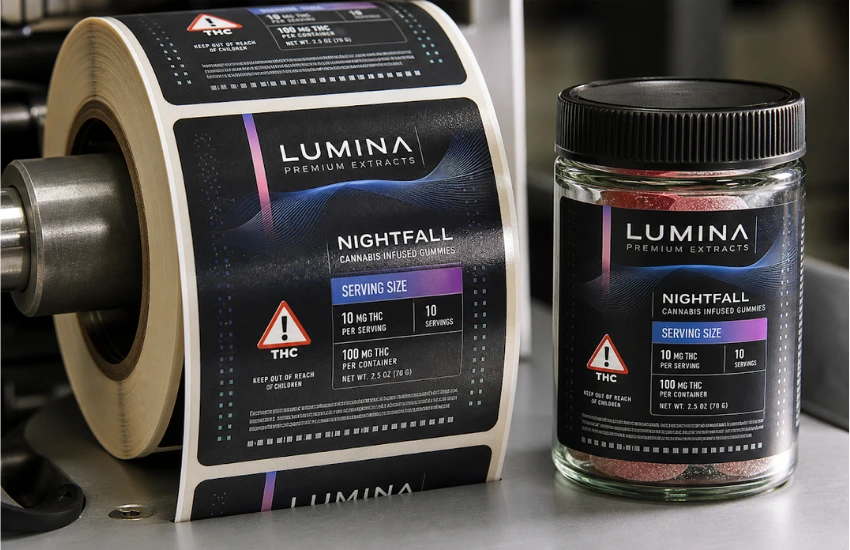
Roll labels are pressure-sensitive, die-cut, and applied to rigid containers — glass jars, PET tubs, or mylar pouches already fitted with a CR closure. For a broader grounding in rigid container label formats and substrate options, see our complete guide to bottle labels.

Compliance fit: The label carries all mandated compliance information — warning text, THC content per serving, universal symbol, batch and lot codes. The container itself provides the child-resistant function via a CR cap or slider mechanism. This split-responsibility model is well-established and accepted in major adult-use states.

Key advantages for cannabis brands:

  • Short-run versioning: Digital label printing eliminates flexographic plate costs entirely — a CA-compliant version and a CO-compliant version can be queued back-to-back with zero changeover cost or minimum run.
  • Reprint speed: When a state updates its warning text or symbol specification, only the label reprints — the container inventory is unaffected.
  • Material durability: Label stock must survive refrigeration and handling without adhesive failure. BOPP and polyester stocks perform reliably in both conditions.

Key limitation on opaque requirements: In states that mandate opaque packaging, the container itself must be opaque — a compliant label applied to a clear container does not satisfy the requirement. Confirm whether your target states require opaque packaging at the container level and specify accordingly.

For roll label production, the ArrowJet Aqua 330R produces pressure-sensitive cannabis gummy labels at speeds up to 195 ft/min with full variable data support — no plates, no minimum run, per-state versioning in a single session.

Flexible Stand-Up Pouch Formats — Pros, Cons, and CR Compliance Options

Roll labels are pressure-sensitive, die-cut, and applied to rigid containers — glass jars, PET tubs, or mylar pouches already fitted with a CR closure. For a broader grounding in rigid container label formats and substrate options, see our complete guide to bottle labels.

Compliance fit: The label carries all mandated compliance information — warning text, THC content per serving, universal symbol, batch and lot codes. The container itself provides the child-resistant function via a CR cap or slider mechanism. This split-responsibility model is well-established and accepted in major adult-use states.

Key advantages for cannabis brands:

  • All-in-one compliance potential: In states that require both opaque packaging and CR closures, a pouch with opaque laminate film and CR zipper closure can satisfy both requirements in a single substrate — simplifying sourcing and reducing secondary packaging cost.
  • Print surface: Wide-web pouches printed at 25″ provide significantly more real estate than jar labels, making it easier to meet minimum font-size mandates where required by state regulation.
  • Barrier properties: Multi-layer laminate films block both light and odor — practical for gummy product integrity during shelf life. For custom mylar and flexible pouch formats, Arrow offers substrate options compatible with its wide-web printing systems.

Key limitations: Any label change requires a full pouch reprint — there is no separation between label and container. Substrate cost per unit is modestly higher than roll labels. For brands with a high volume of per-state SKU variants, artwork management across full-pouch files requires organized pre-press workflow.

For in-house flexible pouch printing, the ArrowJet Aqua 800M handles substrates up to 25″ wide with no plate requirement — enabling per-state pouch versioning and variable data printing for batch codes and warning statements in a single production run.

Comparison: Roll Labels vs. Flexible Pouches for Cannabis Gummies

Both formats are viable for cannabis gummy packaging. The right choice depends on your container strategy, state footprint, and production volume. Arrow’s digital flexible packaging printers and digital label presses support both formats in-house without third-party converters.

AttributeRoll Labels (Rigid Container)Flexible Stand-Up PouchesCannabis-Specific Notes
Child-Resistant FormatNot inherent — provided by container closureCR reseal zipper available on pouchesCR packaging is required in many adult-use states for cannabis edibles — verify requirements with your specific state regulator
Opaque PackagingRequires opaque container — label alone insufficientOpaque laminate film satisfies requirement directlyConfirmed required in CA, CO, WA, OR; verify for IL, NY, NV, MI with state regulators before printing
Universal Symbol PlacementPrinted on label; constrained by label panel sizePrinted directly on pouch face; full wrap surfaceTHC symbol minimum size rules vary by state — CO requires min. 0.5″ × 0.5″; verify CA, WA, OR specs independently
Per-State VersioningReprint label only; no container change neededFull pouch artwork reprinted per state versionDigital printing eliminates plate cost for both formats
Regulatory Update SpeedFast — reprint label only; container unchangedSlower — full pouch file and reprint requiredCannabis regulations change frequently; short-run capability is critical
Short-Run FlexibilityExcellent — no plate costs with digital printingExcellent — ArrowJet Aqua 800M, no plates requiredCannabis brands frequently launch limited or seasonal SKUs
Print CanvasLimited to label panel dimensionsFull wrap on 25″ web — large, flexible canvasState font-size minimums favour wider print surface
Unit Cost at Low VolumeLower per-unit at small quantitiesModestly higher substrate costBoth viable for boutique or single-state operators

ArrowJet Aqua 800M for In-House Cannabis Gummy Pouch Printing — 25" Wide-Web

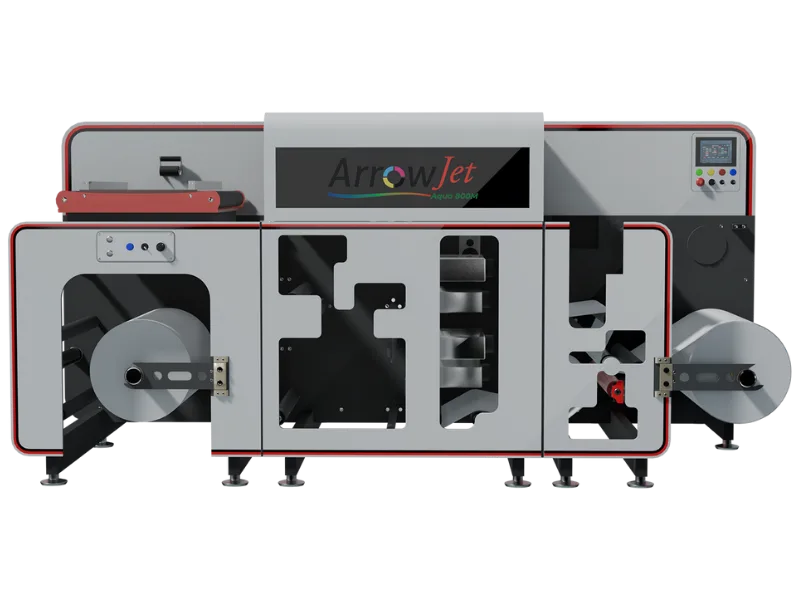
The ArrowJet Aqua 800M is Arrow’s primary solution for in-house flexible cannabis gummy pouch printing, supporting wide-web substrates up to 25 inches across. It is part of Arrow’s range of digital flexible packaging printers designed for pouches, sachets, and flexible formats.

ArrowJet Aqua 800M

Why this matters for cannabis brands: The Aqua 800M prints directly onto flexible pouch films — BOPP, kraft-foil laminates, multi-layer barrier films — without printing plates. A CA-compliant pouch version and a CO-compliant version can be queued and printed in the same production session with no tooling change.

Print Width

Up to 25 inches — accommodates wide-format cannabis stand-up pouches, flat-bottom bags, and child-resistant resealable formats without web splitting or multi-pass printing.

No Plate Costs

Digital inkjet eliminates flexographic plate costs entirely. For MSOs managing multiple state-specific artwork versions, the savings on tooling are significant — and artwork changes take minutes, not days. See our flexo vs. digital printing comparison for a full cost breakdown.

Variable Data Printing

Batch numbers, expiration dates, and state-specific warning statements can all change inline within a single production run. QR codes linking to Certificates of Analysis can also be incorporated inline where state regulations require them — confirm this requirement with your specific state regulator before printing.

Substrate Compatibility

BOPP, kraft, foil laminates, and multi-layer barrier films commonly used in CR cannabis pouch formats are compatible with the Aqua 800M’s aqueous water-based ink system, which aligns with Nestlé Guidance for food and edible-adjacent contact surface applications.

Inline Flexo Stations

Optional inline flexo stations add UV or aqueous varnish and priming in-line, improving surface protection and ink adhesion on specialty cannabis packaging films without requiring a separate finishing pass.

ArrowJet Aqua 330R for Pressure-Sensitive Cannabis Gummy Label Printing

The ArrowJet Aqua 330R is the right tool when cannabis gummies are sold in rigid containers — glass jars, PET tubs, or tubes — where the child-resistant function comes from the container closure and the label carries all compliance information.

Best use case: Cannabis brands using rigid containers that already meet state CR requirements and need short-run, per-state label production without outsourcing to a print converter.

Production Speed

The Aqua 330R produces pressure-sensitive roll labels at speeds up to 195 feet per minute — high enough to make short per-state runs economically viable within a single production shift.

Water-Based Pigment Inks

Aqueous pigment inks produce vivid, durable label color without solvent-based chemistry — relevant for cannabis brands positioning products as clean-label or for retailers with sustainable packaging procurement policies.

Variable Data Inline

Lot numbers, batch codes, expiry dates, and state-specific warning text can all be managed inline — no secondary print step or label sticker overlay required. Learn more about the top benefits of switching to in-house digital label printing.

White Ink Option

The ArrowJet UV 330H upgrade path adds white ink capability — enabling opaque white printing on dark or metallic label stocks, which expands substrate options for cannabis brands with premium packaging aesthetics.

Finishing Integration

The ArrowEZCut 330R+ integrates die-cut label finishing inline — kiss-cutting, matrix stripping, and rewinding — so labels are production-ready off the press without a separate finishing pass. Browse Arrow’s full range of label finishing systems for additional options.

Key Takeaways

  • Cannabis gummy packaging requirements vary by state — child-resistant formats, opaque materials, and state-specific labeling are widely required, but specifications differ across jurisdictions. Always verify with your state cannabis control board before printing.
  • CR packaging is required for cannabis edibles in many adult-use states, based on CPSC PPPA standards. Exact scope and product category coverage vary — confirm with your state regulator.
  • Opaque packaging is confirmed required for cannabis products in California, Colorado, Washington, and Oregon. Illinois, New York, Michigan, and Nevada should be independently verified before printing.
  • Flexible stand-up pouches can satisfy opaque packaging and CR closure requirements in a single substrate in states that mandate both — particularly efficient for multi-state compliance.
  • Roll labels on rigid CR containers remain viable where the container itself is opaque and the label panel accommodates mandatory font sizes.
  • The ArrowJet Aqua 800M (pouches) and Aqua 330R (roll labels) enable per-state label versioning with no plate costs and no minimum print run.
  • Variable data printing handles batch numbers, expiry dates, and per-state warning statement variations inline in a single production pass.

Frequently Asked Questions — Cannabis Gummy Packaging

Child-resistant packaging is required for cannabis gummies in many adult-use states, based on CPSC Poison Prevention Packaging Act standards that many state cannabis regulations reference. However, exact scope — which product categories are covered, whether CR applies to primary or exit packaging, and any exemptions — varies by state. Confirm CR requirements with your specific state cannabis control board before specifying packaging.

Opaque packaging means the product cannot be seen through the packaging from the outside — a design requirement intended to prevent children from identifying contents as candy. Opaque packaging is confirmed required for cannabis products in California, Colorado, Washington, and Oregon. Illinois, New York, Michigan, and Nevada should be verified directly with state regulators before printing, as secondary sources are inconsistent on these states. Opaque laminate films used in flexible stand-up pouches satisfy this requirement in states that mandate it.
In-house printing is viable for both roll labels and flexible pouches with the right equipment. The ArrowJet Aqua 330R handles pressure-sensitive roll labels for jars and rigid containers; the ArrowJet Aqua 800M handles wide-web flexible pouch printing up to 25 inches. Both support variable data printing for per-state compliance versioning without minimum order requirements.

Digital inkjet printing eliminates the per-state tooling cost that flexographic plate printing creates. With the ArrowJet Aqua 330R or Aqua 800M, operators can queue state-specific label versions and print short runs of each without changeover cost. For more on the operational and financial benefits, see our guide to switching to in-house digital label printing.

While requirements vary by state, widely required label elements include: total THC and CBD content per serving and per package; serving size; a state-specific universal THC warning symbol; government-mandated health warning statements; the licensed producer or processor name and license number; a batch or lot number; and an expiration or best-by date. Some states, including New York, require a QR code linking to a Certificate of Analysis (COA) — verify whether your target states mandate this before finalizing artwork.

See How ArrowJet Handles Per-State Cannabis Label Versioning

Talk to an ArrowJet specialist about flexible pouch and roll label printing for cannabis gummy packaging — no plates, no minimums, and variable data built in.